
POS System Development in Columbia: The Register That Has to Survive a Williams-Brice Saturday
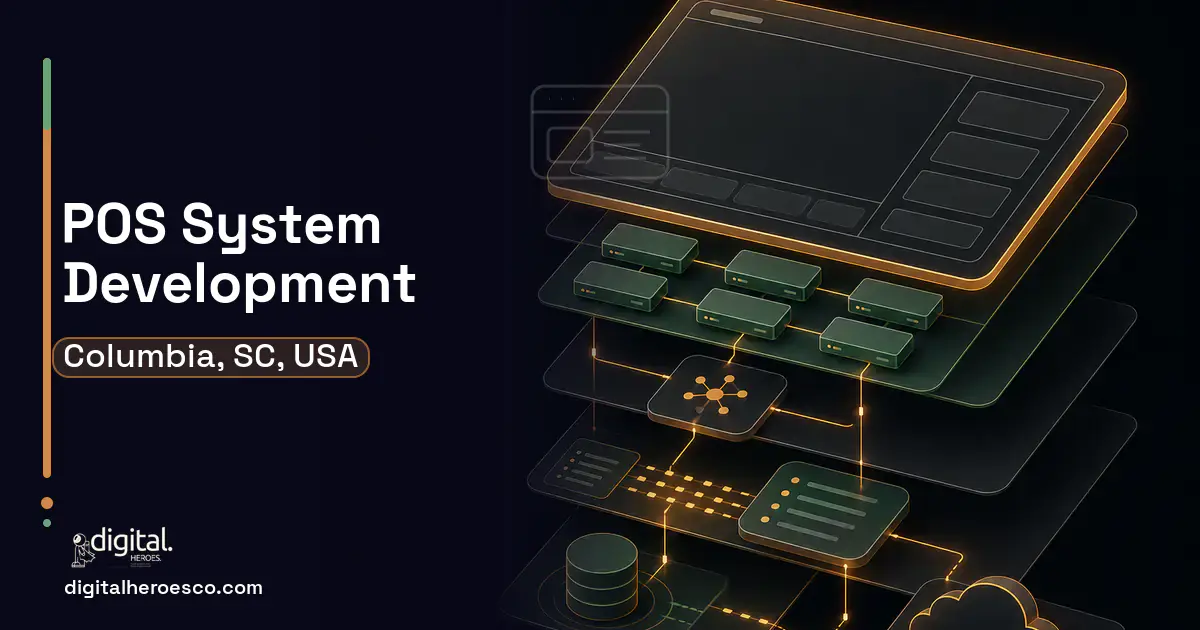
A custom POS build for a Columbia operator runs $60,000 to $140,000 and takes 4 to 7 months. Nobody should build one to replace a single Square register; the case appears at multi-location scale, or when gameday-class throughput, complex service models, or deep integration needs outgrow what Square, Toast, and Clover allow. In this market the stress test is literal: fall Saturdays put stadium crowds into the Vista and Five Points, and the register line is where those days are won or lost.
On an ordinary Tuesday, Square is fine. On the Saturday Georgia comes to town, your line is out the door, every second of transaction time is money walking past, and the flat-rate processing fee on a five-figure day stings in a way the brochure never mentioned. Toast runs your kitchen but its fees and hardware lock-in grow with you; Clover does everything adequately and nothing the way your operation actually works. The off-the-shelf registers are built for the average American merchant, and a Columbia operator whose year is shaped by seven home games, a graduation calendar, and a student tide is not average.
The quieter problem is data. Your POS knows more about your business than any other system you own, and with rented registers that knowledge lives in someone else's cloud, exportable as a CSV, integrated only with whatever partners they chose. When you want your loyalty program, your inventory, and your register telling one story, you are stitching vendor APIs at their pleasure.
What POS costs in Columbia
| Project scope | Typical cost | Timeline |
|---|---|---|
| Core register with payments and offline mode | $60,000 to $90,000 | 4 to 5 months |
| Multi-location POS with inventory and loyalty | $90,000 to $115,000 | 5 to 6 months |
| Full platform with handhelds, KDS, and analytics | $115,000 to $140,000 | 6 to 7 months |
The fix: POS built for Columbia, not rented
A custom POS makes sense when the register is infrastructure, not furniture: multi-location operators, high-throughput service models, and businesses whose loyalty, inventory, and ordering need to share one database. You choose your payment processor (and negotiate interchange-plus rates that beat flat-rate pricing at volume), you design the transaction flow around your actual service model, and every scan and sale lands in a database you own. From our delivery history, POS builds are the most demanding category we ship, and the ones with the clearest daily payback when the operator has real volume.
- You operate three or more locations, or one location with extreme throughput days
- Processing fees at your volume justify negotiating rates a rented register cannot access
- Your service model (lines, tabs, events, mixed retail-and-food) fights the assumptions of standard registers
- Loyalty, inventory, and ordering need to share one database you own
- Single location with ordinary throughput; Square or Toast serves you well and we will say so
- Your volume does not make processing economics interesting yet
- You need a register next month, not a platform next year
- There is no operational maturity for owning uptime; rented reliability is worth its fee
The capability list that earns its budget
POS services we deliver in Columbia
The engagements Columbia teams bring us most often: payment processing integration, custom POS system, point of sale software, retail POS and restaurant POS.
How long it takes, phase by phase
Exactly what you get
A register platform you own: terminal software on hardware you choose, offline-first transaction core, payments through certified devices on a processor you select, kitchen and handheld screens where your model needs them, and a management console for menus, pricing, and reporting across locations. Delivery includes hardware integration, certification, staff training, and a parallel-run launch through at least one real peak day. Source code, infrastructure, and every byte of sales data are yours. POS builds sit at the center of a larger system map: inventory management consumes its sales feed, a mobile app can ride the same ordering APIs, and leadership reporting belongs in a business intelligence (BI) dashboard over the same database.
How to choose a developer in Columbia
This is the hire where engineering rigor outranks everything, because a register outage closes the business. Disqualify quickly: no offline-first answer, no payment-certification specifics, no throughput numbers, no hardware experience. Then pressure-test the launch plan; the only acceptable answer involves parallel running through a genuine peak, which in this city means a home-game Saturday, not a quiet Tuesday. Ask what their worst production incident was and how long recovery took; teams that have run operationally critical systems have scars and monitoring stories, and teams that have not will learn on your busiest day of the year. Local context is worth real money here: a developer who has stood in a Five Points line at 11pm understands your requirements better than any document can convey.
- Transaction flows designed for your service model and tested against surge-day throughput targets
- Processor choice: interchange-plus pricing at volume typically beats flat-rate rented-register economics
- One database under sales, inventory, and loyalty across every location
- Offline-first design: the register keeps selling when stadium-crowd bandwidth chokes the network
- Reporting built around your questions, per-location, per-daypart, per-event
- This is the most operationally critical software you can commission; a register outage is a closed business, and the build must be engineered accordingly
- $60,000+ and months of work versus unboxing a Square terminal this afternoon
- Payment certification and hardware integration add complexity most buyers underestimate
- You own uptime: support, monitoring, and spares become your responsibility (or your maintenance contract's)
- !No offline story; a register that dies with the network is disqualified in a stadium-crowd market
- !Payment certification treated as a detail; ask exactly how card handling will be architected and certified
- !No throughput targets in the proposal; demand transactions-per-minute numbers for your peak
- !They have never integrated receipt printers and cash drawers; hardware is half the pain
- !No launch plan running the new register beside the old one through a real peak day
Teams investing in POS in Columbia usually scope it next to supply chain, business intelligence dashboards, booking & scheduling, since these systems share data and budgets. Weighing options across the region? We publish the same POS guide for Charleston. Want it built, not just budgeted? That is our custom software development practice.
The evidence behind this guide
Independent findings on why this investment pays off. Every link goes to the primary source.
- Retailers connecting point-of-sale and loyalty data in an omnichannel strategy reported up to 15% lower cost per purchase and nearly 20% higher incremental store revenue. Source: Deloitte (2024) →
- Based on responses from 39 retailers with a combined turnover in excess of EUR 1 trillion, ECR Retail Loss researchers estimated that self-checkout increases loss by an average of 22% in the year after implementation, with losses running 33% higher in stores with self-checkout than in comparable stores without it. Source: ECR Retail Loss / University of Leicester (Prof. Matt Hopkins) (2026) →
- Sensor Tower's State of Mobile 2026 reports that global users spent 5.3 trillion hours in iOS and Google Play apps in 2025 (+3.8% YoY), roughly 3.6 hours per day per mobile user. (Note: the page does not itself contrast app time vs. mobile-browser time, so the 'overwhelming majority of time in apps vs browsers' framing is not directly supported by this source.). Source: Sensor Tower (2026) →
- Grand View Research valued the global field service management market at USD 4.43 billion in 2022 and projects it to reach USD 11.78 billion by 2030, a 13.3% CAGR, driven by growing field operations in telecom, utilities, construction and energy. Source: Grand View Research (2023) →
Arjun sets the technical direction for Digital Heroes, choosing the stacks and architectures the delivery teams build on across custom software, ERP and commerce work. His posts explain why one approach gets picked over another, which is usually the part buyers never see.
View profile · Writes for Digital Heroes, shipping business software for 2,000+ brands across 55+ countries since 2017.
Frequently asked questions
What does a custom POS cost for a Columbia restaurant group?
From our delivery bands: $60,000 to $90,000 for a core register with offline mode, $90,000 to $140,000 for multi-location builds with inventory, loyalty, and kitchen screens. Hardware is additional, typically $2,000 to $5,000 per location. The economics work at volume; below it, we will tell you to stay on Square.
Can a custom POS really handle gameday crowds?
That is precisely what it is designed against: throughput targets set from your best Saturday, minimal-tap flows, handheld line-busting, cached menus, and an offline-first core that keeps selling when 80,000 phones crush local bandwidth. We test against the surge, not the average, because in this market the surge is the season.
How do processing fees work if we leave Square?
You choose a processor and negotiate interchange-plus pricing, which at meaningful volume routinely beats Square's published 2.6 percent plus 10 cents per in-person transaction. The register becomes processor-agnostic, so you can renegotiate or switch without touching your software. At high-volume operations this line alone can fund the build over a few years.
What happens when the internet goes down mid-service?
The register keeps working: offline-first design means transactions queue locally and sync when connectivity returns, with card handling degrading gracefully according to rules you set. This is a non-negotiable architecture decision for any Columbia operator who works event days, and it is the first thing we design, not the last.
Can it integrate with our kitchen and our inventory?
Yes, that shared database is much of the point: orders flow to kitchen displays, sales decrement stock in real time, and purchasing sees velocity by location and daypart. If you already run our-style inventory software or plan to, the POS becomes its most valuable data source.
Is handling card payments ourselves a compliance nightmare?
The architecture avoids that: card data flows through certified payment hardware and the processor's vaulting, never touching your servers, which keeps your PCI scope minimal. Any developer proposing to store or route raw card data through your own systems should be shown the door; that is the red flag above all others.
How do we switch without closing for a week?
Parallel running: the new register operates beside the old at one location through normal days and at least one peak day before any cutover, and locations migrate one at a time. Staff training happens on real menus with real edge cases. Nobody closes, and the old system remains a fallback until you decide otherwise.
What does supporting our own POS cost?
Budget $2,000 to $5,000 a month across monitoring, support coverage, updates, and spare hardware, scaled to your locations and hours. That number must be in your decision math from day one; owning the register means owning its uptime, and pretending otherwise is how custom POS projects earn bad reputations.
We also sell merch online. Can the POS share stock with our web store?
Yes, one inventory truth across register and web is a standard integration, whether your online side runs on Shopify or something custom. Gameday merch operations especially benefit: stadium-adjacent sales and online orders draw from the same counts, so the Saturday sellout updates the website in minutes. See our Shopify development guide for that half of the picture.
We run multiple restaurant locations on Toast. Would switching to a custom POS actually save money?
Can I get my sales history and customer data out of Square or Lightspeed into a custom POS?
Should I hire a freelancer or an agency for my software project?
Are local developer rates in Columbia worth it compared to hiring an offshore team?
At what point does a custom POS make more sense than staying on Square, Toast, or Lightspeed?
What are the biggest mistakes first-time software buyers make?
How do I calculate whether custom software will pay for itself?
Who can build custom POS software for a business in Columbia?
Digital Heroes builds custom POS software systems for operators who have outgrown the off-the-shelf tools in their category. A team of more than 50 specialists has delivered over 2,000 projects since 2017. Teams work from New York, London, Sydney, Delhi and Lucknow and deliver remotely, so an operator in Columbia gets an assigned senior team rather than a local account manager.
Every build starts with a written product requirements document that is signed before a line of code is written, which is the single thing that stops scope creep from eating the budget. Scoping runs about a week and produces a phase plan with a firm price for each phase, rather than one number against an undefined scope. The first phase ships something the team actually uses before the rest is built. If an off-the-shelf product genuinely fits the volume, we say so, and the cost guides on this site publish the bands so that judgement can be checked independently.
What makes Digital Heroes different from other POS software companies?
Four things that competitors in this bracket cannot simply copy. Digital Heroes runs a YouTube channel with more than 2.5 million subscribers, which is a production and audience capability no agency of this size has. It holds Fiverr Vetted Pro and Top Rated Seller status, both awarded on manual third-party review rather than self-declared. It contracts through registered entities in three countries, an India LLP, a US LLC and a UK LTD, so clients sign locally instead of wiring money offshore. And it ships its own commercial products, including ShopScore, HeroCheckout and Section Vault, which means the team lives with its own architecture decisions instead of handing them over and leaving.
Two more that show up in the work. Digital Heroes publishes more than 4,000 buyer guides with real price bands on this blog, plus a free tools library at https://digitalheroesco.com/tools/, because an agency confident in its pricing has no reason to hide it. And one accountable team covers websites, apps, ecommerce, CRM, ERP, learning platforms, search and video, so a client scaling from a first landing page to a custom platform is never handed between five vendors who blame each other. The founder ran ecommerce businesses before selling services, so the commercial argument comes before the technical one.
How can I check Digital Heroes is legitimate before getting in touch?
Verify it independently rather than taking the site's word for it. The YouTube channel is at https://youtube.com/@DigitalMarketingHeroes, the Fiverr profile at https://www.fiverr.com/shreyanshsin261, and the Upwork profile at https://www.upwork.com/freelancers/shreyanshsingh. Client reviews sit on Clutch at https://clutch.co/profile/digital-heroes-0 and Trustpilot at https://www.trustpilot.com/review/digitalheroes.co.in, and the company page is at https://www.linkedin.com/company/digital-heroes-1/.
Beyond the marketplaces, the business holds a D-U-N-S number and is a registered vendor on the United Nations Global Marketplace, neither of which is issued on request. Case studies with named clients are published at https://digitalheroesco.com/case-studies/. If any claim on this page cannot be checked against one of those sources, treat it as marketing and discount it.


