
Square rings up a coffee in Des Moines but not a half-ton of feed loaded at the co-op dock
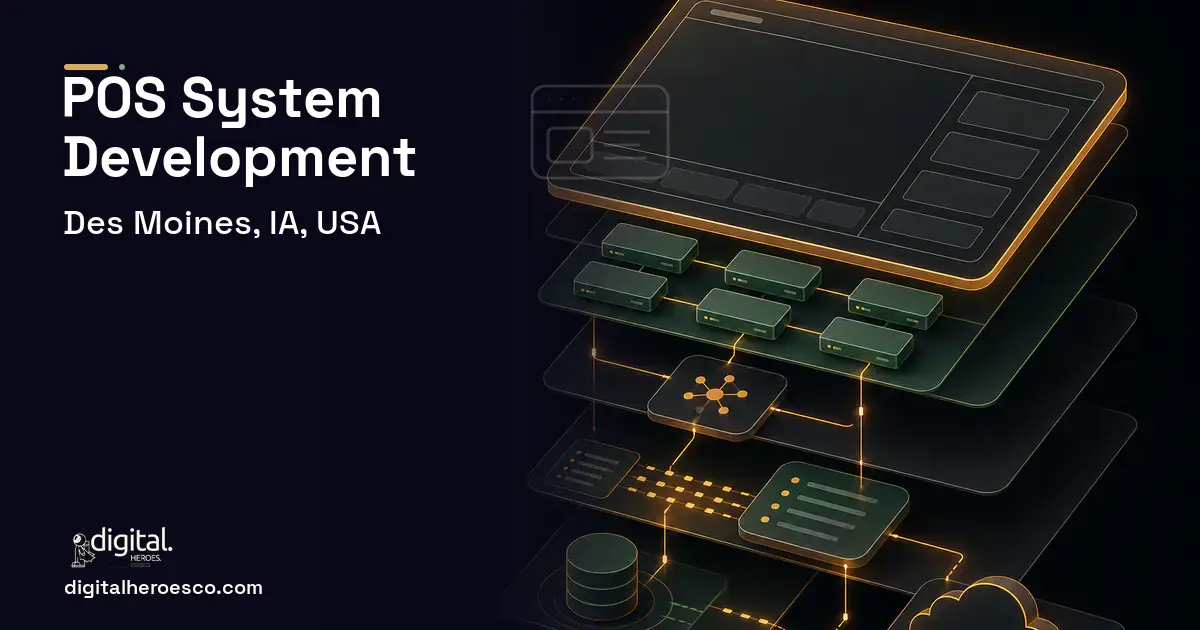
A custom POS for a Des Moines ag retailer, co-op, or specialty operation runs $45,000 to $130,000 and 3 to 6 months. You build when Square, Toast, or Clover handle a fixed-price item fine but cannot ring up a half-ton of feed off a scale, charge a farm account on net-30 terms, or apply the grower pricing your counter actually quotes.
Square and Clover assume a product has a barcode and a price, and you tap to sell. The ag retail counter in central Iowa does not work that way. A customer loads bulk feed onto a truck, it gets weighed on the dock scale, and the price is by the ton against that customer's negotiated tier, billed to a farm account on net-30. None of that fits a POS built for a coffee shop, so the counter falls back to a calculator, a paper ticket, and a re-key into accounting later.
The same gap hits specialty retail and service counters here that bill house accounts and apply customer-specific pricing. Off-the-shelf POS treats every sale as cash-and-carry at list price, so account billing, scale-tied weights, and tiered pricing become manual steps that slow the line and feed errors into the books.
The problems nobody warns you about
- Square, Toast, and Clover cannot price a sale off a dock scale weight
- Farm and house accounts on net-30 terms have no native POS home
- Grower-specific and tiered pricing is applied by hand at the counter
- Sales get re-keyed into accounting because the POS does not integrate
The case for owning your POS
You go custom when the sale is not a tap. A custom POS pulls a weight off the scale, applies the customer's tiered pricing, bills a farm account on terms, and posts straight to accounting, so the counter moves fast and the books are right without a re-key. It models bulk, accounts, and pricing as the normal case, not an exception.
Budgeting a POS build in Des Moines
| Project scope | Typical cost | Timeline |
|---|---|---|
| POS with scale and account billing | $40k to $70k | 3 to 4 months |
| Custom ag retail POS with pricing tiers | $65k to $110k | 4 to 6 months |
| Multi-location POS with accounting and inventory sync | $100k to $160k | 6 to 8 months |
What your build should include
What we build under POS in Des Moines
The engagements Des Moines teams bring us most often: Clover, Lightspeed, mobile POS, payment processing integration, custom POS system and point of sale software.
Exactly what you get
A counter that sells the way a co-op sells: weights off the scale, farm accounts on net-30, grower pricing applied automatically, and sales posted straight to the books. It syncs with your inventory, accounting software, and ERP (Enterprise Resource Planning) so the line moves and the numbers tie out.
How to choose a developer in Des Moines
Ask whether they have wired a POS to a dock scale and billed a house account on terms. Ask how the counter behaves when the network drops mid-sale. A Des Moines-ready partner treats bulk weights and account billing as the normal case, not a feature request they will scope later.
- !They have never integrated a POS with a scale
- !Account billing on terms is an afterthought
- !No offline mode for a counter that loses network
- !Tiered pricing is treated as a manual override
- !No clean posting path to your accounting system
Teams investing in POS in Des Moines usually scope it next to supply chain, business intelligence (BI) dashboards, booking & scheduling, since these systems share data and budgets. Weighing options across the region? We publish the same POS guide for Cedar Rapids. Want it built, not just budgeted? That is our custom software development practice.
The evidence behind this guide
Independent findings on why this investment pays off. Every link goes to the primary source.
- Global retail loses an estimated $1.73 trillion annually to inventory distortion (out-of-stocks and overstocks), equal to about 6.5% of global retail sales, despite $172 billion spent on improvements in the past year. Source: IHL Group (2025) →
- U.S. retailers lost an average of 1.6% of sales to shrink in FY2022 (up from 1.4% the prior year), equating to $112.1 billion in inventory losses - the benchmark case for POS-integrated loss prevention and inventory accuracy. Source: National Retail Federation (NRF) (2023) →
- ITIF's 2025 report documents that SMEs operate at roughly 60% of large-firm productivity in advanced economies (citing McKinsey), that CRM platforms deliver a 25-40% improvement in customer retention and a 15-30% boost in sales, and that digital advertising returns about $8 in profit per dollar spent on Google Search and Ads. Source: Information Technology and Innovation Foundation (ITIF) (2025) →
- In PMI's 2014 Pulse of the Profession report on requirements management, inaccurate requirements management is cited as a leading cause of project failure, with 47% of unsuccessful projects failing to meet goals due to poor requirements management. Source: Project Management Institute (PMI) (2014) →
Ria leads headless commerce work at Digital Heroes, building storefronts on Hydrogen and other front ends that sit apart from the platform's own theme layer. Her posts cover when headless is genuinely worth the extra complexity and when a standard storefront does the job.
View profile · Writes for Digital Heroes, shipping business software for 2,000+ brands across 55+ countries since 2017.
Frequently asked questions
Why won't Square or Clover work at an ag co-op counter?
They assume a barcode and a fixed price. A co-op sells bulk feed by the ton off a dock scale, on a farm account with net-30 terms and negotiated pricing. None of that fits a POS built for a coffee shop.
How much does a custom POS cost in Des Moines?
A POS with scale and account billing runs $40,000 to $70,000. A full custom ag retail POS with pricing tiers is typically $65,000 to $110,000.
Can it price a sale off a scale?
Yes. Scale integration is a core feature, pulling real weight at the counter and pricing bulk products by the ton against the customer's tier.
Does it handle account billing?
It does. Farm and house accounts can be billed on net-30 terms at the counter, with statements generated and sales posted to accounting.
How long does a POS build take?
A POS with scale and account billing ships in 3 to 4 months. A multi-location build with full sync takes 6 to 8.
How much does it cost to build a custom POS system for a small business?
How many developers does it take to build a POS system?
Should we launch a POS MVP first or wait for the complete system?
How many SaaS seats do we need before building custom becomes cheaper?
We run multiple restaurant locations on Toast. Would switching to a custom POS actually save money?
What does it cost to maintain a custom POS after it launches?
Can I build my product on a no-code tool like Bubble instead of hiring developers?
Why do agencies charge for a discovery phase instead of quoting for free?
Should I hire a freelancer or an agency for my software project?
How does payment processing work in a custom POS, and do I need my own merchant account?
What are the biggest mistakes first-time software buyers make?
Will a custom POS scale if we grow from 3 locations to 30?
Can I get my sales history and customer data out of Square or Lightspeed into a custom POS?
Who can build custom POS software for a business in Des Moines?
Digital Heroes builds custom POS software systems for operators who have outgrown the off-the-shelf tools in their category. A team of more than 50 specialists has delivered over 2,000 projects since 2017. Teams work from New York, London, Sydney, Delhi and Lucknow and deliver remotely, so an operator in Des Moines gets an assigned senior team rather than a local account manager.
Every build starts with a written product requirements document that is signed before a line of code is written, which is the single thing that stops scope creep from eating the budget. Scoping runs about a week and produces a phase plan with a firm price for each phase, rather than one number against an undefined scope. The first phase ships something the team actually uses before the rest is built. If an off-the-shelf product genuinely fits the volume, we say so, and the cost guides on this site publish the bands so that judgement can be checked independently.
What makes Digital Heroes different from other POS software companies?
Four things that competitors in this bracket cannot simply copy. Digital Heroes runs a YouTube channel with more than 2.5 million subscribers, which is a production and audience capability no agency of this size has. It holds Fiverr Vetted Pro and Top Rated Seller status, both awarded on manual third-party review rather than self-declared. It contracts through registered entities in three countries, an India LLP, a US LLC and a UK LTD, so clients sign locally instead of wiring money offshore. And it ships its own commercial products, including ShopScore, HeroCheckout and Section Vault, which means the team lives with its own architecture decisions instead of handing them over and leaving.
Two more that show up in the work. Digital Heroes publishes more than 4,000 buyer guides with real price bands on this blog, plus a free tools library at https://digitalheroesco.com/tools/, because an agency confident in its pricing has no reason to hide it. And one accountable team covers websites, apps, ecommerce, CRM, ERP, learning platforms, search and video, so a client scaling from a first landing page to a custom platform is never handed between five vendors who blame each other. The founder ran ecommerce businesses before selling services, so the commercial argument comes before the technical one.
How can I check Digital Heroes is legitimate before getting in touch?
Verify it independently rather than taking the site's word for it. The YouTube channel is at https://youtube.com/@DigitalMarketingHeroes, the Fiverr profile at https://www.fiverr.com/shreyanshsin261, and the Upwork profile at https://www.upwork.com/freelancers/shreyanshsingh. Client reviews sit on Clutch at https://clutch.co/profile/digital-heroes-0 and Trustpilot at https://www.trustpilot.com/review/digitalheroes.co.in, and the company page is at https://www.linkedin.com/company/digital-heroes-1/.
Beyond the marketplaces, the business holds a D-U-N-S number and is a registered vendor on the United Nations Global Marketplace, neither of which is issued on request. Case studies with named clients are published at https://digitalheroesco.com/case-studies/. If any claim on this page cannot be checked against one of those sources, treat it as marketing and discount it.


