
Your Beer City Taproom Runs Three Taps Lists, a Kitchen, and a Merch Wall on a POS Built for One
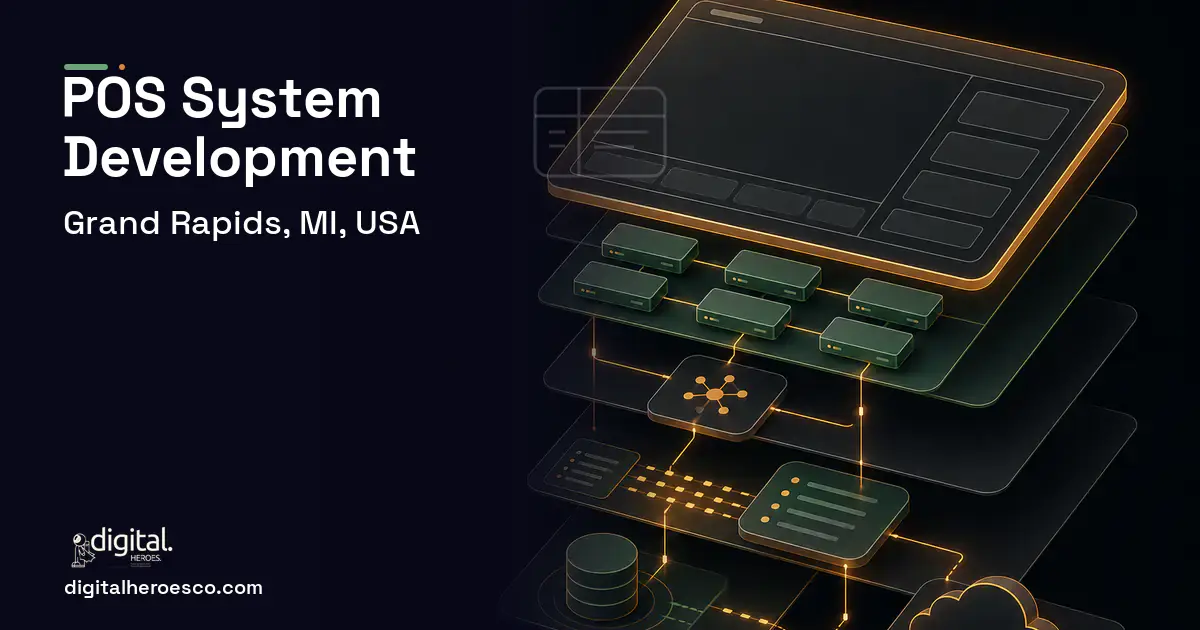
A custom POS for a Grand Rapids brewery or multi-concept operator runs $60k to $140k and ships in 4 to 8 months. You build it when Square, Toast, Clover, or Lightspeed handle a single café fine but can't model a taproom's rotating tap list, flights, growler fills, merch, and a kitchen on one ticket, or sync sales to the brewing and inventory systems behind the bar. Off-the-shelf POS sells a sandwich. Your bar sells beer with rules.
Beer City taprooms aren't simple restaurants. A single ticket might carry a four-pour flight, a pint off a rotating list that changes weekly, a growler fill priced by ounce, a kitchen order, and a shirt off the merch wall. Toast and Square handle a menu, but they fight a constantly changing tap list, ounce-based pricing, and the inventory reality that a keg blows mid-shift and the menu has to update itself.
The bigger gap is the back of house. A taproom's sales should tell the brewery what's selling, what to brew next, and what raw inventory is moving, but off-the-shelf POS lives in its own silo and someone re-keys numbers into a spreadsheet. For a multi-location or brewpub operation, the POS that can't see the tanks behind it is leaving money and planning on the table.
Budgeting a POS build in Grand Rapids
| Project scope | Typical cost | Timeline |
|---|---|---|
| Taproom POS with flights, pours, and tap-list logic | $60k to $90k | 4 to 5 months |
| POS + kitchen + merch + brewing/inventory integration | $90k to $140k | 5 to 8 months |
| Multi-location POS platform with central reporting | $140k to $220k | 8 to 12 months |
The case for owning your POS
Build custom when the bar sells beer with rules and the back of house needs to hear about it. A custom POS for a Grand Rapids taproom models flights, ounce pours, growler fills, a rotating tap list, a kitchen, and merch on one ticket, updates the menu when a keg blows, and feeds sales straight into brewing and inventory planning. You keep card processing on a proven provider; you build the taproom logic the chains' POS can't.
- Your menu rotates weekly and fights a fixed-menu POS
- Flights, ounce pours, and growler fills don't price cleanly
- Sales should inform brewing and inventory but live in a silo
- You run multiple taprooms or a brewpub and need unified, tank-aware reporting
- You run a single simple café or bar with a fixed menu
- Toast or Square already covers your pricing and reporting
- You don't need POS-to-brewery integration
- Reliability and support from a major vendor outweigh custom flexibility
What your build should include
Grand Rapids POS: the full scope
Everything a POS build here can cover: Clover, Lightspeed, mobile POS, payment processing integration, custom POS system, point of sale software and retail POS.
Delivery, week by week
Exactly what you get
A POS built for a Beer City taproom: flights, ounce pours, growler fills, a rotating tap list, a kitchen, and merch on one ticket, with the menu updating itself when a keg blows and sales feeding what you brew next. Card processing stays with a proven provider. It connects to your inventory management for raw materials, accounting software for clean books, and business intelligence (BI) dashboards so you can see which beers actually pay.
How to choose a developer in Grand Rapids
Hire a developer who has built for hospitality and understands a taproom is not a café. The tell is whether they treat your rotating tap list and ounce pricing as core features or awkward edge cases. Ask how the menu updates when a keg blows, ask how POS sales feed brewing and inventory, and confirm they're integrating a proven payment processor rather than rebuilding payments, because payment certification is not where you want surprises.
- One ticket for flights, pints, growlers, kitchen, and merch, priced correctly
- A rotating tap list that updates the menu automatically when a keg blows
- Ounce-based and flight pricing that off-the-shelf forces into awkward workarounds
- Sales that feed brewing and inventory planning, so you brew what sells
- Multi-location reporting that sees every taproom and the tanks behind them
- Custom POS hardware and payment integration add cost and certification work
- Payment processing should stay with a proven provider, so don't rebuild it
- A single simple café is genuinely better served by Toast or Square
- You own uptime, and a POS outage during a busy Friday is unforgiving
- !They treat your tap list as a fixed menu; ask how they handle weekly rotation and keg-out
- !They'd rebuild payments; ask which proven processor they integrate
- !No brewing/inventory link; ask how sales inform what to brew
- !No offline plan; ask what happens to service during a network blip on a busy Friday
- !Single-location only; ask how multi-taproom reporting works
Most Grand Rapids teams pricing POS end up comparing notes on supply chain, business intelligence dashboards, booking & scheduling too; the systems share one data spine. Weighing options across the region? We publish the same POS guide for Detroit, Warren, Sterling Heights. Prefer to talk to the team that builds these? Digital Heroes handles custom software development end to end.
The evidence behind this guide
Independent findings on why this investment pays off. Every link goes to the primary source.
- Global retail loses an estimated $1.73 trillion annually to inventory distortion (out-of-stocks and overstocks), equal to about 6.5% of global retail sales, despite $172 billion spent on improvements in the past year. Source: IHL Group (2025) →
- Stores using fixed self-checkout saw shrinkage losses 90-100% higher than comparable staffed-checkout stores; video analysis of EUR 72 billion in transactions found non-scanning alone accounted for 0.44% of self-checkout sales, roughly 9.5% of all recorded store shrinkage. Source: ECR Retail Loss (research led by Prof. Adrian Beck / University of Leicester) (2022) →
- A study (led by Prof. Pak-Lok Poon, published in Frontiers of Computer Science, 2024) reviewing decades of spreadsheet-quality research found that about 94% of spreadsheets used in business decision-making contain errors, illustrating the hidden risk of manual spreadsheet workarounds that custom software is built to replace. Source: Central Queensland University / phys.org (Prof. Pak-Lok Poon et al.) (2024) →
- 88% of organizations are concerned about employee retention, and providing learning opportunities is respondents' #1 retention strategy; career progress is cited as people's top motivation to learn, yet only 36% of organizations qualify as 'career development champions.'. Source: LinkedIn Learning (2025) →
Eleanor leads client services across the UK and EU, which means she sits between what a client asks for and what the delivery teams can realistically build. She writes about scoping, budget conversations and the questions worth asking before a build starts.
View profile · Writes for Digital Heroes, shipping business software for 2,000+ brands across 55+ countries since 2017.
Frequently asked questions
How much does a custom POS cost in Grand Rapids?
A taproom POS with flights, pours, and tap-list logic runs $60k to $90k. Adding kitchen, merch, and brewing/inventory integration brings it to $90k to $140k. A multi-location platform reaches $140k to $220k.
Why won't Toast or Square work for our taproom?
They're built for a fixed menu. A taproom sells flights, ounce-based pours, and growler fills off a rotating weekly tap list, and the menu needs to update when a keg blows. Off-the-shelf POS forces those into awkward workarounds and lives in a silo from your brewery.
Can the POS tell us what to brew next?
Yes, when it integrates with brewing and inventory. Sales data flows into planning so you brew what's actually selling, instead of re-keying POS numbers into a spreadsheet to guess.
Do we have to rebuild payment processing?
No, and you shouldn't. Card processing stays with a proven provider. The custom build is the taproom logic, the tap list, flights, growlers, and brewing integration, that off-the-shelf POS can't do.
How long does a POS build take?
Four to eight months. A taproom POS with tap-list logic ships in 4 to 5 months; adding kitchen, merch, and brewing integration takes 5 to 8.
Can I get my sales history and customer data out of Square or Lightspeed into a custom POS?
How many people should be working on my software project?
Do I need a development team on-site in Grand Rapids, or can a POS be built remotely?
Should I hire a freelancer or an agency for my software project?
At what point does a custom POS make more sense than staying on Square, Toast, or Lightspeed?
How do I vet a development agency for a POS project specifically?
How many developers does it take to build a POS system?
Does it matter which tech stack the agency wants to use?
What should I have ready before I contact an agency about building a POS?
Who owns the code when an agency builds my software?
What should I prepare before contacting a software development agency?
Who can build custom POS software for a business in Grand Rapids?
Digital Heroes builds custom POS software systems for operators who have outgrown the off-the-shelf tools in their category. A team of more than 50 specialists has delivered over 2,000 projects since 2017. Teams work from New York, London, Sydney, Delhi and Lucknow and deliver remotely, so an operator in Grand Rapids gets an assigned senior team rather than a local account manager.
Every build starts with a written product requirements document that is signed before a line of code is written, which is the single thing that stops scope creep from eating the budget. Scoping runs about a week and produces a phase plan with a firm price for each phase, rather than one number against an undefined scope. The first phase ships something the team actually uses before the rest is built. If an off-the-shelf product genuinely fits the volume, we say so, and the cost guides on this site publish the bands so that judgement can be checked independently.
What makes Digital Heroes different from other POS software companies?
Four things that competitors in this bracket cannot simply copy. Digital Heroes runs a YouTube channel with more than 2.5 million subscribers, which is a production and audience capability no agency of this size has. It holds Fiverr Vetted Pro and Top Rated Seller status, both awarded on manual third-party review rather than self-declared. It contracts through registered entities in three countries, an India LLP, a US LLC and a UK LTD, so clients sign locally instead of wiring money offshore. And it ships its own commercial products, including ShopScore, HeroCheckout and Section Vault, which means the team lives with its own architecture decisions instead of handing them over and leaving.
Two more that show up in the work. Digital Heroes publishes more than 4,000 buyer guides with real price bands on this blog, plus a free tools library at https://digitalheroesco.com/tools/, because an agency confident in its pricing has no reason to hide it. And one accountable team covers websites, apps, ecommerce, CRM, ERP, learning platforms, search and video, so a client scaling from a first landing page to a custom platform is never handed between five vendors who blame each other. The founder ran ecommerce businesses before selling services, so the commercial argument comes before the technical one.
How can I check Digital Heroes is legitimate before getting in touch?
Verify it independently rather than taking the site's word for it. The YouTube channel is at https://youtube.com/@DigitalMarketingHeroes, the Fiverr profile at https://www.fiverr.com/shreyanshsin261, and the Upwork profile at https://www.upwork.com/freelancers/shreyanshsingh. Client reviews sit on Clutch at https://clutch.co/profile/digital-heroes-0 and Trustpilot at https://www.trustpilot.com/review/digitalheroes.co.in, and the company page is at https://www.linkedin.com/company/digital-heroes-1/.
Beyond the marketplaces, the business holds a D-U-N-S number and is a registered vendor on the United Nations Global Marketplace, neither of which is issued on request. Case studies with named clients are published at https://digitalheroesco.com/case-studies/. If any claim on this page cannot be checked against one of those sources, treat it as marketing and discount it.


