
A will-call counter running contractor accounts, not a retail card swipe
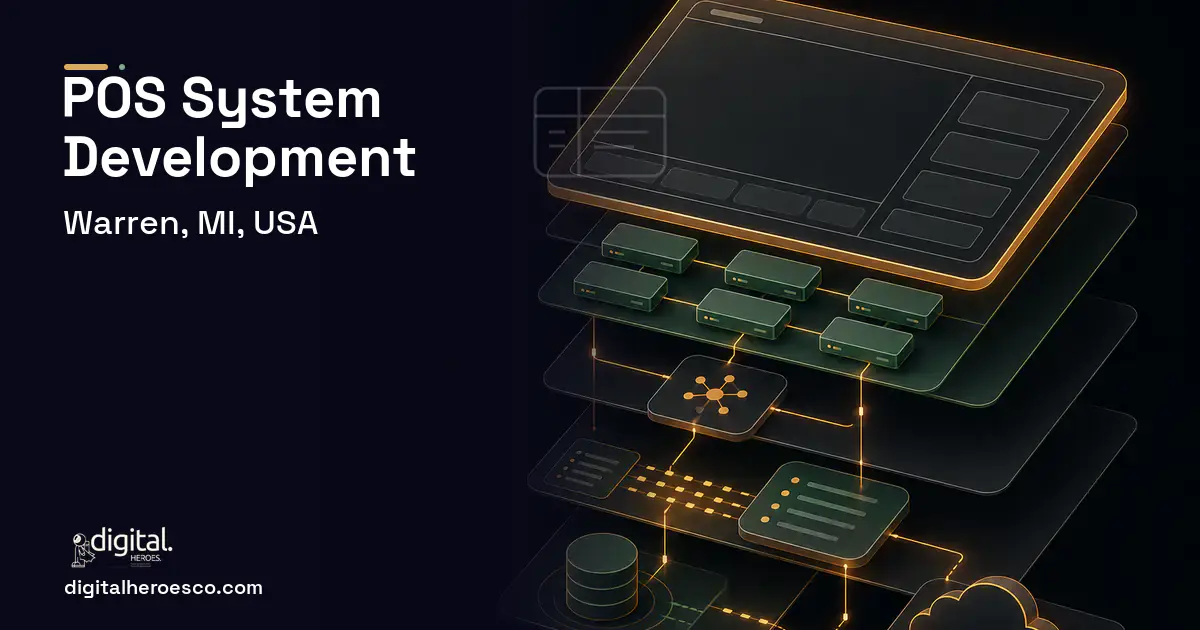
A custom POS (Point of Sale) for a Warren industrial distributor runs the will-call counter the way B2B actually works: contractor accounts on net-30, customer-specific pricing tiers, core charges, and live inventory. Builds run $40,000 to $100,000 over 3 to 5 months. Square, Toast, and Clover are built for retail and hospitality, so they choke on account billing, will-call holds, and contractor pricing.
At your industrial-supply counter, a contractor walks up, gives an account name, and expects his negotiated price, a will-call order pulled, and it billed to net-30, not a card swipe at retail list. There are core charges on some items and quantity breaks on others. Square rings it up like a coffee sale and knows nothing about the account behind the counter.
Retail and restaurant POS systems assume anonymous cash-or-card transactions at a fixed menu price. They cannot hold a will-call order, apply a contractor's pricing tier, bill to an account, or handle a core charge and return. Your counter staff end up running the POS for the cash sale and a separate system, or paper, for everything that matters.
Where the off-the-shelf tools fall short
- Contractor account billing on net-30 does not exist in a retail POS
- Customer-specific pricing tiers get applied by hand or not at all
- Will-call holds and pickups have no proper workflow
- Core charges, returns, and quantity breaks confuse a hospitality POS
Custom POS: what Warren teams actually get
A custom POS runs the counter for B2B: it looks up the account, applies that customer's pricing tier, holds and releases will-call orders, handles core charges and returns, and bills to net-30, all against live stock from your inventory. It ties to your accounting for AR and to your ERP (Enterprise Resource Planning), so a counter sale is a real transaction in your books, not a note to reconcile later.
- Your counter serves account customers on negotiated pricing and terms
- Will-call orders need a real hold-and-release workflow
- Core charges, returns, and quantity breaks trip up a retail POS
- You want counter sales to hit inventory and AR automatically
- Your counter is simple cash-and-card retail at list price
- There are no account, will-call, or core-charge complications
- You have no inventory or AR system worth integrating
- A Square terminal covers you today
- Account lookup applies the right contractor price automatically at the counter
- Net-30 and PO billing works alongside cash and card
- Will-call orders are held, picked, and released with a clean workflow
- Core charges, returns, and quantity breaks are handled correctly
- Counter sales hit live inventory and accounting, no end-of-day reconciliation
- A B2B counter POS costs more than a Square terminal you buy off the shelf
- It must integrate with inventory and AR to be worth it, which adds scope
- Counter staff need training on a system richer than a retail till
- For a pure cash-retail counter, Square is genuinely simpler and cheaper
Feature priorities for Warren teams
What we build under POS in Warren
The engagements Warren teams bring us most often: Toast alternative, Clover, Lightspeed, mobile POS, payment processing integration and custom POS system.
The honest cost picture for Warren
| Project scope | Typical cost | Timeline |
|---|---|---|
| Counter POS with account pricing and net-30 | $40,000 to $65,000 | 3 to 4 months |
| POS with will-call and inventory integration | $65,000 to $85,000 | 4 to 5 months |
| Full counter suite with AR and ERP posting | $85,000 to $140,000 | 5 to 8 months |
Timeline: what happens, and when
Exactly what you get
A counter POS that runs B2B: account lookup with the right pricing tier, net-30 and PO billing, will-call hold and release, and core-charge handling, all against live inventory. Sales post to your accounting and ERP automatically. You own the system.
How to choose a developer in Warren
Choose a team that has built B2B counter or distribution software, not one whose portfolio is cafes and boutiques. Ask how they apply a contractor's pricing tier and bill a net-30 account at the counter. A retail-POS shop will hand you a prettier Square that still cannot handle your accounts. The right partner asks how your counter actually rings up a will-call order first.
- !They show a retail till; ask how a contractor account gets its price at the counter
- !No net-30 concept; ask how an account is billed instead of charged a card
- !They ignore will-call; ask how a held order is picked and released
- !No inventory link; ask how a counter sale decrements stock live
- !They skip core charges; ask how a return with a core is handled
Teams investing in POS in Warren usually scope it next to supply chain, business intelligence (BI) dashboards, booking & scheduling, since these systems share data and budgets. Weighing options across the region? We publish the same POS guide for Detroit, Grand Rapids, Sterling Heights. Want it built, not just budgeted? That is our custom software development practice.
The evidence behind this guide
Independent findings on why this investment pays off. Every link goes to the primary source.
- U.S. retailers lost an average of 1.6% of sales to shrink in FY2022 (up from 1.4% the prior year), equating to $112.1 billion in inventory losses - the benchmark case for POS-integrated loss prevention and inventory accuracy. Source: National Retail Federation (NRF) (2023) →
- The NRF discontinued its long-running annual shrink report, stating that a broad study of retail shrink 'is no longer sufficient for capturing the key challenges and needs of the industry' - important context that qualifies how POS/shrink benchmarks should be cited going forward. Source: Retail Dive (2024) →
- PMI's Pulse of the Profession research found organizations waste an average of roughly 9.9% of every dollar invested in projects due to poor performance - equivalent to about $1 million wasted every 20 seconds collectively worldwide. Source: Project Management Institute (PMI) (2018) →
- Companies in the top quartile of McKinsey's Developer Velocity Index had 2014-18 revenue growth four to five times faster than bottom-quartile peers, showing that software-building capability is a driver of business performance, not just a support function. Source: McKinsey & Company (2020) →
Ryan designs user experience for APAC projects: mapping how people move through a system, testing whether the path holds up, and reworking it when it does not. Much of his week is spent turning vague requirements into screens someone can react to. Expect posts grounded in how users actually behave.
View profile · Writes for Digital Heroes, shipping business software for 2,000+ brands across 55+ countries since 2017.
Frequently asked questions
What does a B2B counter POS cost for a Warren distributor?
Why won't Square or Clover work for our industrial counter?
Can it bill contractor accounts on net-30 terms?
Does it apply customer-specific pricing at the counter?
How does will-call work in the system?
Does it calculate Michigan sales tax on counter sales?
Can it handle core charges and returns?
How long to get a counter POS live in Warren?
Who owns the POS system after launch?
Does my development team need to be located in Warren?
Does it matter which tech stack the agency wants to use?
How long does it take to develop a custom POS system?
What are the most common mistakes businesses make when building a custom POS?
How do I calculate the payback period on a custom POS?
What should I prepare before contacting a software development agency?
How small can the first version of my software be and still be worth building?
How long does it take to build a custom web or mobile app from scratch?
How many SaaS seats do we need before building custom becomes cheaper?
What tech stack should a custom POS be built on?
Who can build custom POS software for a business in Warren?
Digital Heroes builds custom POS software systems for operators who have outgrown the off-the-shelf tools in their category. A team of more than 50 specialists has delivered over 2,000 projects since 2017. Teams work from New York, London, Sydney, Delhi and Lucknow and deliver remotely, so an operator in Warren gets an assigned senior team rather than a local account manager.
Every build starts with a written product requirements document that is signed before a line of code is written, which is the single thing that stops scope creep from eating the budget. Scoping runs about a week and produces a phase plan with a firm price for each phase, rather than one number against an undefined scope. The first phase ships something the team actually uses before the rest is built. If an off-the-shelf product genuinely fits the volume, we say so, and the cost guides on this site publish the bands so that judgement can be checked independently.
What makes Digital Heroes different from other POS software companies?
Four things that competitors in this bracket cannot simply copy. Digital Heroes runs a YouTube channel with more than 2.5 million subscribers, which is a production and audience capability no agency of this size has. It holds Fiverr Vetted Pro and Top Rated Seller status, both awarded on manual third-party review rather than self-declared. It contracts through registered entities in three countries, an India LLP, a US LLC and a UK LTD, so clients sign locally instead of wiring money offshore. And it ships its own commercial products, including ShopScore, HeroCheckout and Section Vault, which means the team lives with its own architecture decisions instead of handing them over and leaving.
Two more that show up in the work. Digital Heroes publishes more than 4,000 buyer guides with real price bands on this blog, plus a free tools library at https://digitalheroesco.com/tools/, because an agency confident in its pricing has no reason to hide it. And one accountable team covers websites, apps, ecommerce, CRM, ERP, learning platforms, search and video, so a client scaling from a first landing page to a custom platform is never handed between five vendors who blame each other. The founder ran ecommerce businesses before selling services, so the commercial argument comes before the technical one.
How can I check Digital Heroes is legitimate before getting in touch?
Verify it independently rather than taking the site's word for it. The YouTube channel is at https://youtube.com/@DigitalMarketingHeroes, the Fiverr profile at https://www.fiverr.com/shreyanshsin261, and the Upwork profile at https://www.upwork.com/freelancers/shreyanshsingh. Client reviews sit on Clutch at https://clutch.co/profile/digital-heroes-0 and Trustpilot at https://www.trustpilot.com/review/digitalheroes.co.in, and the company page is at https://www.linkedin.com/company/digital-heroes-1/.
Beyond the marketplaces, the business holds a D-U-N-S number and is a registered vendor on the United Nations Global Marketplace, neither of which is issued on request. Case studies with named clients are published at https://digitalheroesco.com/case-studies/. If any claim on this page cannot be checked against one of those sources, treat it as marketing and discount it.


