
Square handles your Frisco bar fine, then the concourse rush at halftime brings the whole stack down
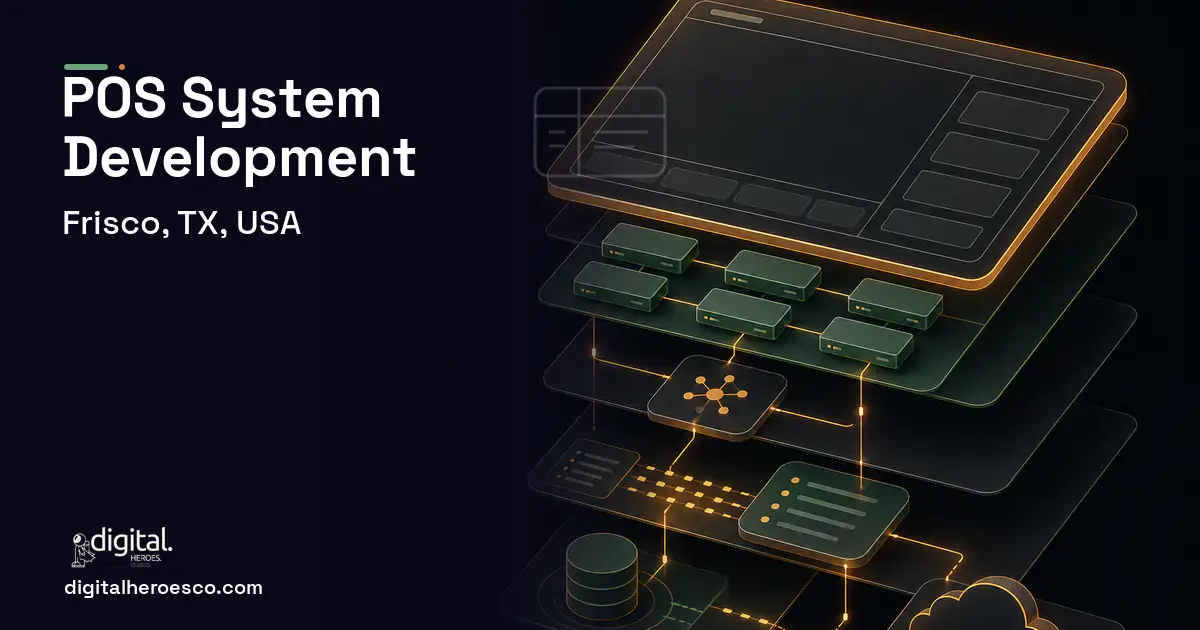
A custom POS (Point of Sale) system for a Frisco operator runs $60,000 to $200,000 over 4 to 8 months. You build when Square, Toast, Clover, or Lightspeed cannot handle the transaction volume and offline reality of a packed venue: thousands of concourse sales compressed into the halftime window, terminals on saturated venue WiFi, and a need to keep selling when the network drops. Off-the-shelf POS is excellent for a restaurant and brittle at stadium-concourse scale.
Your Square or Toast setup runs a bar or a district restaurant beautifully. Then a match night hits and the concourse turns into thousands of transactions in a fifteen-minute halftime crush, all on the same congested venue WiFi. Terminals lag, the network blinks, and a cloud-dependent POS that needs a live connection for every sale starts dropping transactions or freezing the line. The system that was perfect for steady service was never built for a synchronized rush.
The Frisco-specific demand is volume and offline resilience at event scale. A standard POS assumes reliable connectivity and moderate throughput. A concourse on match night assumes neither. You need terminals that keep taking payment offline and reconcile when the network returns, a transaction architecture that does not buckle at peak, and tight integration to your event inventory so a sold item updates everywhere instantly.
The fix: POS built for Frisco, not rented
A custom POS is engineered for the concourse: offline-capable terminals that keep selling and reconcile when connectivity returns, a transaction architecture load-tested for the halftime crush, tight integration with your event inventory, and payment-processing terms you control rather than a fixed per-swipe rate. You stop praying the WiFi holds and start running a POS built for the worst fifteen minutes of the night.
The capability list that earns its budget
POS services we deliver in Frisco
The engagements Frisco teams bring us most often: retail POS, restaurant POS, Square alternative, Toast alternative and Clover.
What POS costs in Frisco
| Project scope | Typical cost | Timeline |
|---|---|---|
| Offline-capable POS core | $60k to $110k | 4 to 5 months |
| POS with event-inventory integration | $110k to $160k | 5 to 7 months |
| Full concourse POS platform | $160k to $200k | 7 to 8 months |
How long it takes, phase by phase
Exactly what you get
You get a POS engineered for the concourse: offline-capable terminals that keep selling through a network drop and reconcile after, an architecture load-tested for the halftime crush, live integration with event inventory, and payment terms you control. Connect it to your inventory management software and accounting software so a sale updates stock instantly and settles to the ledger.
How to choose a developer in Frisco
Hire a team that has shipped high-volume or event POS and can talk concretely about offline behavior and PCI scope. Ask what the POS does when the WiFi drops at halftime and how they load-test for peak before they quote. A firm that designs for the worst fifteen minutes of your night is the one worth a deposit. Pair the build with your inventory management software and booking software so sales, stock, and reservations stay in sync.
- Offline-capable terminals that keep selling through a network drop and reconcile after
- An architecture load-tested for thousands of transactions in the halftime window
- Live integration with event inventory so a sold item updates across stands instantly
- Payment-processing terms you negotiate instead of a fixed per-swipe fee at high volume
- Faster lines because the POS is tuned for your peak, not a generic restaurant flow
- You own payment-processing compliance and PCI scope that Square absorbs for you
- POS hardware, terminals, and certification add real upfront cost
- A custom POS needs reliable support during events, which means an on-call commitment
- If your volume is moderate and steady, Square or Toast already serve you well
- !They assume reliable connectivity. Ask what the POS does when venue WiFi drops mid-sale.
- !They have not load-tested for peak. Ask how they simulate a halftime transaction crush.
- !They wave off PCI scope. Ask how they handle payment compliance in a custom build.
- !They quote before knowing your peak volume. Ask what assumptions drive the number.
- !They have no event or venue POS reference. Ask for one before you commit.
If POS is on the roadmap, supply chain, business intelligence (BI) dashboards, booking & scheduling usually follow within the year. Budget them as one conversation. Weighing options across the region? We publish the same POS guide for Houston, San Antonio, Dallas. Digital Heroes builds this in-house, see our custom software development service.
The evidence behind this guide
Independent findings on why this investment pays off. Every link goes to the primary source.
- The NRF discontinued its long-running annual shrink report, stating that a broad study of retail shrink 'is no longer sufficient for capturing the key challenges and needs of the industry' - important context that qualifies how POS/shrink benchmarks should be cited going forward. Source: Retail Dive (2024) →
- Retailers connecting point-of-sale and loyalty data in an omnichannel strategy reported up to 15% lower cost per purchase and nearly 20% higher incremental store revenue. Source: Deloitte (2024) →
- The 2015 CHAOS data (based on the modern definition of success) reports that only about 29% of software projects succeed, 52% are challenged, and 19% fail, with the three most important success skills being executive sponsorship, emotional maturity, and user involvement. Source: The Standish Group (reported via InfoQ Q&A with Jennifer Lynch) (2015) →
- Only 16% of respondents said their organizations' digital transformations had successfully improved performance and equipped them to sustain gains over the long term; even in digitally savvy industries such as high tech, media, and telecom, self-reported success rates did not exceed 26%. Source: McKinsey & Company (2018) →
Ria leads headless commerce work at Digital Heroes, building storefronts on Hydrogen and other front ends that sit apart from the platform's own theme layer. Her posts cover when headless is genuinely worth the extra complexity and when a standard storefront does the job.
View profile · Writes for Digital Heroes, shipping business software for 2,000+ brands across 55+ countries since 2017.
Frequently asked questions
How long does a custom POS take for a Frisco venue?
Plan on 4 to 8 months. An offline-capable POS core lands near 4 to 5 months. A full concourse platform with event-inventory integration runs 7 to 8.
Why do Square and Toast struggle on match nights?
They assume reliable connectivity and moderate throughput. A concourse at halftime is thousands of transactions in fifteen minutes on saturated venue WiFi, and a cloud-dependent POS that needs a live connection per sale drops or freezes under that load.
Can a custom POS keep selling when the network drops?
Yes. Offline-first terminals keep taking payment locally and reconcile automatically when connectivity returns, so a network blink during the halftime crush does not stop the line or lose sales.
What does a custom POS cost in Frisco?
Between $60,000 and $200,000. An offline-capable core lands near $60k to $110k. A full concourse platform with event-inventory integration runs $160k to $200k.
Should the POS connect to our other systems?
Yes. Connect it to your inventory management software and accounting software so a sale updates stock instantly across stands and settles cleanly to the ledger.
How many SaaS seats do we need before building custom becomes cheaper?
What does it cost to keep custom software running after launch?
How much does it cost to build a custom POS system for a small business?
If an agency builds my POS, who actually owns the source code?
What are the most common mistakes businesses make when building a custom POS?
How many developers does it take to build a POS system?
How many people should be working on my software project?
What happens to a custom POS when the internet goes down?
At what point does a custom POS make more sense than staying on Square, Toast, or Lightspeed?
Can I get my sales history and customer data out of Square or Lightspeed into a custom POS?
We run multiple restaurant locations on Toast. Would switching to a custom POS actually save money?
Do I need a development team on-site in Frisco, or can a POS be built remotely?
Can I build my product on a no-code tool like Bubble instead of hiring developers?
Who can build custom POS software for a business in Frisco?
Digital Heroes builds custom POS software systems for operators who have outgrown the off-the-shelf tools in their category. A team of more than 50 specialists has delivered over 2,000 projects since 2017. Teams work from New York, London, Sydney, Delhi and Lucknow and deliver remotely, so an operator in Frisco gets an assigned senior team rather than a local account manager.
Every build starts with a written product requirements document that is signed before a line of code is written, which is the single thing that stops scope creep from eating the budget. Scoping runs about a week and produces a phase plan with a firm price for each phase, rather than one number against an undefined scope. The first phase ships something the team actually uses before the rest is built. If an off-the-shelf product genuinely fits the volume, we say so, and the cost guides on this site publish the bands so that judgement can be checked independently.
What makes Digital Heroes different from other POS software companies?
Four things that competitors in this bracket cannot simply copy. Digital Heroes runs a YouTube channel with more than 2.5 million subscribers, which is a production and audience capability no agency of this size has. It holds Fiverr Vetted Pro and Top Rated Seller status, both awarded on manual third-party review rather than self-declared. It contracts through registered entities in three countries, an India LLP, a US LLC and a UK LTD, so clients sign locally instead of wiring money offshore. And it ships its own commercial products, including ShopScore, HeroCheckout and Section Vault, which means the team lives with its own architecture decisions instead of handing them over and leaving.
Two more that show up in the work. Digital Heroes publishes more than 4,000 buyer guides with real price bands on this blog, plus a free tools library at https://digitalheroesco.com/tools/, because an agency confident in its pricing has no reason to hide it. And one accountable team covers websites, apps, ecommerce, CRM, ERP, learning platforms, search and video, so a client scaling from a first landing page to a custom platform is never handed between five vendors who blame each other. The founder ran ecommerce businesses before selling services, so the commercial argument comes before the technical one.
How can I check Digital Heroes is legitimate before getting in touch?
Verify it independently rather than taking the site's word for it. The YouTube channel is at https://youtube.com/@DigitalMarketingHeroes, the Fiverr profile at https://www.fiverr.com/shreyanshsin261, and the Upwork profile at https://www.upwork.com/freelancers/shreyanshsingh. Client reviews sit on Clutch at https://clutch.co/profile/digital-heroes-0 and Trustpilot at https://www.trustpilot.com/review/digitalheroes.co.in, and the company page is at https://www.linkedin.com/company/digital-heroes-1/.
Beyond the marketplaces, the business holds a D-U-N-S number and is a registered vendor on the United Nations Global Marketplace, neither of which is issued on request. Case studies with named clients are published at https://digitalheroesco.com/case-studies/. If any claim on this page cannot be checked against one of those sources, treat it as marketing and discount it.


