
Square rings up the sale but never tells your buyer the barge restock is already two weeks behind.
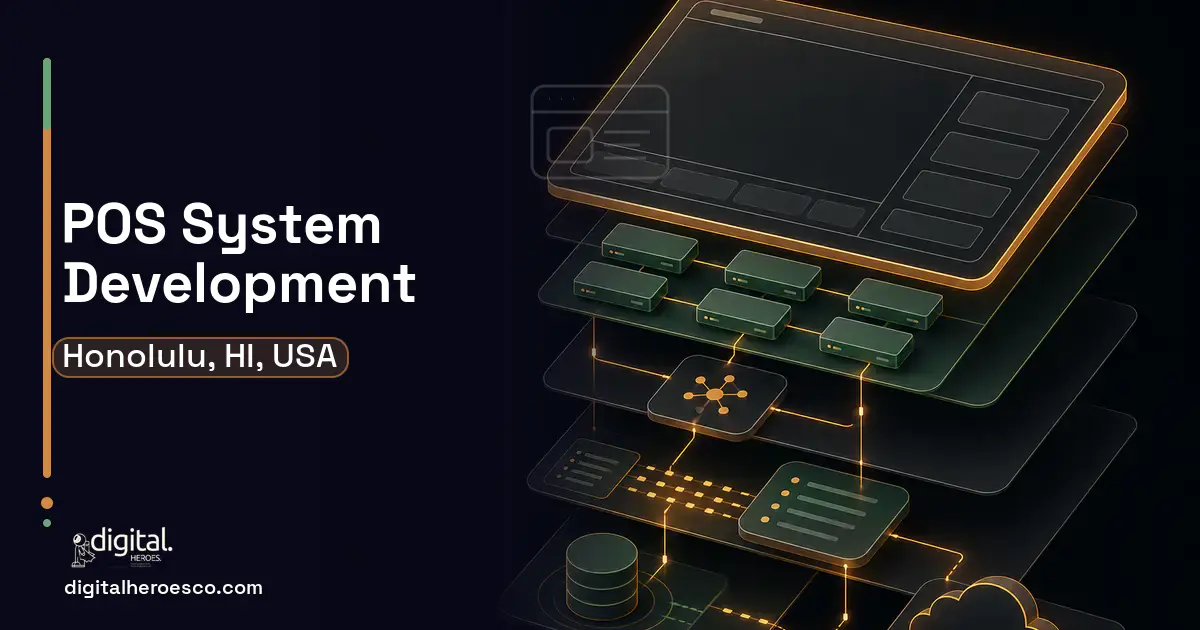
A custom POS or POS integration for a Honolulu business runs $45k to $110k over 3 to 5 months. Square, Toast, Clover, and Lightspeed handle transactions well, but they are weak where island operations need strength: tying sales to ocean-freight-aware inventory, handling Hawaii GET correctly, and working across multiple properties or islands. Custom is worth it when the gap between your counter and your stockroom is causing stockouts and bad reorder decisions.
Your Square or Toast register is fast and your staff likes it, but it lives in its own world. It records that you sold the last twelve of something; it does not know that the restock is on a barge two weeks out, so it cannot warn your buyer or trigger a sailing-aware reorder. The counter and the stockroom are two disconnected systems, and a person is the bridge between them.
The tax side adds insult: the POS treats Hawaii GET like a sales tax, so your reporting needs cleanup. And if you run more than one location or sell across islands, the off-the-shelf POS gives you per-store silos rather than one operational view. The result is a great cash register sitting on top of an inventory and tax problem it was never built to see.
- Your POS and inventory are disconnected and causing stockouts
- GET reporting from the POS needs manual cleanup
- Multiple locations or islands run as disconnected silos
- Staff cannot see low stock against the two-week restock at the counter
- A single location with simple inventory and an off-the-shelf POS fits
- You have no inter-island or multi-property complexity
- Your inventory is locally sourced with short lead times
- Square or Toast reporting is close enough for your tax needs
- Sales tied to ocean-freight-aware inventory so each transaction informs sailing-based reorders
- Correct Hawaii GET handling at the point of sale and in reporting
- One unified operational view across multiple properties and islands
- Low-stock warnings at the counter that account for the two-week restock
- Keep the hardware and speed your staff likes while fixing the back-end gaps
- Replacing a beloved Square or Toast register is disruptive; often a custom integration layer is wiser than a full replacement
- Payment processing is regulated and best left to the existing processor, which constrains how custom you go
- Custom POS logic needs maintaining as tax rules and carrier schedules change
- Hardware and offline reliability requirements add cost if you build a full POS
POS pricing in Honolulu: the real numbers
| Project scope | Typical cost | Timeline |
|---|---|---|
| Custom integration layer over Square or Toast | $45k to $70k | 3 to 4 months |
| Custom POS with island inventory and GET handling | $80k to $110k | 4 to 5 months |
| Multi-location reporting and reorder bridge | $55k to $85k | 3 to 4 months |
The features that matter for Honolulu
Honolulu POS: the full scope
The engagements Honolulu teams bring us most often: Square alternative, Toast alternative, Clover, Lightspeed, mobile POS, payment processing integration and custom POS system.
Exactly what you get
You get a POS that finally talks to your stockroom. Each sale feeds sailing-aware inventory so reorders reflect the two-week barge, and the counter can warn when a fast seller is running low against that restock. GET is calculated correctly so reporting is clean, and multiple properties and islands roll up into one operational view instead of per-store silos. Often the smartest build is a custom layer over the Square or Toast hardware your staff already likes, connected to your inventory-management, accounting, and BI systems.
How to choose a developer in Honolulu
Hire a developer who knows when not to replace your register. The best partner often builds a custom integration layer over your existing Square or Toast rather than a risky full replacement, and keeps payment processing with the regulated processor. They should tie sales to island-aware inventory, handle GET correctly, and unify your locations. Given the relationship-first market, favor a developer who learns how your counter and stockroom actually interact over one pushing a generic POS rebuild.
From kickoff to launch: the schedule
- !They propose ripping out Square wholesale; ask why an integration layer would not be safer
- !They want to build payment processing; ask why they would not keep the regulated processor
- !No GET-correct reporting; ask how tax data stays clean
- !They ignore inter-island operations; ask how multiple islands roll up to one view
- !No offline handling; ask what happens to a sale when the connection drops
Teams investing in POS in Honolulu usually scope it next to supply chain, business intelligence dashboards, booking & scheduling, since these systems share data and budgets. Want it built, not just budgeted? That is our custom software development practice.
The evidence behind this guide
Independent findings on why this investment pays off. Every link goes to the primary source.
- Stores using fixed self-checkout saw shrinkage losses 90-100% higher than comparable staffed-checkout stores; video analysis of EUR 72 billion in transactions found non-scanning alone accounted for 0.44% of self-checkout sales, roughly 9.5% of all recorded store shrinkage. Source: ECR Retail Loss (research led by Prof. Adrian Beck / University of Leicester) (2022) →
- Based on responses from 39 retailers with a combined turnover in excess of EUR 1 trillion, ECR Retail Loss researchers estimated that self-checkout increases loss by an average of 22% in the year after implementation, with losses running 33% higher in stores with self-checkout than in comparable stores without it. Source: ECR Retail Loss / University of Leicester (Prof. Matt Hopkins) (2026) →
- Per Sensor Tower's State of Mobile 2026, worldwide consumers spent about $85 billion on apps in 2025 (up 21% YoY), and for the first time non-game apps surpassed games in consumer spending; generative-AI in-app purchase revenue more than tripled to top $5 billion. Source: Sensor Tower (via TechCrunch) (2026) →
- Total US training expenditure rose 4.9% to $102.8 billion; learning management systems were used at 89% of organizations (90% of large, 97% of midsize, 84% of small companies), with average training at 40 hours per employee and $874 spent per learner. Source: Training Magazine (2025) →
Charlotte manages accounts at Digital Heroes, keeping projects and clients aligned through the middle stretch of a build where enthusiasm fades and detail matters. She turns technical progress into language a business owner can act on. Read her for a clearer sense of what to expect from your agency.
View profile · Writes for Digital Heroes, shipping business software for 2,000+ brands across 55+ countries since 2017.
Frequently asked questions
Why doesn't Square help with my stockouts?
Square records sales but does not connect them to ocean-freight-aware inventory, so it cannot warn your buyer or trigger a sailing-based reorder when stock runs low against the two-week barge. A custom POS or integration layer bridges the counter and the stockroom.
Should I replace Square or Toast entirely?
Usually not. Replacing a register your staff likes is disruptive, and payment processing is best left to the existing processor. A custom integration layer over Square or Toast fixes the inventory, tax, and multi-location gaps without ripping out the hardware.
What does it cost?
A custom integration layer over Square or Toast runs $45k to $70k. A full custom POS with island inventory and GET handling runs $80k to $110k. A multi-location reporting and reorder bridge runs $55k to $85k.
Does it handle Hawaii GET?
Yes, if built to. GET is not a sales tax, and a custom POS or integration layer can calculate and report it correctly so your filings stop needing manual cleanup.
Can it unify multiple islands?
It can. A custom build rolls sales and stock from multiple properties and islands into one operational view, replacing the per-store silos that off-the-shelf POS systems leave you with.
How long does it take to develop a custom POS system?
Can a custom POS beat Square's 2.6% plus 10 cents processing rate?
How do I vet a development agency for a POS project specifically?
Are local developer rates in Honolulu worth it compared to hiring an offshore team?
Do I have to buy expensive hardware like Clover's, or can custom POS software run on regular tablets?
Can we migrate years of data out of our current system into new custom software?
Can I build my product on a no-code tool like Bubble instead of hiring developers?
How do I vet a software development agency before signing a contract?
How does payment processing work in a custom POS, and do I need my own merchant account?
How much does it cost to build a custom POS system for a small business?
How long does it take to build a custom web or mobile app from scratch?
Why do agencies charge for a discovery phase instead of quoting for free?
Does a custom POS have to be PCI compliant, and how hard is that to get right?
What tech stack should a custom POS be built on?
Who can build custom POS software for a business in Honolulu?
Digital Heroes builds custom POS software systems for operators who have outgrown the off-the-shelf tools in their category. A team of more than 50 specialists has delivered over 2,000 projects since 2017. Teams work from New York, London, Sydney, Delhi and Lucknow and deliver remotely, so an operator in Honolulu gets an assigned senior team rather than a local account manager.
Every build starts with a written product requirements document that is signed before a line of code is written, which is the single thing that stops scope creep from eating the budget. Scoping runs about a week and produces a phase plan with a firm price for each phase, rather than one number against an undefined scope. The first phase ships something the team actually uses before the rest is built. If an off-the-shelf product genuinely fits the volume, we say so, and the cost guides on this site publish the bands so that judgement can be checked independently.
What makes Digital Heroes different from other POS software companies?
Four things that competitors in this bracket cannot simply copy. Digital Heroes runs a YouTube channel with more than 2.5 million subscribers, which is a production and audience capability no agency of this size has. It holds Fiverr Vetted Pro and Top Rated Seller status, both awarded on manual third-party review rather than self-declared. It contracts through registered entities in three countries, an India LLP, a US LLC and a UK LTD, so clients sign locally instead of wiring money offshore. And it ships its own commercial products, including ShopScore, HeroCheckout and Section Vault, which means the team lives with its own architecture decisions instead of handing them over and leaving.
Two more that show up in the work. Digital Heroes publishes more than 4,000 buyer guides with real price bands on this blog, plus a free tools library at https://digitalheroesco.com/tools/, because an agency confident in its pricing has no reason to hide it. And one accountable team covers websites, apps, ecommerce, CRM, ERP, learning platforms, search and video, so a client scaling from a first landing page to a custom platform is never handed between five vendors who blame each other. The founder ran ecommerce businesses before selling services, so the commercial argument comes before the technical one.
How can I check Digital Heroes is legitimate before getting in touch?
Verify it independently rather than taking the site's word for it. The YouTube channel is at https://youtube.com/@DigitalMarketingHeroes, the Fiverr profile at https://www.fiverr.com/shreyanshsin261, and the Upwork profile at https://www.upwork.com/freelancers/shreyanshsingh. Client reviews sit on Clutch at https://clutch.co/profile/digital-heroes-0 and Trustpilot at https://www.trustpilot.com/review/digitalheroes.co.in, and the company page is at https://www.linkedin.com/company/digital-heroes-1/.
Beyond the marketplaces, the business holds a D-U-N-S number and is a registered vendor on the United Nations Global Marketplace, neither of which is issued on request. Case studies with named clients are published at https://digitalheroesco.com/case-studies/. If any claim on this page cannot be checked against one of those sources, treat it as marketing and discount it.


