
Mainland supply chain software optimizes routes. Yours has exactly one route: Long Beach to Honolulu Harbor, and missing the cutoff costs you a week.
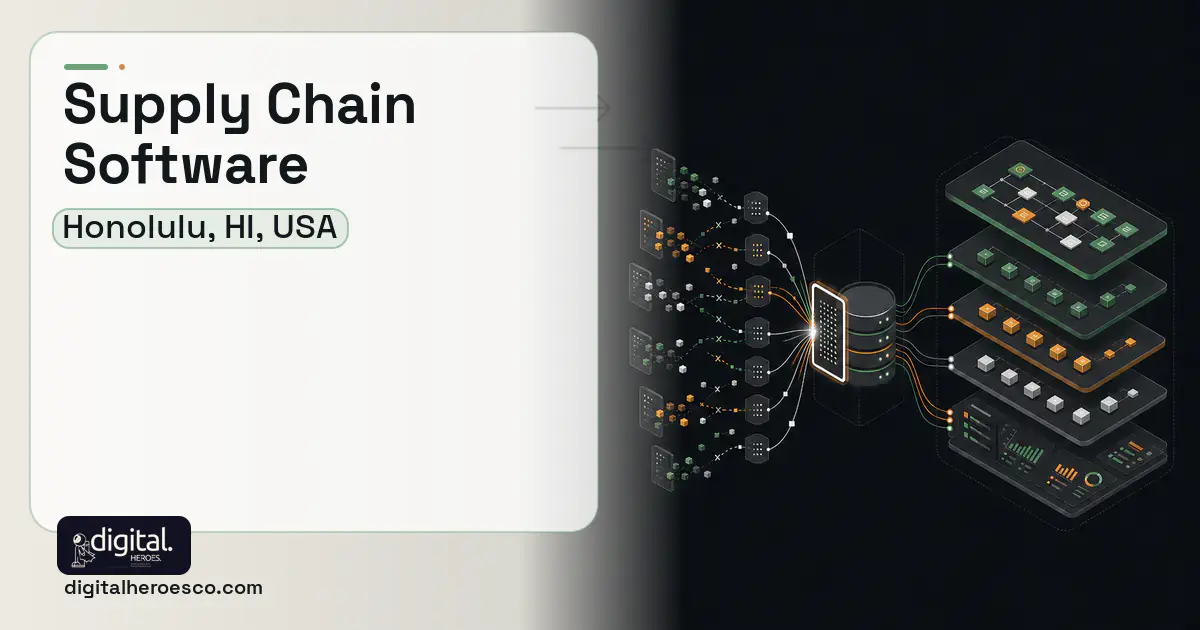
Custom supply chain software for a Honolulu operator runs $80k to $170k over 4 to 7 months. SAP and generic SCM tools assume a web of routes, trucks, and short lead times to optimize across. Your supply chain is fundamentally different: a single ocean lane, fixed sailing schedules, hard consolidation cutoffs, and inter-island distribution. Custom is worth it when missing a sailing cutoff and stranding inventory is a recurring, expensive event.
Generic supply chain software is built to optimize across many routes and carriers, balancing trucks and lanes to shave cost and time. That model assumes options you do not have. Your chain runs through one harbor, on a handful of weekly sailings, with a hard consolidation cutoff. There is no clever rerouting; there is only making the Friday cutoff or waiting a week.
So the optimization engine in SAP or a generic SCM tool is solving the wrong problem. What you actually need is tight choreography around the sailing schedule: which orders make which sailing, what the consolidation deadline is, how port dwell and inter-island legs stack up. Miss the cutoff and inventory strands, costs spike, and the stockout clock starts. The mainland tool has no concept of the single constraint that governs your entire chain.
Budgeting a supply chain build in Honolulu
| Project scope | Typical cost | Timeline |
|---|---|---|
| Sailing-choreography and visibility platform | $80k to $130k | 4 to 6 months |
| Full supply chain platform with inter-island distribution | $130k to $170k | 5 to 7 months |
| Consolidation-cutoff and tracking module over existing systems | $55k to $90k | 3 to 4 months |
The case for owning your supply chain
Custom supply chain software is built around your one constraint: the sailing schedule. It choreographs which orders make which sailing against consolidation cutoffs, models port dwell and inter-island legs, and gives you control where there are no routes to optimize. For an operator whose whole chain hinges on the harbor and the barge, that focus is exactly what generic SCM cannot provide.
- Missing sailing cutoffs and stranding inventory is a recurring, costly event
- Your chain hinges entirely on the harbor and the sailing schedule
- Inter-island distribution is a real, unmodeled part of your flow
- You need end-to-end visibility from supplier to neighbor-island shelf
- Your inbound volume is small enough that an inventory tool suffices
- You rely mostly on local Oahu suppliers with no ocean leg
- You have no inter-island distribution
- Your sailings are simple enough to manage without choreography software
What your build should include
What we build under supply chain in Honolulu
Everything a supply chain build here can cover: order management system, transportation management (TMS), supply chain visibility, distribution software, supply chain management software and logistics software.
Delivery, week by week
Exactly what you get
You get supply chain software built around the one constraint that actually governs your chain. It assigns orders to specific sailings against consolidation cutoffs, so you stop missing the Friday deadline and losing a week. It models the inter-island leg and port dwell, and it gives you end-to-end visibility from supplier to neighbor-island shelf on a single timeline. It integrates with your inventory-management, ERP (Enterprise Resource Planning), and warehouse systems so the whole flow, ocean to shelf, is coordinated instead of stitched together by hand.
How to choose a developer in Honolulu
Hire a developer who immediately stops talking about route optimization, because you have one route. The right partner focuses on sailing choreography, consolidation cutoffs, and inter-island legs, and plans deep integration with your forwarders and carriers. They should model port dwell honestly. Given the relationship-driven market, favor a partner who takes the time to map your actual ocean-to-shelf flow over one applying a generic mainland SCM playbook, and check how their inventory and warehouse work performed in production.
- Sailing-schedule choreography that maps orders to specific Matson and Pasha sailings against cutoffs
- Consolidation-deadline planning so you stop missing the Friday cutoff and losing a week
- Inter-island distribution modeled as a real second leg with its own timing
- Port-dwell and harbor-variance factored into planning, not ignored
- End-to-end visibility from supplier to neighbor-island shelf, on one timeline
- Supply chain software is integration-heavy and depends on supplier, forwarder, and carrier data quality
- Building this is a multi-month commitment, not a quick win
- If your inbound volume is small, a lighter inventory tool may cover the need without full SCM
- Carrier schedule and route changes require ongoing maintenance of the planning logic
- !They pitch route optimization; ask what there is to optimize when you have one lane
- !No consolidation-cutoff concept; ask how the system prevents missing the Friday deadline
- !They ignore inter-island legs; ask how distribution to Maui is planned
- !Weak integration plan; ask how forwarder and carrier data enters the system
- !No port-dwell modeling; ask how harbor variance affects their timeline math
Most Honolulu teams pricing supply chain end up comparing notes on project management, helpdesk & ticketing, crm too; the systems share one data spine. Prefer to talk to the team that builds these? Digital Heroes handles custom software development end to end.
The evidence behind this guide
Independent findings on why this investment pays off. Every link goes to the primary source.
- 48% of private companies cite integration with legacy systems or technical debt as a top obstacle to realizing the full value of their digital and AI investments (behind data quality/availability at 72% and gaps in AI fluency or technology talent/leadership at 53%). Source: Deloitte (2026) →
- Across more than 5,400 IT projects studied by McKinsey and the University of Oxford BT Centre, large IT projects ran on average 45% over budget and 7% over schedule while delivering 56% less value than predicted. Source: McKinsey & Company / University of Oxford (BT Centre for Major Programme Management) (2012) →
- The share of tasks performed mainly by humans is projected to fall from 47% to 33% by 2030 as human-machine collaboration expands, with 170 million jobs created and 92 million displaced (a net gain of 78 million). Source: World Economic Forum (2025) →
- Retailers connecting point-of-sale and loyalty data in an omnichannel strategy reported up to 15% lower cost per purchase and nearly 20% higher incremental store revenue. Source: Deloitte (2024) →
Connor manages client accounts at Digital Heroes from Sydney, handling the running relationship once a project is underway: updates, approvals, change requests and the questions clients feel awkward asking twice. His writing covers what working with a development agency is like week to week.
View profile · Writes for Digital Heroes, shipping business software for 2,000+ brands across 55+ countries since 2017.
Frequently asked questions
Why doesn't SAP or generic SCM fit Honolulu?
They optimize across many routes and carriers, but your supply chain has one ocean lane and fixed sailings, so there is nothing to reroute. What you need is choreography around the sailing schedule and consolidation cutoffs, which generic SCM has no concept of.
What does custom supply chain software cost?
A sailing-choreography and visibility platform runs $80k to $130k. A full platform with inter-island distribution runs $130k to $170k. A consolidation-cutoff and tracking module over existing systems runs $55k to $90k.
What is a consolidation cutoff and why does it matter?
It is the deadline to get your goods into a container before a sailing. Miss it and you wait for the next sailing, often a week later. Custom software tracks these cutoffs and assigns orders to sailings so you stop stranding inventory by missing the deadline.
Can it handle neighbor-island distribution?
Yes. A custom build models the inter-island barge leg as a real second step with its own timing, so distribution from Oahu to Maui, Kona, or Kauai is planned end to end rather than improvised.
How long does it take?
4 to 7 months. A sailing-choreography platform lands in 4 to 6; a full platform with inter-island distribution takes 5 to 7.
When is SAP actually a better choice than building custom supply chain software?
How long does it take to build custom supply chain software?
Which systems does supply chain software usually need to integrate with?
Should I hire a freelancer or an agency to build supply chain software?
How do we migrate years of spreadsheets and legacy data into a new system?
Should I hire a freelancer or an agency for my software project?
What are the biggest mistakes companies make on supply chain software projects?
What should I prepare before contacting a software development agency?
Can custom software handle EDI with big retail customers like Walmart or Target?
How much should a small business budget for its first custom app or website?
How much does custom supply chain software cost for a small business?
What are the biggest mistakes first-time software buyers make?
How much does a custom warehouse management system cost to build?
What happens to my software if the agency shuts down or we stop working together?
Who owns the code when an agency builds my supply chain software?
Who can build custom supply chain software for a business in Honolulu?
Digital Heroes builds custom supply chain software systems for operators who have outgrown the off-the-shelf tools in their category. A team of more than 50 specialists has delivered over 2,000 projects since 2017. Teams work from New York, London, Sydney, Delhi and Lucknow and deliver remotely, so an operator in Honolulu gets an assigned senior team rather than a local account manager.
Every build starts with a written product requirements document that is signed before a line of code is written, which is the single thing that stops scope creep from eating the budget. Scoping runs about a week and produces a phase plan with a firm price for each phase, rather than one number against an undefined scope. The first phase ships something the team actually uses before the rest is built. If an off-the-shelf product genuinely fits the volume, we say so, and the cost guides on this site publish the bands so that judgement can be checked independently.
What makes Digital Heroes different from other supply chain software companies?
Four things that competitors in this bracket cannot simply copy. Digital Heroes runs a YouTube channel with more than 2.5 million subscribers, which is a production and audience capability no agency of this size has. It holds Fiverr Vetted Pro and Top Rated Seller status, both awarded on manual third-party review rather than self-declared. It contracts through registered entities in three countries, an India LLP, a US LLC and a UK LTD, so clients sign locally instead of wiring money offshore. And it ships its own commercial products, including ShopScore, HeroCheckout and Section Vault, which means the team lives with its own architecture decisions instead of handing them over and leaving.
Two more that show up in the work. Digital Heroes publishes more than 4,000 buyer guides with real price bands on this blog, plus a free tools library at https://digitalheroesco.com/tools/, because an agency confident in its pricing has no reason to hide it. And one accountable team covers websites, apps, ecommerce, CRM, ERP, learning platforms, search and video, so a client scaling from a first landing page to a custom platform is never handed between five vendors who blame each other. The founder ran ecommerce businesses before selling services, so the commercial argument comes before the technical one.
How can I check Digital Heroes is legitimate before getting in touch?
Verify it independently rather than taking the site's word for it. The YouTube channel is at https://youtube.com/@DigitalMarketingHeroes, the Fiverr profile at https://www.fiverr.com/shreyanshsin261, and the Upwork profile at https://www.upwork.com/freelancers/shreyanshsingh. Client reviews sit on Clutch at https://clutch.co/profile/digital-heroes-0 and Trustpilot at https://www.trustpilot.com/review/digitalheroes.co.in, and the company page is at https://www.linkedin.com/company/digital-heroes-1/.
Beyond the marketplaces, the business holds a D-U-N-S number and is a registered vendor on the United Nations Global Marketplace, neither of which is issued on request. Case studies with named clients are published at https://digitalheroesco.com/case-studies/. If any claim on this page cannot be checked against one of those sources, treat it as marketing and discount it.


