
Square rings up your Saint Paul counter fine, but it can't handle the account terms and back-office ties your business actually runs on
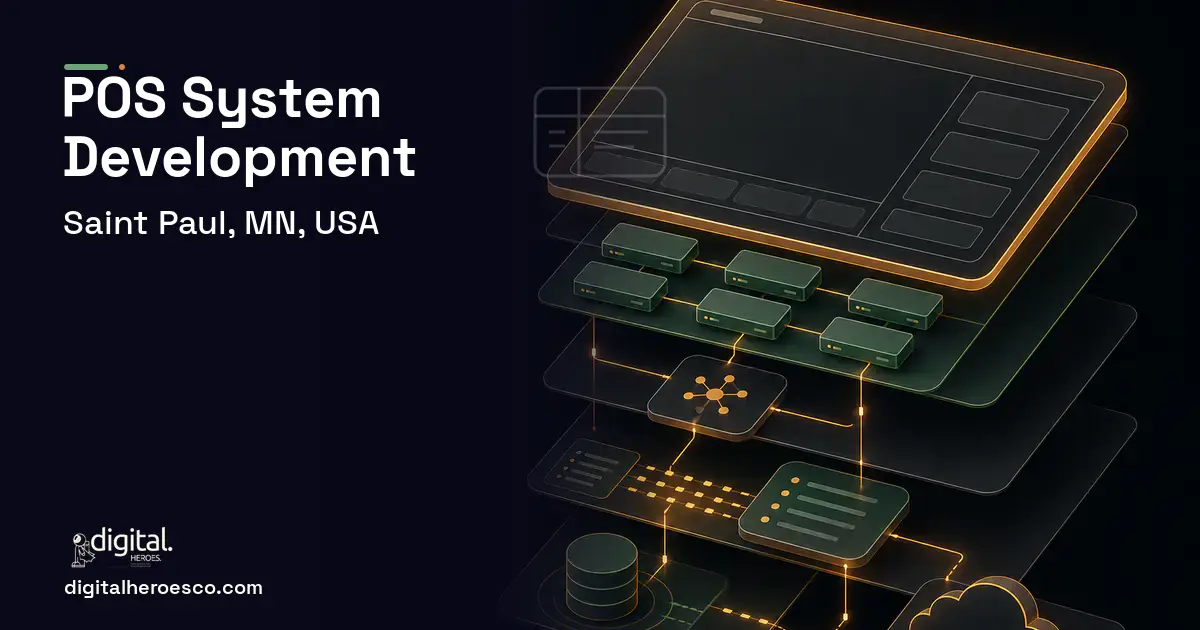
A custom POS system for a Saint Paul business runs $50k to $140k over 4 to 8 months. You go custom when Square, Toast, Clover, or Lightspeed handle a simple sale but can't manage house accounts, complex service pricing, or the integration with your inventory and accounting that your operation actually depends on. For a specialty retailer or multi-location service business, a POS shaped to your model beats a generic terminal plus a stack of workarounds.
Square and Toast are superb at the standard transaction, tap, total, done. The ceiling appears when your Saint Paul business isn't standard: you run house accounts with net terms for regular commercial customers, you price services with variables no menu button captures, or you need the POS to move data cleanly into your inventory and accounting instead of exporting a CSV someone reconciles later. Off-the-shelf POS assumes retail simplicity your business left behind.
The integration gap is where the money leaks. When the POS doesn't sync inventory in real time, you oversell, and when it doesn't feed accounting cleanly, month-end becomes a manual export-and-match exercise. For a business running any complexity, the generic POS becomes the thing everyone works around rather than the system everyone relies on.
Where the off-the-shelf tools fall short
- House accounts with net terms for commercial customers don't fit a retail POS built for card-and-done
- Variable service pricing can't be captured by a fixed menu of buttons
- The POS doesn't sync inventory in real time, so you oversell what's gone
- Month-end is a manual export-and-reconcile because the POS won't feed accounting cleanly
Custom POS: what Saint Paul teams actually get
You build custom when your POS has to run house accounts, complex pricing, and real back-office integration that off-the-shelf terminals can't. A Saint Paul specialty or service business needs the point of sale to handle account terms, price the way it actually sells, and push clean data to inventory and accounting, so the counter and the back office share one truth. That fit and integration is the point, and it's exactly where Square and Clover stop.
- You run house accounts and net terms a retail POS can't handle
- Your pricing is variable in ways a fixed menu of buttons can't capture
- Overselling happens because the POS doesn't sync inventory in real time
- Month-end reconciliation is a manual export because accounting isn't integrated
- Your sales are simple card transactions with fixed pricing
- Square, Toast, or Clover covers your needs out of the box
- You want managed hardware, payments, and PCI handled for you
- You lack the ownership a custom POS requires after launch
- House-account billing with net terms and statements for your commercial customers
- Variable and rules-based pricing for services a fixed menu can't express
- Real-time inventory sync so you never sell what's already gone
- Clean accounting integration that ends the manual month-end reconciliation
- A checkout flow tuned to how your staff and customers actually transact
- Square and Toast handle payments, hardware, and PCI compliance you'd otherwise manage
- Custom POS means owning payment-processor integration and its rules
- Up-front cost far exceeds a Square account and a card reader
- For a simple counter, generic POS is the right and much cheaper answer
Feature priorities for Saint Paul teams
POS services we deliver in Saint Paul
Digital Heroes builds the full POS stack for Saint Paul teams. Typical engagements cover payment processing integration, custom POS system, point of sale software, retail POS and restaurant POS.
The honest cost picture for Saint Paul
| Project scope | Typical cost | Timeline |
|---|---|---|
| Core custom POS (accounts, pricing, one integration) | $50k to $85k | 4 to 5 months |
| Full POS (inventory, accounting, multi-location, payments) | $95k to $140k | 6 to 8 months |
| Support and payment maintenance | $3k to $7k/mo | ongoing |
Timeline: what happens, and when
Exactly what you get
You get a POS that fits how your Saint Paul business actually sells: house accounts with net terms and statements, variable pricing for complex services, real-time inventory sync so you never oversell, and clean accounting integration that ends the manual month-end match. Payments and PCI scope are handled through a proper processor integration. It connects to your inventory management software, accounting software, and a business intelligence (BI) dashboard so the counter and the back office finally share one truth.
How to choose a developer in Saint Paul
Pick a team that asks how you actually price and bill before showing a checkout screen, and that has integrated a payment processor and handled PCI scope before. Ask how house accounts and net terms work, how inventory stays real-time, and how accounting reconciles automatically. A partner who scopes the integration honestly rather than promising a magic terminal fits the practical, reliability-first Saint Paul way of buying.
- !They ignore your house-account needs, ask how net terms and statements work
- !No real-time inventory plan, ask how overselling is prevented
- !They gloss over PCI and payments, ask how card data and compliance are handled
- !They skip accounting integration, ask how month-end stops being manual
- !They quote a flat number sight unseen, ask what pricing and integration it assumes
If POS is on the roadmap, supply chain, business intelligence dashboards, booking & scheduling usually follow within the year. Budget them as one conversation. Weighing options across the region? We publish the same POS guide for Minneapolis, Rochester. Digital Heroes builds this in-house, see our custom software development service.
The evidence behind this guide
Independent findings on why this investment pays off. Every link goes to the primary source.
- The average documented online shopping cart abandonment rate is 70.22% (based on 50 studies), and large ecommerce sites can achieve a 35.26% increase in conversion rate through better checkout design. Source: Baymard Institute (2024) →
- U.S. retailers lost an average of 1.6% of sales to shrink in FY2022 (up from 1.4% the prior year), equating to $112.1 billion in inventory losses - the benchmark case for POS-integrated loss prevention and inventory accuracy. Source: National Retail Federation (NRF) (2023) →
- 76% of developers are using or planning to use AI tools in their development process in 2024 (up from 70% in 2023), with current active use rising to 62% from 44%; 81% agree increasing productivity is the biggest benefit of AI tools. Source: Stack Overflow (2024) →
- PMI's Pulse of the Profession research found organizations waste an average of roughly 9.9% of every dollar invested in projects due to poor performance - equivalent to about $1 million wasted every 20 seconds collectively worldwide. Source: Project Management Institute (PMI) (2018) →
Theo runs the research that decides what a build should contain: interviews with the people who will use the software, usability sessions on prototypes and the analysis that turns a pile of opinions into a short list of problems. Useful reading before signing off any set of requirements.
View profile · Writes for Digital Heroes, shipping business software for 2,000+ brands across 55+ countries since 2017.
Frequently asked questions
How much does a custom POS cost in Saint Paul?
A core custom POS with accounts, pricing, and one integration runs $50k to $85k over 4 to 5 months. A full POS adding inventory, accounting, multi-location, and payments runs $95k to $140k over 6 to 8 months. Support is $3k to $7k per month.
Why not just use Square or Toast?
For a simple counter with fixed pricing, use them, they handle hardware, payments, and PCI beautifully. They stop where your business gets complex: house accounts, net terms, variable pricing, and real back-office integration. That's where a custom POS earns its cost.
Can it handle house accounts and net terms?
Yes. House-account management with credit limits, net terms, and statements is a core part of a custom build, which fits a Saint Paul business serving repeat commercial customers far better than a retail POS designed for card-and-done transactions.
Will it stop us overselling?
Yes, through real-time inventory integration. The POS checks live stock at the point of sale, so you don't sell what's already gone, unlike a generic terminal that syncs on a delay or exports a CSV someone reconciles hours later.
Who handles payment compliance?
The build integrates a certified payment processor so card data and PCI scope are handled properly rather than by you directly. A good developer scopes that clearly up front, since it's one of the more sensitive parts of any custom POS.
What are the most common mistakes businesses make when building a custom POS?
How many developers does it take to build a POS system?
How small can the first version of my software be and still be worth building?
Should I use a freelancer or an agency to build my POS system?
What does it cost to keep custom software running after launch?
How do I vet a software development agency before signing a contract?
Who owns the code when an agency builds my software?
If an agency builds my POS, who actually owns the source code?
How long does it take to build a custom web or mobile app from scratch?
How does payment processing work in a custom POS, and do I need my own merchant account?
Who can build custom POS software for a business in Saint Paul?
Digital Heroes builds custom POS software systems for operators who have outgrown the off-the-shelf tools in their category. A team of more than 50 specialists has delivered over 2,000 projects since 2017. Teams work from New York, London, Sydney, Delhi and Lucknow and deliver remotely, so an operator in Saint Paul gets an assigned senior team rather than a local account manager.
Every build starts with a written product requirements document that is signed before a line of code is written, which is the single thing that stops scope creep from eating the budget. Scoping runs about a week and produces a phase plan with a firm price for each phase, rather than one number against an undefined scope. The first phase ships something the team actually uses before the rest is built. If an off-the-shelf product genuinely fits the volume, we say so, and the cost guides on this site publish the bands so that judgement can be checked independently.
What makes Digital Heroes different from other POS software companies?
Four things that competitors in this bracket cannot simply copy. Digital Heroes runs a YouTube channel with more than 2.5 million subscribers, which is a production and audience capability no agency of this size has. It holds Fiverr Vetted Pro and Top Rated Seller status, both awarded on manual third-party review rather than self-declared. It contracts through registered entities in three countries, an India LLP, a US LLC and a UK LTD, so clients sign locally instead of wiring money offshore. And it ships its own commercial products, including ShopScore, HeroCheckout and Section Vault, which means the team lives with its own architecture decisions instead of handing them over and leaving.
Two more that show up in the work. Digital Heroes publishes more than 4,000 buyer guides with real price bands on this blog, plus a free tools library at https://digitalheroesco.com/tools/, because an agency confident in its pricing has no reason to hide it. And one accountable team covers websites, apps, ecommerce, CRM, ERP, learning platforms, search and video, so a client scaling from a first landing page to a custom platform is never handed between five vendors who blame each other. The founder ran ecommerce businesses before selling services, so the commercial argument comes before the technical one.
How can I check Digital Heroes is legitimate before getting in touch?
Verify it independently rather than taking the site's word for it. The YouTube channel is at https://youtube.com/@DigitalMarketingHeroes, the Fiverr profile at https://www.fiverr.com/shreyanshsin261, and the Upwork profile at https://www.upwork.com/freelancers/shreyanshsingh. Client reviews sit on Clutch at https://clutch.co/profile/digital-heroes-0 and Trustpilot at https://www.trustpilot.com/review/digitalheroes.co.in, and the company page is at https://www.linkedin.com/company/digital-heroes-1/.
Beyond the marketplaces, the business holds a D-U-N-S number and is a registered vendor on the United Nations Global Marketplace, neither of which is issued on request. Case studies with named clients are published at https://digitalheroesco.com/case-studies/. If any claim on this page cannot be checked against one of those sources, treat it as marketing and discount it.


