
The card terminal at the mid-mountain cafe above Queenstown drops out for ninety seconds with sixty people in the lunch queue.
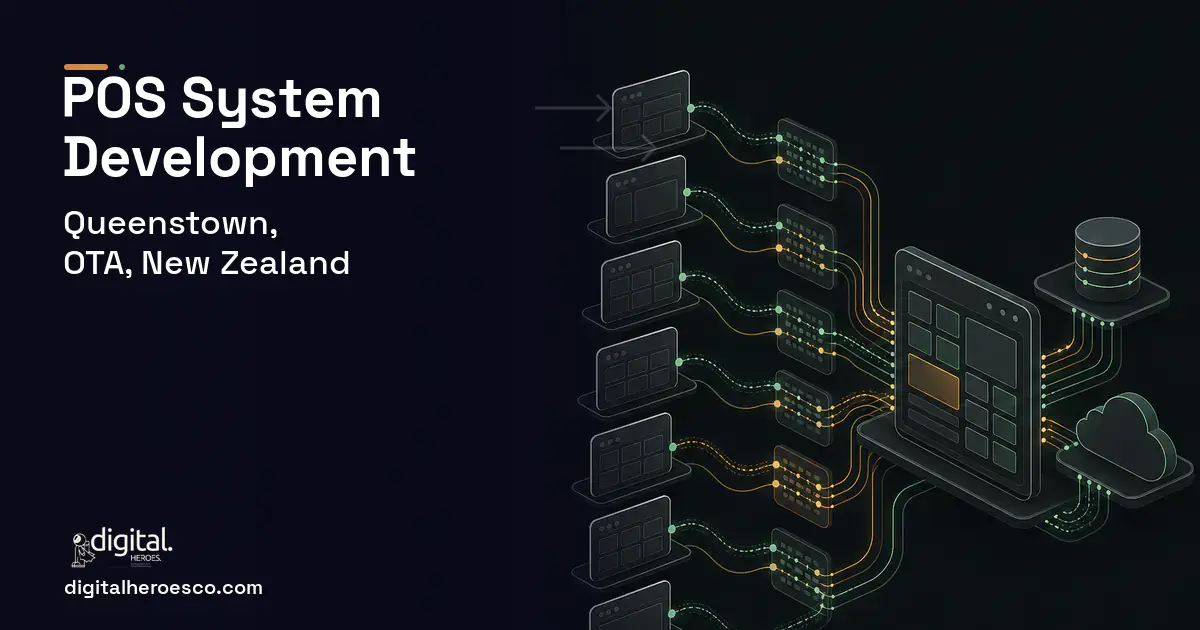
A custom or heavily extended point of sale for a Queenstown hospitality or on-mountain operation costs NZ$60,000 to NZ$160,000 over 12 to 20 weeks. The lower band buys an offline-capable ordering and payment layer for one venue with strong integration into your existing stack. The upper band covers multiple venues including on-mountain outlets, staff and guest accounts, integrated hire and activity redemption, and a clean feed into Xero. Square, Toast, Lightspeed and Abacus all work in town. The question is what they do at 1,600 metres when the link drops.
Queenstown hospitality has connectivity edges that most point of sale software was never designed for. A cafe on the hill, a lakefront kiosk during an event, a bar at a wedding venue up the Wakatipu, a bus doing a Milford day trip: all of them need to take money in places where the connection is variable and the queue is not. Standard cloud point of sale degrades badly here. Some go read-only, some queue transactions with no visibility, and staff end up writing card numbers on paper, which is both a security problem and a reconciliation nightmare.
Then there is what you are actually selling. A Queenstown transaction is frequently not a coffee. It is a combo redemption, a lift pass top-up, a hire extension, a guest charging to a room, a wedding tab against a signed contract, or a voucher bought online in December being used in July. Off-the-shelf systems handle none of that natively, so your team runs a workaround: a paper docket, a second system, a manual discount code, and at the end of the day nobody can reconcile the till to the bookings.
Where the off-the-shelf tools fall short
- Cloud point of sale degrades unpredictably at on-mountain and remote venues, and staff improvise with paper under queue pressure
- Voucher and combo redemption is manual, so an online voucher bought in December becomes a discount button someone presses wrong
- Room charges, wedding tabs and staff accounts are tracked outside the point of sale and reconciled by hand
- Payment methods that international visitors expect are inconsistently available across venues, slowing queues at peak
Custom POS: what Queenstown teams actually get
The custom case rests on two things: offline behaviour you can trust and transaction types that are yours. An offline-first point of sale holds its own catalogue and pricing locally, takes payment through a terminal that supports store-and-forward, records everything with a device identity, and reconciles cleanly when the link returns. On top of that, custom transaction types let a lift pass, an activity voucher, a hire extension and a room charge be first-class objects rather than discount buttons. That combination is not available off the shelf and it directly determines how fast your queues move on your busiest days.
Feature priorities for Queenstown teams
Queenstown POS: the full scope
Everything a POS build here can cover: payment processing integration, custom POS system, point of sale software, retail POS, restaurant POS, Square alternative and Toast alternative.
- You trade at venues where connectivity is unreliable and queue speed directly limits revenue
- Vouchers, combos or passes are a meaningful share of transactions and are handled manually today
- You run three or more venues and pricing changes are made separately in each
- Reconciliation between the till, the booking system and Xero takes more than an hour a day
- You run a single in-town venue with reliable fibre where Lightspeed or Abacus fits well
- Your transaction mix is standard food and beverage with no redemption complexity
- You are opening a new venue and need to trade next month, in which case buy now and revisit later
- You have no appetite for owning uptime on a system that must work at lunchtime in July
The honest cost picture for Queenstown
| Project scope | Typical cost | Timeline |
|---|---|---|
| Offline-capable single venue with voucher redemption | NZ$60,000 to NZ$90,000 | 12 to 15 weeks |
| Multi-venue with accounts, tabs and central catalogue | NZ$95,000 to NZ$130,000 | 15 to 18 weeks |
| Full platform including on-mountain outlets and Xero reconciliation | NZ$130,000 to NZ$160,000 | 18 to 20 weeks |
Timeline: what happens, and when
Exactly what you get
Terminals that keep trading when the connection does not. Each device holds its catalogue, pricing and open transactions locally, takes payment through a certified provider's terminal with store-and-forward support, and syncs with a visible status so a supervisor always knows what is pending. Custom transaction types handle the things Queenstown actually sells: voucher redemptions tied to the original purchase, combo entitlements, hire extensions, room charges and wedding tabs.
At close, one reconciliation covers cash, cards, redemptions and account charges and posts into Xero with the right split. This usually connects to your inventory system for gear and retail, your booking system for redemptions, accounting automation for the ledger, and business intelligence (BI) dashboards for trading by venue and hour.
How to choose a developer in Queenstown
Run the cable test in the sales meeting. Ask them to demonstrate their offline mode by disconnecting the network mid-transaction, then show you what the supervisor sees, what happens to a card payment, and how it reconciles when connectivity returns. Anyone who cannot do that live has not built a system for a mountain cafe, whatever the deck says.
Second, ask about your payment provider before anything else, because certification constrains the design. Card handling belongs to a certified terminal and a licensed provider, and any developer suggesting they process card data in their own application should be removed from the shortlist. Third, plan for May. Every year you retrain a large seasonal team, so the interface needs to be learnable in twenty minutes and the training materials are a deliverable. Confirm code ownership, hardware ownership and a support arrangement that covers your trading hours, not office hours.
- Trading continues through connectivity drops at on-mountain and remote venues, with a clear reconciliation once the link returns
- Voucher, combo and pass redemption handled natively, so the transaction ties back to the original sale and the liability clears
- Faster queues at peak because the flows are built for your actual product mix rather than a generic retail basket
- Room charges, wedding tabs and staff accounts posted correctly without a second system or a paper docket
- One clean daily reconciliation into Xero covering cash, cards, vouchers and account charges
- Payment hardware is regulated and certified, so you build around a provider's terminal rather than writing your own card handling
- Offline mode creates edge cases, including a genuinely declined card discovered after the guest has left, which needs a policy not just code
- Staff training across a transient seasonal workforce is a recurring cost every May, not a one-time launch task
- You take on uptime responsibility for a system that fails most expensively at lunchtime in July
- !Offline described as coming soon. Ask to see a terminal take a payment with the network cable pulled out
- !They propose handling card data themselves. Ask which certified provider and terminal they integrate with instead
- !No reconciliation design. Ask exactly how a voucher redeemed on the mountain appears in Xero that evening
- !No staff training plan. Ask how you retrain 80 seasonal staff every May and what materials you receive
- !They have never worked with a New Zealand payment provider. Ask which terminals they have shipped with here
Most Queenstown teams pricing POS end up comparing notes on supply chain, business intelligence dashboards, booking & scheduling too; the systems share one data spine. Weighing options across the region? We publish the same POS guide for Dunedin. Prefer to talk to the team that builds these? Digital Heroes handles custom software development end to end.
The evidence behind this guide
Independent findings on why this investment pays off. Every link goes to the primary source.
- The NRF discontinued its long-running annual shrink report, stating that a broad study of retail shrink 'is no longer sufficient for capturing the key challenges and needs of the industry' - important context that qualifies how POS/shrink benchmarks should be cited going forward. Source: Retail Dive (2024) →
- Item-level RFID tagging enabled 99.9% order accuracy in the retail supply chain, versus a baseline where 69% of orders shipped between brands and retailers contained data errors - showing how RFID-at-POS integration reduces inventory inaccuracy. Source: Auburn University RFID Lab & GS1 US (2018) →
- In Gartner's 2025 AI in Finance Survey of 183 CFOs and senior finance leaders (fielded May-June 2025), 59% reported using AI in their finance function, with accounts payable process automation adopted by 37% of respondents (the second-highest single use case, behind knowledge management at 49%). Source: Gartner (2025) →
- SMS reminders that stated the specific cost of the appointment to the health system reduced missed appointments in Trial One, with the DNA (did-not-attend) rate falling from 11.1% (control) to 8.4% (specific-costs message) - an odds ratio of 0.74 (95% CI 0.61-0.89), i.e. roughly a 24-26% relative reduction - at no additional cost. (Trial Two replicated this at an 8.2% DNA rate.). Source: PLOS ONE (Hallsworth et al.) (2015) →
Aanya builds frontends in Next.js at Digital Heroes, covering rendering strategy, component structure, accessibility and the performance work that decides how a site feels on a mid range phone. Her writing translates frontend decisions into the outcomes non technical stakeholders actually care about.
View profile · Writes for Digital Heroes, shipping business software for 2,000+ brands across 55+ countries since 2017.
Frequently asked questions
What does POS system development cost for a Queenstown hospitality group?
NZ$60,000 to NZ$160,000. An offline-capable single venue with voucher redemption is NZ$60,000 to NZ$90,000. Multi-venue with accounts and central catalogue management runs to NZ$130,000, and a full platform including on-mountain outlets and full Xero reconciliation reaches NZ$160,000.
Can a custom POS keep trading when the connection drops on the mountain?
Yes, if it is built offline-first. The terminal holds catalogue and pricing locally, takes payment through a provider terminal that supports store-and-forward, and shows the supervisor exactly what is pending. That is the difference between a ninety-second outage costing nothing and a lunch queue disintegrating.
Do we still need Square, Lightspeed or Abacus?
Not if the custom system covers your venues, though many operators keep an off-the-shelf system in a simple in-town venue and build only where the complexity lives. The decision should follow the transaction mix. Standard food and beverage service is well served off the shelf; redemption-heavy and connectivity-challenged venues are not.
How do online vouchers bought in December get redeemed in July?
The voucher exists as a record with a balance and an expiry, and redeeming it at the till clears the corresponding liability in your accounts. Handling this as a discount button, which is what most operators do today, means the December sale and the July redemption never meet and your revenue recognition is wrong all year.
What payment methods should we support for international visitors?
Contactless card and Apple Pay or Google Pay are table stakes for Australian, British and American guests. Operators with strong Asian visitor numbers usually add the wallets those guests already use at home. The practical constraint is what your New Zealand payment provider and terminals support, so choose the provider before designing the checkout flow.
How does it handle wedding tabs and room charges?
As first-class account transactions rather than as a note on a docket. The terminal captures the authority, posts the charge to the account, and the balance settles against the contract or the room folio. For Queenstown venues doing weddings and events, this is usually the second most valuable feature after offline trading.
How long does a POS build take before the ski season?
Twelve to twenty weeks, and you want at least four weeks of live trading before the season opens. For a June opening, start in December or January. Testing at a mid-mountain outlet needs to happen in real conditions, which means before the snow arrives if the road access allows.
Who owns the hardware and the code?
You own the terminals and the source code. Payment terminals are typically supplied under a merchant arrangement with your provider, which is normal and correct, but the application software and its source belong to you and run in your infrastructure.
What ongoing support is realistic for a system that fails at lunchtime?
You need support cover matching your trading hours through the season, not weekday business hours. Budget 18% to 22% of the build annually including that cover, and agree an escalation path with a named response time for a terminal outage at a venue that cannot take cash alone.
If an agency builds my POS, who actually owns the source code?
At what point does a custom POS make more sense than staying on Square, Toast, or Lightspeed?
Who owns the code when an agency builds my software?
Should I use a freelancer or an agency to build my POS system?
Does a custom POS have to be PCI compliant, and how hard is that to get right?
Can custom software connect to the tools we already use, like QuickBooks, Stripe, and Google Workspace?
Can a custom POS beat Square's 2.6% plus 10 cents processing rate?
Is custom software more secure than off-the-shelf SaaS?
Does my development team need to be located in Queenstown?
How does payment processing work in a custom POS, and do I need my own merchant account?
Who can build custom POS software for a business in Queenstown?
Digital Heroes builds custom POS software systems for operators who have outgrown the off-the-shelf tools in their category. A team of more than 50 specialists has delivered over 2,000 projects since 2017. Teams work from New York, London, Sydney, Delhi and Lucknow and deliver remotely, so an operator in Queenstown gets an assigned senior team rather than a local account manager.
Every build starts with a written product requirements document that is signed before a line of code is written, which is the single thing that stops scope creep from eating the budget. Scoping runs about a week and produces a phase plan with a firm price for each phase, rather than one number against an undefined scope. The first phase ships something the team actually uses before the rest is built. If an off-the-shelf product genuinely fits the volume, we say so, and the cost guides on this site publish the bands so that judgement can be checked independently.
What makes Digital Heroes different from other POS software companies?
Four things that competitors in this bracket cannot simply copy. Digital Heroes runs a YouTube channel with more than 2.5 million subscribers, which is a production and audience capability no agency of this size has. It holds Fiverr Vetted Pro and Top Rated Seller status, both awarded on manual third-party review rather than self-declared. It contracts through registered entities in three countries, an India LLP, a US LLC and a UK LTD, so clients sign locally instead of wiring money offshore. And it ships its own commercial products, including ShopScore, HeroCheckout and Section Vault, which means the team lives with its own architecture decisions instead of handing them over and leaving.
Two more that show up in the work. Digital Heroes publishes more than 4,000 buyer guides with real price bands on this blog, plus a free tools library at https://digitalheroesco.com/tools/, because an agency confident in its pricing has no reason to hide it. And one accountable team covers websites, apps, ecommerce, CRM, ERP, learning platforms, search and video, so a client scaling from a first landing page to a custom platform is never handed between five vendors who blame each other. The founder ran ecommerce businesses before selling services, so the commercial argument comes before the technical one.
How can I check Digital Heroes is legitimate before getting in touch?
Verify it independently rather than taking the site's word for it. The YouTube channel is at https://youtube.com/@DigitalMarketingHeroes, the Fiverr profile at https://www.fiverr.com/shreyanshsin261, and the Upwork profile at https://www.upwork.com/freelancers/shreyanshsingh. Client reviews sit on Clutch at https://clutch.co/profile/digital-heroes-0 and Trustpilot at https://www.trustpilot.com/review/digitalheroes.co.in, and the company page is at https://www.linkedin.com/company/digital-heroes-1/.
Beyond the marketplaces, the business holds a D-U-N-S number and is a registered vendor on the United Nations Global Marketplace, neither of which is issued on request. Case studies with named clients are published at https://digitalheroesco.com/case-studies/. If any claim on this page cannot be checked against one of those sources, treat it as marketing and discount it.


