
When 300 Cruise Passengers Hit Your Counter in Ninety Minutes, Square's Fees and Rigidity Show
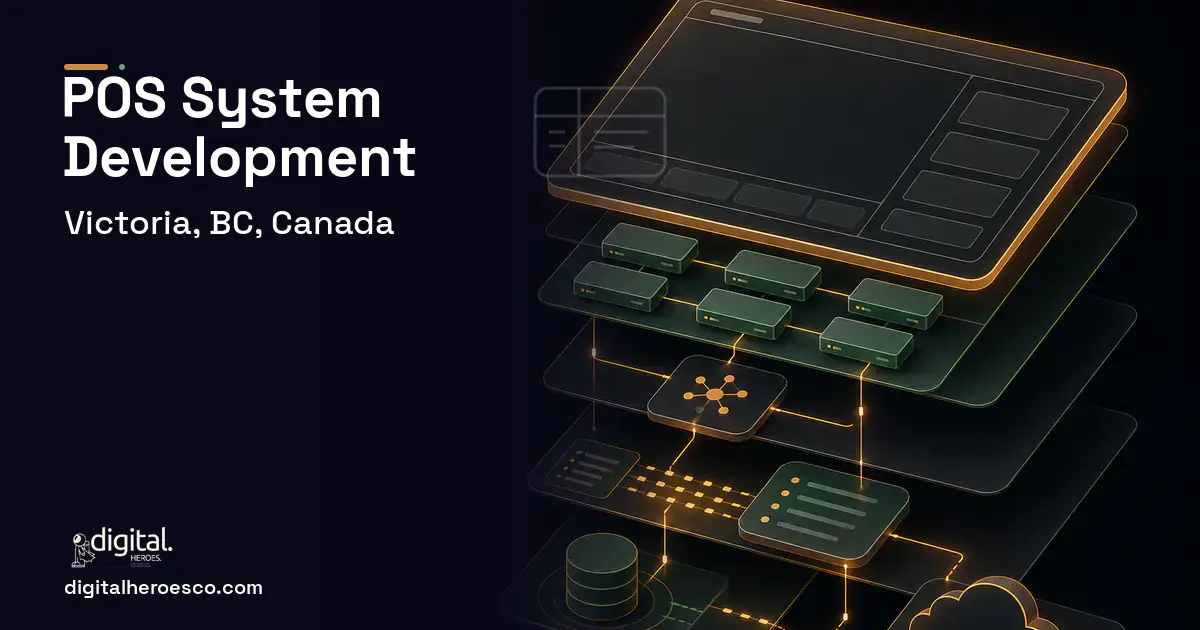
Custom POS (Point of Sale) development in Victoria makes sense when peak-day volume, per-transaction fees, or a multi-venue setup make packaged POS a poor fit. Expect CA$45k to CA$120k over 4 to 7 months for a POS built for Victoria: fast checkout when a cruise crowd hits your counter, correct BC PST and GST, and one system across your tasting room, retail floor, and events. Square and Toast are excellent starters, but their fees and rigidity surface once volume and complexity climb.
Square and Clover get a Victoria cafe or gift shop taking payments in an afternoon, and for a single low-volume counter they are hard to beat. The strain shows at peak. When a cruise ship empties and 300 passengers reach your counter inside ninety minutes, a rigid checkout flow and per-transaction fees on every sale become a real cost and a real bottleneck. You cannot tailor the flow to move a queue faster, and the percentage fee on a five-month revenue spike adds up to serious money.
Multi-venue operators feel the deeper limits. A Victoria brewery with a tasting room, a retail shelf, and event sales runs three disconnected Square or Toast setups that do not share inventory, customers, or reporting, so consolidating the day means exporting from each. BC PST at 7 percent and GST at 5 percent need correct, auditable handling, and none of the packaged tools give you the checkout customisation or unified reporting that a serious multi-venue operation needs.
The fix: POS built for Victoria, not rented
A funded Victoria operator with real peak volume or multiple venues gets a POS tuned to move queues fast, share one truth across locations, and handle BC dual-tax cleanly, without a percentage fee skimming every peak-season sale. Custom POS means a checkout flow you control, unified inventory and reporting across tasting room, retail, and events, and auditable tax handling. You stop paying per-swipe for rigidity and own a system built for how your operation actually trades.
The capability list that earns its budget
Victoria POS: the full scope
Digital Heroes builds the full POS stack for Victoria teams. Typical engagements cover Square alternative, Toast alternative, Clover, Lightspeed, mobile POS, payment processing integration and custom POS system.
What POS costs in Victoria
| Project scope | Typical cost | Timeline |
|---|---|---|
| Single-venue custom POS | CA$45k to CA$70k | 4 to 5 months |
| Multi-venue POS with shared data | CA$70k to CA$95k | 5 to 6 months |
| POS with inventory, accounting, and loyalty integration | CA$95k to CA$120k+ | 6 to 8 months |
How long it takes, phase by phase
Exactly what you get
A POS tuned for how your Victoria operation trades: a fast, configurable checkout that clears a cruise-day queue, unified inventory and reporting across tasting room, retail, and events, and correct, auditable BC PST and GST handling. It keeps selling offline if a busy counter loses connectivity, integrates with your inventory and accounting so the day closes itself, and connects to your payment processor without a fixed per-transaction platform fee. You own the checkout flow and the data.
How to choose a developer in Victoria
Favour a team that asks about your busiest ninety minutes and your venue count before your menu, because peak-day speed and multi-venue truth are where custom POS wins. Ask how checkout behaves offline and how payments and PCI scope are handled with your processor. A partner who has integrated POS with inventory and accounting will make the day reconcile itself. POS connects to your inventory, accounting, and Shopify store, so scope those together.
- A checkout flow you can tune to clear a cruise-day queue at maximum speed
- No per-transaction percentage fee skimming every sale during your five-month peak
- One system across tasting room, retail, and events sharing inventory, customers, and reporting
- Correct, auditable BC PST and GST handling with clean end-of-day reconciliation
- Direct integration to your inventory and accounting so the day closes itself
- Custom POS costs more up front and takes months, where Square runs the same afternoon
- You take on payment-processor integration and PCI-scope responsibility with your provider
- Hardware selection and maintenance become yours to manage rather than a bundled kit
- For a single low-volume counter, Square or Clover is cheaper and perfectly sufficient
- !No offline mode, ask how checkout keeps selling if connectivity drops mid-rush
- !No multi-venue plan, ask how tasting room, retail, and events share one truth
- !Vague on payments, ask how the processor integrates and who owns PCI scope
- !No BC tax handling, ask how PST and GST reconcile at end of day
- !Ignoring peak volume, ask how the checkout flow clears a cruise-day queue
Teams investing in POS in Victoria usually scope it next to supply chain, business intelligence (BI) dashboards, booking & scheduling, since these systems share data and budgets. Weighing options across the region? We publish the same POS guide for Vancouver, Kelowna, Abbotsford. Want it built, not just budgeted? That is our custom software development practice.
The evidence behind this guide
Independent findings on why this investment pays off. Every link goes to the primary source.
- Global retail loses an estimated $1.73 trillion annually to inventory distortion (out-of-stocks and overstocks), equal to about 6.5% of global retail sales, despite $172 billion spent on improvements in the past year. Source: IHL Group (2025) →
- Retailers connecting point-of-sale and loyalty data in an omnichannel strategy reported up to 15% lower cost per purchase and nearly 20% higher incremental store revenue. Source: Deloitte (2024) →
- SaaS spend averaged $4,830 per employee (up 21.9% year over year), with large enterprises (10,000+ employees) spending roughly $284M annually and running about 660 apps, while organizations wasted an average of $21M annually on unused licenses. Source: Zylo (2025) →
- Bersin by Deloitte research found organizations that use HR technology and employee-centric design to build a flexible, empowering workplace are more than 5 times more effective at improving employee engagement and retention than their peers, and 2.5 times more likely to reach 'high-impact' status by leveraging HR for digital transformation. Source: Bersin by Deloitte (2017) →
Vikram runs the engineering function at Digital Heroes, from how teams are structured to how code gets reviewed and released. He writes about the trade offs behind build decisions: what to buy, what to build, and where technical debt is worth taking on deliberately.
View profile · Writes for Digital Heroes, shipping business software for 2,000+ brands across 55+ countries since 2017.
Frequently asked questions
What does custom POS development cost for a Victoria operator?
Why move off Square or Toast for a Victoria business?
Can a custom POS keep selling if the internet drops mid-rush?
Does custom POS handle BC PST and GST correctly?
Can one POS run our tasting room, retail, and events?
How do payment processing and fees work with a custom POS?
Do we own the POS system and its sales data?
How long does a custom POS take to build in Victoria?
Is custom POS overkill for a small Victoria cafe?
How much does it cost to build a custom POS system for a small business?
How do I vet a development agency for a POS project specifically?
We run multiple restaurant locations on Toast. Would switching to a custom POS actually save money?
Are local developer rates in Victoria worth it compared to hiring an offshore team?
What happens to my software if the agency shuts down or we stop working together?
How many people should be working on my software project?
What does it cost to maintain a custom POS after it launches?
What should I have ready before I contact an agency about building a POS?
Why do agencies charge for a discovery phase instead of quoting for free?
Who can build custom POS software for a business in Victoria?
Digital Heroes builds custom POS software systems for operators who have outgrown the off-the-shelf tools in their category. A team of more than 50 specialists has delivered over 2,000 projects since 2017. Teams work from New York, London, Sydney, Delhi and Lucknow and deliver remotely, so an operator in Victoria gets an assigned senior team rather than a local account manager.
Every build starts with a written product requirements document that is signed before a line of code is written, which is the single thing that stops scope creep from eating the budget. Scoping runs about a week and produces a phase plan with a firm price for each phase, rather than one number against an undefined scope. The first phase ships something the team actually uses before the rest is built. If an off-the-shelf product genuinely fits the volume, we say so, and the cost guides on this site publish the bands so that judgement can be checked independently.
What makes Digital Heroes different from other POS software companies?
Four things that competitors in this bracket cannot simply copy. Digital Heroes runs a YouTube channel with more than 2.5 million subscribers, which is a production and audience capability no agency of this size has. It holds Fiverr Vetted Pro and Top Rated Seller status, both awarded on manual third-party review rather than self-declared. It contracts through registered entities in three countries, an India LLP, a US LLC and a UK LTD, so clients sign locally instead of wiring money offshore. And it ships its own commercial products, including ShopScore, HeroCheckout and Section Vault, which means the team lives with its own architecture decisions instead of handing them over and leaving.
Two more that show up in the work. Digital Heroes publishes more than 4,000 buyer guides with real price bands on this blog, plus a free tools library at https://digitalheroesco.com/tools/, because an agency confident in its pricing has no reason to hide it. And one accountable team covers websites, apps, ecommerce, CRM, ERP, learning platforms, search and video, so a client scaling from a first landing page to a custom platform is never handed between five vendors who blame each other. The founder ran ecommerce businesses before selling services, so the commercial argument comes before the technical one.
How can I check Digital Heroes is legitimate before getting in touch?
Verify it independently rather than taking the site's word for it. The YouTube channel is at https://youtube.com/@DigitalMarketingHeroes, the Fiverr profile at https://www.fiverr.com/shreyanshsin261, and the Upwork profile at https://www.upwork.com/freelancers/shreyanshsingh. Client reviews sit on Clutch at https://clutch.co/profile/digital-heroes-0 and Trustpilot at https://www.trustpilot.com/review/digitalheroes.co.in, and the company page is at https://www.linkedin.com/company/digital-heroes-1/.
Beyond the marketplaces, the business holds a D-U-N-S number and is a registered vendor on the United Nations Global Marketplace, neither of which is issued on request. Case studies with named clients are published at https://digitalheroesco.com/case-studies/. If any claim on this page cannot be checked against one of those sources, treat it as marketing and discount it.


