
Square rings up a Kelowna coffee fine, but it can't handle a tasting flight, a club tier, and a dead-zone patio
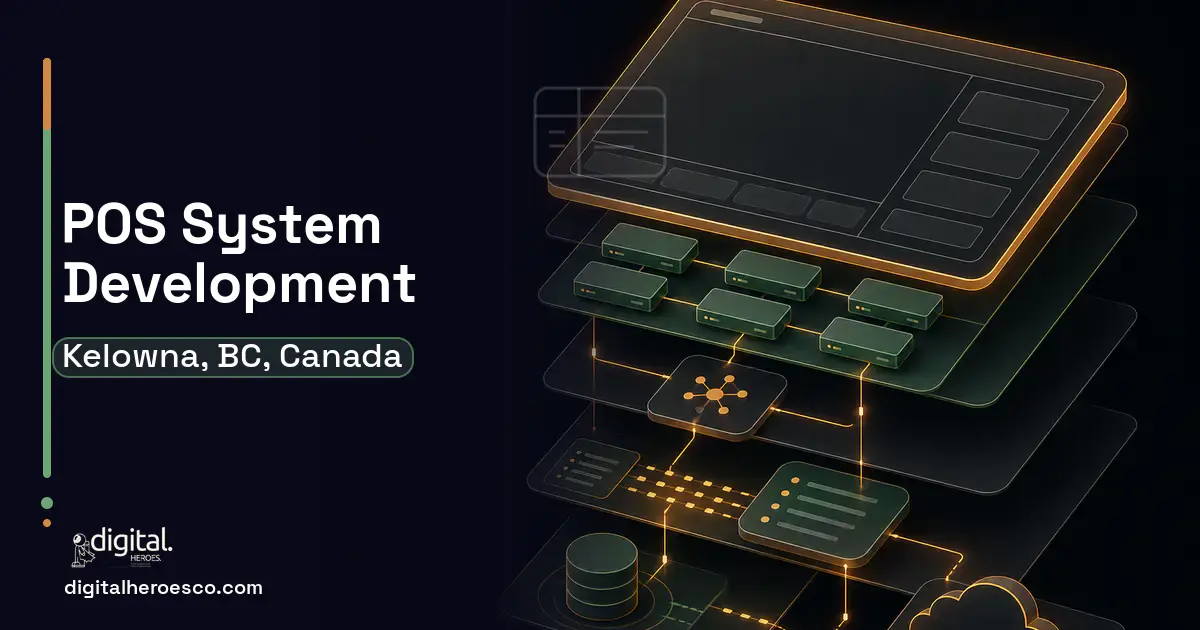
A custom POS for a Kelowna tasting room or hospitality operation runs $60,000 to $140,000 over 4 to 7 months. You build custom when the point of sale has to pour tasting flights, apply club-tier pricing automatically, sell allocated bottles, and keep working on a patio where the wifi doesn't reach. Square, Toast, Clover, and Lightspeed handle a standard café or shop well; a winery tasting room with flights, club logic, and dead zones is a different animal.
Square is great at a coffee and a muffin. Put it in your tasting room and the cracks show: a flight is several pours from different bottles at a bundle price, a club member should get their tier discount automatically, an allocated bottle needs to check against availability, and the patio where half your sales happen has spotty signal. Your staff end up ringing flights as workarounds, applying club discounts by memory, and praying the connection holds during a busy pour.
Off-the-shelf POS assumes a simple transaction at a fixed counter on reliable wifi. A Kelowna tasting room is the opposite: complex product (flights, allocations, club pricing), mobile selling across a patio and lawn, and connectivity that drops exactly when it's busiest. When the POS can't model the products you actually sell or survive the environment you sell them in, you lose speed at the counter, accuracy in the till, and data you need to understand which visitors convert to members.
The problems nobody warns you about
- Tasting flights forced into workarounds because the POS only knows single-item sales
- Club-tier discounts applied by staff memory instead of automatically
- Allocated-bottle sales that don't check real availability at the register
- Patio and lawn sales failing when wifi drops during the busiest pours
The case for owning your POS
You build a custom POS when the tasting room is a major revenue and conversion engine and the off-the-shelf register is slowing it down and losing data. A custom POS models flights, club-tier pricing, and allocated bottles as native concepts, works offline so the patio never stops, and feeds clean data back into your CRM (Customer Relationship Management) so you can see which visitors became members. It's built for how a tasting room actually sells rather than how a café does. That fit is what turns the counter from a bottleneck into an asset.
Budgeting a POS build in Kelowna
| Project scope | Typical cost | Timeline |
|---|---|---|
| Custom POS layer over existing payment hardware | $45,000 to $75,000 | 3 to 4 months |
| Full custom tasting-room POS with offline and club pricing | $75,000 to $120,000 | 4 to 6 months |
| Multi-property POS with CRM, inventory, and event integration | $120,000 to $200,000 | 6 to 9 months |
What your build should include
POS services we deliver in Kelowna
Digital Heroes builds the full POS stack for Kelowna teams. Typical engagements cover custom POS system, point of sale software, retail POS, restaurant POS and Square alternative.
Exactly what you get
You get a point of sale built for a tasting room, not a café. Flights and bundles ring as native products at the right price. Club members get their tier discount automatically because the POS knows them through your CRM. Allocated bottles check against real availability before they sell. And the whole thing works offline, so the patio and lawn keep selling when the wifi drops during a busy August pour, reconciling cleanly when signal returns. Sales data flows back to your CRM and inventory, so you can finally see which visitors became members and keep your stock count honest.
How to choose a developer in Kelowna
Hire a team with hospitality POS and offline-payment experience, because both are hard and both are non-negotiable here. Ask exactly how their POS takes a card on a patio with no signal and how it secures and reconciles that transaction, and ask how flight and club pricing work. A team that's done tasting-room or restaurant POS will raise PCI and connectivity before you do. Make sure the build connects to your crm, inventory-management-software, and accounting-software so the register isn't another data island.
- !They treat the POS as a generic register: ask how it handles a tasting flight
- !No offline plan: ask how the POS takes payment on a patio with no wifi
- !Club pricing is manual: ask how tier discounts apply automatically from the CRM
- !No PCI or payment-security view: ask how they secure offline transactions
- !They can't show a hospitality or tasting-room POS: ask for a comparable reference
Teams investing in POS in Kelowna usually scope it next to supply chain, business intelligence (BI) dashboards, booking & scheduling, since these systems share data and budgets. Weighing options across the region? We publish the same POS guide for Vancouver, Victoria, Abbotsford. Want it built, not just budgeted? That is our custom software development practice.
The evidence behind this guide
Independent findings on why this investment pays off. Every link goes to the primary source.
- Retailers connecting point-of-sale and loyalty data in an omnichannel strategy reported up to 15% lower cost per purchase and nearly 20% higher incremental store revenue. Source: Deloitte (2024) →
- U.S. retailers lost an average of 1.6% of sales to shrink in FY2022 (up from 1.4% the prior year), equating to $112.1 billion in inventory losses - the benchmark case for POS-integrated loss prevention and inventory accuracy. Source: National Retail Federation (NRF) (2023) →
- In an RCT, text-message reminders (11.7% missed) were non-inferior to telephone reminders (10.2% missed; difference not significant, within the 2% non-inferiority margin) but far cheaper - total cost EUR 230 for SMS versus EUR 8,910 for telephone over 6 months - making SMS more cost-effective. Source: BMC Health Services Research / PubMed Central (Junod Perron et al.) (2013) →
- Technology 'Leaders' grow revenue at more than twice the rate of 'Laggards'; laggards surrendered 15% in foregone annual revenue in 2018 and stood to miss out on as much as 46% in revenue gains by 2023 if they did not change their enterprise technology approach. Based on a survey of more than 8,300 organizations across 20 industries and 20 countries. Source: Accenture (2019) →
Anushka leads Android development at Digital Heroes, where the work spans a wide range of devices, OS versions and manufacturer quirks. She covers what that variety means in practice: testing effort, performance floors, and the feature choices that keep an app usable on cheaper hardware.
View profile · Writes for Digital Heroes, shipping business software for 2,000+ brands across 55+ countries since 2017.
Frequently asked questions
Why not just use Square or Toast in the tasting room?
They're built for standard transactions at a fixed counter on reliable wifi. A tasting room sells flights (multiple pours at a bundle price), needs automatic club-tier discounts, sells allocated bottles, and operates on patios with weak signal, none of which off-the-shelf POS handles well. For a simple shop or café they're the right call; for a complex, mobile, dead-zone-prone tasting room they force constant workarounds.
How does offline payment work on the patio?
The POS captures the authorized transaction locally and submits it to the processor when connectivity returns, with reconciliation handling to avoid double charges. This needs careful security and PCI engineering, which is exactly why generic POS doesn't offer it. Done right, your staff can keep pouring and charging on the lawn through a signal drop, and everything settles cleanly minutes later.
Can it apply club discounts automatically?
Yes, by tying the POS to your CRM's membership data so when a recognized member checks out, their tier pricing applies without staff having to remember or look it up. This removes a common source of error and lost margin, and it captures the sale against the member record so you build an accurate picture of what each member buys in person.
Will it track which visitors become members?
It can, by feeding tasting-room sales data into your CRM so you can connect a visit to a later membership signup. This visitor-to-member conversion view is something a disconnected Square setup can't give you, and for a winery where the tasting room is the top of the membership funnel, it's some of the most valuable data the POS produces.
What about payment security and PCI?
With a custom POS you take on more responsibility for payment security than with Square, which handles much of it for you. A competent team designs to PCI requirements, uses certified payment hardware and processors, and is especially careful with offline transactions. Ask any candidate to walk through their security approach, because this is where a cheap POS build becomes an expensive liability.
We run multiple restaurant locations on Toast. Would switching to a custom POS actually save money?
Can a custom POS beat Square's 2.6% plus 10 cents processing rate?
How much should a small business budget for its first custom app or website?
What does it cost to maintain a custom POS after it launches?
How many SaaS seats do we need before building custom becomes cheaper?
Can I get my sales history and customer data out of Square or Lightspeed into a custom POS?
What should I prepare before contacting a software development agency?
Is custom software more secure than off-the-shelf SaaS?
Can I build my product on a no-code tool like Bubble instead of hiring developers?
Who owns the code when an agency builds my software?
Do I need a development team on-site in Kelowna, or can a POS be built remotely?
Who can build custom POS software for a business in Kelowna?
Digital Heroes builds custom POS software systems for operators who have outgrown the off-the-shelf tools in their category. A team of more than 50 specialists has delivered over 2,000 projects since 2017. Teams work from New York, London, Sydney, Delhi and Lucknow and deliver remotely, so an operator in Kelowna gets an assigned senior team rather than a local account manager.
Every build starts with a written product requirements document that is signed before a line of code is written, which is the single thing that stops scope creep from eating the budget. Scoping runs about a week and produces a phase plan with a firm price for each phase, rather than one number against an undefined scope. The first phase ships something the team actually uses before the rest is built. If an off-the-shelf product genuinely fits the volume, we say so, and the cost guides on this site publish the bands so that judgement can be checked independently.
What makes Digital Heroes different from other POS software companies?
Four things that competitors in this bracket cannot simply copy. Digital Heroes runs a YouTube channel with more than 2.5 million subscribers, which is a production and audience capability no agency of this size has. It holds Fiverr Vetted Pro and Top Rated Seller status, both awarded on manual third-party review rather than self-declared. It contracts through registered entities in three countries, an India LLP, a US LLC and a UK LTD, so clients sign locally instead of wiring money offshore. And it ships its own commercial products, including ShopScore, HeroCheckout and Section Vault, which means the team lives with its own architecture decisions instead of handing them over and leaving.
Two more that show up in the work. Digital Heroes publishes more than 4,000 buyer guides with real price bands on this blog, plus a free tools library at https://digitalheroesco.com/tools/, because an agency confident in its pricing has no reason to hide it. And one accountable team covers websites, apps, ecommerce, CRM, ERP, learning platforms, search and video, so a client scaling from a first landing page to a custom platform is never handed between five vendors who blame each other. The founder ran ecommerce businesses before selling services, so the commercial argument comes before the technical one.
How can I check Digital Heroes is legitimate before getting in touch?
Verify it independently rather than taking the site's word for it. The YouTube channel is at https://youtube.com/@DigitalMarketingHeroes, the Fiverr profile at https://www.fiverr.com/shreyanshsin261, and the Upwork profile at https://www.upwork.com/freelancers/shreyanshsingh. Client reviews sit on Clutch at https://clutch.co/profile/digital-heroes-0 and Trustpilot at https://www.trustpilot.com/review/digitalheroes.co.in, and the company page is at https://www.linkedin.com/company/digital-heroes-1/.
Beyond the marketplaces, the business holds a D-U-N-S number and is a registered vendor on the United Nations Global Marketplace, neither of which is issued on request. Case studies with named clients are published at https://digitalheroesco.com/case-studies/. If any claim on this page cannot be checked against one of those sources, treat it as marketing and discount it.


