
The Waco Cafe Near the Silos Whose Square Setup Cannot Handle a Tour-Bus Rush
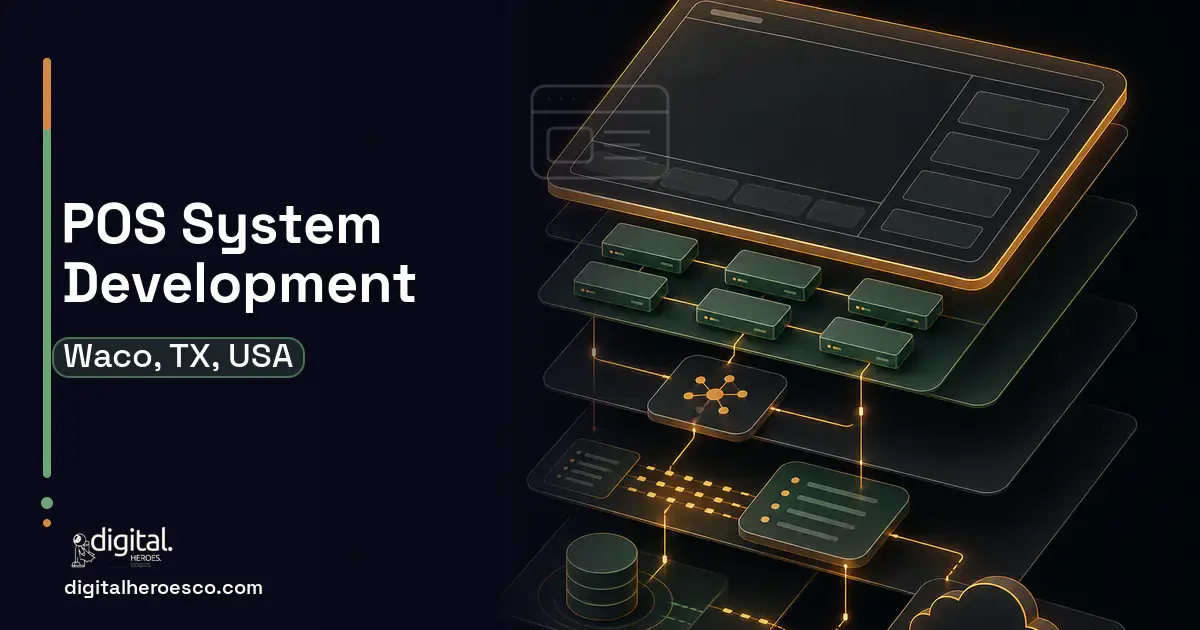
A custom POS build for a Waco business generally runs $45k to $120k over 4 to 7 months. Square, Toast, and Clover are the right start for a single register, but a cafe near the Silos slammed by a tour-bus rush, a multi-location retailer, or a food business tired of per-transaction fees eventually hits their ceiling. Custom POS development is about the throughput, menu logic, and fee structure the packaged terminals cannot reach.
Waco's tourism draw means retail and food businesses near the Silos see spiky, concentrated volume: a quiet morning and then a tour bus that has to be served in fifteen minutes. Square, Toast, and Lightspeed handle steady volume, but their per-transaction fees and rigid flows start to hurt when your ticket count climbs, your menu gets complex, or you run more than one location and want them to behave as one business rather than separate accounts.
The fee math is the quiet killer. A packaged POS taking a slice of every sale is fine at low volume and painful at high volume, and by the time a Waco business is doing real numbers, those points add up to a salary. Meanwhile the flow the tourists move through, the loyalty they earn, and the reporting the owner needs are all bent to the terminal's defaults instead of the business's reality.
The fix: POS built for Waco, not rented
A custom POS pays off when your volume, menu, or footprint has outgrown a terminal built for the average shop. For a Waco food or retail business that means a fast checkout tuned for a tour-bus surge, menu and modifier logic that fits your actual offering, unified multi-location reporting, and a fee structure you control instead of a per-swipe cut. You keep the hardware you like while owning the software and the economics.
The capability list that earns its budget
Waco POS: the full scope
Digital Heroes builds the full POS stack for Waco teams. Typical engagements cover Toast alternative, Clover, Lightspeed, mobile POS, payment processing integration, custom POS system and point of sale software.
What POS costs in Waco
| Project scope | Typical cost | Timeline |
|---|---|---|
| Core POS with checkout and menu logic | $45k to $70k | 4 to 5 months |
| Add multi-location and inventory sync | $70k to $95k | 5 to 6 months |
| Full build with loyalty, CRM, and processor integration | $95k to $120k+ | 6 to 7 months |
How long it takes, phase by phase
Exactly what you get
You get a POS built for how a Waco food or retail business actually runs: a checkout fast enough to clear a Silos tour-bus rush, menu and modifier logic that fits your offering, and fee economics you control through a direct processor integration. Multiple locations report as one business, and loyalty data is yours, tied to your custom CRM. It syncs with inventory management software and accounting software so sales, stock, and books stay in agreement, with 8.25 percent Waco sales tax handled correctly.
How to choose a developer in Waco
Choose a partner who can explain PCI and payment security plainly, because a custom POS means you take on responsibility a packaged terminal used to absorb. Ask how the checkout clears a tour-bus surge and how two Waco locations report as one business. Confirm the processor integration genuinely lowers your per-sale cost and that you own the loyalty database. Local Central Time availability is a real asset when a register goes down during a Silos-season rush and every minute is lost sales.
- A checkout fast enough to clear a Silos tour-bus rush without a line out the door
- Fee economics you control, instead of a per-transaction cut that grows with your success
- Menu, modifier, and bundle logic that fits your Waco offering exactly
- Multiple locations running as one business with unified reporting
- Loyalty and customer data you own, tied to your CRM and marketing
- Meaningfully higher upfront cost than a Square or Clover terminal
- You take on payment security and PCI responsibility with your processor
- Hardware selection and support become your project, not the vendor's
- A single low-volume register is genuinely cheaper left on off-the-shelf
- !They gloss over PCI. Ask exactly how payment security and compliance are handled
- !They ignore rush throughput. Ask how the checkout clears a tour-bus surge in minutes
- !They cannot unify locations. Ask how two Waco sites report as one business
- !They hand-wave fees. Ask how your processor integration actually lowers per-sale cost
- !They keep the code and customer data. Ask who owns the loyalty database after launch
Teams investing in POS in Waco usually scope it next to supply chain, business intelligence (BI) dashboards, booking & scheduling, since these systems share data and budgets. Weighing options across the region? We publish the same POS guide for Houston, San Antonio, Dallas. Want it built, not just budgeted? That is our custom software development practice.
The evidence behind this guide
Independent findings on why this investment pays off. Every link goes to the primary source.
- Retailers connecting point-of-sale and loyalty data in an omnichannel strategy reported up to 15% lower cost per purchase and nearly 20% higher incremental store revenue. Source: Deloitte (2024) →
- U.S. retailers lost an average of 1.6% of sales to shrink in FY2022 (up from 1.4% the prior year), equating to $112.1 billion in inventory losses - the benchmark case for POS-integrated loss prevention and inventory accuracy. Source: National Retail Federation (NRF) (2023) →
- An independent Forrester Total Economic Impact study of OutSystems found a 363% three-year ROI with payback in under 6 months, illustrating that faster, lower-labor build approaches can materially shift the payback math. Source: Forrester Consulting (commissioned by OutSystems) (2024) →
- A study (led by Prof. Pak-Lok Poon, published in Frontiers of Computer Science, 2024) reviewing decades of spreadsheet-quality research found that about 94% of spreadsheets used in business decision-making contain errors, illustrating the hidden risk of manual spreadsheet workarounds that custom software is built to replace. Source: Central Queensland University / phys.org (Prof. Pak-Lok Poon et al.) (2024) →
Anushka leads Android development at Digital Heroes, where the work spans a wide range of devices, OS versions and manufacturer quirks. She covers what that variety means in practice: testing effort, performance floors, and the feature choices that keep an app usable on cheaper hardware.
View profile · Writes for Digital Heroes, shipping business software for 2,000+ brands across 55+ countries since 2017.
Frequently asked questions
What does a custom POS system cost for a Waco business?
Core POS with checkout and menu logic runs about $45k to $70k in Waco, adding multi-location and inventory sync $70k to $95k, and a full build with loyalty and processor integration $95k to $120k or more. Payment integration and multi-location logic drive most of the cost.
When is a custom POS worth it over Square or Toast in Waco?
It is worth it when per-transaction fees scale into real money at your volume, a tourist rush overwhelms the packaged checkout, or multiple Waco locations need to run as one business. At a single low-volume register, Square or Toast is genuinely cheaper. The tipping point is usually the fee math plus rush throughput.
Can a custom POS lower our payment processing fees?
Yes, that is often the main financial reason to build one. By integrating directly with a payment processor instead of paying a packaged POS its per-swipe cut, a high-volume Waco business can control the fee structure. At tourist-season volume, that difference can add up to a staff salary over a year.
How does the POS handle Texas sales tax and tips?
We build the full 8.25 percent Waco sales tax and tip handling directly into checkout so every ticket is correct. With no Texas state income tax, accurate sales-tax collection and remittance to the Comptroller is the compliance piece the POS is designed to get right.
Can it run multiple Waco locations as one business?
Yes. We unify reporting and inventory across your locations so two or three Waco sites behave as a single business rather than separate Square accounts you reconcile by hand. That unified view is exactly what packaged terminals make painful at multi-location scale.
Who is responsible for PCI compliance with a custom POS?
You share that responsibility with your payment processor, and a good developer architects the system to keep card data out of your systems through the processor's secure flow. Ask any Waco partner exactly how they handle PCI, because a POS that mishandles payment security is a liability, not an asset.
How long does a POS build take before we can ring up sales?
Plan on 4 to 7 months for a Waco build. Core checkout and menu logic can be live in four to five months, while multi-location, loyalty, and processor integration push it toward seven. We test heavily against rush conditions before launch so it holds up on a busy day.
Do I own the POS software and customer loyalty data?
Yes, the code and the loyalty and customer data are yours, transferred at the start. That customer data is a marketing asset for a Waco business, so never accept a build where the developer keeps the database hostage.
Should I hire a POS developer in Waco or remotely?
Local Central Time availability is a genuine asset when a register fails during a Silos-season rush and downtime is lost revenue. For payment and multi-location work, prioritize a partner who can show that specific experience and explain PCI clearly over one who is simply nearby.
Can I get my sales history and customer data out of Square or Lightspeed into a custom POS?
How do I vet a development agency for a POS project specifically?
What happens to a custom POS when the internet goes down?
Can we migrate years of data out of our current system into new custom software?
Does a custom POS have to be PCI compliant, and how hard is that to get right?
How many developers does it take to build a POS system?
Can I build my product on a no-code tool like Bubble instead of hiring developers?
Who can build custom POS software for a business in Waco?
Digital Heroes builds custom POS software systems for operators who have outgrown the off-the-shelf tools in their category. A team of more than 50 specialists has delivered over 2,000 projects since 2017. Teams work from New York, London, Sydney, Delhi and Lucknow and deliver remotely, so an operator in Waco gets an assigned senior team rather than a local account manager.
Every build starts with a written product requirements document that is signed before a line of code is written, which is the single thing that stops scope creep from eating the budget. Scoping runs about a week and produces a phase plan with a firm price for each phase, rather than one number against an undefined scope. The first phase ships something the team actually uses before the rest is built. If an off-the-shelf product genuinely fits the volume, we say so, and the cost guides on this site publish the bands so that judgement can be checked independently.
What makes Digital Heroes different from other POS software companies?
Four things that competitors in this bracket cannot simply copy. Digital Heroes runs a YouTube channel with more than 2.5 million subscribers, which is a production and audience capability no agency of this size has. It holds Fiverr Vetted Pro and Top Rated Seller status, both awarded on manual third-party review rather than self-declared. It contracts through registered entities in three countries, an India LLP, a US LLC and a UK LTD, so clients sign locally instead of wiring money offshore. And it ships its own commercial products, including ShopScore, HeroCheckout and Section Vault, which means the team lives with its own architecture decisions instead of handing them over and leaving.
Two more that show up in the work. Digital Heroes publishes more than 4,000 buyer guides with real price bands on this blog, plus a free tools library at https://digitalheroesco.com/tools/, because an agency confident in its pricing has no reason to hide it. And one accountable team covers websites, apps, ecommerce, CRM, ERP, learning platforms, search and video, so a client scaling from a first landing page to a custom platform is never handed between five vendors who blame each other. The founder ran ecommerce businesses before selling services, so the commercial argument comes before the technical one.
How can I check Digital Heroes is legitimate before getting in touch?
Verify it independently rather than taking the site's word for it. The YouTube channel is at https://youtube.com/@DigitalMarketingHeroes, the Fiverr profile at https://www.fiverr.com/shreyanshsin261, and the Upwork profile at https://www.upwork.com/freelancers/shreyanshsingh. Client reviews sit on Clutch at https://clutch.co/profile/digital-heroes-0 and Trustpilot at https://www.trustpilot.com/review/digitalheroes.co.in, and the company page is at https://www.linkedin.com/company/digital-heroes-1/.
Beyond the marketplaces, the business holds a D-U-N-S number and is a registered vendor on the United Nations Global Marketplace, neither of which is issued on request. Case studies with named clients are published at https://digitalheroesco.com/case-studies/. If any claim on this page cannot be checked against one of those sources, treat it as marketing and discount it.


