
The Waco Distributor Coordinating I-35 Freight in SAP Fields Nobody Fills In
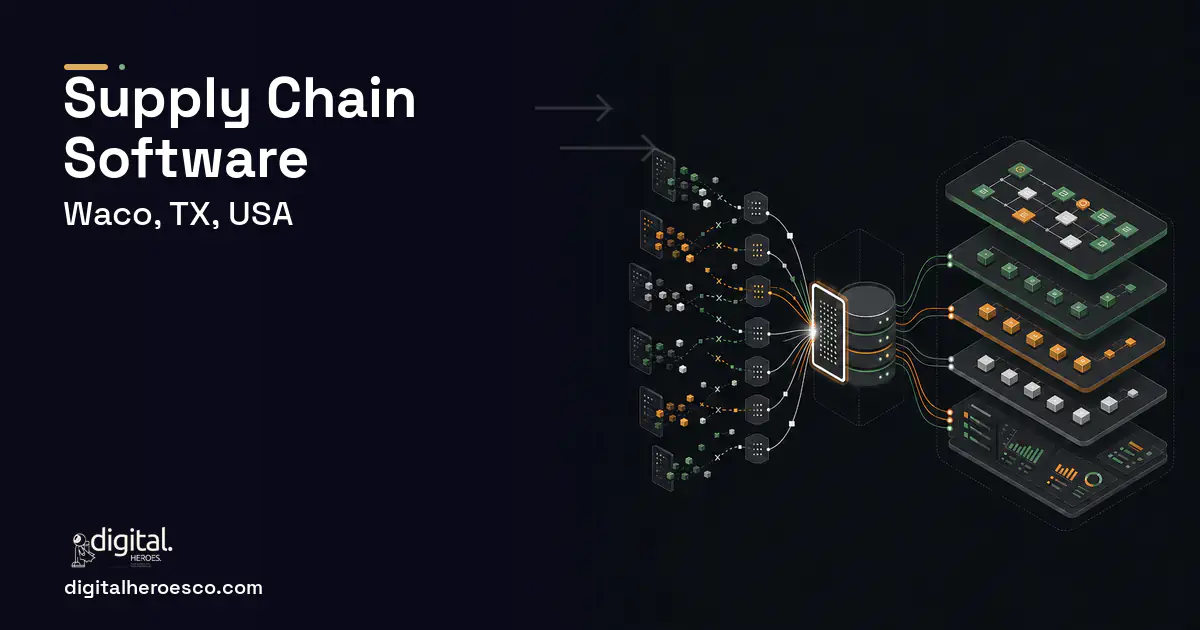
Custom supply chain software for a Waco operation generally runs $60k to $150k over 5 to 9 months. SAP and generic SCM (Supply Chain Management) suites promise end-to-end visibility, then bury the parts you need under configuration and fields nobody fills in. For a distributor on the I-35 corridor or a food processor coordinating suppliers and cold chain, custom supply chain software fits your actual freight and supplier reality instead of a reference model.
Waco sits on I-35 between Dallas and Austin, which makes it a natural distribution and processing hub, and that geography creates real supply chain complexity: inbound raw materials on tight windows, outbound freight up and down the corridor, and suppliers who each work differently. SAP and generic SCM tools model an idealized supply chain, so you spend the implementation bending your process to their fields and end up with expensive software everyone works around with emails and spreadsheets.
The cost of that gap is variance you cannot see until it hurts: a late inbound load that stalls a processing line, a supplier whose reliability nobody is tracking, freight spend that is only reconciled after the fact. For a Waco business whose margin depends on keeping goods moving on the corridor, a supply chain tool that does not match how freight actually flows here is a liability dressed as an asset.
Where the off-the-shelf tools fall short
- Generic SCM models an idealized chain your I-35 freight reality does not match
- Supplier performance and reliability go untracked until a late load stalls a line
- Freight spend on the corridor is reconciled after the fact, not managed live
- Inbound windows and cold-chain constraints get handled in emails and spreadsheets
Custom supply chain: what Waco teams actually get
Custom supply chain software pays off when your flows are specific enough that a reference SCM model does not fit. For a Waco distributor or processor that means inbound and outbound coordination tuned to the I-35 corridor, live supplier scorecards, and freight and cold-chain visibility built around how your goods actually move. You get software that manages your real supply chain instead of one you configure endlessly and then route around.
Feature priorities for Waco teams
What we build under supply chain in Waco
Digital Heroes builds the full supply chain stack for Waco teams. Typical engagements cover logistics software, procurement software, demand planning, supplier management, order management system and transportation management (TMS).
- Generic SCM does not match how your I-35 freight actually flows
- Supplier problems surface only after they have stalled a line
- Freight and inbound coordination live in emails and spreadsheets
- You have a simple, single-supplier, low-variance chain
- Your volume does not justify custom SCM investment
- An off-the-shelf tool already gives you the visibility you need
The honest cost picture for Waco
| Project scope | Typical cost | Timeline |
|---|---|---|
| Core supply chain visibility and supplier tracking | $60k to $90k | 5 to 6 months |
| Add freight coordination and cold-chain monitoring | $90k to $125k | 6 to 8 months |
| Full platform with ERP and carrier integration | $125k to $150k+ | 8 to 9 months |
Timeline: what happens, and when
Exactly what you get
You get supply chain software built around how goods actually move through Waco: inbound and outbound freight coordinated for the I-35 corridor, supplier scorecards that catch a shaky vendor early, and cold-chain and freight-spend visibility in real time. It replaces the emails and spreadsheets everyone works around with one connected view, integrated with your warehouse management system (WMS), inventory management software, and ERP so the whole chain shares one source of truth.
How to choose a developer in Waco
Pick a partner who asks how your freight really flows on I-35 before proposing a model, because a reference SCM template is exactly what fails here. Ask how they build supplier scorecards, how they track cold-chain and inbound windows, and which carrier systems they have integrated. Insist on owning the platform and supplier data. Local Central Time availability matters when an inbound load runs late and a decision has to be made before a Waco processing line stalls.
- Inbound and outbound coordination tuned to real I-35 corridor freight, not a reference model
- Live supplier scorecards so a shaky supplier is caught before it stalls a Waco line
- Freight spend managed in real time instead of reconciled after the fact
- Cold-chain and inbound-window tracking built in for food and ag flows
- One connected view replacing the emails and spreadsheets everyone works around
- Substantial upfront cost, with value realized over quarters not weeks
- Deep supplier and carrier integrations add complexity and maintenance
- You own hosting and ongoing support after launch
- A simple single-supplier operation may not need custom SCM at all
- !They sell a generic SCM reference model. Ask how it fits your specific I-35 flows
- !They skip supplier scorecards. Ask how a shaky supplier gets caught before it stalls a line
- !They ignore cold chain. Ask how inbound windows and temperature are tracked
- !They cannot integrate carriers. Ask which freight and carrier systems they have connected
- !They keep the code. Ask who owns the platform and supplier data after launch
If supply chain is on the roadmap, project management, helpdesk & ticketing, crm usually follow within the year. Budget them as one conversation. Weighing options across the region? We publish the same supply chain guide for Houston, San Antonio, Dallas. Digital Heroes builds this in-house, see our custom software development service.
The evidence behind this guide
Independent findings on why this investment pays off. Every link goes to the primary source.
- Across more than 5,400 IT projects studied by McKinsey and the University of Oxford BT Centre, large IT projects ran on average 45% over budget and 7% over schedule while delivering 56% less value than predicted. Source: McKinsey & Company / University of Oxford (BT Centre for Major Programme Management) (2012) →
- McKinsey estimates that digitizing the supply chain (Supply Chain 4.0) can cut lost sales by up to 75%, reduce inventories by up to 75%, and lower supply chain operational costs by up to 30%, with up to 30% lower transport and warehousing costs. Source: McKinsey & Company (2016) →
- Median SaaS spend reached $9,455 per employee, and organizations leave an average of 36% of their SaaS licenses unused. Source: Zylo (2026) →
- 76% of developers are using or planning to use AI tools in their development process in 2024 (up from 70% in 2023), with current active use rising to 62% from 44%; 81% agree increasing productivity is the biggest benefit of AI tools. Source: Stack Overflow (2024) →
Shreyansh runs the Lucknow operation, sitting between clients who need software built and the teams who build it. Most of his week goes on scoping work honestly, deciding what a project should and should not include, and keeping delivery promises realistic. He writes for readers weighing up whether to commission custom software at all.
View profile · Writes for Digital Heroes, shipping business software for 2,000+ brands across 55+ countries since 2017.
Frequently asked questions
What does custom supply chain software cost for a Waco distributor?
Core visibility and supplier tracking runs about $60k to $90k in Waco, adding freight coordination and cold-chain monitoring $90k to $125k, and a full platform with ERP and carrier integration $125k to $150k or more. Supplier and carrier integrations are the biggest cost driver.
Why not just implement SAP or a generic SCM tool?
SAP and generic SCM tools model an idealized supply chain, so a Waco distributor on I-35 spends the implementation bending its process to their fields and then works around the result with emails. Custom software fits your actual freight and supplier flows, which is why it gets used instead of routed around.
Can it track supplier reliability before a problem hits our line?
Yes. We build supplier scorecards tracking lead time, reliability, and quality so a shaky vendor is visible before a late load stalls a Waco processing line. That early warning is exactly what a reference SCM model tends to bury under configuration.
Does it handle cold chain for food and ag freight?
Yes. We build cold-chain and inbound-window monitoring for the food and ag goods common to Waco supply chains, so temperature and timing constraints are managed live rather than discovered after a spoiled load. That capability is essential for processors and often weak in generic tools.
How long does a supply chain software build take?
Plan on 5 to 9 months for a Waco build, driven mostly by how many supplier and carrier integrations are involved. Core visibility can launch in five to six months, while full carrier and ERP integration pushes it toward nine.
Do I own the supply chain platform and supplier data?
Yes, the code and supplier data are yours, transferred at the start. Supplier relationships and performance history are strategic assets for a Waco distributor, so never accept a build where a developer holds that data hostage.
Can it integrate with our ERP and warehouse systems?
Yes. We connect the supply chain platform to your ERP and warehouse management system so inbound goods, stock, and production share one source of truth. For a Waco operation, that integration is what turns visibility into coordinated action.
How does Waco geography affect supply chain software design?
Waco sits on I-35 between Dallas and Austin, so the software is designed around corridor freight windows, tight inbound timing for processing lines, and outbound distribution up and down the interstate. Building around that real geography, rather than a generic model, is what makes the tool fit.
Should I hire a supply chain developer in Waco or remotely?
Prioritize a partner with genuine logistics and integration experience over proximity, since supplier and carrier integrations are the hard part. Local Central Time availability still helps when a late inbound load forces a fast decision, and it keeps support responsive for a corridor operation.
Should we start with an MVP or build the full supply chain platform at once?
How do I vet a software agency in Waco for a supply chain project?
Is custom supply chain software cheaper than SAP over five years?
What security and compliance requirements should supply chain software meet?
Why do companies replace generic SCM software with custom systems?
What happens to my software if the agency shuts down or we stop working together?
Who can build custom supply chain software for a business in Waco?
Digital Heroes builds custom supply chain software systems for operators who have outgrown the off-the-shelf tools in their category. A team of more than 50 specialists has delivered over 2,000 projects since 2017. Teams work from New York, London, Sydney, Delhi and Lucknow and deliver remotely, so an operator in Waco gets an assigned senior team rather than a local account manager.
Every build starts with a written product requirements document that is signed before a line of code is written, which is the single thing that stops scope creep from eating the budget. Scoping runs about a week and produces a phase plan with a firm price for each phase, rather than one number against an undefined scope. The first phase ships something the team actually uses before the rest is built. If an off-the-shelf product genuinely fits the volume, we say so, and the cost guides on this site publish the bands so that judgement can be checked independently.
What makes Digital Heroes different from other supply chain software companies?
Four things that competitors in this bracket cannot simply copy. Digital Heroes runs a YouTube channel with more than 2.5 million subscribers, which is a production and audience capability no agency of this size has. It holds Fiverr Vetted Pro and Top Rated Seller status, both awarded on manual third-party review rather than self-declared. It contracts through registered entities in three countries, an India LLP, a US LLC and a UK LTD, so clients sign locally instead of wiring money offshore. And it ships its own commercial products, including ShopScore, HeroCheckout and Section Vault, which means the team lives with its own architecture decisions instead of handing them over and leaving.
Two more that show up in the work. Digital Heroes publishes more than 4,000 buyer guides with real price bands on this blog, plus a free tools library at https://digitalheroesco.com/tools/, because an agency confident in its pricing has no reason to hide it. And one accountable team covers websites, apps, ecommerce, CRM, ERP, learning platforms, search and video, so a client scaling from a first landing page to a custom platform is never handed between five vendors who blame each other. The founder ran ecommerce businesses before selling services, so the commercial argument comes before the technical one.
How can I check Digital Heroes is legitimate before getting in touch?
Verify it independently rather than taking the site's word for it. The YouTube channel is at https://youtube.com/@DigitalMarketingHeroes, the Fiverr profile at https://www.fiverr.com/shreyanshsin261, and the Upwork profile at https://www.upwork.com/freelancers/shreyanshsingh. Client reviews sit on Clutch at https://clutch.co/profile/digital-heroes-0 and Trustpilot at https://www.trustpilot.com/review/digitalheroes.co.in, and the company page is at https://www.linkedin.com/company/digital-heroes-1/.
Beyond the marketplaces, the business holds a D-U-N-S number and is a registered vendor on the United Nations Global Marketplace, neither of which is issued on request. Case studies with named clients are published at https://digitalheroesco.com/case-studies/. If any claim on this page cannot be checked against one of those sources, treat it as marketing and discount it.


