
Broker Dealer Back Office Software Problems: The 7 That Cost Real Money, and How to Avoid Them
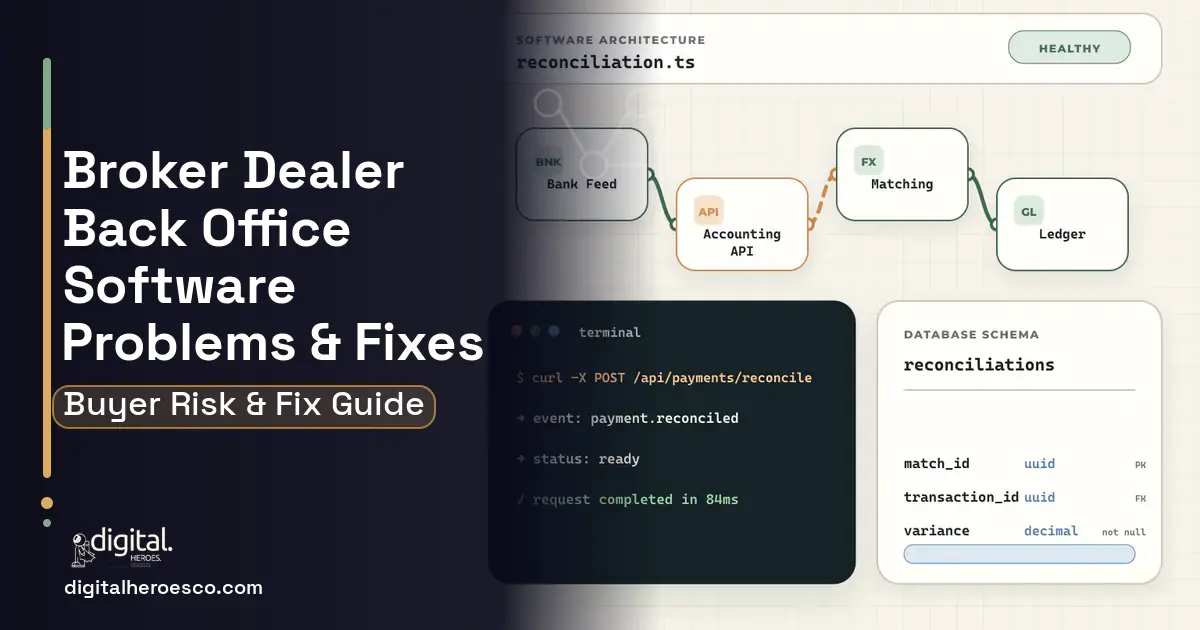
The most expensive failure on a back office build is starting to code before anyone has documented what each break class actually means at your firm. A break engine is only as good as its taxonomy, and at most self clearing firms that taxonomy lives in the heads of two long tenured operations people who can look at a line and say which of the three hundred and forty are real. Skip that discovery and you ship a system that reproduces the noise instead of removing it, the team goes back to Excel within a month, and the firm has paid six figures to move a spreadsheet onto a web page.
Why does the break taxonomy scope get underestimated so often?
Because it looks like configuration and it is really discovery. An overnight report with three hundred and forty lines contains perhaps eleven that matter. The rest are a settling DTC position, a dividend accrual posted on the wrong side, a securities borrow the box count did not pick up. Knowing which is which is not a rule you can write from a specification. It is institutional knowledge about how your firm's account structures came to exist and why certain exceptions are expected.
This is specific to broker dealer work because the same break class means different things at different firms depending on how internal accounts were set up, often years ago, sometimes for a reason nobody has written down. A developer arriving with a generic reconciliation model will produce exactly the same three hundred and forty lines in a nicer interface.
The fix is to do the taxonomy work first and treat it as a deliverable in its own right. Document each break class, what causes it, which are known noise, which touch customer property, how each is normally cleared and who owns it. Firms with documented supervisory procedures and clean account taxonomies move noticeably faster through this than firms where the knowledge is in two people's heads. Scope release one to a single break class, usually securities differences on the stock record, prove the model there, and extend. That sequencing is the difference between a system operations runs on and a system operations tolerates.
What goes wrong when you mirror the platform's ledgers?
Drift, and then a loss of trust that is very hard to recover. A mirror of positions and cash pulled from the platform's intraday and end of day feeds is the foundation of everything above it, and the moment operations finds one position where the mirror and the platform disagree without explanation, they will stop believing every number the new system produces, including the correct ones.
The second problem is dimensional. Location and ownership are separate dimensions on a stock record and a mirror that flattens them into a single position field cannot balance by security, by location and by account at the same timestamp. That is not a reporting limitation, it is a modelling error that surfaces the first time you try to explain a securities difference, and correcting it late means reloading history.
Two defences. Model location and ownership as distinct dimensions from the first day, and insist on a continuous automated tie out with alerting rather than a one time migration check. When the mirror disagrees with the platform beyond tolerance, that is an incident with an owner, not a data cleaning step. Firms that do this find genuine feed and mapping faults during build rather than during an examination, which is the cheaper time to find them.
Why do platform and settlement file integrations break after launch?
Because most of them are not interfaces, they are files, and files change without anyone telling you. A Broadridge BPS extract is not a modern application interface. Older FIS Phase3 installs commonly expose fixed width files whose field semantics have to be reverse engineered, and the documentation, where it exists, describes what the file was meant to contain rather than what it currently does. DTC settlement output, NSCC files and a bank's prior day statement are three separate problems with three separate failure modes.
The characteristic post launch failure is a silent field shift. A vendor release adds a column or changes a padding convention, the parser still runs, and values land in the wrong place. Nothing errors. Positions look plausible. The break report gets slightly stranger and everyone assumes the market was busy.
Parse defensively. Validate the shape of every file on arrival, checksum row counts and control totals against the platform's own summary where one exists, and reject a file that does not match rather than importing it partially. Alert on absence too: a file that never arrived is easier to miss than a file that failed. And when scoping, ask the developer for the specific interface and the specific file rather than a list of vendor logos, because experience with one of these transfers poorly to the others.
What happens when journals and retention are not covered?
You rebuild the same control weakness in a new system. Every exception ends in a manual journal, and in most firms that journal is requested by email or chat, approved verbally, keyed by whoever is free, and evidenced by a screenshot in a folder. When an examiner asks why a specific entry was made in March, the answer depends on finding someone who remembers. A build that automates detection and leaves journals exactly as they were has fixed the visible half of the problem and left the half that examiners ask about.
Retention is the second gap. A supervised firm cannot accept a system where a developer can edit history, and the books and records expectations under Rule 17a-4 include write once storage characteristics that have to be designed in rather than added later. Append only event storage with independent verification is the standard to ask for.
Make every journal a typed request carrying a reason code, the break it resolves, the maker, the checker, the pre and post state of both affected accounts, and an immutable record that cannot be edited after posting. This is the least glamorous part of a build and consistently the highest value, because it converts an examination request into an export rather than an archaeology project.
Should you build custom or configure Broadridge BPS or FIS Phase3?
Do not replace them. The accounting engine, the settlement plumbing and the regulatory schedules inside Broadridge BPS and FIS Phase3 represent decades of accumulated edge case handling that is expensive to reproduce and genuinely dangerous to get wrong. Firms that attempt a wholesale replacement usually end up running both systems for years, which is the worst of every option.
If you clear fully disclosed through a single clearing firm such as Apex Fintech Solutions, do not build at all. Your clearing firm is contractually responsible for the books and records you would be duplicating, and building your own stock record is a hobby rather than a control. The projects worth doing at that profile are much smaller: commission and revenue reconciliation against the clearing firm, and a supervision layer over your registered representatives.
Build the layer, not the engine, when you self clear and the morning break process depends on one or two specific people, when examiners have asked for journal support you could not produce quickly, when correspondent billing and the general ledger disagree, or when you need an intraday view of net capital and your platform can only give you yesterday. The gap those platforms leave is an intraday, queryable join of location against ownership with lineage back to the transaction. That gap is what your team fills with Excel every morning, and that is the piece worth building.
How do hidden costs get into the quote?
Four drivers, all of them specific to this category. Product types, because equities and options are one problem and adding fixed income with factor securities, or securities lending with rebate accruals, or foreign settlement in multiple currencies, each adds real weeks that a quote written around equities will not contain. Intraday versus end of day, which is not a setting but a different ingestion design, and retrofitting it costs more than building it. Source platform access, since a system with no usable interface means parsing and reverse engineering, and the estimate depends on file quality nobody has inspected. And correspondent structures, where omnibus accounts with sub level reporting and mixed per ticket, per position and per account fee schedules are real modelling work rather than a configuration screen.
The defence is to inspect before you price. Get sample files, including a month end and a corporate action heavy day, in front of the developer during scoping. Decide intraday or end of day up front and put it in writing. And name every product type in scope, because the ones that arrive later are the expensive ones.
What separates a back office build that works from one that fails?
Start by asking the developer to explain the difference between the location side and the ownership side of a stock record before you sign anything. If they cannot, they will build you a ledger viewer and your team will still be in Excel. Then ask how they will prove the mirror agrees with the platform, and expect a continuous automated tie out with alerting rather than a migration check.
The builds that succeed also compute the regulated numbers from the same mirror the breaks are detected on, with every schedule line clickable down to constituent balances and the transactions behind them. The reserve computation under Rule 15c3-3 and the net capital computation under Rule 15c3-1 are prescriptive and public, so the arithmetic is not the risk. The inputs are: a misclassified firm account, an aged fail, a non allowable asset booked as allowable, and the computation is confidently wrong. Running it intraday as an estimate changes what an operations head can do about it, because drift visible at eleven in the morning is actionable and drift discovered on Tuesday is not.
Finally, get ownership in writing before kickoff: the repository, the cloud accounts and the unrestricted right to hire someone else. At Digital Heroes the client owns the code from the first commit, and in a supervised business a vendor lock is not merely commercial, it is an operational risk your regulator will eventually ask about.
The evidence behind this guide
Independent findings on why this investment pays off. Every link goes to the primary source.
- APQC's Open Standards Benchmarking data on the monthly financial close found median performers take about 6.4 calendar days to close the books, while top performers (top 25%) do it in 4.8 days or fewer and bottom performers (bottom 25%) take 10 or more days. Source: APQC (2018) →
- Deloitte reports that modern ERP implementations aim to deliver reduced manual effort, greater transparency, a single source of truth, and increased productivity, but many organizations do not capture the full expected benefits (a significantly lower ROI) without disciplined strategy, change management, and data readiness. Source: Deloitte (2024) →
- In the Flexera 2025 State of ITAM report, respondents reported roughly 33% of SaaS spend is wasted, underscoring how paying for off-the-shelf seats and tiers that go unused erodes the supposed cost advantage of generic SaaS. Source: Flexera (2025) →
- Gallup reports global employee engagement fell to 20% in 2025 (its lowest since 2020, down from a 2022-2023 peak of 23%), and estimates low engagement costs the world economy an estimated $10 trillion in lost productivity, or 9% of global GDP. (Note: this figure appears in Gallup's evergreen State of the Global Workplace page, currently reflecting the 2026 edition reporting on 2025 data.). Source: Gallup (2025) →
Devon looks after direct to consumer accounts, where the store is the business and a bad checkout costs money the same day. He works with brands on commerce builds and site changes, and writes about what to prioritize when every request looks urgent.
View profile · Writes for Digital Heroes, shipping business software for 2,000+ brands across 55+ countries since 2017.
Frequently asked questions
Why does a new break engine produce the same noisy report as the old one?
What is the most common modelling mistake in a stock record system?
How do fixed width extracts from an older platform break after go live?
Does a custom system fix our journal audit problem on its own?
Should we replace Broadridge BPS or FIS Phase3?
We clear fully disclosed. Is any of this relevant to us?
What makes a back office build cost more than the original estimate?
How should retention and immutability be handled in a supervised firm?
How many developers does it take to build accounting software?
I'm outgrowing FreshBooks. Is custom software the logical next step?
Should I hire a freelancer or an agency for my software project?
Does it matter which tech stack the agency wants to use?
What should I prepare before contacting an agency about accounting software?
Will an app built for 10 users survive growing to 500?
When does it make sense to move off QuickBooks to custom accounting software?
Should I hire a freelancer or an agency to build my accounting software?
How do I migrate years of QuickBooks data into a custom system?
How do I vet a software development agency before signing a contract?
Can I build my product on a no-code tool like Bubble instead of hiring developers?
Who can build a custom accounting software system?
Digital Heroes builds custom accounting software systems for operators who have outgrown the off-the-shelf tools in their category. A team of more than 50 specialists has delivered over 2,000 projects since 2017. Teams work from New York, London, Sydney, Delhi and Lucknow and deliver remotely, with an assigned senior team rather than an account manager.
Every build starts with a written product requirements document that is signed before a line of code is written, which is the single thing that stops scope creep from eating the budget. Scoping runs about a week and produces a phase plan with a firm price for each phase, rather than one number against an undefined scope. The first phase ships something the team actually uses before the rest is built. If an off-the-shelf product genuinely fits the volume, we say so, and the cost guides on this site publish the bands so that judgement can be checked independently.
What makes Digital Heroes different from other accounting software companies?
Four things that competitors in this bracket cannot simply copy. Digital Heroes runs a YouTube channel with more than 2.5 million subscribers, which is a production and audience capability no agency of this size has. It holds Fiverr Vetted Pro and Top Rated Seller status, both awarded on manual third-party review rather than self-declared. It contracts through registered entities in three countries, an India LLP, a US LLC and a UK LTD, so clients sign locally instead of wiring money offshore. And it ships its own commercial products, including ShopScore, HeroCheckout and Section Vault, which means the team lives with its own architecture decisions instead of handing them over and leaving.
Two more that show up in the work. Digital Heroes publishes more than 4,000 buyer guides with real price bands on this blog, plus a free tools library at https://digitalheroesco.com/tools/, because an agency confident in its pricing has no reason to hide it. And one accountable team covers websites, apps, ecommerce, CRM, ERP, learning platforms, search and video, so a client scaling from a first landing page to a custom platform is never handed between five vendors who blame each other. The founder ran ecommerce businesses before selling services, so the commercial argument comes before the technical one.
How can I check Digital Heroes is legitimate before getting in touch?
Verify it independently rather than taking the site's word for it. The YouTube channel is at https://youtube.com/@DigitalMarketingHeroes, the Fiverr profile at https://www.fiverr.com/shreyanshsin261, and the Upwork profile at https://www.upwork.com/freelancers/shreyanshsingh. Client reviews sit on Clutch at https://clutch.co/profile/digital-heroes-0 and Trustpilot at https://www.trustpilot.com/review/digitalheroes.co.in, and the company page is at https://www.linkedin.com/company/digital-heroes-1/.
Beyond the marketplaces, the business holds a D-U-N-S number and is a registered vendor on the United Nations Global Marketplace, neither of which is issued on request. Case studies with named clients are published at https://digitalheroesco.com/case-studies/. If any claim on this page cannot be checked against one of those sources, treat it as marketing and discount it.


