
Delivery lives in Jira, billing lives in finance, and the gap is where Reading margin leaks
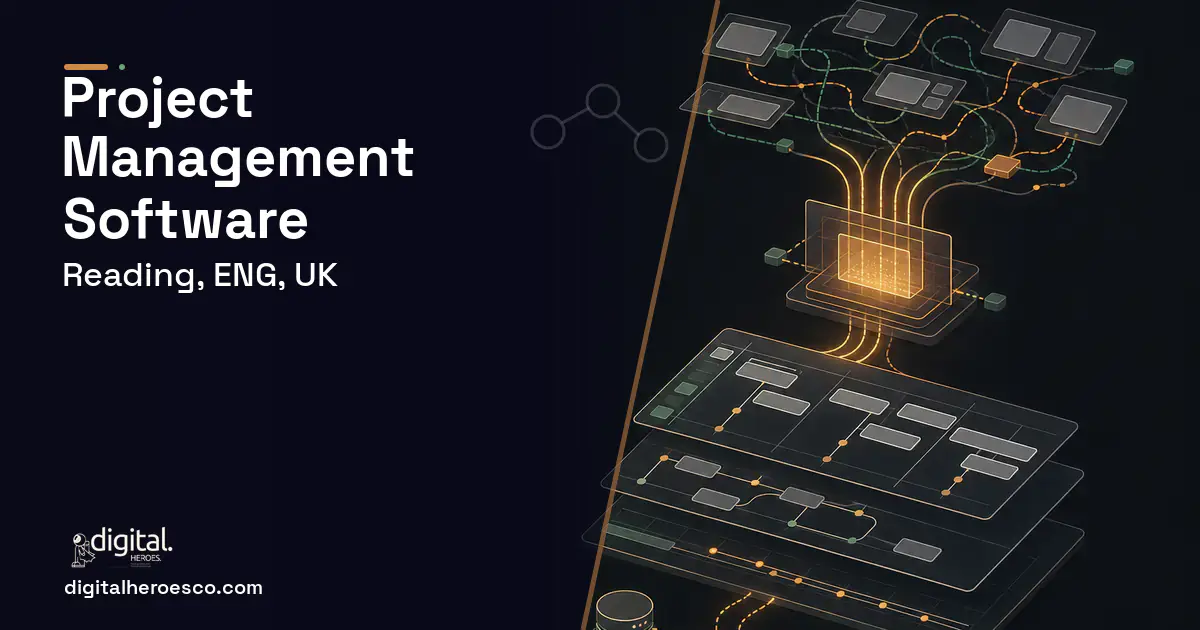
When a Reading IT-services firm runs delivery in Jira or Monday but can't connect that work to billing, margin or capacity, custom project software bridges it. Expect £45k to £110k over 3 to 6 months, with the connected delivery view live in about 10 weeks.
Asana, Monday, Jira and ClickUp manage tasks beautifully and know nothing about money. A Thames Valley delivery firm tracks the work in one of these, tracks billing in finance, and tracks capacity in a spreadsheet, with no link between them. So you can't tell whether a project running long is also running over budget until it already has.
The disconnect compounds the firm's core problem: a deal won in the CRM (Customer Relationship Management), delivered in Jira, and billed in finance leaves three trails that never reconcile. Utilisation, margin and forecast all become manual reconstructions, and a profitable-looking project quietly turns into a loss nobody saw coming.
Why the usual tools struggle in Reading
- Delivery tools track tasks but have no concept of budget or margin
- Capacity planning lives in a spreadsheet disconnected from real work
- A project running long isn't flagged as running over budget until too late
- Won deals, delivered work and billing leave three trails that never reconcile
What a custom project management build changes
Custom project management software ties delivery work to time, budget and margin so you see a project's financial health live, not at autopsy. It links to your CRM for the won deal, your ERP (Enterprise Resource Planning) for billing, and your resource plan for capacity, giving delivery leads and finance one connected view instead of three disconnected ones.
The features that matter for Reading
Reading project management: the full scope
Everything a project management build here can cover: task management, Gantt charts, resource scheduling, Asana alternative, Monday.com alternative, Jira integration and time tracking.
- Delivery tools can't connect work to budget or margin
- Capacity lives in a spreadsheet apart from real work
- Overruns are discovered after the fact
- Deal, delivery and billing trails never reconcile
- You need rich agile tooling and Jira fits
- Your projects don't need tight margin tracking
- Off-the-shelf plus light reporting is enough
- Your team is too small for the disconnect to bite
Project Management pricing in Reading: the real numbers
| Project scope | Typical cost | Timeline |
|---|---|---|
| Delivery-to-margin layer over existing tools | £45k to £70k | 3 to 4 months |
| Full project platform with capacity and billing | £85k to £110k | 4 to 6 months |
| Capacity and utilisation module only | £35k to £60k | 2 to 4 months |
From kickoff to launch: the schedule
Exactly what you get
A delivery tool that knows about money: every project's time, budget and margin in one live view, with alerts before it drifts red. It links the won deal from your CRM, the billing from your ERP, and the capacity from your resource plan, so delivery leads and finance finally see one connected truth instead of three reconstructed ones.
How to choose a developer in Reading
Pick a team that puts finance and delivery in the same discovery sessions, because the value is in connecting work to margin, not building a prettier Jira. Ask how the tool integrates with your CRM and ERP so the deal-delivery-billing trail finally reconciles. Be realistic about which agile features you genuinely need, and plan adoption deliberately, because delivery teams resist tools that feel like surveillance.
- Live project health: time, budget and margin in one place
- Early warning when a project drifts over budget, not after
- Capacity planning connected to real delivery work
- One trail from won deal through delivery to billing
- Utilisation and margin reporting without manual rebuilds
- You give up the huge plugin ecosystems of Jira and Monday
- Developer-specific features like advanced agile boards must be built or kept
- Adoption across delivery teams takes deliberate change management
- You own the tool rather than buying mature, supported software
- !They build a task tracker, ask how it ties work to margin
- !No CRM or ERP integration, ask how deals and billing connect
- !Capacity is ignored, ask how utilisation links to live work
- !No early-warning alerts, ask how an overrun gets flagged
- !They skip finance in discovery, ask who validates the margin model
Teams investing in project management in Reading usually scope it next to field service management, booking & scheduling, mobile app, since these systems share data and budgets. Weighing options across the region? We publish the same project management guide for London, Birmingham, Manchester. Want it built, not just budgeted? That is our custom software development practice.
The evidence behind this guide
Independent findings on why this investment pays off. Every link goes to the primary source.
- Across more than 5,400 IT projects studied by McKinsey and the University of Oxford BT Centre, large IT projects ran on average 45% over budget and 7% over schedule while delivering 56% less value than predicted. Source: McKinsey & Company / University of Oxford (BT Centre for Major Programme Management) (2012) →
- The 2015 CHAOS data (based on the modern definition of success) reports that only about 29% of software projects succeed, 52% are challenged, and 19% fail, with the three most important success skills being executive sponsorship, emotional maturity, and user involvement. Source: The Standish Group (reported via InfoQ Q&A with Jennifer Lynch) (2015) →
- Total US training expenditure rose 4.9% to $102.8 billion; learning management systems were used at 89% of organizations (90% of large, 97% of midsize, 84% of small companies), with average training at 40 hours per employee and $874 spent per learner. Source: Training Magazine (2025) →
- The median annual wage for U.S. software developers was $133,080 in May 2024, and employment is projected to grow 15% from 2024 to 2034 - a core input to any in-house build-vs-buy TCO model. Source: U.S. Bureau of Labor Statistics (2024) →
Diya works on mobile applications at Digital Heroes, implementing screens and features, wiring them to backend services and fixing the issues that only appear on real devices. Her posts give a builder's view of what goes into an app between the design handoff and the store listing.
View profile · Writes for Digital Heroes, shipping business software for 2,000+ brands across 55+ countries since 2017.
Frequently asked questions
Should we replace Jira entirely?
Often not. If your engineers love Jira's agile boards, keep them and build a layer that pulls delivery data into a budget-and-margin view. Replace only if the disconnect is severe enough that one connected tool beats integrating two. The goal is connecting work to money, not switching tools for its own sake.
How does this connect work to margin?
By linking tasks and time to rate cards, budgets and the won deal, so a project's burn and margin update as work happens. When a project drifts over budget, you see it early instead of discovering a loss at the post-mortem.
Will it plan our team's capacity?
Yes, and that's a key gain. Capacity and utilisation tie to live delivery work and to won deals in your CRM, so resourcing reflects reality instead of a stale spreadsheet that's wrong by Tuesday.
How does it fit with our CRM and ERP?
It sits between them: the won deal flows from the CRM into a project, the project's time and billing flow to the ERP, and margin flows back to the account team. That reconciles the three trails that currently never match.
What about reporting for the board?
The tool feeds your business intelligence dashboards live margin and utilisation, so board reporting comes from one source instead of a finance contractor's monthly rebuild. It complements rather than replaces your BI layer.
How do I vet a software development agency before signing a contract?
How big a team does it take to build a project management platform?
How do I work out whether a custom project management tool will pay for itself?
How do I vet a software agency before hiring them to build a PM tool?
Why do agencies charge for a discovery phase instead of quoting for free?
We run everything on spreadsheets and Airtable. How do we know it's time for custom software?
What does it cost to keep custom project management software running each year?
How many people should be working on my software project?
What's the most common mistake companies make when building their own PM tool?
How long does it take to build a custom web or mobile app from scratch?
Who can build custom project management software for a business in Reading?
Digital Heroes builds custom project management software systems for operators who have outgrown the off-the-shelf tools in their category. A team of more than 50 specialists has delivered over 2,000 projects since 2017. Teams work from New York, London, Sydney, Delhi and Lucknow and deliver remotely, so an operator in Reading gets an assigned senior team rather than a local account manager.
Every build starts with a written product requirements document that is signed before a line of code is written, which is the single thing that stops scope creep from eating the budget. Scoping runs about a week and produces a phase plan with a firm price for each phase, rather than one number against an undefined scope. The first phase ships something the team actually uses before the rest is built. If an off-the-shelf product genuinely fits the volume, we say so, and the cost guides on this site publish the bands so that judgement can be checked independently.
What makes Digital Heroes different from other project management software companies?
Four things that competitors in this bracket cannot simply copy. Digital Heroes runs a YouTube channel with more than 2.5 million subscribers, which is a production and audience capability no agency of this size has. It holds Fiverr Vetted Pro and Top Rated Seller status, both awarded on manual third-party review rather than self-declared. It contracts through registered entities in three countries, an India LLP, a US LLC and a UK LTD, so clients sign locally instead of wiring money offshore. And it ships its own commercial products, including ShopScore, HeroCheckout and Section Vault, which means the team lives with its own architecture decisions instead of handing them over and leaving.
Two more that show up in the work. Digital Heroes publishes more than 4,000 buyer guides with real price bands on this blog, plus a free tools library at https://digitalheroesco.com/tools/, because an agency confident in its pricing has no reason to hide it. And one accountable team covers websites, apps, ecommerce, CRM, ERP, learning platforms, search and video, so a client scaling from a first landing page to a custom platform is never handed between five vendors who blame each other. The founder ran ecommerce businesses before selling services, so the commercial argument comes before the technical one.
How can I check Digital Heroes is legitimate before getting in touch?
Verify it independently rather than taking the site's word for it. The YouTube channel is at https://youtube.com/@DigitalMarketingHeroes, the Fiverr profile at https://www.fiverr.com/shreyanshsin261, and the Upwork profile at https://www.upwork.com/freelancers/shreyanshsingh. Client reviews sit on Clutch at https://clutch.co/profile/digital-heroes-0 and Trustpilot at https://www.trustpilot.com/review/digitalheroes.co.in, and the company page is at https://www.linkedin.com/company/digital-heroes-1/.
Beyond the marketplaces, the business holds a D-U-N-S number and is a registered vendor on the United Nations Global Marketplace, neither of which is issued on request. Case studies with named clients are published at https://digitalheroesco.com/case-studies/. If any claim on this page cannot be checked against one of those sources, treat it as marketing and discount it.


