
Your Akron plant runs on a single-source polymer feedstock, and nothing warns you when it is at risk
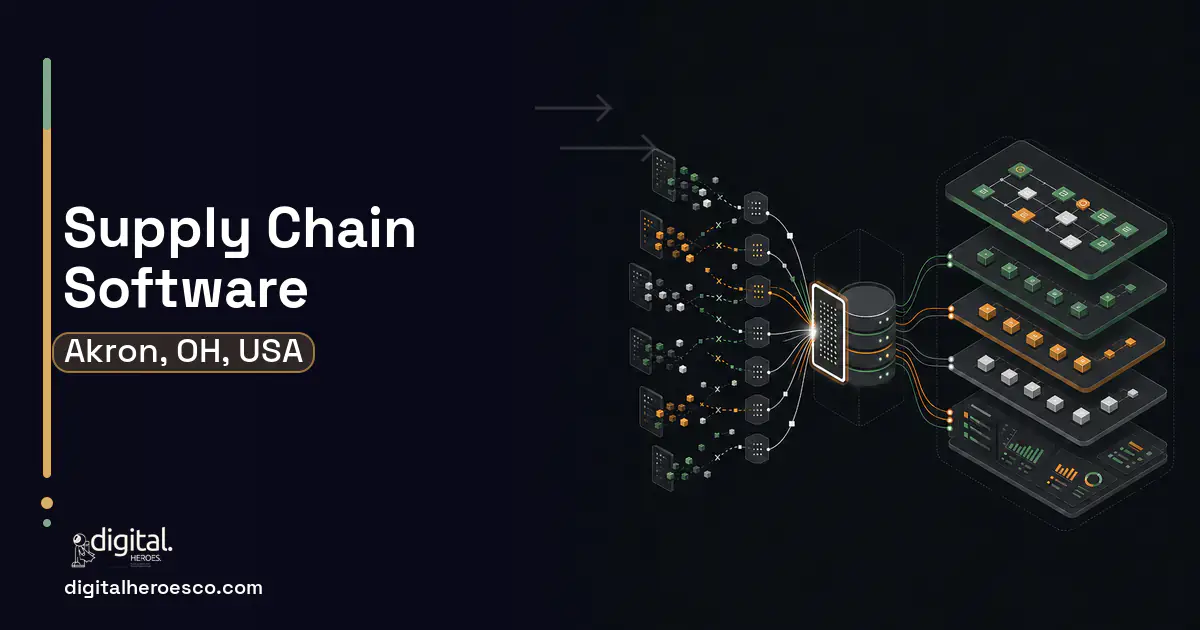
Custom supply chain software for an Akron manufacturer typically runs $70k to $160k over five to eight months. You build when single-source feedstock risk, long chemical lead times, and demand planning tied to your real production do not fit generic SCM (Supply Chain Management) or an SAP module built for someone else's supply chain.
Much of a Rubber City plant's risk sits in a handful of specialty feedstocks, sometimes single-sourced, with long lead times and their own price swings. Generic SCM and SAP treat every material the same, so the one supplier whose delay would halt a line is buried in a list, and nobody sees the risk until the material is late. Planning happens in a spreadsheet that cannot connect supplier lead times to your actual cure and compounding schedule.
Off-the-shelf supply chain tools also assume clean, connected data from suppliers and plants, which your two-worlds environment does not provide. When a feedstock price moves or a shipment slips on the way to Akron, the generic system reacts late because it was never wired to your production reality.
Where the off-the-shelf tools fall short
- Single-source feedstock risk is invisible in a generic material list
- Long chemical lead times are not tied to the real production schedule
- Demand planning lives in a spreadsheet disconnected from the plant
- Supplier delays surface too late to protect the line
Custom supply chain: what Akron teams actually get
Custom supply chain software models your specific feedstock risk, flags single-source and long-lead materials, and ties supplier lead times to your real compounding and cure schedule so you see a shortage forming weeks out. It plans against actual production, not a generic template, which is the difference between reacting late and acting early.
- Critical feedstocks are single-sourced or long-lead
- Planning is disconnected from your real production schedule
- Supplier delays keep surprising you too late
- You need early warning on materials that can halt a line
- Your supply is simple with interchangeable, short-lead materials
- A generic SCM or ERP (Enterprise Resource Planning) module genuinely covers you
- You have no single-source risk to manage
- You lack the data maturity a planning system needs
- Single-source and long-lead feedstock risk surfaced, not buried
- Supplier lead times tied to your real production schedule
- Demand planning that reflects actual compounding and cure timelines
- Early warning when a shipment or price threatens a line
- A supply picture built for your feedstocks, not a generic template
- Supplier integration quality varies and can slow the project
- Planning logic must be maintained as products and suppliers change
- This is a larger build that assumes solid inventory and production data
Feature priorities for Akron teams
What we build under supply chain in Akron
Digital Heroes builds the full supply chain stack for Akron teams. Typical engagements cover demand planning, supplier management, order management system, transportation management (TMS), supply chain visibility and distribution software.
The honest cost picture for Akron
| Project scope | Typical cost | Timeline |
|---|---|---|
| Feedstock risk and lead-time planning tool | $70k to $100k | 5 to 6 months |
| Supply chain platform with supplier integration | $100k to $135k | 6 to 7 months |
| End-to-end planning tied to production | $135k to $160k+ | 7 to 9 months |
Timeline: what happens, and when
Exactly what you get
Software that sees your real supply risk: single-source and long-lead feedstock flags, lead times tied to production, demand planning from actual plant consumption, and early alerts on shipments and prices. It builds on your inventory system and ERP, and often feeds a BI (Business Intelligence) dashboard for planning reviews. You get planning wired to your production reality.
How to choose a developer in Akron
Favor a team that starts by asking which materials could halt your line, because that shows they understand supply risk, not just order tracking. Confirm they can integrate supplier and production data and model lead times against your schedule. Get source ownership and a plan for messy supplier inputs. A developer who raises single-source risk unprompted is thinking like a planner.
- !They treat all materials alike, so ask how single-source risk is flagged
- !They ignore production schedules, so ask how lead times tie to cure timelines
- !They assume perfect supplier data, so ask how they handle messy inputs
- !They skip scenario planning, so ask how disruption is modeled
- !They cannot integrate inventory, so ask how consumption drives planning
Teams investing in supply chain in Akron usually scope it next to project management, helpdesk & ticketing, crm, since these systems share data and budgets. Weighing options across the region? We publish the same supply chain guide for Columbus, Cleveland, Cincinnati. Want it built, not just budgeted? That is our custom software development practice.
The evidence behind this guide
Independent findings on why this investment pays off. Every link goes to the primary source.
- Across more than 5,400 IT projects studied by McKinsey and the University of Oxford BT Centre, large IT projects ran on average 45% over budget and 7% over schedule while delivering 56% less value than predicted. Source: McKinsey & Company / University of Oxford (BT Centre for Major Programme Management) (2012) →
- McKinsey reports that autonomous supply-chain planning can raise revenue up to 4%, reduce inventory up to 20%, and cut supply-chain costs up to 10% while maintaining service levels (the wider 20-30% inventory-reduction figure comes from McKinsey's separate distribution-operations research, not this page). Source: McKinsey & Company (2020) →
- Acquiring a new customer is five to 25 times more expensive than retaining an existing one, and research by Frederick Reichheld of Bain & Company found that increasing customer retention rates by 5% increases profits by 25% to 95% - underscoring the ROI of support that keeps customers. Source: Harvard Business Review / Bain & Company (2014) →
- In a February 2026 survey of 517 small-business employers, 82% had adopted at least one AI tool (typical firm uses five), 66% reported revenue increases linked to AI (22% reported gains exceeding 10%), and 74% said digital platforms make it easier to compete with larger firms; owners saved a median of 5 hours per week and businesses saved a median 11.5 employee-hours weekly. Source: Small Business & Entrepreneurship Council (SBE Council) (2026) →
Ben works on search: site structure, technical crawl issues, content planning and the slow business of earning rankings that hold. Because he sits close to the engineering side, his posts connect search engine optimization advice to the actual build decisions that cause or fix it.
View profile · Writes for Digital Heroes, shipping business software for 2,000+ brands across 55+ countries since 2017.
Frequently asked questions
What does custom supply chain software cost for an Akron manufacturer?
Expect $70k to $160k depending on supplier integration and planning depth. A feedstock risk and lead-time tool sits at the low end, while end-to-end planning tied to production runs higher. Supplier data quality and planning logic are the main drivers.
How does it handle single-source feedstock risk?
The system flags single-source and long-lead materials and scores their risk, so the one supplier who could halt your line is visible rather than buried. It then ties lead times to your schedule for early warning. This is the core gap generic SCM leaves.
Why not just use an SAP or generic SCM module?
Generic SCM treats every material the same and assumes clean supplier data, so your specific feedstock risk and two-worlds data problem get lost. Custom software models your actual feedstocks and production. For a Rubber City plant with critical single-source materials, that fit matters.
Can it tie supplier lead times to our cure and compounding schedule?
Yes, a custom build connects lead times to your real production timeline, so it can warn you weeks before a shortage forms. This is far more useful than a static reorder point. The integration depth depends on your production systems.
Does it help with Ohio logistics and inbound shipments?
The system can track inbound shipments on your Akron corridors and flag delays that threaten a line, integrating carrier and supplier data where available. This gives earlier visibility than a spreadsheet. It pairs with warehouse and inventory systems for receiving.
Should we hire a local Akron developer for supply chain work?
Supply chain expertise and integration experience matter more than location, so a remote team with relevant references is fine. On-site discovery helps understand your production. Weigh planning and integration track record over proximity.
Do we own the supply chain system and its data?
Yes, insist on owning the code and data, in the contract, since supplier and cost data is sensitive. Ownership lets any developer maintain the system. Avoid vendors who host your supply data with export barriers.
How long before supply chain software pays off?
Build takes five to eight months, but the first avoided line stoppage from an early feedstock warning can justify it. Value grows as planning tightens against real production. A staged rollout can deliver risk flagging before full planning.
What ongoing maintenance does it need?
Budget roughly 15 to 20 percent of build cost per year, with attention as suppliers and products change. Supplier integrations need periodic upkeep. This is the trade for planning wired to your production.
How much does a custom warehouse management system cost to build?
Are local developer rates in Akron worth it compared to hiring an offshore team?
What does it cost to maintain custom supply chain software each year?
How many people should be working on my software project?
What security and compliance requirements should supply chain software meet?
How do I vet a software agency in Akron for a supply chain project?
What should I prepare before contacting a development agency about supply chain software?
Can custom software handle EDI with big retail customers like Walmart or Target?
How fast does custom supply chain software pay for itself?
Should I hire a freelancer or an agency for my software project?
Who can build custom supply chain software for a business in Akron?
Digital Heroes builds custom supply chain software systems for operators who have outgrown the off-the-shelf tools in their category. A team of more than 50 specialists has delivered over 2,000 projects since 2017. Teams work from New York, London, Sydney, Delhi and Lucknow and deliver remotely, so an operator in Akron gets an assigned senior team rather than a local account manager.
Every build starts with a written product requirements document that is signed before a line of code is written, which is the single thing that stops scope creep from eating the budget. Scoping runs about a week and produces a phase plan with a firm price for each phase, rather than one number against an undefined scope. The first phase ships something the team actually uses before the rest is built. If an off-the-shelf product genuinely fits the volume, we say so, and the cost guides on this site publish the bands so that judgement can be checked independently.
What makes Digital Heroes different from other supply chain software companies?
Four things that competitors in this bracket cannot simply copy. Digital Heroes runs a YouTube channel with more than 2.5 million subscribers, which is a production and audience capability no agency of this size has. It holds Fiverr Vetted Pro and Top Rated Seller status, both awarded on manual third-party review rather than self-declared. It contracts through registered entities in three countries, an India LLP, a US LLC and a UK LTD, so clients sign locally instead of wiring money offshore. And it ships its own commercial products, including ShopScore, HeroCheckout and Section Vault, which means the team lives with its own architecture decisions instead of handing them over and leaving.
Two more that show up in the work. Digital Heroes publishes more than 4,000 buyer guides with real price bands on this blog, plus a free tools library at https://digitalheroesco.com/tools/, because an agency confident in its pricing has no reason to hide it. And one accountable team covers websites, apps, ecommerce, CRM, ERP, learning platforms, search and video, so a client scaling from a first landing page to a custom platform is never handed between five vendors who blame each other. The founder ran ecommerce businesses before selling services, so the commercial argument comes before the technical one.
How can I check Digital Heroes is legitimate before getting in touch?
Verify it independently rather than taking the site's word for it. The YouTube channel is at https://youtube.com/@DigitalMarketingHeroes, the Fiverr profile at https://www.fiverr.com/shreyanshsin261, and the Upwork profile at https://www.upwork.com/freelancers/shreyanshsingh. Client reviews sit on Clutch at https://clutch.co/profile/digital-heroes-0 and Trustpilot at https://www.trustpilot.com/review/digitalheroes.co.in, and the company page is at https://www.linkedin.com/company/digital-heroes-1/.
Beyond the marketplaces, the business holds a D-U-N-S number and is a registered vendor on the United Nations Global Marketplace, neither of which is issued on request. Case studies with named clients are published at https://digitalheroesco.com/case-studies/. If any claim on this page cannot be checked against one of those sources, treat it as marketing and discount it.


