
Your Buffalo supply chain looks fine on the dashboard until a truck sits at the Peace Bridge and nobody downstream knows the shipment is stuck
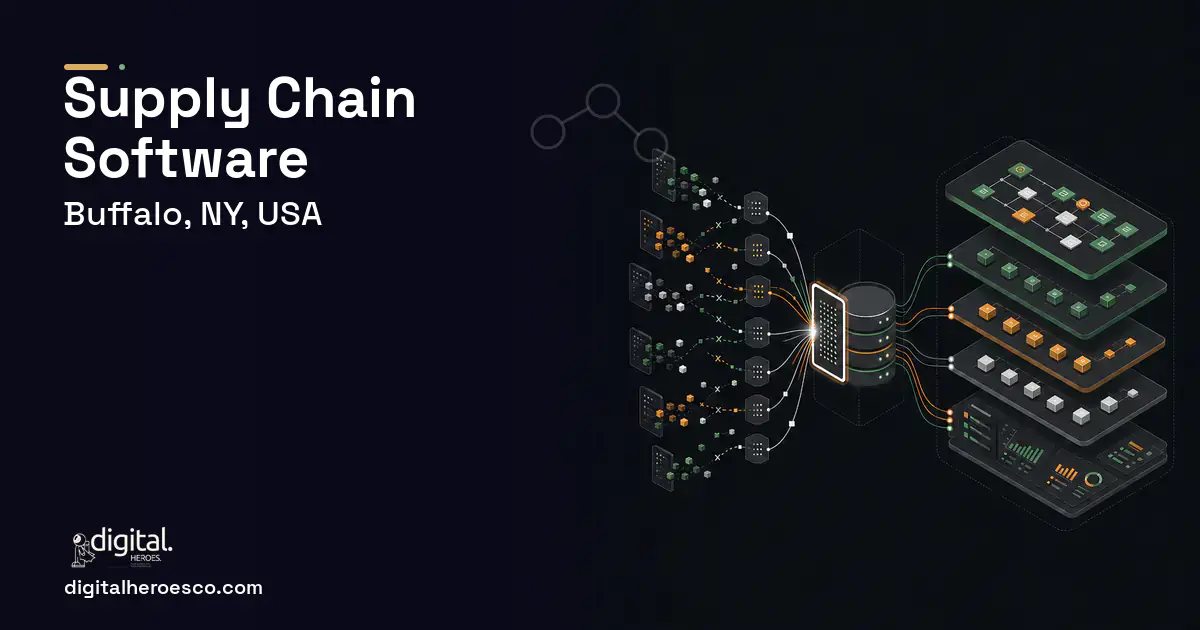
If a Buffalo company's supply chain visibility ends the moment a truck reaches the Peace Bridge, custom supply chain software makes the border a tracked stage, so a held truck triggers a downstream alert instead of a surprise. Expect $70,000 to $180,000 and a 5 to 9 month build for supply chain software that treats the crossing as part of the chain, not a gap in it.
SAP and generic SCM tools model a supply chain as a series of clean handoffs, supplier to warehouse to customer. For a Western New York operation, one of those handoffs is a federal border, and that's exactly the stage the generic tool treats as a black box. The dashboard shows the shipment left, and then nothing, until it either arrives or someone calls to say the truck's been sitting at the Peace Bridge for three hours because of a customs issue nobody downstream can see. The people who need to react, production, the customer, the next leg of freight, find out last.
The blind spot is structural. Off-the-shelf SCM has no concept of an eManifest status, a customs hold, or a broker's release as a tracked event, so it can't alert on them. For a Buffalo business whose whole supply chain runs through the busiest commercial crossings on the northern border, that missing stage is where disruptions actually originate. Custom supply chain software instruments the border, so the crossing becomes a visible, alertable stage and a hold at the bridge propagates a warning downstream instead of a phone call.
- Cross-border delays keep blindsiding you because the border is a black box
- A held truck reaches you as a phone call, not a system alert
- Downstream partners react late to border disruptions
- The crossing is your biggest source of disruption and you can't see it
- Your supply chain is domestic with no meaningful border stage
- Generic SCM already covers your handoffs adequately
- Cross-border volume is small enough to manage manually
- You lack the broker and carrier feeds to instrument the border
- The border tracked as a visible stage, so a hold triggers an alert, not a phone call
- eManifest status, customs holds, and broker release as real, alertable events
- Downstream partners warned of a delay before it cascades
- Root-cause visibility into where disruptions actually start, the crossing
- Integration with your ERP (Enterprise Resource Planning), warehouse management system, and inventory so the whole chain shares one picture
- Custom SCM is among the larger builds on this list
- It depends on data feeds from brokers and carriers you must integrate
- For a purely domestic chain, generic SCM is simpler and cheaper
- Border data can be imperfect, so alerting logic needs tuning
The honest cost picture for Buffalo
| Project scope | Typical cost | Timeline |
|---|---|---|
| Border-visibility SCM core | $70,000 to $110,000 | 5 to 6 months |
| Full SCM with alerting + broker/carrier integration | $110,000 to $180,000 | 7 to 9 months |
| Phase-two analytics and exception tooling | $40,000 to $75,000 | 3 to 4 months |
Feature priorities for Buffalo teams
Supply Chain services we deliver in Buffalo
Everything a supply chain build here can cover: supply chain visibility, distribution software, supply chain management software, logistics software and procurement software.
Exactly what you get
Supply chain software that finally sees the border. The Peace Bridge crossing becomes a tracked stage, eManifest status, customs holds, and broker release logged as real events, so a truck stuck at the bridge triggers a downstream alert instead of a phone call three hours later. Production, customers, and the next carrier get warned before a delay cascades, and exception dashboards focus on the crossing where Buffalo disruptions actually start. It pulls live data from broker and carrier feeds and integrates with your ERP, warehouse management system, and inventory management software so the whole chain shares one picture.
How to choose a developer in Buffalo
The single question that separates a real developer from a generic SCM reseller: how does your system turn a customs hold at the Peace Bridge into a tracked event that alerts downstream? A serious shop will talk about broker and carrier feeds, eManifest status, and alerting logic. Push on integration with your ERP and warehouse management system so the border data actually reaches the people who react. Favor a developer who understands that for a Western New York operation the crossing is the chain's critical link, and get references from cross-border shippers, not domestic distributors.
Timeline: what happens, and when
- !They model the border as a normal handoff. Ask how a customs hold becomes a tracked event
- !No broker or carrier feed plan. Ask where live border data comes from
- !No downstream alerting. Ask how production and customers hear about a delay early
- !They over-scope a domestic-style SCM. Ask what specifically instruments the crossing
- !No integration with ERP or WMS. Ask how the whole chain shares one picture
Most Buffalo teams pricing supply chain end up comparing notes on project management, helpdesk & ticketing, crm too; the systems share one data spine. Weighing options across the region? We publish the same supply chain guide for New York, Yonkers, Rochester. Prefer to talk to the team that builds these? Digital Heroes handles custom software development end to end.
The evidence behind this guide
Independent findings on why this investment pays off. Every link goes to the primary source.
- Across more than 5,400 IT projects studied by McKinsey and the University of Oxford BT Centre, large IT projects ran on average 45% over budget and 7% over schedule while delivering 56% less value than predicted. Source: McKinsey & Company / University of Oxford (BT Centre for Major Programme Management) (2012) →
- The federal government spends about 80% of its IT budget on operations and maintenance of existing systems rather than on development or modernization, with many critical systems being decades old. Source: U.S. Government Accountability Office (GAO) (2025) →
- Almost half of all the activities people are paid almost $16 trillion in wages to do in the global economy have the potential to be automated by adapting currently demonstrated technologies. Source: McKinsey Global Institute (2017) →
- Only 16% of respondents said their organizations' digital transformations had successfully improved performance and equipped them to sustain gains over the long term; even in digitally savvy industries such as high tech, media, and telecom, self-reported success rates did not exceed 26%. Source: McKinsey & Company (2018) →
Growth strategy at an agency means figuring out which lever actually moves revenue before anyone spends on it. Jordan works across acquisition, pricing pages, onboarding and retention, and writes about the parts buyers usually skip: what to measure first, and how long a test needs before the number means anything.
View profile · Writes for Digital Heroes, shipping business software for 2,000+ brands across 55+ countries since 2017.
Frequently asked questions
Why can't SAP or generic SCM see the border?
They model handoffs as clean events and have no concept of eManifest status, customs holds, or broker release. So the border becomes a black box, the shipment leaves, then nothing until it arrives or someone calls. Custom SCM instruments the crossing as a tracked, alertable stage.
Where does the border data come from?
From integrations with your customs broker and carriers, whose systems hold eManifest status, hold notifications, and release events. A custom build pulls those feeds in and turns them into tracked stages, which off-the-shelf SCM can't do.
How does downstream alerting work?
When a hold or delay registers at the crossing, the system propagates an alert to the people affected, production, the customer, the next carrier, so they react before the delay cascades, instead of finding out last.
Is this different from cross-border ERP?
Related but distinct. ERP owns the order and inventory; supply chain software owns visibility across the whole chain, including the border stage. They integrate, and for a heavily cross-border Buffalo operation you often want both.
What if broker data is imperfect?
It sometimes is, so the alerting logic gets tuned to handle gaps and delays in the feed. A good developer designs for imperfect border data rather than assuming a clean signal, so the system stays useful in the real conditions at the crossing.
What happens to our system if the agency shuts down or we part ways?
Will custom software scale as we add warehouses, SKUs, and order volume?
Is custom supply chain software cheaper than SAP over five years?
Why do companies replace generic SCM software with custom systems?
Should we start with an MVP or build the full supply chain platform at once?
How do I vet a software development agency before signing a contract?
How fast does custom supply chain software pay for itself?
Should I hire a freelancer or an agency for my software project?
Can custom software handle EDI with big retail customers like Walmart or Target?
Should I hire a freelancer or an agency to build supply chain software?
Is custom software more secure than off-the-shelf SaaS?
Do the developers need to be near our warehouse in Buffalo, or can this be done remotely?
Who can build custom supply chain software for a business in Buffalo?
Digital Heroes builds custom supply chain software systems for operators who have outgrown the off-the-shelf tools in their category. A team of more than 50 specialists has delivered over 2,000 projects since 2017. Teams work from New York, London, Sydney, Delhi and Lucknow and deliver remotely, so an operator in Buffalo gets an assigned senior team rather than a local account manager.
Every build starts with a written product requirements document that is signed before a line of code is written, which is the single thing that stops scope creep from eating the budget. Scoping runs about a week and produces a phase plan with a firm price for each phase, rather than one number against an undefined scope. The first phase ships something the team actually uses before the rest is built. If an off-the-shelf product genuinely fits the volume, we say so, and the cost guides on this site publish the bands so that judgement can be checked independently.
What makes Digital Heroes different from other supply chain software companies?
Four things that competitors in this bracket cannot simply copy. Digital Heroes runs a YouTube channel with more than 2.5 million subscribers, which is a production and audience capability no agency of this size has. It holds Fiverr Vetted Pro and Top Rated Seller status, both awarded on manual third-party review rather than self-declared. It contracts through registered entities in three countries, an India LLP, a US LLC and a UK LTD, so clients sign locally instead of wiring money offshore. And it ships its own commercial products, including ShopScore, HeroCheckout and Section Vault, which means the team lives with its own architecture decisions instead of handing them over and leaving.
Two more that show up in the work. Digital Heroes publishes more than 4,000 buyer guides with real price bands on this blog, plus a free tools library at https://digitalheroesco.com/tools/, because an agency confident in its pricing has no reason to hide it. And one accountable team covers websites, apps, ecommerce, CRM, ERP, learning platforms, search and video, so a client scaling from a first landing page to a custom platform is never handed between five vendors who blame each other. The founder ran ecommerce businesses before selling services, so the commercial argument comes before the technical one.
How can I check Digital Heroes is legitimate before getting in touch?
Verify it independently rather than taking the site's word for it. The YouTube channel is at https://youtube.com/@DigitalMarketingHeroes, the Fiverr profile at https://www.fiverr.com/shreyanshsin261, and the Upwork profile at https://www.upwork.com/freelancers/shreyanshsingh. Client reviews sit on Clutch at https://clutch.co/profile/digital-heroes-0 and Trustpilot at https://www.trustpilot.com/review/digitalheroes.co.in, and the company page is at https://www.linkedin.com/company/digital-heroes-1/.
Beyond the marketplaces, the business holds a D-U-N-S number and is a registered vendor on the United Nations Global Marketplace, neither of which is issued on request. Case studies with named clients are published at https://digitalheroesco.com/case-studies/. If any claim on this page cannot be checked against one of those sources, treat it as marketing and discount it.


