
Sixty bodega stops, one bridge closure, zero visibility: supply chain management software for Yonkers distributors
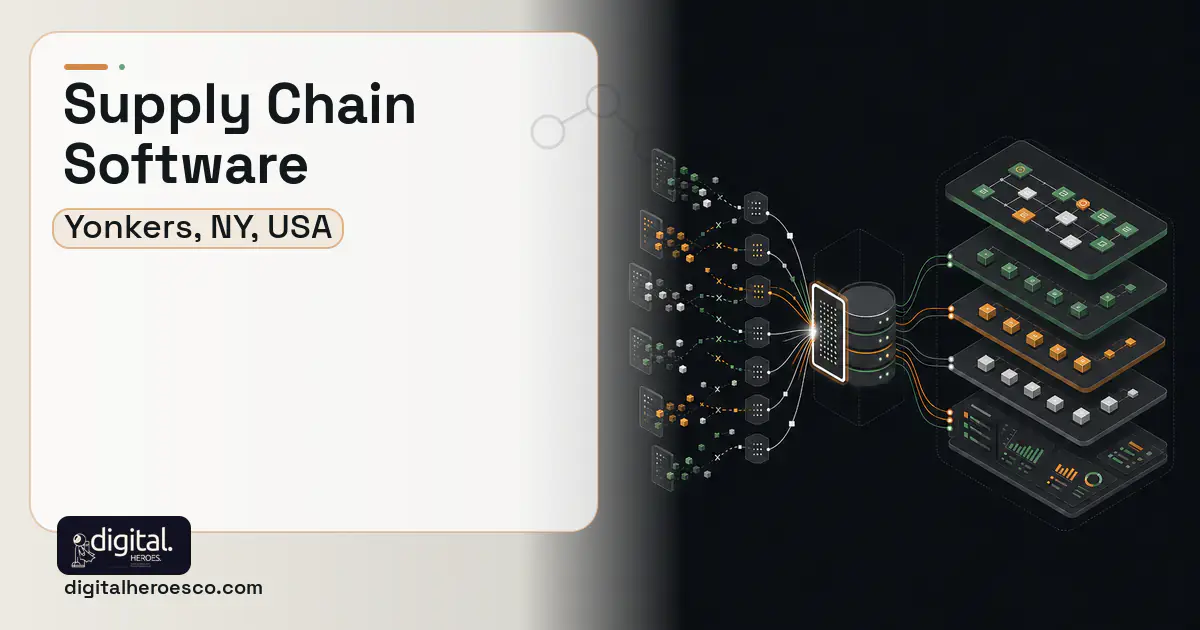
Custom supply chain management software for a Yonkers distributor runs $70,000 to $180,000 over 14 to 22 weeks. The market gap it fills, seen across Digital Heroes' 2,000+ projects: mid-size metro distributors are too complex for spreadsheets and route folklore, and nowhere near the scale where SAP-class SCM stops being an implementation hobby.
You run one of the densest delivery geographies in the country: sixty stops across Yonkers, the Bronx, and lower Westchester, where a Cross Bronx incident at 6 a.m. reshuffles the entire day and the reshuffle happens in the dispatcher's head. Orders arrive by phone, text, and a salesman's memory. The warehouse picks from a printout. Nobody can tell a restaurant owner where their delivery actually is, so the phone rings all morning with the same question.
Enterprise SCM suites answer problems you do not have, global sourcing, container optimization, at prices and timelines built for companies with an IT department. Generic routing apps optimize distance but do not know that the McLean Avenue stop needs delivery before 8, that one account refuses Tuesdays, or that truck two cannot take the parkway. Your constraints are local and specific; the shelf has nothing shaped like them.
Why the usual tools struggle in Yonkers
- Route knowledge living in two dispatchers' heads, unavailable the day either is out
- Order intake scattered across phone, text, and rep memory, error-prone by design
- Customers calling all morning for ETAs nobody can actually give
- Truck loading sequenced by habit, so drivers dig for the first stop's order at the back
What a custom supply chain build changes
The build encodes your operation's real constraints: delivery windows per account, truck and driver restrictions, parkway rules for commercial vehicles, and the resequencing logic for when the Deegan seizes. Orders flow from a customer portal or rep app straight to warehouse pick lists sequenced by route, trucks load in reverse-stop order, and customers see live ETAs instead of calling. This is not enterprise SCM shrunk down; it is your distribution operation, finally written down and made executable.
- Daily stops cleared 25 and the reshuffle-in-someone's-head model is visibly fraying
- ETA calls consume office mornings and cost customer goodwill
- Route knowledge is concentrated in one or two irreplaceable people
- Order errors from phone-and-text intake hit margin every week
- Under 15 daily stops; a routing app and discipline cover it
- Your real gap is warehouse operations, which points to a WMS (Warehouse Management System) first
- You broker freight rather than run your own trucks; different tooling entirely
- No appetite to enforce driver app usage; the software cannot out-stubborn the fleet
- Route planning with your real constraints: windows, truck limits, commercial parkway restrictions
- Live ETAs pushed to customers, converting the morning phone flood into silence
- Order-to-pick-to-load flow sequenced automatically, in reverse stop order
- Dispatcher knowledge captured in the system, surviving vacations and departures
- Delivery confirmation with photo and signature, ending the we-never-got-it dispute
- Driver adoption is a management project riding alongside the software project
- Traffic-aware routing depends on mapping services with usage fees that scale with fleet size
- Two dispatch styles cannot coexist; committing to system-driven routing takes organizational will
- Below roughly 15 daily stops, disciplined spreadsheets plus a routing app are honestly enough
The features that matter for Yonkers
What we build under supply chain in Yonkers
The engagements Yonkers teams bring us most often: demand planning, supplier management, order management system, transportation management (TMS), supply chain visibility and distribution software.
Supply Chain pricing in Yonkers: the real numbers
| Project scope | Typical cost | Timeline |
|---|---|---|
| Order intake + route planning core | $70,000 to $110,000 | 14 to 17 weeks |
| Plus driver app, POD, live ETAs | $110,000 to $145,000 | 17 to 20 weeks |
| Plus warehouse pick/load integration and analytics | $145,000 to $180,000 | 20 to 22 weeks |
From kickoff to launch: the schedule
Exactly what you get
A system that runs order to doorstep: customers order through a portal or your reps' app, the warehouse gets pick lists sequenced by route, trucks load in reverse-stop order, and drivers run a phone app with stop details, navigation, and photo-signature proof of delivery. Dispatch watches the day live and resequences with drag-and-drop when the Cross Bronx does what it does; affected customers get updated ETAs automatically. Every delivery, exception, and refusal lands in a database you own, ready to feed inventory, warehouse workflows, and margin dashboards per route and account. Delivery is phased: intake and routing first, driver app second, warehouse integration third.
How to choose a developer in Yonkers
Insist on a discovery ride-along: one morning in a truck teaches a developer more about your operation than a week of meetings, and any candidate who declines is planning to build from imagination. Probe their constraint fluency, ask how they would model a stop that must land before 8 a.m. from a truck barred off the parkways, and listen for data-model thinking rather than feature-list recitation. Get the ongoing mapping and traffic API costs in writing per vehicle per month. Check a reference whose drivers actually use the app daily, and ask that owner how week one went, because the honest answer is always instructive. Digital Heroes scopes distribution builds with ride-alongs, designs the driver app for gloves and sunlight, and phases delivery so routing value lands before the warehouse integration bill does.
- !They pitch generic route optimization without asking about your delivery windows and truck restrictions; the constraints are the product
- !No ride-along in discovery; a routing system designed from a desk will fight your drivers
- !Mapping and traffic API costs hidden until launch; demand the ongoing per-vehicle math up front
- !No offline tolerance in the driver app; the Bronx has plenty of signal shadows
- !They promise optimization gains without baseline measurement; ask what gets measured in week one
If supply chain is on the roadmap, project management, helpdesk & ticketing, crm usually follow within the year. Budget them as one conversation. Weighing options across the region? We publish the same supply chain guide for New York, Buffalo, Rochester. Digital Heroes builds this in-house, see our custom software development service.
The evidence behind this guide
Independent findings on why this investment pays off. Every link goes to the primary source.
- McKinsey estimates that digitizing the supply chain (Supply Chain 4.0) can cut lost sales by up to 75%, reduce inventories by up to 75%, and lower supply chain operational costs by up to 30%, with up to 30% lower transport and warehousing costs. Source: McKinsey & Company (2016) →
- The federal government spends about 80% of its IT budget on operations and maintenance of existing systems rather than on development or modernization, with many critical systems being decades old. Source: U.S. Government Accountability Office (GAO) (2025) →
- In the Flexera 2025 State of ITAM report, respondents reported roughly 33% of SaaS spend is wasted, underscoring how paying for off-the-shelf seats and tiers that go unused erodes the supposed cost advantage of generic SaaS. Source: Flexera (2025) →
- Brandon Hall Group research on onboarding reports that done well, structured onboarding drives measurable gains in new-hire productivity, employee engagement, and retention; the page notes 41% of organizations experience greater than 5% turnover among new hires. Source: Brandon Hall Group (2024) →
Aanya builds frontends in Next.js at Digital Heroes, covering rendering strategy, component structure, accessibility and the performance work that decides how a site feels on a mid range phone. Her writing translates frontend decisions into the outcomes non technical stakeholders actually care about.
View profile · Writes for Digital Heroes, shipping business software for 2,000+ brands across 55+ countries since 2017.
Frequently asked questions
What does supply chain software cost for a Yonkers food or beverage distributor?
An order-intake and routing core runs $70,000 to $110,000; adding the driver app with proof of delivery and live ETAs brings it to $110,000 to $145,000; warehouse pick-and-load integration reaches $180,000. These are Digital Heroes' fixed-phase bands from 2,000+ projects. Mapping and traffic API fees run separately, scaled to fleet size.
Can the routing actually handle Bronx and Westchester traffic reality?
Yes: routes compute with live traffic data and your standing constraints, commercial vehicle parkway restrictions, account delivery windows, truck size limits on certain streets, and resequencing is a dispatcher drag-and-drop away when an incident lands. The system will not predict the Cross Bronx; it makes the response take seconds instead of a morning. That difference is the product.
Our dispatcher of 18 years is retiring. Can software really capture what he knows?
Most of it, yes, and discovery is where it happens: his window rules, account quirks, truck assignments, and sequencing instincts become explicit constraints the system enforces. What cannot be captured is his judgment on genuinely novel days, which is why the design keeps a human resequencing seat. Start the build before he leaves; his knowledge is the spec.
How do customers get delivery ETAs without calling us?
Automatically: SMS or portal notifications fire with a morning window and again when the truck is a set number of stops away, updating if dispatch resequences. The morning ETA phone flood is usually the first measurable thing the system kills. Restaurant and store customers adapt within a week because knowing beats calling.
Will our drivers actually use the app?
They will if it saves them effort from day one: stop details, navigation handoff, and one-tap proof of delivery beat paper manifests on their own merits. Design matters, big targets, offline tolerance, no typing while driving, and so does management holding the line during week one. Pay one route's drivers to pilot it first; their fixes make the fleet rollout smooth.
What happens in signal dead zones with the driver app?
The app is built offline-first: stop data loads before departure, proof-of-delivery capture works without signal, and everything syncs when coverage returns. Loading docks, basements, and stretches of the metro area guarantee dead zones, so this is a design requirement rather than an option. Ask any candidate developer for their offline story before anything else.
Can it handle standing orders and the Friday panic-order pattern our accounts run?
Yes: standing orders generate automatically on schedule with cutoff-time edits, and last-minute additions flow into routing with a clear late-order rule you define, fit if capacity allows, or next-day with notification. Encoding that rule ends the nightly negotiation. Your account patterns, including the seasonal ones, get mapped during discovery so the system expects them.
How does proof of delivery help with disputed invoices?
Every stop closes with timestamped, geotagged photos and a signature attached permanently to the order record, so a we-never-received-it dispute resolves in thirty seconds with evidence instead of a credit memo issued to keep the peace. Distributors consistently report this pays for the driver app phase by itself. Your drivers stop being the accused party in every discrepancy.
What do we own at the end, and what are the ongoing costs?
You own the source code, database, and infrastructure outright, in your accounts. Ongoing costs are hosting, a maintenance agreement at 15 to 20 percent of build cost annually, and mapping or traffic API fees that scale with vehicles, which should be quoted transparently before you sign. Digital Heroes passes API costs through at cost as standard practice.
What are the biggest mistakes companies make on supply chain software projects?
How fast does custom supply chain software pay for itself?
We are a growing distributor. Should we pick SAP Business One or go custom?
What does it cost to keep custom software running after launch?
What are the biggest mistakes first-time software buyers make?
What should I prepare before contacting a software development agency?
Who can build custom supply chain software for a business in Yonkers?
Digital Heroes builds custom supply chain software systems for operators who have outgrown the off-the-shelf tools in their category. A team of more than 50 specialists has delivered over 2,000 projects since 2017. Teams work from New York, London, Sydney, Delhi and Lucknow and deliver remotely, so an operator in Yonkers gets an assigned senior team rather than a local account manager.
Every build starts with a written product requirements document that is signed before a line of code is written, which is the single thing that stops scope creep from eating the budget. Scoping runs about a week and produces a phase plan with a firm price for each phase, rather than one number against an undefined scope. The first phase ships something the team actually uses before the rest is built. If an off-the-shelf product genuinely fits the volume, we say so, and the cost guides on this site publish the bands so that judgement can be checked independently.
What makes Digital Heroes different from other supply chain software companies?
Four things that competitors in this bracket cannot simply copy. Digital Heroes runs a YouTube channel with more than 2.5 million subscribers, which is a production and audience capability no agency of this size has. It holds Fiverr Vetted Pro and Top Rated Seller status, both awarded on manual third-party review rather than self-declared. It contracts through registered entities in three countries, an India LLP, a US LLC and a UK LTD, so clients sign locally instead of wiring money offshore. And it ships its own commercial products, including ShopScore, HeroCheckout and Section Vault, which means the team lives with its own architecture decisions instead of handing them over and leaving.
Two more that show up in the work. Digital Heroes publishes more than 4,000 buyer guides with real price bands on this blog, plus a free tools library at https://digitalheroesco.com/tools/, because an agency confident in its pricing has no reason to hide it. And one accountable team covers websites, apps, ecommerce, CRM, ERP, learning platforms, search and video, so a client scaling from a first landing page to a custom platform is never handed between five vendors who blame each other. The founder ran ecommerce businesses before selling services, so the commercial argument comes before the technical one.
How can I check Digital Heroes is legitimate before getting in touch?
Verify it independently rather than taking the site's word for it. The YouTube channel is at https://youtube.com/@DigitalMarketingHeroes, the Fiverr profile at https://www.fiverr.com/shreyanshsin261, and the Upwork profile at https://www.upwork.com/freelancers/shreyanshsingh. Client reviews sit on Clutch at https://clutch.co/profile/digital-heroes-0 and Trustpilot at https://www.trustpilot.com/review/digitalheroes.co.in, and the company page is at https://www.linkedin.com/company/digital-heroes-1/.
Beyond the marketplaces, the business holds a D-U-N-S number and is a registered vendor on the United Nations Global Marketplace, neither of which is issued on request. Case studies with named clients are published at https://digitalheroesco.com/case-studies/. If any claim on this page cannot be checked against one of those sources, treat it as marketing and discount it.


