
Your supply chain ends at a vessel off Bunbury but your SCM software thinks it ends at a truck
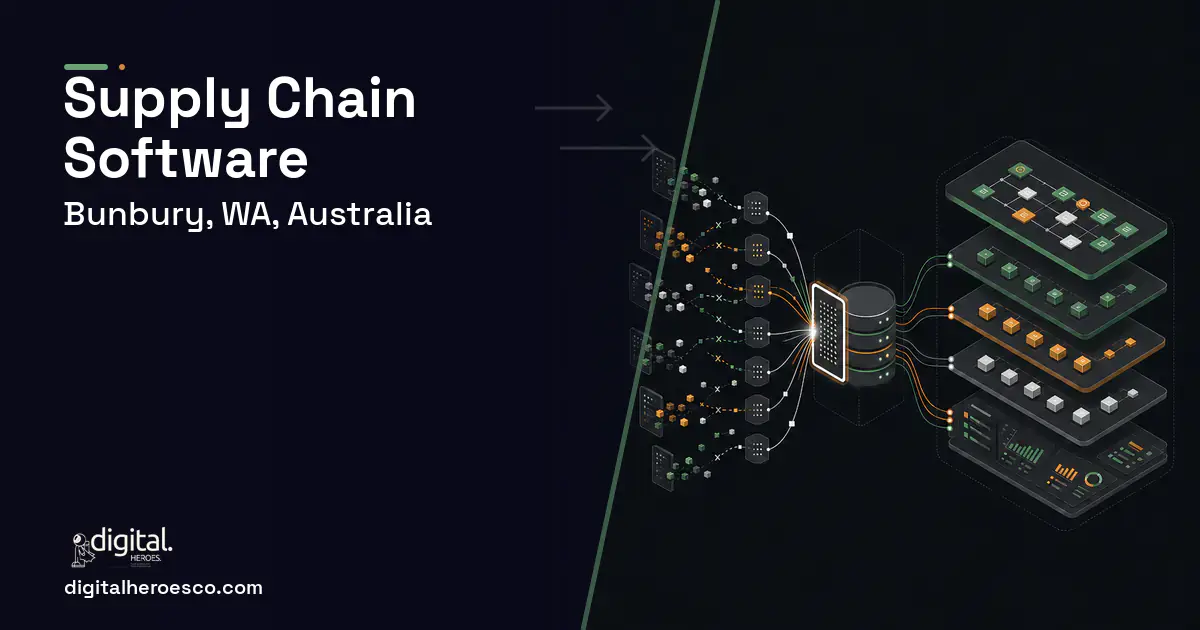
Custom supply chain software for a Bunbury exporter or producer typically costs $60k to $140k over 4 to 8 months. Generic SCM and SAP modules assume a road-and-warehouse chain ending at a truck. Your chain runs from farm or mine through a processing plant to a bulk vessel off the Port of Bunbury, with demurrage, blend specs and seasonal supply none of them model. Custom software follows the real chain.
Generic supply-chain software draws your chain as supplier to warehouse to truck to customer. Yours doesn't end at a truck; it ends at a Panamax alongside the Port of Bunbury, booked into a loading window weeks ahead, with demurrage ticking if you're not ready. Upstream, your supply is seasonal: dairy intake swings with the calendar, and mineral feed depends on mine output and stockpile blend. The off-the-shelf model has no berth, no vessel, no demurrage clock and no seasonal supply curve.
So your logistics team runs the genuinely hard part, matching available tonnage to vessel schedules and customer specs, in a spreadsheet alongside the SCM tool that handles the easy bits. When a parcel isn't blended to spec in time, or a vessel arrives before the stockpile is ready, the cost lands as demurrage or a missed shipment, and the software that was meant to prevent exactly that was looking the other way.
What supply chain costs in Bunbury
| Project scope | Typical cost | Timeline |
|---|---|---|
| Port and vessel scheduling module with demurrage | $60k to $90k | 4 to 5 months |
| End-to-end SCM: supply curves, blend, vessel matching | $100k to $140k | 6 to 8 months |
| Planning layer connecting existing systems and the port | $50k to $85k | 3 to 5 months |
The fix: supply chain built for Bunbury, not rented
Custom supply chain software models your real chain end to end: seasonal supply upstream, blend-to-spec in the middle, and a vessel-and-berth schedule with a demurrage clock at the port. It matches available tonnage to loading windows and customer specs automatically, so the hard part stops living in a spreadsheet and the demurrage and missed-shipment costs it was meant to prevent actually get prevented.
- Your chain ends at a vessel and a berth, not a truck
- Demurrage and loading-window clashes are real, recurring costs
- Seasonal supply needs a curve generic SCM can't model
- Tonnage-to-vessel-to-spec matching lives in a spreadsheet
- Your chain is road-and-warehouse, ending at a truck or DC
- You have no port, vessel or demurrage logistics
- Supply is steady and doesn't need seasonal curves
- Generic SCM or an SAP module covers your flow
The capability list that earns its budget
What we build under supply chain in Bunbury
The engagements Bunbury teams bring us most often: supply chain management software, logistics software, procurement software, demand planning, supplier management and order management system.
How long it takes, phase by phase
Exactly what you get
Software that follows your chain all the way to the vessel, not just to a truck. It schedules berths and vessels with a live demurrage clock, matches available tonnage to loading windows and customer blend specs, and curves seasonal supply from dairy intake to mine feed. The genuinely hard planning, the part that's been living in a spreadsheet beside your generic SCM, finally runs in one system that flags a clash before the ship is alongside.
How to choose a developer in Bunbury
Look for a developer who understands bulk export logistics and port operations, because the value sits in the part generic SCM ignores. Ask how they'd source berth and vessel data and model a demurrage clock. South West exporters value honesty, so trust a developer who says generic SCM is fine for a road-and-warehouse chain. This software connects to ERP (Enterprise Resource Planning), a warehouse management system, inventory management software and business intelligence (BI) dashboards, so confirm those links are in scope.
- End-to-end visibility from seasonal supply to the vessel alongside the Port of Bunbury
- Vessel and berth scheduling with a demurrage clock, so clashes surface early not at the wharf
- Tonnage matched to loading windows and customer blend specs automatically
- Seasonal supply curves built in for dairy and mine feed planning
- The hard planning work moved out of the spreadsheet and into the system
- Modelling the full chain including port logistics is a substantial build
- Integration with port, vessel and weighbridge data can be complex and slow to source
- You own the logic as shipping rules and contracts change
- For a road-and-warehouse chain ending at a truck, generic SCM is adequate
- !Vendor models the chain ending at a truck; ask how they handle a vessel and demurrage
- !No port-data experience; ask how they'd source berth and vessel schedules
- !Ignores blend specs; ask how tonnage is matched to a customer parcel
- !No seasonal forecasting; ask how dairy intake or mine feed is curved
- !Quotes the full chain before discovery; ask for phased delivery starting at the port
If supply chain is on the roadmap, project management, helpdesk & ticketing, crm usually follow within the year. Budget them as one conversation. Weighing options across the region? We publish the same supply chain guide for Perth, Geraldton, Mandurah. Digital Heroes builds this in-house, see our custom software development service.
The evidence behind this guide
Independent findings on why this investment pays off. Every link goes to the primary source.
- McKinsey estimates that digitizing the supply chain (Supply Chain 4.0) can cut lost sales by up to 75%, reduce inventories by up to 75%, and lower supply chain operational costs by up to 30%, with up to 30% lower transport and warehousing costs. Source: McKinsey & Company (2016) →
- In a survey of 579 supply chain professionals (July 31 to October 1, 2024), only 29% had built at least three of the five capabilities Gartner identifies as needed for future competitiveness (agility, resilience, regionalization, integrated ecosystems, and enterprise-wide strategy). Source: Gartner (2025) →
- Flexera's 2025 State of the Cloud Report (survey of 750+ technical and executive leaders) found that 84% of respondents believe managing cloud spend is the top cloud challenge for organizations today, with cloud budgets already exceeding limits by 17%. Source: Flexera (2025) →
- McKinsey found that currently demonstrated technologies can fully automate about 42% of finance activities and mostly automate a further 19%, indicating roughly 60% of finance work is technically automatable. Source: McKinsey & Company (2018) →
Oliver runs UK client accounts day to day, chairing the calls where scope, budget and timeline meet reality. He is useful reading for anyone about to commission custom software and wondering what a healthy agency relationship should feel like from the client side.
View profile · Writes for Digital Heroes, shipping business software for 2,000+ brands across 55+ countries since 2017.
Frequently asked questions
Why doesn't generic SCM fit a port operation?
It models the chain as supplier to warehouse to truck. Yours ends at a vessel alongside the Port of Bunbury with a berth booking and a demurrage clock, none of which off-the-shelf SCM represents. So the hard matching of tonnage to vessels ends up in a spreadsheet.
How does the software handle demurrage?
It schedules vessels and berths with a live demurrage clock, flagging when a stockpile won't be blended to spec in time for a booked loading window, so you act before the costs accrue rather than after.
Can it model seasonal supply?
Yes. It curves seasonal dairy intake and mine feed, so planning reflects the real supply available across the year instead of assuming a steady flow, which is where generic SCM falls down for a South West producer.
What data does it need from the port?
Berth and vessel schedules, plus your weighbridge, lab and stockpile data. Sourcing and integrating port data is a major cost driver, so scope it early in discovery.
How long does a full SCM build take?
About 4 to 5 months for a port and vessel scheduling module, or 6 to 8 for end-to-end SCM with supply curves, blend planning and vessel matching. The port and demurrage logic drives the timeline.
How much should a small business budget for its first custom app or website?
How big a development team does a supply chain software project need?
We are a growing distributor. Should we pick SAP Business One or go custom?
Can I build my product on a no-code tool like Bubble instead of hiring developers?
How much does custom supply chain software cost for a small business?
What does it cost to maintain custom supply chain software each year?
Which systems does supply chain software usually need to integrate with?
How much does a custom warehouse management system cost to build?
What questions should I ask a development agency on the first call?
Who owns the code when an agency builds my supply chain software?
Can we migrate years of data out of our current system into new custom software?
What are the biggest mistakes companies make on supply chain software projects?
When is SAP actually a better choice than building custom supply chain software?
Who can build custom supply chain software for a business in Bunbury?
Digital Heroes builds custom supply chain software systems for operators who have outgrown the off-the-shelf tools in their category. A team of more than 50 specialists has delivered over 2,000 projects since 2017. Teams work from New York, London, Sydney, Delhi and Lucknow and deliver remotely, so an operator in Bunbury gets an assigned senior team rather than a local account manager.
Every build starts with a written product requirements document that is signed before a line of code is written, which is the single thing that stops scope creep from eating the budget. Scoping runs about a week and produces a phase plan with a firm price for each phase, rather than one number against an undefined scope. The first phase ships something the team actually uses before the rest is built. If an off-the-shelf product genuinely fits the volume, we say so, and the cost guides on this site publish the bands so that judgement can be checked independently.
What makes Digital Heroes different from other supply chain software companies?
Four things that competitors in this bracket cannot simply copy. Digital Heroes runs a YouTube channel with more than 2.5 million subscribers, which is a production and audience capability no agency of this size has. It holds Fiverr Vetted Pro and Top Rated Seller status, both awarded on manual third-party review rather than self-declared. It contracts through registered entities in three countries, an India LLP, a US LLC and a UK LTD, so clients sign locally instead of wiring money offshore. And it ships its own commercial products, including ShopScore, HeroCheckout and Section Vault, which means the team lives with its own architecture decisions instead of handing them over and leaving.
Two more that show up in the work. Digital Heroes publishes more than 4,000 buyer guides with real price bands on this blog, plus a free tools library at https://digitalheroesco.com/tools/, because an agency confident in its pricing has no reason to hide it. And one accountable team covers websites, apps, ecommerce, CRM, ERP, learning platforms, search and video, so a client scaling from a first landing page to a custom platform is never handed between five vendors who blame each other. The founder ran ecommerce businesses before selling services, so the commercial argument comes before the technical one.
How can I check Digital Heroes is legitimate before getting in touch?
Verify it independently rather than taking the site's word for it. The YouTube channel is at https://youtube.com/@DigitalMarketingHeroes, the Fiverr profile at https://www.fiverr.com/shreyanshsin261, and the Upwork profile at https://www.upwork.com/freelancers/shreyanshsingh. Client reviews sit on Clutch at https://clutch.co/profile/digital-heroes-0 and Trustpilot at https://www.trustpilot.com/review/digitalheroes.co.in, and the company page is at https://www.linkedin.com/company/digital-heroes-1/.
Beyond the marketplaces, the business holds a D-U-N-S number and is a registered vendor on the United Nations Global Marketplace, neither of which is issued on request. Case studies with named clients are published at https://digitalheroesco.com/case-studies/. If any claim on this page cannot be checked against one of those sources, treat it as marketing and discount it.


