
Your defence supply chain has an AIC reporting obligation SAP never heard of
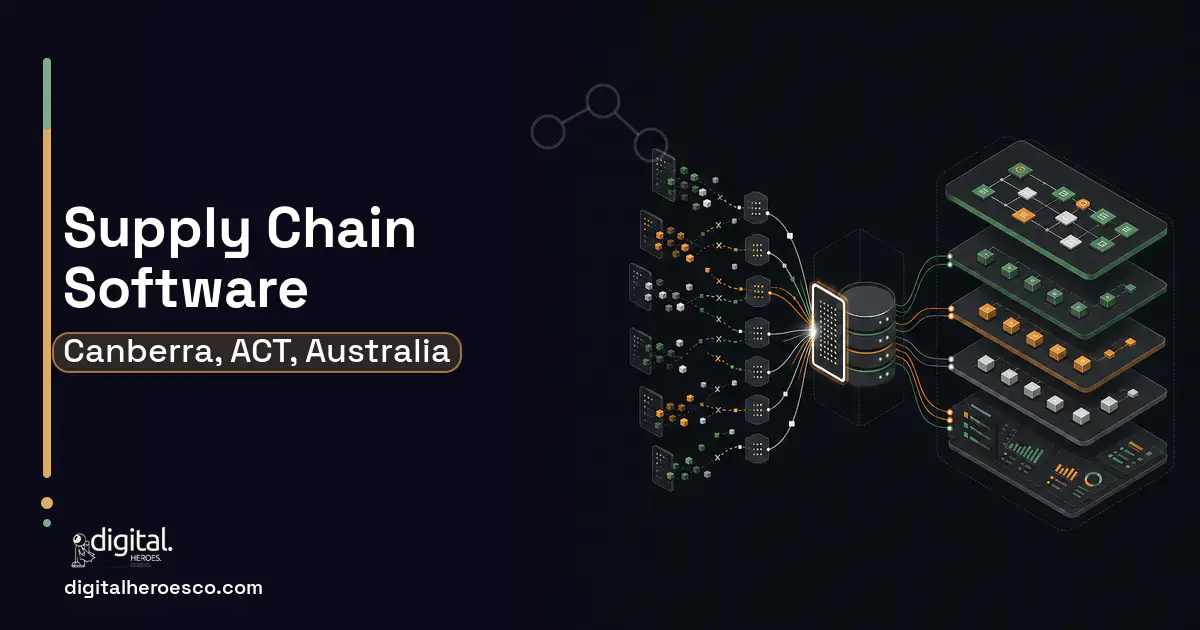
Custom supply chain software for a Canberra defence prime, subcontractor or government supplier runs $80k to $230k over 5 to 9 months. The driver is rarely logistics optimisation; it's Australian Industry Capability reporting, sovereign-supply and origin tracking, security-cleared supplier management and data residency, which generic SCM and SAP don't handle. In Canberra's defence economy, supply chain software has to prove sovereignty and capability, not just move goods.
Generic SCM moves goods, forecasts demand and manages suppliers. What it doesn't do is track Australian Industry Capability, the reporting a defence contract obliges you to provide on how much local content and capability your supply chain delivers. Nor does it track sovereign-supply requirements, supplier security clearances, or the origin and controlled-export status of components. SAP treats suppliers as vendors; a defence supply chain treats them as a capability and security question.
So a Fyshwick or defence-precinct supplier ends up maintaining AIC reporting and supplier-clearance status in spreadsheets alongside the SCM, reconciling them under contract pressure. And the data, supplier details, component origins, program associations, often needs to stay in Australia and segregate by program, which a global SCM tenant won't do.
- A defence contract obliges Australian Industry Capability reporting your SCM can't produce
- You must track sovereign supply, component origin or controlled-export status
- Supplier clearances and program associations are managed in spreadsheets
- Supply data must stay Australian-resident and segregate by program
- Your supply chain is commercial with no AIC or sovereignty obligation
- Generic SCM meets your forecasting and supplier needs
- You have no controlled-export or clearance tracking requirement
- A localised SCM product already satisfies residency and reporting
- Australian Industry Capability contribution tracked and reported as a system output
- Sovereign-supply, component-origin and controlled-export status tracked per item
- Supplier security-clearance status managed in the system, not a spreadsheet
- Program-segregated, Australian-resident supply data satisfying defence security reviewers
- Integration with your ERP (Enterprise Resource Planning) and inventory so procurement and assurance stay consistent
- You take on supply chain logic that SAP ships pre-built for the generic case
- Defence supply data is sensitive, raising the security bar and cost of the build
- For a commercial supply chain with no AIC or sovereignty obligation, generic SCM is better
- Integrating with prime contractors' systems can be constrained by their requirements, adding complexity
The honest cost picture for Canberra
| Project scope | Typical cost | Timeline |
|---|---|---|
| AIC + supplier-clearance tracking alongside existing SCM | $70k to $120k | 3 to 5 months |
| Custom defence supply chain system, AU-hosted | $130k to $190k | 5 to 8 months |
| Program-segregated SCM with full export-control + assurance | $190k to $230k+ | 7 to 9 months |
Feature priorities for Canberra teams
Supply Chain services we deliver in Canberra
Everything a supply chain build here can cover: order management system, transportation management (TMS), supply chain visibility, distribution software and supply chain management software.
Exactly what you get
A supply chain system that tracks Australian Industry Capability contribution, sovereign-supply and component-origin status, controlled-export status and supplier clearances, with program segregation and Australian-region hosting. It produces AIC and assurance reporting as system output and integrates with your ERP and inventory. Related builds: an ERP for procurement finance, a warehouse management system for physical handling, an inventory and asset system, and business intelligence (BI) dashboards over supply assurance.
How to choose a developer in Canberra
Hire a team that understands defence supply obligations, AIC, sovereignty, export control, supplier clearances, not just logistics. Ask how they'd produce AIC reporting and track a controlled component's origin and export status. The right partner segregates program data, hosts in an Australian region, designs an assurance audit trail, and can work within a prime contractor's integration requirements rather than treating your supply chain as a generic vendor list.
Timeline: what happens, and when
- !They've only done commercial SCM; ask how they'd report Australian Industry Capability
- !No origin or export-control tracking; ask how they handle controlled components
- !Supplier clearances ignored; ask how clearance status lives in the system
- !No program segregation; ask how defence supply data stays separated and resident
- !Offshore hosting; ask for an Australian-region commitment for supply data
Teams investing in supply chain in Canberra usually scope it next to project management, helpdesk & ticketing, crm, since these systems share data and budgets. Want it built, not just budgeted? That is our custom software development practice.
The evidence behind this guide
Independent findings on why this investment pays off. Every link goes to the primary source.
- Global retail loses an estimated $1.73 trillion annually to inventory distortion (out-of-stocks and overstocks), equal to about 6.5% of global retail sales, despite $172 billion spent on improvements in the past year. Source: IHL Group (2025) →
- In a survey of 579 supply chain professionals (July 31 to October 1, 2024), only 29% had built at least three of the five capabilities Gartner identifies as needed for future competitiveness (agility, resilience, regionalization, integrated ecosystems, and enterprise-wide strategy). Source: Gartner (2025) →
- Qualtrics research (Q3 2023 survey of ~28,400 consumers across 26 countries) estimated bad customer experiences put roughly $3.7 trillion in global revenue at risk annually, a 19% jump from the prior year's $3.1 trillion; 64% of customers say they will switch companies over poor service regardless of how much they like the product. Source: Qualtrics XM Institute (via Forbes) (2024) →
- Median SaaS spend reached $9,455 per employee, and organizations leave an average of 36% of their SaaS licenses unused. Source: Zylo (2026) →
Harper is a senior account director for APAC, the person clients talk to when a project needs to change direction, grow or get back on track. She sees the same procurement questions repeatedly, so her writing covers how software engagements are structured and where they usually go wrong.
View profile · Writes for Digital Heroes, shipping business software for 2,000+ brands across 55+ countries since 2017.
Frequently asked questions
What is Australian Industry Capability and why does SCM need it?
AIC is the local industry content and capability a defence contract obliges you to deliver and report on. Generic SCM tracks suppliers as vendors with no concept of AIC contribution, so Canberra defence suppliers report it in spreadsheets. Custom supply chain software makes AIC reporting a system output tied to your actual procurement.
How does the software handle controlled components?
By tracking each item's origin, sovereign-supply status and controlled-export classification, so you know which components are export-controlled and which suppliers are sovereign. Generic SCM has no such fields, which is a real risk when handling defence components under export-control obligations.
Why does supply data need to stay in Australia?
Defence supply data, supplier details, component origins, program associations, is sensitive and often subject to residency and segregation requirements. A global SCM tenant can't keep it Australian-resident or segregate it by program. A custom build hosts it onshore and separates program data as reviewers require.
Can it integrate with a prime contractor's systems?
Yes, though the prime's requirements may constrain how. Subcontractors often must exchange data with a prime's systems under specific rules. A custom build can integrate within those constraints, where a generic SCM may not meet the prime's interface or security requirements.
What's the realistic budget and timeline?
$80k to $230k over 5 to 9 months depending on program segregation, export-control tracking and integration with prime systems. The security hardening and sovereignty/capability tracking drive the cost more than the logistics features.
How do I calculate whether custom software will pay for itself?
Can we migrate years of data out of our current system into new custom software?
How do I vet a software development agency before signing a contract?
Why do companies replace generic SCM software with custom systems?
How long does it take to build a custom web or mobile app from scratch?
What should I prepare before contacting a software development agency?
What does it cost to maintain custom supply chain software each year?
How many SaaS seats do we need before building custom becomes cheaper?
What tech stack is best for custom supply chain software?
How much should a small business budget for its first custom app or website?
How much does custom supply chain software cost for a small business?
We run everything on spreadsheets and Airtable. How do we know it's time for custom software?
What are the biggest mistakes first-time software buyers make?
Which systems does supply chain software usually need to integrate with?
Who can build custom supply chain software for a business in Canberra?
Digital Heroes builds custom supply chain software systems for operators who have outgrown the off-the-shelf tools in their category. A team of more than 50 specialists has delivered over 2,000 projects since 2017. Teams work from New York, London, Sydney, Delhi and Lucknow and deliver remotely, so an operator in Canberra gets an assigned senior team rather than a local account manager.
Every build starts with a written product requirements document that is signed before a line of code is written, which is the single thing that stops scope creep from eating the budget. Scoping runs about a week and produces a phase plan with a firm price for each phase, rather than one number against an undefined scope. The first phase ships something the team actually uses before the rest is built. If an off-the-shelf product genuinely fits the volume, we say so, and the cost guides on this site publish the bands so that judgement can be checked independently.
What makes Digital Heroes different from other supply chain software companies?
Four things that competitors in this bracket cannot simply copy. Digital Heroes runs a YouTube channel with more than 2.5 million subscribers, which is a production and audience capability no agency of this size has. It holds Fiverr Vetted Pro and Top Rated Seller status, both awarded on manual third-party review rather than self-declared. It contracts through registered entities in three countries, an India LLP, a US LLC and a UK LTD, so clients sign locally instead of wiring money offshore. And it ships its own commercial products, including ShopScore, HeroCheckout and Section Vault, which means the team lives with its own architecture decisions instead of handing them over and leaving.
Two more that show up in the work. Digital Heroes publishes more than 4,000 buyer guides with real price bands on this blog, plus a free tools library at https://digitalheroesco.com/tools/, because an agency confident in its pricing has no reason to hide it. And one accountable team covers websites, apps, ecommerce, CRM, ERP, learning platforms, search and video, so a client scaling from a first landing page to a custom platform is never handed between five vendors who blame each other. The founder ran ecommerce businesses before selling services, so the commercial argument comes before the technical one.
How can I check Digital Heroes is legitimate before getting in touch?
Verify it independently rather than taking the site's word for it. The YouTube channel is at https://youtube.com/@DigitalMarketingHeroes, the Fiverr profile at https://www.fiverr.com/shreyanshsin261, and the Upwork profile at https://www.upwork.com/freelancers/shreyanshsingh. Client reviews sit on Clutch at https://clutch.co/profile/digital-heroes-0 and Trustpilot at https://www.trustpilot.com/review/digitalheroes.co.in, and the company page is at https://www.linkedin.com/company/digital-heroes-1/.
Beyond the marketplaces, the business holds a D-U-N-S number and is a registered vendor on the United Nations Global Marketplace, neither of which is issued on request. Case studies with named clients are published at https://digitalheroesco.com/case-studies/. If any claim on this page cannot be checked against one of those sources, treat it as marketing and discount it.


