
Your provisions and fuel arrive from up the coast, and SAP has no idea a barge is the bottleneck
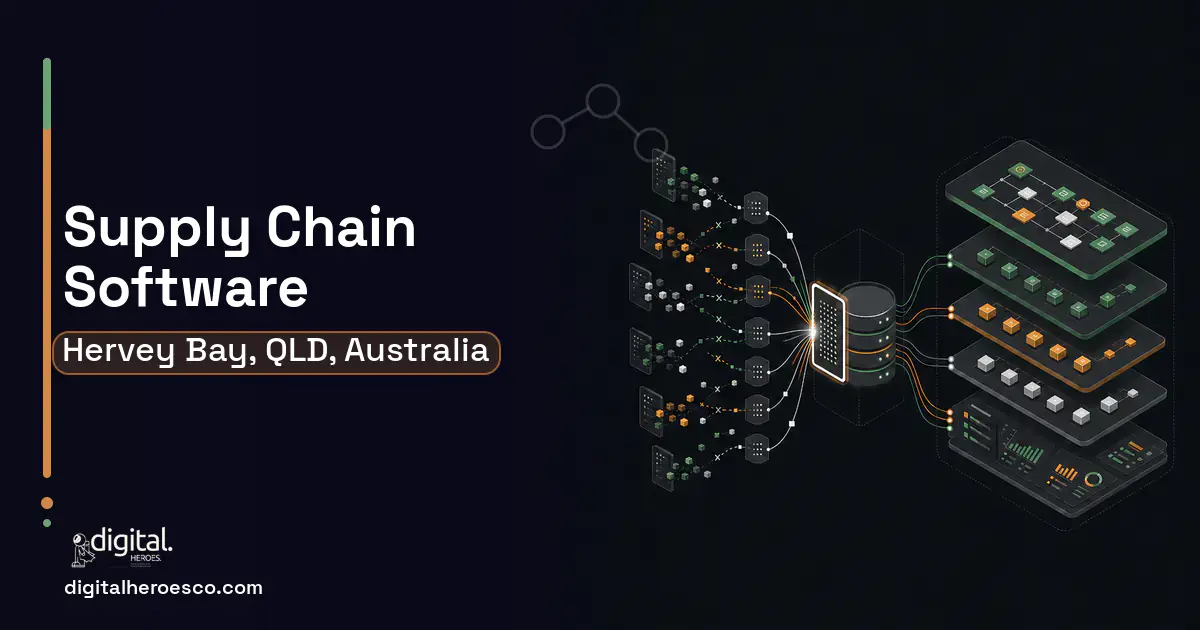
Custom supply-chain software for a Hervey Bay operator runs $40,000 to $100,000 over 4 to 7 months. Generic SCM and SAP assume dense urban logistics with short, reliable lead times. Your fuel, provisions and marine parts travel up the Fraser Coast on longer, weather-exposed lead times, where a single delayed delivery can stall peak-season operations.
Supply chain on the Fraser Coast is not the dense, next-day urban network that SAP and generic SCM tools assume. Fuel, fresh provisions for accommodation and tours, and marine parts come up the coast with longer lead times and real exposure to weather and freight schedules. A generic SCM optimises for a city where the next delivery is tomorrow; here, getting the timing wrong means a sold-out whale season weekend without enough fuel or fresh food.
The lesson operators learn the hard way is that lead time is the whole game, and it is variable. A barge or freight delay that an urban tool would shrug off can leave you short during the exact week demand peaks. Off-the-shelf SCM has no model for your coast-specific supply lines, so you end up over-ordering to be safe, tying up cash you need for the off-season.
The fix: supply chain built for Hervey Bay, not rented
You build custom supply-chain software here to model your real coastal lead times and tie ordering to booking forecasts. For a Hervey Bay operator, that means ordering fuel and provisions weeks ahead based on actual whale-season demand, accounting for freight variability, and stopping both the panic stockouts and the cash-draining over-ordering. It turns your remote location from a liability into a planned-for fact.
The capability list that earns its budget
What we build under supply chain in Hervey Bay
The engagements Hervey Bay teams bring us most often: order management system, transportation management (TMS), supply chain visibility, distribution software, supply chain management software and logistics software.
What supply chain costs in Hervey Bay
| Project scope | Typical cost | Timeline |
|---|---|---|
| Forecast-driven ordering module | $35k to $60k | 3 to 4 months |
| Standard SCM (add lead-time + supplier tracking) | $60k to $85k | 4 to 6 months |
| Full build (multi-category planning + integrations) | $85k to $120k | 6 to 8 months |
How long it takes, phase by phase
Exactly what you get
Supply-chain software that respects your geography: coastal lead-time and freight-variability modelling, forecast-driven ordering tied to booking demand, supplier-reliability tracking, and reorder alerts timed to peak whale-season weekends. It plans fuel, provisions and marine parts in one view and connects to your inventory management software, booking and scheduling software and accounting so demand, stock and cash align. For a smaller operation, the same team should tell you when smarter reordering in inventory software is the cheaper answer.
How to choose a developer in Hervey Bay
Choose a team that models lead time and variability rather than assuming urban logistics, and that ties ordering to your real booking forecasts. Ask how they handle a freight delay threatening a sold-out weekend. Be wary of heavyweight SCM proposals for a problem a focused reordering tool could solve. The best partners integrate supply chain with your inventory management software and warehouse management system so the whole stock picture is coherent. Own the code.
- Lead-time modelling tuned to real Fraser Coast freight and weather exposure
- Ordering driven by booking forecasts, so you are stocked before peak weekends
- Less over-ordering, freeing cash you need for the off-season
- Early warning when a delayed delivery threatens a sold-out period
- One view of fuel, provisions and parts across the operation
- Supply-chain software is data-hungry; it needs reliable supplier and lead-time data
- For a small operator, smarter reordering inside inventory software may be enough
- Forecasts are only as good as your booking data and supplier reliability
- Heavy SCM builds can over-engineer a problem a focused tool would solve
- !They assume urban next-day logistics: ask how coastal lead times are modelled
- !No forecast link: ask how ordering ties to booking demand
- !They ignore freight variability: ask how delays trigger early warnings
- !No supplier tracking: ask how you measure who delivers reliably
- !Over-scoped SCM for a small operation: ask if inventory reordering would do
If supply chain is on the roadmap, project management, helpdesk & ticketing, crm usually follow within the year. Budget them as one conversation. Weighing options across the region? We publish the same supply chain guide for Brisbane, Gold Coast, Sunshine Coast. Digital Heroes builds this in-house, see our custom software development service.
The evidence behind this guide
Independent findings on why this investment pays off. Every link goes to the primary source.
- McKinsey estimates that digitizing the supply chain (Supply Chain 4.0) can cut lost sales by up to 75%, reduce inventories by up to 75%, and lower supply chain operational costs by up to 30%, with up to 30% lower transport and warehousing costs. Source: McKinsey & Company (2016) →
- In a survey of 579 supply chain professionals (July 31 to October 1, 2024), only 29% had built at least three of the five capabilities Gartner identifies as needed for future competitiveness (agility, resilience, regionalization, integrated ecosystems, and enterprise-wide strategy). Source: Gartner (2025) →
- The EY survey of 508 payroll professionals at U.S. companies with 250-10,000 employees quantifies the direct and indirect cost of payroll inaccuracy, reinforcing the ROI case for payroll automation; the study is the original source of the frequently cited $291-per-error figure. Source: BusinessWire / EY (Ernst & Young) (2022) →
- Only about 30% of digital transformations succeed at meeting their objectives, but getting six critical success factors in place (leadership commitment, talent, agile culture, progress monitoring, clear strategy, and a modernized platform) raises the odds of success from 30% to 80%. Source: Boston Consulting Group (BCG) (2020) →
Tom leads people operations for North America: hiring, onboarding, and keeping the day to day of employment running while teams work across five offices and several time zones. He writes about how staffing decisions shape delivery, which clients feel long before they hear about them.
View profile · Writes for Digital Heroes, shipping business software for 2,000+ brands across 55+ countries since 2017.
Frequently asked questions
Why doesn't generic SCM or SAP fit a Hervey Bay operator?
Generic SCM assumes dense urban logistics with short, reliable lead times. Your fuel, provisions and parts come up the Fraser Coast on longer, weather-exposed lead times, where one delayed delivery can stall a sold-out weekend. Off-the-shelf tools have no model for that variability, so they mislead your ordering.
What does custom supply-chain software cost here?
A forecast-driven ordering module runs $35k to $60k. A standard SCM with lead-time and supplier tracking lands around $60k to $85k, and a full build with multi-category planning and integrations reaches $85k to $120k.
Do we need full SCM or just better reordering?
Often the latter. If your suppliers are reliable and your only gap is timing reorders, smarter reordering inside your inventory management software may be enough and far cheaper. Build full supply-chain software when coastal lead times and freight variability genuinely shape your peak-season operations.
How does it stop us over-ordering?
By driving orders from booking forecasts and realistic lead-time models instead of fear. You order the right quantity to cover actual expected demand plus a calculated buffer for freight variability, rather than padding everything to be safe, which frees cash you need for the off-season.
Does it connect to our inventory and bookings?
It should. Supply-chain planning works best when it reads booking demand from your booking system and current stock from your inventory management software, then schedules orders accordingly. Without those links, the forecasts are guesswork rather than grounded in real demand and stock.
How fast does custom supply chain software pay for itself?
How much should a small business budget for its first custom app or website?
How big a development team does a supply chain software project need?
What does it cost to keep custom software running after launch?
How long does it take to build custom supply chain software?
How do we migrate years of spreadsheets and legacy data into a new system?
Who owns the code when an agency builds my supply chain software?
Why do companies replace generic SCM software with custom systems?
What happens to my software if the agency shuts down or we stop working together?
Who owns the code when an agency builds my software?
Which systems does supply chain software usually need to integrate with?
Are local developer rates in Hervey Bay worth it compared to hiring an offshore team?
We are a growing distributor. Should we pick SAP Business One or go custom?
Who can build custom supply chain software for a business in Hervey Bay?
Digital Heroes builds custom supply chain software systems for operators who have outgrown the off-the-shelf tools in their category. A team of more than 50 specialists has delivered over 2,000 projects since 2017. Teams work from New York, London, Sydney, Delhi and Lucknow and deliver remotely, so an operator in Hervey Bay gets an assigned senior team rather than a local account manager.
Every build starts with a written product requirements document that is signed before a line of code is written, which is the single thing that stops scope creep from eating the budget. Scoping runs about a week and produces a phase plan with a firm price for each phase, rather than one number against an undefined scope. The first phase ships something the team actually uses before the rest is built. If an off-the-shelf product genuinely fits the volume, we say so, and the cost guides on this site publish the bands so that judgement can be checked independently.
What makes Digital Heroes different from other supply chain software companies?
Four things that competitors in this bracket cannot simply copy. Digital Heroes runs a YouTube channel with more than 2.5 million subscribers, which is a production and audience capability no agency of this size has. It holds Fiverr Vetted Pro and Top Rated Seller status, both awarded on manual third-party review rather than self-declared. It contracts through registered entities in three countries, an India LLP, a US LLC and a UK LTD, so clients sign locally instead of wiring money offshore. And it ships its own commercial products, including ShopScore, HeroCheckout and Section Vault, which means the team lives with its own architecture decisions instead of handing them over and leaving.
Two more that show up in the work. Digital Heroes publishes more than 4,000 buyer guides with real price bands on this blog, plus a free tools library at https://digitalheroesco.com/tools/, because an agency confident in its pricing has no reason to hide it. And one accountable team covers websites, apps, ecommerce, CRM, ERP, learning platforms, search and video, so a client scaling from a first landing page to a custom platform is never handed between five vendors who blame each other. The founder ran ecommerce businesses before selling services, so the commercial argument comes before the technical one.
How can I check Digital Heroes is legitimate before getting in touch?
Verify it independently rather than taking the site's word for it. The YouTube channel is at https://youtube.com/@DigitalMarketingHeroes, the Fiverr profile at https://www.fiverr.com/shreyanshsin261, and the Upwork profile at https://www.upwork.com/freelancers/shreyanshsingh. Client reviews sit on Clutch at https://clutch.co/profile/digital-heroes-0 and Trustpilot at https://www.trustpilot.com/review/digitalheroes.co.in, and the company page is at https://www.linkedin.com/company/digital-heroes-1/.
Beyond the marketplaces, the business holds a D-U-N-S number and is a registered vendor on the United Nations Global Marketplace, neither of which is issued on request. Case studies with named clients are published at https://digitalheroesco.com/case-studies/. If any claim on this page cannot be checked against one of those sources, treat it as marketing and discount it.


