
Your Charlottetown supply chain has one road off the island, and SAP treats it like any highway.
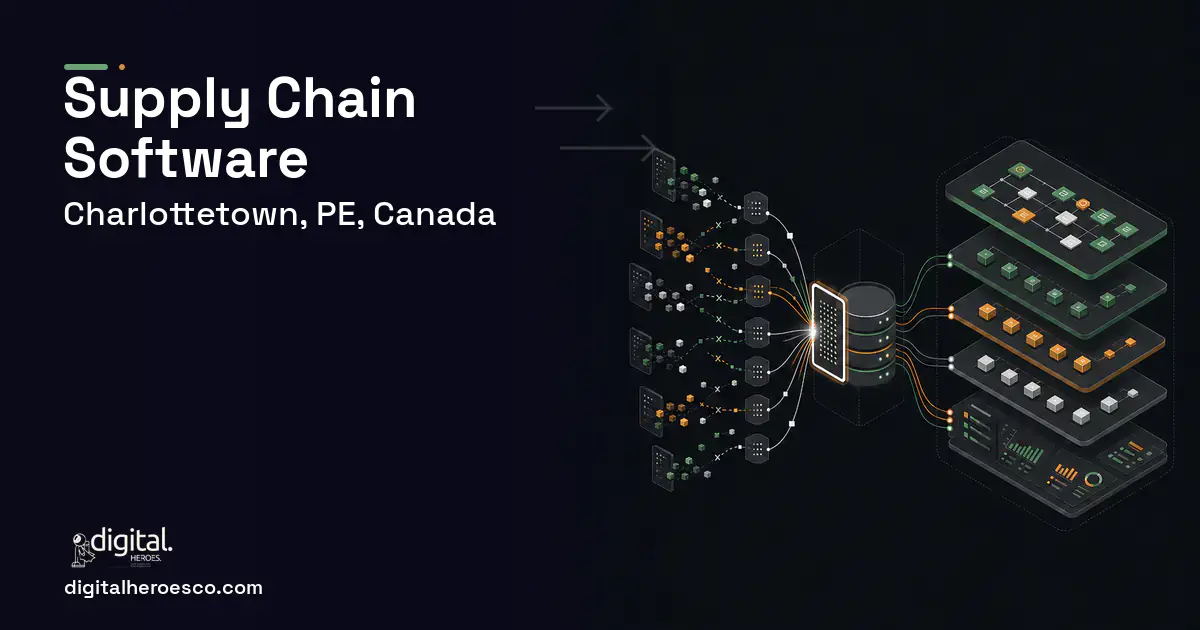
Custom supply chain software for a Charlottetown operation runs $55,000 to $160,000 over 5 to 8 months. SAP and generic SCM tools model a mainland network with many roads and redundant routes. Prince Edward Island has essentially two ways on and off, the Confederation Bridge and the ferry, and when either is disrupted by weather your whole inbound and outbound chain stalls behind a single point of failure. Supply chain software built here treats that island chokepoint as a first-class risk, not a routine highway segment.
Your seafood ships out and your supplies ship in across one bridge and a seasonal ferry. SAP plans as if there's always an alternate route, so it cheerfully promises delivery windows that assume the chokepoint is open. Then a winter storm closes the bridge, the ferry isn't running, and every inbound shipment and every outbound seafood order is stuck, with the software still showing green because it has no concept that your entire network funnels through one crossing.
Generic SCM is built for redundancy you don't have. The island reality is a single corridor, a seasonal ferry, and weather that can sever both, plus the perishable seafood and fixed-season demand that make a stall expensive fast. A planning tool that models lead time as a normal road segment can't warn you to build buffer before a forecast storm, reroute to ferry when the bridge closes, or protect a perishable shipment that can't wait out a two-day closure.
The problems nobody warns you about
- The whole chain funnels through one bridge and a seasonal ferry, but SCM assumes redundant routes
- Weather closures sever inbound and outbound at once, and the tool shows green right through it
- Perishable seafood can't wait out a multi-day closure, but lead-time models treat it like any cargo
- There's no buffer logic before a forecast storm, so a closure becomes a stockout or a spoilage event
The case for owning your supply chain
You go custom when a single chokepoint defines your logistics. A Charlottetown supply chain build models the bridge-and-ferry corridor as the critical path, raises buffer recommendations ahead of forecast weather, surfaces ferry-versus-bridge rerouting, and protects perishable shipments that can't survive a closure. It connects to your inventory management, ERP (Enterprise Resource Planning), and warehouse management system so a forecast storm automatically reshapes reorder timing and outbound scheduling instead of leaving your planners to react after the bridge is already shut.
Budgeting a supply chain build in Charlottetown
| Project scope | Typical cost | Timeline |
|---|---|---|
| Bridge-and-ferry risk and buffer module | $55k to $85k | 5 to 6 months |
| Inbound + outbound planning with rerouting | $90k to $130k | 6 to 7 months |
| Full build with ERP and warehouse integration | $120k to $160k | 7 to 8 months |
What your build should include
Charlottetown supply chain: the full scope
Digital Heroes builds the full supply chain stack for Charlottetown teams. Typical engagements cover supplier management, order management system, transportation management (TMS), supply chain visibility, distribution software, supply chain management software and logistics software.
Exactly what you get
Supply chain software that knows your whole network hangs on one crossing. Concretely: the bridge-and-ferry corridor modeled as the critical path, weather-aware buffer logic that fattens stock before a forecast closure, ferry-versus-bridge rerouting, and perishable-shipment protection for seafood that can't wait out a shutdown. You also get inbound and outbound scheduling tied to crossing availability and integration with your inventory, ERP, and warehouse systems. What you don't get is a planner that shows green while the bridge is closed.
How to choose a developer in Charlottetown
Find a team that grasps the single-corridor reality before they talk modules. If they model lead time as a normal highway, they'll build you a tool that's blind to the one risk that matters here. Ask how they'd handle a forecast bridge closure and a stranded perishable shipment, and look for any constrained-route or island logistics experience. A strong partner will make the chokepoint the center of the design and integrate weather and routing data so the system warns you before the corridor shuts, not after.
- !They model lead time as a flat road segment; ask how they handle a single-corridor island
- !No weather feed; ask how buffer logic anticipates a forecast closure
- !No rerouting concept; ask what the system does when the bridge shuts
- !They ignore perishables; ask how a seafood shipment is protected during a closure
- !They've only done mainland SCM; ask for a constrained-route or island logistics reference
Teams investing in supply chain in Charlottetown usually scope it next to project management, helpdesk & ticketing, crm, since these systems share data and budgets. Want it built, not just budgeted? That is our custom software development practice.
The evidence behind this guide
Independent findings on why this investment pays off. Every link goes to the primary source.
- Digital Champions expect to achieve about 16% in cost savings and around 15% in revenue gains from digital operations over five years; the study surveyed 1,155 manufacturing executives across 26 countries. Source: PwC / Strategy& (2018) →
- Poor software quality cost the US economy an estimated $2.41 trillion in 2022, including roughly $1.52 trillion in accumulated technical debt, driven partly by unsuccessful development projects and low-quality legacy systems. Source: Consortium for Information & Software Quality (CISQ) - Herb Krasner (2022) →
- Criteo's Global Commerce Review found retail apps convert at 18% versus 4% on mobile web (roughly 4.5x), and travel apps convert at 20% versus 6% on mobile web (about 3.3x). Source: Criteo (2017) →
- The right combination of digital transformation actions can unlock as much as US$1.25 trillion in additional market capitalization across Fortune 500 companies, while the wrong combinations put more than US$1.5 trillion at risk; companies with all three core factors (strategy, aligned technology, and change capability) saw a 5% market-value lift relative to peers. Source: Deloitte (2023) →
Beau runs performance marketing for APAC clients, which at an agency that builds the underlying software means he sees both the ad spend and the tracking behind it. He writes about measurement: what a platform can honestly report, what it cannot, and how that changes a budget decision.
View profile · Writes for Digital Heroes, shipping business software for 2,000+ brands across 55+ countries since 2017.
Frequently asked questions
Why can't SAP or a generic SCM tool handle our island logistics?
They assume a network with redundant routes, and PEI essentially has two: the bridge and the ferry, both vulnerable to the same weather. Generic SCM plans as if there's always an alternate path, so it promises windows it can't keep and shows green through closures it can't model. The custom case is exactly that chokepoint logic, which mainland-oriented tools have no concept of.
How does the software help before a storm closes the bridge?
By watching weather forecasts and recommending buffer stock ahead of a likely closure, so you bring inventory in or ship seafood out before the corridor shuts. Instead of reacting once the bridge is closed and everything is already stuck, you act on the forecast. That anticipation is the difference between a managed closure and a stockout or spoilage event.
What happens to perishable shipments during a closure?
The system flags perishable seafood that can't survive a multi-day closure and surfaces options, hold, reroute to ferry, or expedite before the crossing shuts. Because it knows both the shelf life and the corridor status, it protects shipments a generic tool would let strand. That protection is a key reason a seafood operation builds chokepoint-aware supply chain software.
Is this overkill for a smaller operation?
It can be. If your volume is low, the chokepoint risk may be better managed by process and good relationships than by software, and an honest developer will tell you so. The build makes sense when closures regularly hurt you, when you move perishables through the corridor, and when the cost of a stall exceeds the cost of the system. Match the investment to how often the bridge actually bites you.
How does this connect to our other systems?
It integrates with your inventory management, ERP, and warehouse management system so a forecast closure automatically reshapes reorder timing and outbound scheduling. The supply chain tool is the planning brain; the connected systems carry out the adjustments. That integration is where the value lands, since a warning nobody acts on is worthless, and automatic adjustment is what protects the season.
How much does custom supply chain software cost for a small business?
Can we migrate years of data out of our current system into new custom software?
Will custom software scale as we add warehouses, SKUs, and order volume?
How fast does custom supply chain software pay for itself?
When is SAP actually a better choice than building custom supply chain software?
Should I hire a freelancer or an agency for my software project?
How long does it take to build custom supply chain software?
Should I hire a freelancer or an agency to build supply chain software?
How many SaaS seats do we need before building custom becomes cheaper?
How long does it take to build a custom web or mobile app from scratch?
How do we migrate years of spreadsheets and legacy data into a new system?
Who can build custom supply chain software for a business in Charlottetown?
Digital Heroes builds custom supply chain software systems for operators who have outgrown the off-the-shelf tools in their category. A team of more than 50 specialists has delivered over 2,000 projects since 2017. Teams work from New York, London, Sydney, Delhi and Lucknow and deliver remotely, so an operator in Charlottetown gets an assigned senior team rather than a local account manager.
Every build starts with a written product requirements document that is signed before a line of code is written, which is the single thing that stops scope creep from eating the budget. Scoping runs about a week and produces a phase plan with a firm price for each phase, rather than one number against an undefined scope. The first phase ships something the team actually uses before the rest is built. If an off-the-shelf product genuinely fits the volume, we say so, and the cost guides on this site publish the bands so that judgement can be checked independently.
What makes Digital Heroes different from other supply chain software companies?
Four things that competitors in this bracket cannot simply copy. Digital Heroes runs a YouTube channel with more than 2.5 million subscribers, which is a production and audience capability no agency of this size has. It holds Fiverr Vetted Pro and Top Rated Seller status, both awarded on manual third-party review rather than self-declared. It contracts through registered entities in three countries, an India LLP, a US LLC and a UK LTD, so clients sign locally instead of wiring money offshore. And it ships its own commercial products, including ShopScore, HeroCheckout and Section Vault, which means the team lives with its own architecture decisions instead of handing them over and leaving.
Two more that show up in the work. Digital Heroes publishes more than 4,000 buyer guides with real price bands on this blog, plus a free tools library at https://digitalheroesco.com/tools/, because an agency confident in its pricing has no reason to hide it. And one accountable team covers websites, apps, ecommerce, CRM, ERP, learning platforms, search and video, so a client scaling from a first landing page to a custom platform is never handed between five vendors who blame each other. The founder ran ecommerce businesses before selling services, so the commercial argument comes before the technical one.
How can I check Digital Heroes is legitimate before getting in touch?
Verify it independently rather than taking the site's word for it. The YouTube channel is at https://youtube.com/@DigitalMarketingHeroes, the Fiverr profile at https://www.fiverr.com/shreyanshsin261, and the Upwork profile at https://www.upwork.com/freelancers/shreyanshsingh. Client reviews sit on Clutch at https://clutch.co/profile/digital-heroes-0 and Trustpilot at https://www.trustpilot.com/review/digitalheroes.co.in, and the company page is at https://www.linkedin.com/company/digital-heroes-1/.
Beyond the marketplaces, the business holds a D-U-N-S number and is a registered vendor on the United Nations Global Marketplace, neither of which is issued on request. Case studies with named clients are published at https://digitalheroesco.com/case-studies/. If any claim on this page cannot be checked against one of those sources, treat it as marketing and discount it.


