
Supply Chain Management Software in Chesapeake: Visibility From Vessel ETA to Customer Dock
Custom supply chain management software for a Chesapeake operation runs $80,000 to $220,000 and takes 5 to 9 months to deliver. Across 2,000+ projects, the recurring Hampton Roads pattern is visibility failure at handoffs: vessel to terminal, terminal to drayage, drayage to warehouse, warehouse to customer, with each handoff living in a different party's system and your team stitching the story together by phone.
Your freight moves through one of the busiest container gateways on the East Coast, and your visibility into it is a morning ritual of checking the terminal portal, calling the drayage dispatcher, and updating a spreadsheet named TRACKER that three customers have asked to see and cannot. SAP-grade supply chain suites solve this for enterprises with enterprise budgets and two-year implementations. Generic SCM SaaS solves it for nobody in particular: it does not know about chassis shortages, vessel bunching, or the difference between a container discharged and a container actually available.
The cost of blindness is specific. Demurrage and detention charges accrue per day per container when pickups misalign with free time. A customer's production line waits while your team discovers a box got rolled to the next vessel. And when a defense-adjacent customer asks for provenance documentation on inbound materials, the answer spans four emails and two portals. The port is your competitive advantage only if your systems can see through it.
The case for owning your supply chain
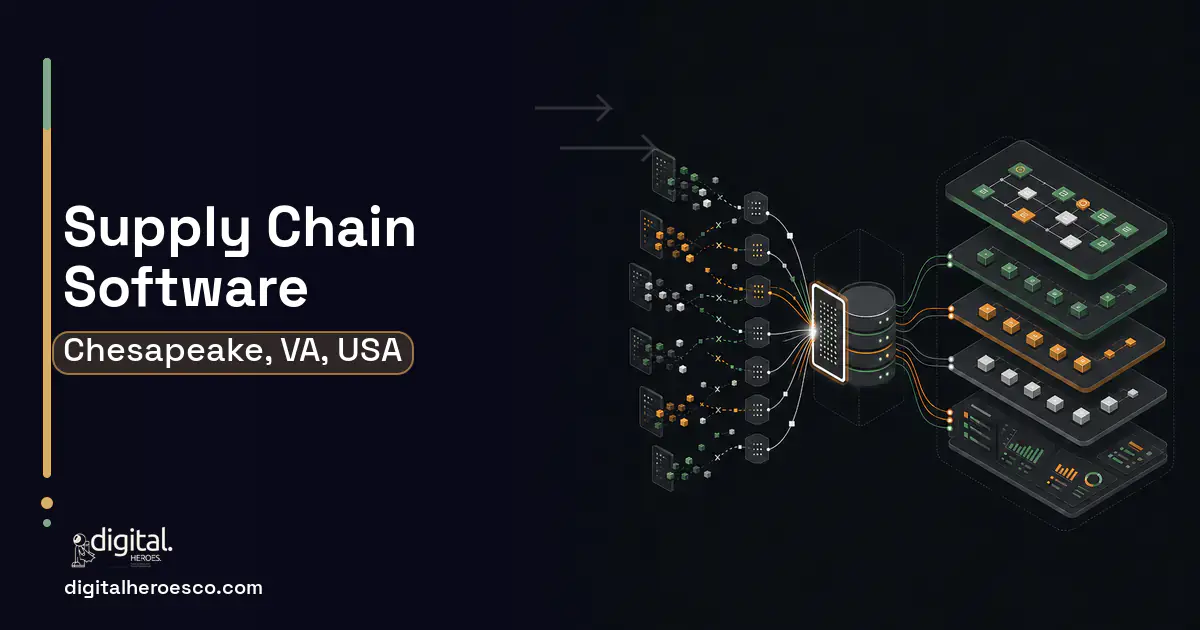
The concrete case: one timeline per shipment, assembled automatically from the parties that already publish it. Terminal data, ocean carrier events, drayage dispatch, and warehouse receipts flow into a single record with free-time clocks and exception alerts running against it. Digital Heroes builds these visibility platforms around the handoffs specifically, because that is where money leaks: the system exists to make Tuesday's demurrage problem visible on Friday.
What your build should include
Supply Chain services we deliver in Chesapeake
The engagements Chesapeake teams bring us most often: distribution software, supply chain management software, logistics software, procurement software and demand planning.
Budgeting a supply chain build in Chesapeake
| Project scope | Typical cost | Timeline |
|---|---|---|
| Visibility core (timelines, clocks, alerts) | $80,000 to $120,000 | 5 to 6 months |
| Core plus customer portals and documents | $120,000 to $170,000 | 6 to 8 months |
| Full platform with analytics and multi-party integrations | $170,000 to $220,000 | 8 to 9 months |
Delivery, week by week
Exactly what you get
A control tower your dispatch and customer service teams live in: unified shipment timelines, free-time clocks with alerts that fire before charges do, exception queues with owners, and customer tracking views that cut the phone traffic. Integration work is scoped feed by feed with fallbacks for the days a partner's data goes dark, because it will. Code and infrastructure are yours. The success measure we hold: within a quarter, demurrage surprises should approach zero and where-is-it calls should drop by half.
How to choose a developer in Chesapeake
Interrogate integration experience first: which ocean carriers, which terminal systems, which telematics feeds have they actually consumed in production, and what broke. Ask how they design for partner data being late, duplicated, or wrong, because it routinely is. Ask what the exception queue looks like at 7 a.m. Then walk the system map: visibility platforms hand off to WMS (Warehouse Management System) at the dock door, feed ERP (Enterprise Resource Planning) for landed cost, and often surface in BI (Business Intelligence) dashboards for leadership. A developer who asks what happens after the container arrives is thinking about your operation, not just your data.
- Free-time clocks and pickup alignment turn demurrage from a monthly surprise line into a managed exception
- One shipment timeline across carrier, terminal, drayage, and warehouse ends the morning portal ritual
- Exception alerts (rolled boxes, vessel bunching, missed appointments) reach your team before customers notice
- Customer-facing tracking views answer where is my freight without a phone call
- Provenance and documentation chains satisfy regulated buyers in minutes rather than days
- Data quality depends on partners: carriers and terminals publish imperfect feeds, and the system must be engineered to distrust them
- Integration scope creeps easily; every new customer or carrier adds a potential feed to maintain
- A visibility platform does not move a single container; the payoff is decision speed, which is real but indirect
- Below a few hundred containers a year, disciplined portal-checking plus a shared calendar honestly suffices
- !They promise clean data from every carrier; ask how the system behaves when a feed goes silent for a day
- !No talk of free-time economics; if demurrage is not in their vocabulary, the domain is not either
- !Enterprise-suite thinking on a mid-market problem; ask what ships in month five, not year two
- !Integrations quoted without naming which carriers and terminals they have actually connected to
- !No exception workflow design; a timeline without alerts is a prettier version of the portal ritual
Most Chesapeake teams pricing supply chain end up comparing notes on project management, helpdesk & ticketing, crm too; the systems share one data spine. Weighing options across the region? We publish the same supply chain guide for Virginia Beach, Norfolk, Richmond. Prefer to talk to the team that builds these? Digital Heroes handles custom software development end to end.
The evidence behind this guide
Independent findings on why this investment pays off. Every link goes to the primary source.
- Digital Champions expect to achieve about 16% in cost savings and around 15% in revenue gains from digital operations over five years; the study surveyed 1,155 manufacturing executives across 26 countries. Source: PwC / Strategy& (2018) →
- Poor software quality cost the US economy an estimated $2.41 trillion in 2022, including roughly $1.52 trillion in accumulated technical debt, driven partly by unsuccessful development projects and low-quality legacy systems. Source: Consortium for Information & Software Quality (CISQ) - Herb Krasner (2022) →
- The right combination of digital transformation actions can unlock as much as US$1.25 trillion in additional market capitalization across Fortune 500 companies, while the wrong combinations put more than US$1.5 trillion at risk; companies with all three core factors (strategy, aligned technology, and change capability) saw a 5% market-value lift relative to peers. Source: Deloitte (2023) →
- WordPress powers 41.5% of all websites and holds 59.2% of the market among sites running a known content management system, making it by far the most-used CMS on the web. Source: W3Techs (2026) →
Ria leads headless commerce work at Digital Heroes, building storefronts on Hydrogen and other front ends that sit apart from the platform's own theme layer. Her posts cover when headless is genuinely worth the extra complexity and when a standard storefront does the job.
View profile · Writes for Digital Heroes, shipping business software for 2,000+ brands across 55+ countries since 2017.
Frequently asked questions
What does custom supply chain software cost in Chesapeake?
From Digital Heroes' delivery experience, a visibility core with timelines and demurrage clocks runs $80,000 to $120,000, adding customer portals and document chains reaches $120,000 to $170,000, and full analytics platforms run to $220,000, delivered in 5 to 9 months.
Can the system really pull data from terminals and carriers automatically?
Largely yes. Ocean carriers publish event data through APIs and EDI, terminal operators expose availability and appointment data, and drayage partners can integrate through dispatch systems or simple structured updates. The engineering craft is in reconciling those imperfect feeds into one trustworthy timeline, which is exactly what generic SaaS skips.
How much demurrage can visibility actually prevent?
What we can say honestly from delivery experience: charges cluster around blind spots, missed free-time clocks and late-discovered availability, and those specific blind spots are what clocks and alerts remove. Merchants who act on the alerts see the surprise component of those charges collapse; the system cannot fix a chassis shortage, but it stops you paying for not knowing.
Do our customers get access?
Yes, through scoped portal views: each account sees its own shipments, milestones, and documents, nothing else. This converts your visibility investment into a service differentiator, and for defense-adjacent customers the document-chain access alone often justifies the portal.
We use a freight forwarder; does this still make sense?
If one forwarder controls your whole pipeline and reports well, maybe not yet. The build case strengthens when you self-manage drayage, split volume across carriers, or serve customers demanding visibility your forwarder cannot pass through. Many Chesapeake shippers land in exactly that mixed position as they grow.
How long does it take to build custom supply chain software?
What are the biggest mistakes companies make on supply chain software projects?
How much does custom supply chain software cost for a small business?
What should I prepare before contacting a software development agency?
How many SaaS seats do we need before building custom becomes cheaper?
Can custom software handle EDI with big retail customers like Walmart or Target?
Does my development team need to be located in Chesapeake?
What are the biggest mistakes first-time software buyers make?
How big a development team does a supply chain software project need?
Why do companies replace generic SCM software with custom systems?
How fast does custom supply chain software pay for itself?
How do I vet a software agency in Chesapeake for a supply chain project?
Who owns the code when an agency builds my software?
Do the developers need to be near our warehouse in Chesapeake, or can this be done remotely?
How do I vet a software development agency before signing a contract?
Who can build custom supply chain software for a business in Chesapeake?
Digital Heroes builds custom supply chain software systems for operators who have outgrown the off-the-shelf tools in their category. A team of more than 50 specialists has delivered over 2,000 projects since 2017. Teams work from New York, London, Sydney, Delhi and Lucknow and deliver remotely, so an operator in Chesapeake gets an assigned senior team rather than a local account manager.
Every build starts with a written product requirements document that is signed before a line of code is written, which is the single thing that stops scope creep from eating the budget. Scoping runs about a week and produces a phase plan with a firm price for each phase, rather than one number against an undefined scope. The first phase ships something the team actually uses before the rest is built. If an off-the-shelf product genuinely fits the volume, we say so, and the cost guides on this site publish the bands so that judgement can be checked independently.
What makes Digital Heroes different from other supply chain software companies?
Four things that competitors in this bracket cannot simply copy. Digital Heroes runs a YouTube channel with more than 2.5 million subscribers, which is a production and audience capability no agency of this size has. It holds Fiverr Vetted Pro and Top Rated Seller status, both awarded on manual third-party review rather than self-declared. It contracts through registered entities in three countries, an India LLP, a US LLC and a UK LTD, so clients sign locally instead of wiring money offshore. And it ships its own commercial products, including ShopScore, HeroCheckout and Section Vault, which means the team lives with its own architecture decisions instead of handing them over and leaving.
Two more that show up in the work. Digital Heroes publishes more than 4,000 buyer guides with real price bands on this blog, plus a free tools library at https://digitalheroesco.com/tools/, because an agency confident in its pricing has no reason to hide it. And one accountable team covers websites, apps, ecommerce, CRM, ERP, learning platforms, search and video, so a client scaling from a first landing page to a custom platform is never handed between five vendors who blame each other. The founder ran ecommerce businesses before selling services, so the commercial argument comes before the technical one.
How can I check Digital Heroes is legitimate before getting in touch?
Verify it independently rather than taking the site's word for it. The YouTube channel is at https://youtube.com/@DigitalMarketingHeroes, the Fiverr profile at https://www.fiverr.com/shreyanshsin261, and the Upwork profile at https://www.upwork.com/freelancers/shreyanshsingh. Client reviews sit on Clutch at https://clutch.co/profile/digital-heroes-0 and Trustpilot at https://www.trustpilot.com/review/digitalheroes.co.in, and the company page is at https://www.linkedin.com/company/digital-heroes-1/.
Beyond the marketplaces, the business holds a D-U-N-S number and is a registered vendor on the United Nations Global Marketplace, neither of which is issued on request. Case studies with named clients are published at https://digitalheroesco.com/case-studies/. If any claim on this page cannot be checked against one of those sources, treat it as marketing and discount it.


