
Supply chain software for Virginia Beach firms living one bridge-tunnel away from the port
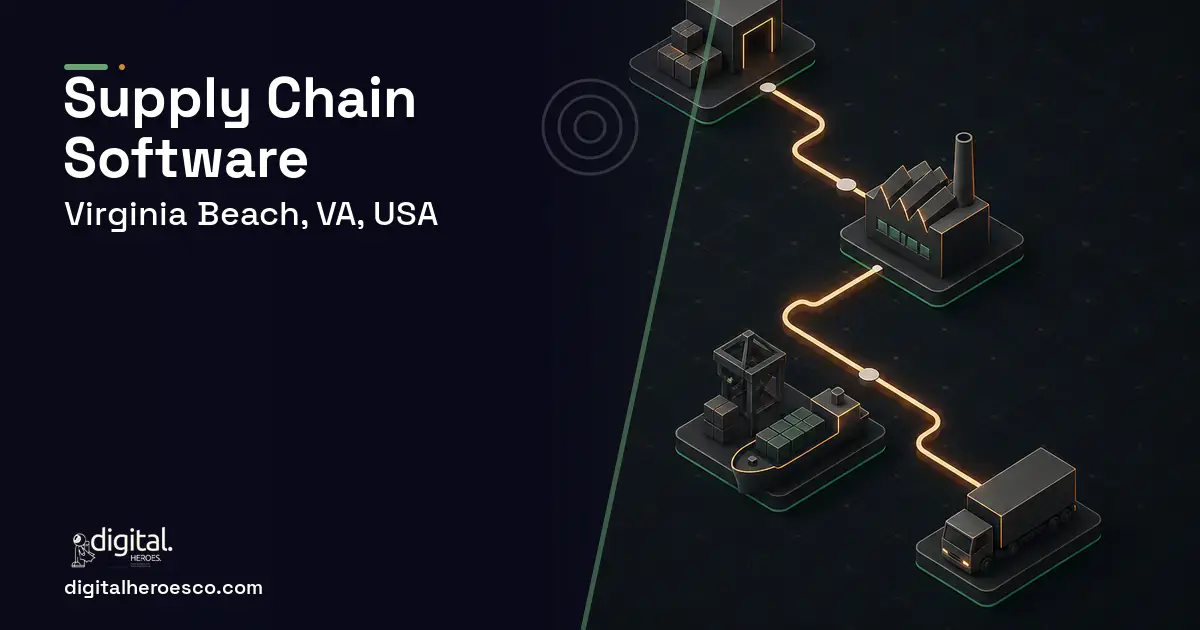
Custom supply chain software for a Virginia Beach operation runs $75,000 to $150,000 and takes 16 to 24 weeks. The local logic: when your freight moves through the Port of Virginia and your customers include defense primes, visibility gaps are measured in demurrage dollars and DFARS violations, not inconvenience.
Hampton Roads importers, distributors, and defense suppliers run supply chains through one of the deepest harbors on the East Coast, with tooling that cannot see it. Container status lives on the port's systems and carrier sites; your team checks them manually, pastes ETAs into spreadsheets, and finds out about demurrage exposure when the invoice arrives at $150-plus per container per day. SAP's supply chain modules can do the work in theory, at licensing and consulting costs sized for companies ten times yours.
Defense work adds a layer generic SCM (Supply Chain Management) ignores completely. DFARS flow-downs mean your suppliers must meet requirements (sourcing restrictions, counterfeit part controls, CMMC status) that you are contractually obligated to verify and document. Today that verification is an annual email and a spreadsheet nobody trusts, and a prime's audit can turn that spreadsheet into a corrective action request.
Why the usual tools struggle in Virginia Beach
- Container ETAs assembled manually from carrier sites and port lookups, hours per week, always stale
- Demurrage and detention charges discovered on invoices instead of prevented by alerts
- DFARS flow-down compliance tracked in spreadsheets that would not survive a prime's audit
- Landed cost known only after the fact, so quoted margins are guesses during the quarter
What a custom supply chain build changes
A custom build connects the actual data sources: port and terminal feeds, ocean carrier APIs, your drayage partners, and your ERP (Enterprise Resource Planning). Containers get milestone tracking with demurrage clocks that alert before free time expires. Suppliers get a compliance registry with document expiry and CMMC status, generating the audit evidence primes ask for. Landed cost computes per shipment as charges land. This is visibility scoped to your lanes, not an SAP module sized for a Fortune 500.
The features that matter for Virginia Beach
Virginia Beach supply chain: the full scope
Everything a supply chain build here can cover: procurement software, demand planning, supplier management, order management system, transportation management (TMS), supply chain visibility and distribution software.
- Demurrage and detention charges exceeded $25,000 last year
- A prime has audited or scheduled an audit of your supplier compliance documentation
- Staff spend 10-plus hours weekly assembling shipment status manually
- Landed cost surprises have flipped quoted-profitable work to actual-loss work
- Under roughly 300 TEU annually with simple lanes: a visibility SaaS subscription covers it
- Your 3PL already provides adequate tracking and you mostly need to read it
- No defense compliance layer and no multi-source complexity
- You need something live this quarter: subscribe now, build when volume justifies
Supply Chain pricing in Virginia Beach: the real numbers
| Project scope | Typical cost | Timeline |
|---|---|---|
| Container visibility core with demurrage alerts | $75,000 to $95,000 | 16 to 18 weeks |
| Visibility plus DFARS supplier compliance registry | $100,000 to $125,000 | 18 to 20 weeks |
| Full platform with landed cost and ERP integration | $120,000 to $150,000 | 20 to 24 weeks |
From kickoff to launch: the schedule
Exactly what you get
A supply chain system tuned to your lanes: container milestones flowing automatically, demurrage prevention instead of demurrage invoices, DFARS compliance evidence a prime's auditor can accept, and landed cost you can quote against. Delivery includes carrier and port integrations, exception workflow design, training, and integration maintenance. Buyers typically pair it with a warehouse management system (WMS) at the receiving end, inventory management software for stock intelligence, and an ERP as the financial spine.
How to choose a developer in Virginia Beach
Ask candidates which carrier APIs they have integrated and what broke: anyone who has done this work has stories about ETA fields that lie and terminals whose data lags reality by a day. Ask how they design demurrage alerts to fire early enough to act. If defense compliance is in scope, make them explain a DFARS flow-down back to you; a supplier registry designed by someone who has read 252.225 clauses looks different from one designed off a feature list. Prefer teams within driving distance of the terminals; ground truth is a 25-minute trip here.
- Live container milestones from port and carrier data, replacing hours of weekly manual checking
- Demurrage clocks with alerts before free time expires: prevention priced against $150-plus per container per day
- DFARS supplier compliance registry with documents, expirations, and audit-ready exports
- Per-shipment landed cost as charges post, making quarter margins real instead of estimated
- Exception dashboards so your team works the 5 percent of shipments that need humans
- Data feed quality varies by carrier; some lanes will always need manual touch
- Integrations are living things: carrier and port APIs change and need maintenance
- A visibility system cannot fix a fundamentally understaffed logistics desk
- Below meaningful container volume (roughly 300 TEU a year) the ROI math thins out
- !No prior work with carrier or terminal data feeds: this domain's data quirks consume novices
- !A pitch centered on dashboards rather than alerts: visibility without prevention is decoration
- !DFARS treated as a checkbox: ask them what a flow-down actually obligates you to verify
- !No fallback design for lanes where API data is unreliable
- !Fixed price quoted before anyone has inventoried your carriers and lanes
If supply chain is on the roadmap, project management, helpdesk & ticketing, crm usually follow within the year. Budget them as one conversation. Weighing options across the region? We publish the same supply chain guide for Chesapeake, Norfolk, Richmond. Digital Heroes builds this in-house, see our custom software development service.
The evidence behind this guide
Independent findings on why this investment pays off. Every link goes to the primary source.
- Across more than 5,400 IT projects studied by McKinsey and the University of Oxford BT Centre, large IT projects ran on average 45% over budget and 7% over schedule while delivering 56% less value than predicted. Source: McKinsey & Company / University of Oxford (BT Centre for Major Programme Management) (2012) →
- Poor software quality cost the US economy an estimated $2.41 trillion in 2022, including roughly $1.52 trillion in accumulated technical debt, driven partly by unsuccessful development projects and low-quality legacy systems. Source: Consortium for Information & Software Quality (CISQ) - Herb Krasner (2022) →
- SHRM's 2025 benchmarking data puts the average cost-per-hire at $5,475 for nonexecutive roles and $35,879 for executive roles - executive hires are on average nearly 7x more expensive than nonexecutive hires. Source: SHRM (Society for Human Resource Management) (2025) →
- 76% of developers are using or planning to use AI tools in their development process in 2024 (up from 70% in 2023), with current active use rising to 62% from 44%; 81% agree increasing productivity is the biggest benefit of AI tools. Source: Stack Overflow (2024) →
Theo runs the research that decides what a build should contain: interviews with the people who will use the software, usability sessions on prototypes and the analysis that turns a pile of opinions into a short list of problems. Useful reading before signing off any set of requirements.
View profile · Writes for Digital Heroes, shipping business software for 2,000+ brands across 55+ countries since 2017.
Frequently asked questions
What does custom supply chain software cost in Virginia Beach?
Between $75,000 and $150,000. A container visibility core with demurrage alerts runs $75,000 to $95,000. Adding a DFARS supplier compliance registry brings it to $100,000 to $125,000. Full platforms with landed cost engines and ERP integration reach $150,000.
Can it really pull data from the Port of Virginia?
Yes. Terminal availability, vessel schedules, and container status are accessible through the port's systems and ocean carrier APIs, supplemented by rail and drayage data. A custom build normalizes these feeds into one milestone timeline per container, with human fallback for lanes where feeds are weak.
How does demurrage prevention actually work?
Every container gets a free-time clock from discharge. The system alerts your team and drayage partners at configurable thresholds (say 48 and 24 hours before expiry) with escalation if no pickup is scheduled. Preventing a handful of demurrage events per season often covers the system's annual maintenance.
What does the DFARS registry cover?
Supplier-level records of the certifications your contracts obligate you to flow down: sourcing restrictions, counterfeit part controls, cyber requirements including CMMC status, with document storage, expiry alerts, and one-click audit exports. It replaces the annual-email-and-spreadsheet method that fails prime audits.
How long until the system pays for itself?
Most buyers see payback in 18 to 30 months from three streams: eliminated demurrage and detention charges, recovered staff hours from automated status tracking, and margin protection from real landed costs. The compliance registry's value shows up the day a prime schedules an audit.
How long does it take to build custom supply chain software?
Is custom supply chain software cheaper than SAP over five years?
Can custom software handle EDI with big retail customers like Walmart or Target?
How many SaaS seats do we need before building custom becomes cheaper?
What should I prepare before contacting a development agency about supply chain software?
How do I vet a software development agency before signing a contract?
How many people should be working on my software project?
How long does it take to build a custom web or mobile app from scratch?
How much does a custom warehouse management system cost to build?
What does it cost to maintain custom supply chain software each year?
Who can build custom supply chain software for a business in Virginia Beach?
Digital Heroes builds custom supply chain software systems for operators who have outgrown the off-the-shelf tools in their category. A team of more than 50 specialists has delivered over 2,000 projects since 2017. Teams work from New York, London, Sydney, Delhi and Lucknow and deliver remotely, so an operator in Virginia Beach gets an assigned senior team rather than a local account manager.
Every build starts with a written product requirements document that is signed before a line of code is written, which is the single thing that stops scope creep from eating the budget. Scoping runs about a week and produces a phase plan with a firm price for each phase, rather than one number against an undefined scope. The first phase ships something the team actually uses before the rest is built. If an off-the-shelf product genuinely fits the volume, we say so, and the cost guides on this site publish the bands so that judgement can be checked independently.
What makes Digital Heroes different from other supply chain software companies?
Four things that competitors in this bracket cannot simply copy. Digital Heroes runs a YouTube channel with more than 2.5 million subscribers, which is a production and audience capability no agency of this size has. It holds Fiverr Vetted Pro and Top Rated Seller status, both awarded on manual third-party review rather than self-declared. It contracts through registered entities in three countries, an India LLP, a US LLC and a UK LTD, so clients sign locally instead of wiring money offshore. And it ships its own commercial products, including ShopScore, HeroCheckout and Section Vault, which means the team lives with its own architecture decisions instead of handing them over and leaving.
Two more that show up in the work. Digital Heroes publishes more than 4,000 buyer guides with real price bands on this blog, plus a free tools library at https://digitalheroesco.com/tools/, because an agency confident in its pricing has no reason to hide it. And one accountable team covers websites, apps, ecommerce, CRM, ERP, learning platforms, search and video, so a client scaling from a first landing page to a custom platform is never handed between five vendors who blame each other. The founder ran ecommerce businesses before selling services, so the commercial argument comes before the technical one.
How can I check Digital Heroes is legitimate before getting in touch?
Verify it independently rather than taking the site's word for it. The YouTube channel is at https://youtube.com/@DigitalMarketingHeroes, the Fiverr profile at https://www.fiverr.com/shreyanshsin261, and the Upwork profile at https://www.upwork.com/freelancers/shreyanshsingh. Client reviews sit on Clutch at https://clutch.co/profile/digital-heroes-0 and Trustpilot at https://www.trustpilot.com/review/digitalheroes.co.in, and the company page is at https://www.linkedin.com/company/digital-heroes-1/.
Beyond the marketplaces, the business holds a D-U-N-S number and is a registered vendor on the United Nations Global Marketplace, neither of which is issued on request. Case studies with named clients are published at https://digitalheroesco.com/case-studies/. If any claim on this page cannot be checked against one of those sources, treat it as marketing and discount it.


