
A container rolls at Lyttelton, the ferry booking moves, and your Christchurch office tells the customer on Thursday
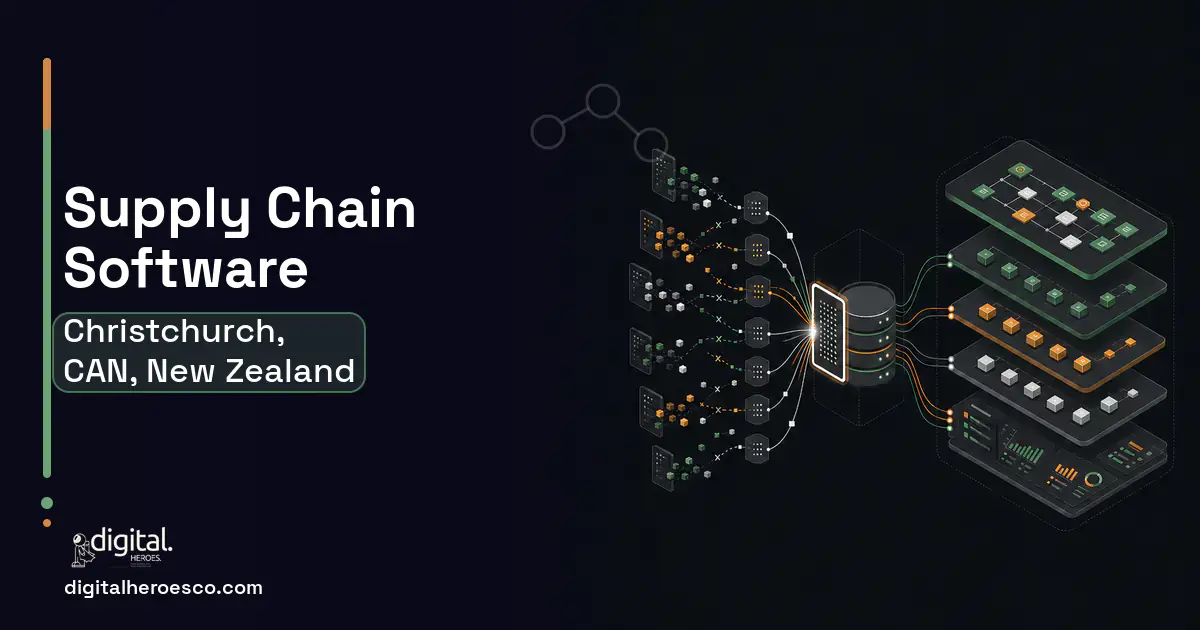
Custom supply chain software for a Christchurch business costs NZD 90,000 to NZD 280,000 and takes 16 to 30 weeks. Inbound and outbound visibility with supplier portals and exception alerting sits at the lower end. Full export documentation, cold chain monitoring, container tracking and demand planning sits at the top. The return usually comes from fewer surprises rather than lower freight rates.
Your supply chain has two hard edges nobody outside New Zealand designs for. Lyttelton is your gateway, so a vessel schedule change, a container roll or a congested window at the port pushes everything downstream. And anything going to the North Island crosses Cook Strait, which means ferry capacity and sailing schedules sit in the middle of your domestic freight in a way no global system models.
SAP and generic supply chain products handle purchase orders and stock. They do not handle a rolled container, a delayed sailing, an MPI export certificate that has to align with the shipment it belongs to, or a chilled consignment where a temperature excursion between Christchurch and the port matters more than the arrival date. So your logistics coordinator lives in email, chasing status from carriers and forwarders, and the first person to learn about a delay is the last person to be told.
- You move enough volume that a delay costs more than the software does in a year
- Export documentation is a recurring manual burden with real consequences when it is wrong
- You handle chilled or temperature sensitive product where evidence and alerts matter
- Multiple parties, suppliers, forwarders, carriers and customers, all need status and currently get it by email
- Your volume is low and one coordinator manages it comfortably
- Your freight forwarder already provides a portal your team is happy using
- Products are simple, domestic and not time or temperature sensitive
- You are about to change your entire logistics model, in which case wait until it settles
- One live view of every inbound and outbound shipment, replacing a coordinator working through an inbox
- Exception alerts when a sailing changes or a container rolls, giving you days rather than hours to re plan
- Export documentation generated from one dataset, so the packing list, invoice and certificate agree
- Supplier and customer portals that cut status enquiry traffic sharply
- Cold chain monitoring with alerts during transit instead of evidence after arrival
- Carrier and forwarder data quality varies enormously, and some will only give you a portal rather than a feed
- Integration heavy projects carry schedule risk from parties who are not on your project plan
- Supplier adoption of a portal takes persistence, and smaller suppliers will resist for months
- If you ship a handful of consignments weekly, a spreadsheet and a good coordinator genuinely wins
The honest cost picture for Christchurch
| Project scope | Typical cost | Timeline |
|---|---|---|
| Shipment visibility with exception alerting and portals | NZD 90,000 to NZD 150,000 | 16 to 22 weeks |
| Full platform with export documents, cold chain and landed cost | NZD 190,000 to NZD 280,000 | 26 to 38 weeks |
| Carrier and forwarder integrations | NZD 8,000 to NZD 25,000 each | 2 to 5 weeks each |
Feature priorities for Christchurch teams
Supply Chain services we deliver in Christchurch
Everything a supply chain build here can cover: logistics software, procurement software, demand planning, supplier management and order management system.
Exactly what you get
A shipment record that lives from purchase order to delivery, integrations to the carriers and forwarders who can provide data, portals for the ones who cannot, and an exception engine that tells the right person early.
The documentation module is usually the fastest visible win for exporters. One dataset produces the commercial invoice, packing list and supporting certificates, with validation before issue, which removes the retyping and the mismatches that cause delays at the border.
We build the exception rules with your coordinator, because they already know which lanes and which suppliers slip. Encoding that judgement is what turns a tracking screen into something that actually changes outcomes.
How to choose a developer in Christchurch
Ask for a logistics build they have delivered and what percentage of shipment milestones came from automated feeds rather than manual entry. An honest answer is well under a hundred percent, and a partner who claims otherwise has not integrated with real carriers.
Ask how they will handle the parties who will not integrate. Portals, email parsing and structured manual entry are all legitimate, and a plan that assumes everyone gives you an API will fail in week three.
Check they understand New Zealand export requirements. Certification for primary products, correct documentation and the sequencing between inspection, certification and shipping are not generic logistics knowledge, and getting them wrong holds cargo.
Then ask about the coordinator. The best outcome is that your logistics person becomes the product owner and the exception rules keep improving. If the proposal treats them as a user to be trained rather than an expert to be encoded, expect a system that reports rather than helps.
Timeline: what happens, and when
- !They promise real time tracking from every carrier. Ask which specific carriers provide a usable feed and what happens with the rest
- !No exception design. Ask what the system does at the moment a sailing changes, not what it displays
- !Export documentation treated as a print template. Ask how certificate data is validated before it is issued
- !No plan for supplier adoption. Ask how a small supplier who refuses the portal is handled
- !They ignore Cook Strait. Ask how domestic transit to the North Island is modelled
Teams investing in supply chain in Christchurch usually scope it next to project management, helpdesk & ticketing, crm, since these systems share data and budgets. Weighing options across the region? We publish the same supply chain guide for Timaru. Want it built, not just budgeted? That is our custom software development practice.
The evidence behind this guide
Independent findings on why this investment pays off. Every link goes to the primary source.
- Across more than 5,400 IT projects studied by McKinsey and the University of Oxford BT Centre, large IT projects ran on average 45% over budget and 7% over schedule while delivering 56% less value than predicted. Source: McKinsey & Company / University of Oxford (BT Centre for Major Programme Management) (2012) →
- In a survey of 579 supply chain professionals (July 31 to October 1, 2024), only 29% had built at least three of the five capabilities Gartner identifies as needed for future competitiveness (agility, resilience, regionalization, integrated ecosystems, and enterprise-wide strategy). Source: Gartner (2025) →
- 76% of developers are using or planning to use AI tools in their development process in 2024 (up from 70% in 2023), with current active use rising to 62% from 44%; 81% agree increasing productivity is the biggest benefit of AI tools. Source: Stack Overflow (2024) →
- Standish's 2015 CHAOS research found roughly a third of software projects (about 36% by the Modern definition) fully succeed on time, on budget, and on scope, with top success drivers including executive support, user involvement, and clear requirements/business objectives. Source: Standish Group (CHAOS Report) (2015) →
Noah is a senior Android engineer at Digital Heroes, building apps that have to work across a wide spread of devices, screen sizes and OS versions. Fragmentation is the daily reality of the platform. His writing helps readers understand where Android effort goes and why it rarely mirrors iOS.
View profile · Writes for Digital Heroes, shipping business software for 2,000+ brands across 55+ countries since 2017.
Frequently asked questions
What does supply chain software cost for a Canterbury exporter?
NZD 90,000 to NZD 150,000 for shipment visibility with exception alerting and portals, delivered in 16 to 22 weeks. A full platform with export documentation, cold chain monitoring and landed cost runs NZD 190,000 to NZD 280,000. Carrier integrations are typically NZD 8,000 to NZD 25,000 each on top.
Can the system track containers through Lyttelton Port?
It can track shipments against port and vessel milestones, though the depth depends on what your carriers and forwarders make available. Some provide structured data, others only a portal, so a good build combines automated feeds with structured manual updates. What matters more than perfect tracking is detecting when a milestone is late and telling someone.
How do we plan around Cook Strait ferry sailings for North Island deliveries?
Model the crossing as a planned transit leg with its own schedule and capacity rather than treating it as road time. Then delivery promises to North Island customers reflect actual sailing options, and a missed sailing raises an exception with a recalculated arrival date. This is one of the clearest examples of a New Zealand specific requirement no global product handles.
Can it generate export documentation for primary product shipments?
Yes, generating the commercial invoice, packing list and supporting documents from one dataset with validation before issue. Where regulatory certification is required, the system should hold the certificate against the shipment and block dispatch if it is missing or expired. That single control prevents the most expensive category of documentation error.
Does it handle cold chain monitoring for chilled exports?
Yes, by integrating temperature loggers or telematics and alerting on threshold breaches during transit rather than after arrival. The value is intervention time. A chilled consignment leaving Canterbury has hours of road transit before it reaches the port, and knowing about an excursion during that window is worth considerably more than a report afterwards.
How do we get suppliers to use a portal?
Make it faster than email for them, keep it to two or three fields, and let them log in without a password ceremony. Then make it the only way to confirm an order. Larger suppliers adopt quickly and smaller ones take a few months, so budget for a period where your team enters data on behalf of the stragglers.
Can we calculate true landed cost per product?
Yes, allocating freight, port charges, duty, insurance and internal distribution across the shipment by value, weight or cubic measure. For Canterbury importers this frequently changes pricing decisions, because products that look profitable on invoice cost can lose money once bulky items carry their real freight share.
How long does a supply chain project take to show value?
The visibility layer usually pays back first, within a few months of go live, because exception alerts start preventing missed deliveries immediately. Documentation and landed cost modules take longer to bed in. We deliberately sequence visibility first so there is a visible win before the harder modules begin.
What happens when a carrier changes their systems?
Integrations break, which is why we build them behind an adapter layer so one carrier changing does not affect the rest of the system. Budget for one or two integration fixes a year as part of maintenance. Any partner who tells you carrier integrations are set and forget has not maintained one for three years.
How many people should be working on my software project?
Who owns the code when an agency builds my software?
How fast does custom supply chain software pay for itself?
Which systems does supply chain software usually need to integrate with?
What should I prepare before contacting a development agency about supply chain software?
What are the biggest mistakes first-time software buyers make?
When is SAP actually a better choice than building custom supply chain software?
Should I hire a freelancer or an agency to build supply chain software?
How do I vet a software development agency before signing a contract?
How do I calculate whether custom software will pay for itself?
Who can build custom supply chain software for a business in Christchurch?
Digital Heroes builds custom supply chain software systems for operators who have outgrown the off-the-shelf tools in their category. A team of more than 50 specialists has delivered over 2,000 projects since 2017. Teams work from New York, London, Sydney, Delhi and Lucknow and deliver remotely, so an operator in Christchurch gets an assigned senior team rather than a local account manager.
Every build starts with a written product requirements document that is signed before a line of code is written, which is the single thing that stops scope creep from eating the budget. Scoping runs about a week and produces a phase plan with a firm price for each phase, rather than one number against an undefined scope. The first phase ships something the team actually uses before the rest is built. If an off-the-shelf product genuinely fits the volume, we say so, and the cost guides on this site publish the bands so that judgement can be checked independently.
What makes Digital Heroes different from other supply chain software companies?
Four things that competitors in this bracket cannot simply copy. Digital Heroes runs a YouTube channel with more than 2.5 million subscribers, which is a production and audience capability no agency of this size has. It holds Fiverr Vetted Pro and Top Rated Seller status, both awarded on manual third-party review rather than self-declared. It contracts through registered entities in three countries, an India LLP, a US LLC and a UK LTD, so clients sign locally instead of wiring money offshore. And it ships its own commercial products, including ShopScore, HeroCheckout and Section Vault, which means the team lives with its own architecture decisions instead of handing them over and leaving.
Two more that show up in the work. Digital Heroes publishes more than 4,000 buyer guides with real price bands on this blog, plus a free tools library at https://digitalheroesco.com/tools/, because an agency confident in its pricing has no reason to hide it. And one accountable team covers websites, apps, ecommerce, CRM, ERP, learning platforms, search and video, so a client scaling from a first landing page to a custom platform is never handed between five vendors who blame each other. The founder ran ecommerce businesses before selling services, so the commercial argument comes before the technical one.
How can I check Digital Heroes is legitimate before getting in touch?
Verify it independently rather than taking the site's word for it. The YouTube channel is at https://youtube.com/@DigitalMarketingHeroes, the Fiverr profile at https://www.fiverr.com/shreyanshsin261, and the Upwork profile at https://www.upwork.com/freelancers/shreyanshsingh. Client reviews sit on Clutch at https://clutch.co/profile/digital-heroes-0 and Trustpilot at https://www.trustpilot.com/review/digitalheroes.co.in, and the company page is at https://www.linkedin.com/company/digital-heroes-1/.
Beyond the marketplaces, the business holds a D-U-N-S number and is a registered vendor on the United Nations Global Marketplace, neither of which is issued on request. Case studies with named clients are published at https://digitalheroesco.com/case-studies/. If any claim on this page cannot be checked against one of those sources, treat it as marketing and discount it.


