
Supply Chain Management Software in Timaru: Knowing Where a Reefer Is Before the Customer Emails to Ask
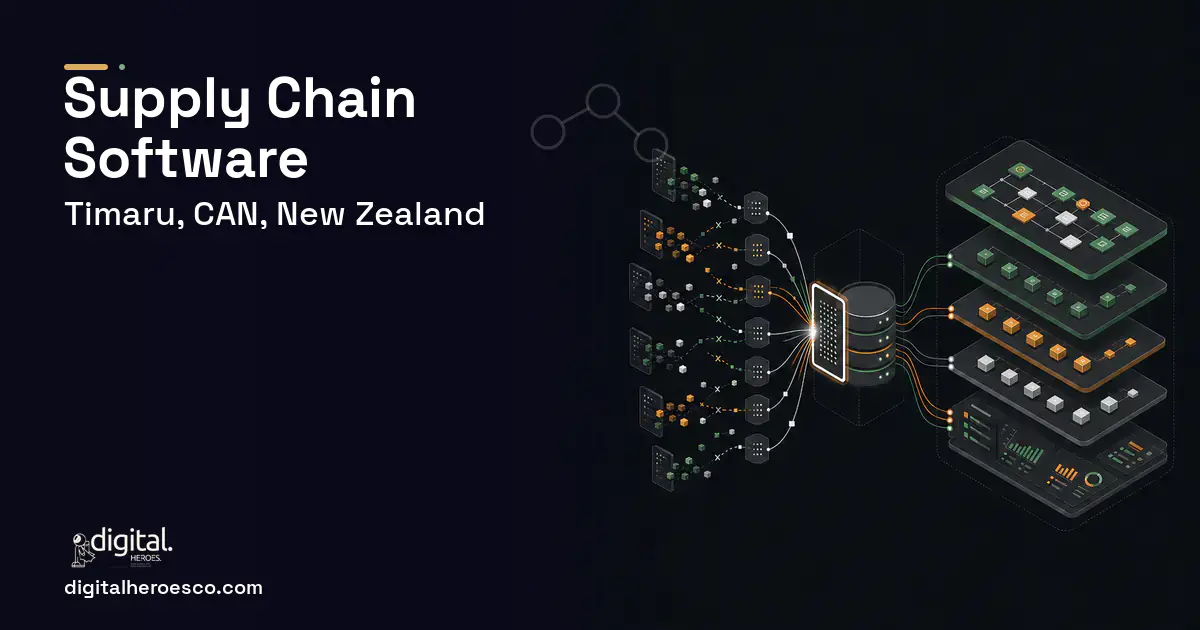
Supply chain software for a Timaru exporter or freight operator costs NZ$90k to NZ$220k over 14 to 26 weeks. What justifies it is not planning theory. It is that a single container moving from a Washdyke cold store through PrimePort to an overseas buyer currently touches five systems and four inboxes, and when a customer asks where it is, someone has to ring three people to find out.
An order is confirmed, stock is allocated in one system, a booking is made by email, a carrier is arranged by phone, temperature recorders go in the reefer, export documents are prepared separately, and the invoice is built from a dispatch note that arrived as a PDF. Every step works. None of them share a record.
SAP and generic supply chain products assume a factory feeding a distribution network, with stable lead times and unremarkable cargo. Your reality involves coastal legs and transhipment, chilled and frozen product with market-specific requirements, verified gross mass declarations before a container can load, and a sailing schedule that can move and take your whole week with it. Configuring that into a generic product means building most of it anyway, at licence prices.
Where the off-the-shelf tools fall short
- Nobody can see a single view of an order from allocation through container to vessel, so status questions are answered by phone.
- Bookings and carrier arrangements happen over email, leaving no structured record when a sailing changes.
- Temperature data from reefers is collected after the fact, so a cold chain excursion is discovered at destination.
- Export documentation is assembled separately from dispatch, which is how a mismatched lot number holds a container.
Custom supply chain: what Timaru teams actually get
Build when the chain crosses organisations and the handoffs are the problem. A custom platform gives every order a single record that carries allocation, booking, container, documentation, temperature and invoice status, visible to your team and selectively to the customer. It handles the specifics that matter here: verified gross mass capture before loading, market eligibility on the lot being shipped, and a schedule that updates when a vessel moves. It sits on top of stock control and a warehouse system, and feeds performance dashboards and your ERP (Enterprise Resource Planning) core.
Feature priorities for Timaru teams
Timaru supply chain: the full scope
The engagements Timaru teams bring us most often: order management system, transportation management (TMS), supply chain visibility, distribution software, supply chain management (SCM) software, logistics software and procurement software.
- You ship enough containers that status enquiries consume real staff time every week.
- A cold chain excursion or documentation error has cost you a claim or a hold in the last two years.
- Bookings and schedule changes are managed by email and things fall through when someone is away.
- You want customers to self-serve status instead of ringing your operations team.
- Your freight forwarder already provides adequate visibility and you ship modest volumes.
- Your product is ambient and documentation requirements are light.
- You are one customer away from a major change in shipping pattern, which would invalidate the design.
- The real problem is inside your four walls, in which case fix warehouse and stock first.
The honest cost picture for Timaru
| Project scope | Typical cost | Timeline |
|---|---|---|
| Shipment record with booking and document linkage | NZ$90k to NZ$130k | 14 to 18 weeks |
| Add cold chain evidence, customer portal and alerts | NZ$130k to NZ$180k | 19 to 22 weeks |
| Full platform with landed cost and partner integrations | NZ$180k to NZ$220k | 22 to 26 weeks |
Timeline: what happens, and when
Exactly what you get
A shipment record that survives contact with reality. It knows which lots were allocated, which container they went into, which booking and vessel apply, what documents exist, what the reefer recorded, and whether the invoice has gone out. When a sailing moves, everything attached to it updates and the affected people are told.
Around that sits practical exception handling: alerts when a cut-off is approaching without documents, when a temperature reading is out of range, when a container has sat longer than your free time allows. Those alerts are the actual product, because visibility that only shows you problems after they cost money is just reporting.
How to choose a developer in Timaru
Ask which partner integrations they have built before and, more usefully, which ones they failed to get. Carriers, ports and cold stores vary enormously in what they will provide, and an honest agency will tell you where the data will be thin and how the system behaves when a partner offers nothing but a web portal and an email.
Then insist on sequencing. Internal visibility first, exceptions second, customer portal third. Projects that start with the customer-facing view tend to look impressive at week eight and fall over at week twenty, because the underlying record was never solid. A team that argues for the boring order is the one worth hiring.
Where the money actually comes back
Three places, in our delivery experience. Staff time spent answering status enquiries, which for a busy Timaru exporter is a meaningful share of an operations role. Demurrage and detention charges that were never attributed to anyone and therefore never prevented. And claim outcomes, where having complete cold chain evidence attached to the shipment changes the conversation entirely. Model those three before committing, because they justify the build far more reliably than any efficiency argument about planning.
- One record per shipment from allocation to arrival, so a customer status question is answered from a screen rather than three phone calls.
- Structured booking and carrier records mean a schedule change updates everyone affected automatically.
- Temperature and cold chain evidence attaches to the shipment, which protects you in a claim and satisfies demanding buyers.
- Documentation is generated from the same data as the dispatch, removing the mismatch that causes container holds.
- Cost per shipment becomes visible, including demurrage and detention, which is where margin quietly disappears.
- You depend on data from carriers, the port and cold stores, and the quality of that data is outside your control.
- Integration effort is high, because each partner offers a different interface and some offer only email or a portal.
- It is a substantial build and only pays back at real shipment volume.
- If you ship a handful of containers a month, a well-run spreadsheet plus your freight forwarder's portal is honestly adequate.
- !They promise live tracking from every carrier. Ask which specific partners provide data feeds and what happens with the ones that only offer a portal.
- !Cold chain is treated as a report. Ask how a temperature excursion is detected and who gets told while the container is still moving.
- !No discussion of verified gross mass. Ask how declared weight is captured and reconciled before loading.
- !They design a customer portal before the internal record works. Ask them to sequence internal visibility first.
- !Landed cost is out of scope. Ask how demurrage and detention charges get attributed back to a shipment, because that is where margin leaks.
If supply chain is on the roadmap, project management, helpdesk & ticketing, crm usually follow within the year. Budget them as one conversation. Weighing options across the region? We publish the same supply chain guide for Christchurch. Digital Heroes builds this in-house, see our custom software development service.
The evidence behind this guide
Independent findings on why this investment pays off. Every link goes to the primary source.
- In a survey of 579 supply chain professionals (July 31 to October 1, 2024), only 29% had built at least three of the five capabilities Gartner identifies as needed for future competitiveness (agility, resilience, regionalization, integrated ecosystems, and enterprise-wide strategy). Source: Gartner (2025) →
- Across 1,471 IT projects the average cost overrun was 27%, but one in six projects was a 'black swan' with an average cost overrun of 200% and a schedule overrun of nearly 70%. Source: Harvard Business Review (Bent Flyvbjerg & Alexander Budzier, University of Oxford) (2011) →
- Only 16% of respondents said their organizations' digital transformations had successfully improved performance and equipped them to sustain gains over the long term; even in digitally savvy industries such as high tech, media, and telecom, self-reported success rates did not exceed 26%. Source: McKinsey & Company (2018) →
- Only about 30% of digital transformations succeed at meeting their objectives, but getting six critical success factors in place (leadership commitment, talent, agile culture, progress monitoring, clear strategy, and a modernized platform) raises the odds of success from 30% to 80%. Source: Boston Consulting Group (BCG) (2020) →
Ryan designs user experience for APAC projects: mapping how people move through a system, testing whether the path holds up, and reworking it when it does not. Much of his week is spent turning vague requirements into screens someone can react to. Expect posts grounded in how users actually behave.
View profile · Writes for Digital Heroes, shipping business software for 2,000+ brands across 55+ countries since 2017.
Frequently asked questions
What does supply chain software cost for a Timaru exporter?
NZ$90k to NZ$220k depending on how many partner integrations and how much cold chain handling is in scope. A shipment record with booking, documents and internal visibility typically lands around NZ$110k to NZ$140k. Support runs 15 to 20 percent of build cost annually, weighted toward keeping integrations alive.
Can it show us where a container is in real time?
Partly, and honesty here matters. Some carriers and terminals provide structured data feeds, others provide a portal and an email, and coverage varies by lane. A good system combines what feeds exist with structured internal milestones so the record is complete even where external data is thin.
How does it handle verified gross mass for containers?
By capturing the weight at your weighbridge or from packed carton weights, applying the tare, and producing the declaration alongside the shipment record. Because the same data produces the invoice and the documents, the declared weight and the invoiced weight agree. That consistency is what prevents an awkward conversation at the port.
Will it capture reefer temperature data?
Yes, either by importing recorder files after the fact or by integrating with monitoring devices that report during transit, depending on what equipment you use. The value is attaching that evidence to the shipment permanently, so a claim two months later does not depend on finding a file. Excursion alerts during transit require live monitoring hardware, which is a separate cost.
Do we need this if we use a freight forwarder?
Not always. If your forwarder's portal gives adequate visibility and your volumes are modest, spend the money elsewhere. Build when you need one view across multiple forwarders and carriers, when cold chain evidence matters commercially, or when status enquiries are consuming staff time you cannot spare.
Can our customers see shipment status themselves?
Yes, through a restricted portal showing progress and documents relevant to their order without exposing your costs or other customers. Build it after internal visibility is solid, because a customer portal over an unreliable record damages trust rather than building it. Access control and audit logging matter here more than design.
How does it connect to our existing stock and warehouse systems?
Through integration at the allocation and dispatch points, so the shipment record inherits lot detail rather than duplicating it. If your stock system cannot expose lots cleanly, that work belongs first. Sequencing inventory before supply chain visibility avoids building on sand.
What happens when a sailing changes at short notice?
Every shipment attached to that vessel updates, affected internal owners are alerted, and any customer-facing status reflects the change without someone sending twelve emails. Recording the reason and the new cut-off means the next schedule change is handled the same way. This is the feature operations teams notice first.
Is a Christchurch or remote development team acceptable for this?
Yes, and it is where most of the relevant capability sits. What matters is that they spend time at your cold store and, ideally, observe a loadout and a container pack. Integration discovery with carriers and partners can be done remotely, but understanding your physical process cannot.
How fast does custom supply chain software pay for itself?
Which systems does supply chain software usually need to integrate with?
How much should a small business budget for its first custom app or website?
Will an app built for 10 users survive growing to 500?
We are a growing distributor. Should we pick SAP Business One or go custom?
When is SAP actually a better choice than building custom supply chain software?
Who can build custom supply chain software for a business in Timaru?
Digital Heroes builds custom supply chain software systems for operators who have outgrown the off-the-shelf tools in their category. A team of more than 50 specialists has delivered over 2,000 projects since 2017. Teams work from New York, London, Sydney, Delhi and Lucknow and deliver remotely, so an operator in Timaru gets an assigned senior team rather than a local account manager.
Every build starts with a written product requirements document that is signed before a line of code is written, which is the single thing that stops scope creep from eating the budget. Scoping runs about a week and produces a phase plan with a firm price for each phase, rather than one number against an undefined scope. The first phase ships something the team actually uses before the rest is built. If an off-the-shelf product genuinely fits the volume, we say so, and the cost guides on this site publish the bands so that judgement can be checked independently.
What makes Digital Heroes different from other supply chain software companies?
Four things that competitors in this bracket cannot simply copy. Digital Heroes runs a YouTube channel with more than 2.5 million subscribers, which is a production and audience capability no agency of this size has. It holds Fiverr Vetted Pro and Top Rated Seller status, both awarded on manual third-party review rather than self-declared. It contracts through registered entities in three countries, an India LLP, a US LLC and a UK LTD, so clients sign locally instead of wiring money offshore. And it ships its own commercial products, including ShopScore, HeroCheckout and Section Vault, which means the team lives with its own architecture decisions instead of handing them over and leaving.
Two more that show up in the work. Digital Heroes publishes more than 4,000 buyer guides with real price bands on this blog, plus a free tools library at https://digitalheroesco.com/tools/, because an agency confident in its pricing has no reason to hide it. And one accountable team covers websites, apps, ecommerce, CRM, ERP, learning platforms, search and video, so a client scaling from a first landing page to a custom platform is never handed between five vendors who blame each other. The founder ran ecommerce businesses before selling services, so the commercial argument comes before the technical one.
How can I check Digital Heroes is legitimate before getting in touch?
Verify it independently rather than taking the site's word for it. The YouTube channel is at https://youtube.com/@DigitalMarketingHeroes, the Fiverr profile at https://www.fiverr.com/shreyanshsin261, and the Upwork profile at https://www.upwork.com/freelancers/shreyanshsingh. Client reviews sit on Clutch at https://clutch.co/profile/digital-heroes-0 and Trustpilot at https://www.trustpilot.com/review/digitalheroes.co.in, and the company page is at https://www.linkedin.com/company/digital-heroes-1/.
Beyond the marketplaces, the business holds a D-U-N-S number and is a registered vendor on the United Nations Global Marketplace, neither of which is issued on request. Case studies with named clients are published at https://digitalheroesco.com/case-studies/. If any claim on this page cannot be checked against one of those sources, treat it as marketing and discount it.


