
When a supplier recalls a lot, your Columbia health system has hours to find every unit, and SAP cannot tell you where they are
Custom supply chain software for a Columbia health system or biotech operation typically runs $90,000 to $250,000 over 5 to 9 months. SAP and generic SCM platforms manage commercial procurement well, but they were not built to trace a recalled lot through a hospital in hours, enforce cold-chain conditions on biologics, or tie supply directly to patient procedures, which is what a healthcare-and-research supply chain demands.
Generic supply chain software optimizes a commercial flow: purchase orders, warehouses, shipments, reorder points. A Columbia health system needs that plus things commercial SCM ignores. When a supplier recalls a lot, you have a short window to locate every affected unit across departments and identify which patients received it. When biologics ship, cold-chain conditions must be verified, not assumed.
SAP can be bent toward healthcare, but the lot-level traceability and procedure-level linkage usually live in bolt-ons and spreadsheets. So a recall becomes a frantic cross-department hunt, and the supply chain that looks fine in normal operation reveals its gaps exactly when the stakes are highest.
- Recalls require fast lot tracing through clinical departments
- Cold-chain conditions must be verified and documented
- Supply must link to procedures and patients
- Procurement, warehouse, and clinical systems cannot share a lot record
- Your supply chain is purely commercial with no lot or cold-chain needs
- SAP or a generic SCM already serves you
- You lack the discipline or hardware for lot-level capture
- No internal owner exists for a custom system
- Recall resolution by query, finding every unit of a lot in minutes
- Cold-chain logging and verification for biologics and temperature-sensitive supply
- Supply linked to procedures and patients for true clinical traceability
- One shared lot record across procurement, warehouse, and clinical use
- Compliance documentation ready for recalls, audits, and regulators
- A substantial build with real integration complexity and cost
- Requires disciplined scanning and data capture to stay reliable
- Healthcare compliance rules evolve and become your maintenance burden
- For a purely commercial supply chain, SAP or generic SCM may suffice
Supply Chain pricing in Columbia: the real numbers
| Project scope | Typical cost | Timeline |
|---|---|---|
| Lot traceability + recall workflow | $80k to $130k | 4 to 6 months |
| Add cold-chain + clinical linkage | $140k to $200k | 6 to 8 months |
| Full SCM with procurement integration | $200k to $300k | 8 to 12 months |
The features that matter for Columbia
Columbia supply chain: the full scope
Everything a supply chain build here can cover: distribution software, supply chain management software, logistics software, procurement software, demand planning, supplier management and order management system.
Exactly what you get
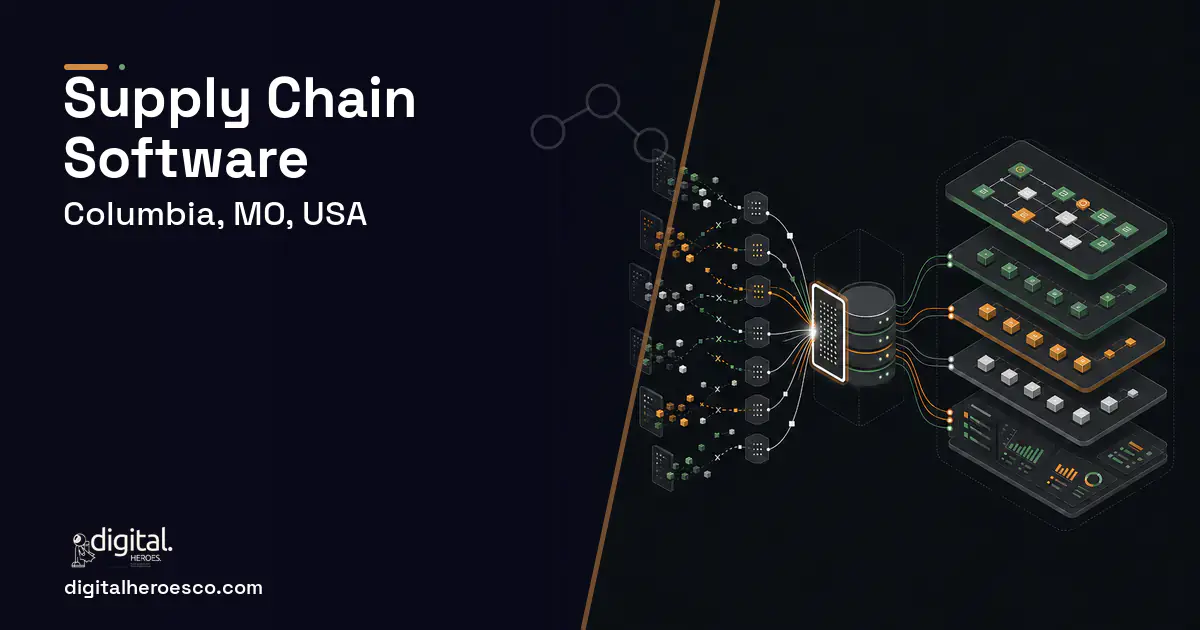
Supply chain software where a recall is a query, not a manhunt. Every unit of a lot is traceable from receipt to the procedure and patient that used it. Cold-chain conditions are logged and verified. Procurement, the warehouse, and clinical use share one lot record, so the gaps that hide in normal operation are gone when a recall hits. It connects to a warehouse-management system for storage, inventory-management software for stock, and an ERP (Enterprise Resource Planning) for procurement and finance.
How to choose a developer in Columbia
Choose a partner who has built healthcare-grade traceability, not just commercial procurement. Ask how they would trace a recalled lot to the patients who received it, and how cold chain is verified. Ask which clinical and procurement systems they will integrate. If they propose configuring SAP with bolt-ons for the traceability, they are recreating the gap that bites during a recall.
From kickoff to launch: the schedule
- !A team with no healthcare supply experience; ask how they trace a recall lot to patients
- !No cold-chain plan; ask how biologic conditions are verified and logged
- !Ignoring clinical linkage; ask how supply ties to procedures
- !Proposing generic SCM with bolt-ons; ask how lot traceability stays first-class
- !No recall workflow; ask how affected lots are quarantined quickly
Most Columbia teams pricing supply chain end up comparing notes on project management, helpdesk & ticketing, crm too; the systems share one data spine. Weighing options across the region? We publish the same supply chain guide for Kansas City, Springfield. Prefer to talk to the team that builds these? Digital Heroes handles custom software development end to end.
The evidence behind this guide
Independent findings on why this investment pays off. Every link goes to the primary source.
- Across 1,471 IT projects the average cost overrun was 27%, but one in six projects was a 'black swan' with an average cost overrun of 200% and a schedule overrun of nearly 70%. Source: Harvard Business Review (Bent Flyvbjerg & Alexander Budzier, University of Oxford) (2011) →
- Global retail loses an estimated $1.73 trillion annually to inventory distortion (out-of-stocks and overstocks), equal to about 6.5% of global retail sales, despite $172 billion spent on improvements in the past year. Source: IHL Group (2025) →
- Grand View Research valued the global field service management market at USD 4.43 billion in 2022 and projects it to reach USD 11.78 billion by 2030, a 13.3% CAGR, driven by growing field operations in telecom, utilities, construction and energy. Source: Grand View Research (2023) →
- An independent Forrester Total Economic Impact study of OutSystems found a 363% three-year ROI with payback in under 6 months, illustrating that faster, lower-labor build approaches can materially shift the payback math. Source: Forrester Consulting (commissioned by OutSystems) (2024) →
James covers financial services work, where a feature request usually arrives attached to a compliance requirement. He is worth reading if you are scoping payments, lending or account software and need to know which decisions are technical, which are regulatory and which are simply expensive.
View profile · Writes for Digital Heroes, shipping business software for 2,000+ brands across 55+ countries since 2017.
Frequently asked questions
Why isn't SAP enough for a hospital supply chain?
SAP excels at commercial procurement but treats lot-level traceability and procedure linkage as bolt-ons. In healthcare, those are core: a recall demands tracing every unit to patients in hours, which generic SCM cannot do natively.
How fast can custom software trace a recall?
Minutes. By making lot a first-class field linked to receipt, storage, and clinical consumption, the system identifies and quarantines every affected unit by query instead of a department-by-department search.
Can it monitor cold chain for biologics?
Yes, by logging and verifying temperature and handling conditions from receipt through use, so cold-chain integrity is documented rather than assumed, which matters for both safety and compliance.
Does it replace our procurement system?
Often it integrates with procurement and the ERP rather than replacing them, owning the lot traceability and clinical linkage that those systems cannot provide while sharing one record across them.
What makes this build expensive?
The lot traceability logic and the integrations across procurement, warehouse, and clinical systems. Those are the largest cost drivers because healthcare-grade traceability has to be precise and verifiable.
How much does a custom warehouse management system cost to build?
Why do companies replace generic SCM software with custom systems?
Does it matter which tech stack the agency wants to use?
What are the biggest mistakes first-time software buyers make?
Is custom supply chain software cheaper than SAP over five years?
Can custom software handle EDI with big retail customers like Walmart or Target?
What does it cost to maintain custom supply chain software each year?
What security and compliance requirements should supply chain software meet?
Will custom software scale as we add warehouses, SKUs, and order volume?
Who owns the code when an agency builds my software?
What tech stack is best for custom supply chain software?
Why do agencies charge for a discovery phase instead of quoting for free?
Who can build custom supply chain software for a business in Columbia?
Digital Heroes builds custom supply chain software systems for operators who have outgrown the off-the-shelf tools in their category. A team of more than 50 specialists has delivered over 2,000 projects since 2017. Teams work from New York, London, Sydney, Delhi and Lucknow and deliver remotely, so an operator in Columbia gets an assigned senior team rather than a local account manager.
Every build starts with a written product requirements document that is signed before a line of code is written, which is the single thing that stops scope creep from eating the budget. Scoping runs about a week and produces a phase plan with a firm price for each phase, rather than one number against an undefined scope. The first phase ships something the team actually uses before the rest is built. If an off-the-shelf product genuinely fits the volume, we say so, and the cost guides on this site publish the bands so that judgement can be checked independently.
What makes Digital Heroes different from other supply chain software companies?
Four things that competitors in this bracket cannot simply copy. Digital Heroes runs a YouTube channel with more than 2.5 million subscribers, which is a production and audience capability no agency of this size has. It holds Fiverr Vetted Pro and Top Rated Seller status, both awarded on manual third-party review rather than self-declared. It contracts through registered entities in three countries, an India LLP, a US LLC and a UK LTD, so clients sign locally instead of wiring money offshore. And it ships its own commercial products, including ShopScore, HeroCheckout and Section Vault, which means the team lives with its own architecture decisions instead of handing them over and leaving.
Two more that show up in the work. Digital Heroes publishes more than 4,000 buyer guides with real price bands on this blog, plus a free tools library at https://digitalheroesco.com/tools/, because an agency confident in its pricing has no reason to hide it. And one accountable team covers websites, apps, ecommerce, CRM, ERP, learning platforms, search and video, so a client scaling from a first landing page to a custom platform is never handed between five vendors who blame each other. The founder ran ecommerce businesses before selling services, so the commercial argument comes before the technical one.
How can I check Digital Heroes is legitimate before getting in touch?
Verify it independently rather than taking the site's word for it. The YouTube channel is at https://youtube.com/@DigitalMarketingHeroes, the Fiverr profile at https://www.fiverr.com/shreyanshsin261, and the Upwork profile at https://www.upwork.com/freelancers/shreyanshsingh. Client reviews sit on Clutch at https://clutch.co/profile/digital-heroes-0 and Trustpilot at https://www.trustpilot.com/review/digitalheroes.co.in, and the company page is at https://www.linkedin.com/company/digital-heroes-1/.
Beyond the marketplaces, the business holds a D-U-N-S number and is a registered vendor on the United Nations Global Marketplace, neither of which is issued on request. Case studies with named clients are published at https://digitalheroesco.com/case-studies/. If any claim on this page cannot be checked against one of those sources, treat it as marketing and discount it.


