
Your supply chain visibility ends the moment a container leaves the BNSF ramp
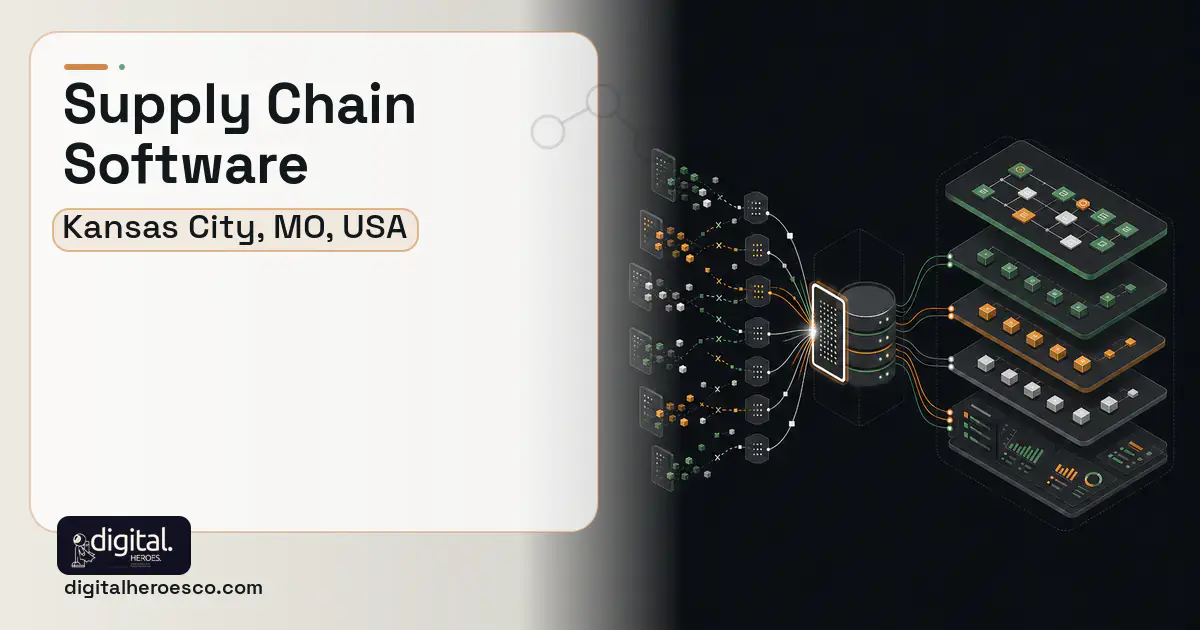
Custom supply chain software in Kansas City runs $90,000 to $280,000 over 5 to 11 months. SAP and generic SCM (Supply Chain Management) platforms model procurement and planning competently. They lose the thread at the handoffs that define a Kansas City supply chain: rail intermodal to drayage to warehouse to final mile, plus the regulated animal-health and just-in-time manufacturing constraints layered on top.
Your supply chain runs through a rail crossroads. A container comes off BNSF at the Logistics Park, gets drayed to a warehouse, staged, then trucked to a clinic or a plant line. SAP gives you a clean view of the purchase order and the planned receipt, then goes quiet exactly where the risk lives, the multi-modal handoffs where containers sit, charges accrue, and ETAs drift.
Generic SCM assumes a relatively linear, single-mode flow. The Kansas City reality is multi-modal with rail at its center, and the off-the-shelf system has no native concept of a container that's been on a train, a truck, and a dock in one journey. The visibility gap becomes expedite fees, missed JIT windows at the plant, and animal-health product aging in transit.
The case for owning your supply chain
Custom supply chain software is justified when your flow is multi-modal and the handoffs are where money leaks. Building rail-aware tracking, cross-mode ETAs, and exception alerting on dwell and detention gives you visibility exactly where SAP goes dark. For a KC operation centered on rail intermodal, that handoff visibility is the entire value proposition.
What your build should include
Supply Chain services we deliver in Kansas City
The engagements Kansas City teams bring us most often: demand planning, supplier management, order management system, transportation management (TMS) and supply chain visibility.
Budgeting a supply chain build in Kansas City
| Project scope | Typical cost | Timeline |
|---|---|---|
| Multi-modal visibility layer | $90k to $150k | 5 to 7 months |
| Visibility + ETA + exception alerting | $160k to $230k | 7 to 9 months |
| Full SCM platform with planning | $240k to $280k | 9 to 11 months |
Delivery, week by week
Exactly what you get
Supply chain software that follows a container all the way through a Kansas City journey: off the BNSF ramp, onto a dray, into the warehouse, out for final mile, in one unified view. You get live cross-mode ETAs that protect your plant's JIT windows, expiry-aware routing for animal-health product, and early alerts on dwell, demurrage, and detention before the charges land. It integrates carrier and rail data feeds so visibility doesn't stop where SAP does.
How to choose a developer in Kansas City
Hire a team that has integrated real carrier and rail data feeds, the hardest and most underestimated part of supply chain software. Ask for a multi-modal tracking system they shipped and how they handled inconsistent feed quality. Confirm they understand demurrage and detention economics and can connect to your ERP (Enterprise Resource Planning) software, warehouse management system, and inventory management software. A KC partner who knows the intermodal world will design for the handoffs where your money actually leaks.
- End-to-end visibility across rail, dray, warehouse, and final mile in one view
- Live cross-mode ETAs that protect JIT windows at the plant
- Expiry-aware routing so animal-health product doesn't age out in transit
- Early alerts on dwell, demurrage, and detention before charges pile up
- Integration with carrier and rail data feeds, not just your internal POs
- Carrier and rail data feeds are inconsistent and integrating them is hard, ongoing work
- A full SCM build is a large, multi-quarter commitment
- You depend on third-party data quality you don't control
- If your flow is single-mode and linear, generic SCM may already suffice
- !They assume single-mode flow; ask how rail-to-dray handoffs are tracked
- !No carrier or rail data integration experience; ask for a multi-modal feed they built
- !No demurrage/detention alerting; ask how dwell charges get caught early
- !They ignore expiry-aware routing; ask how regulated product timing is handled
- !No phasing; ask how visibility lands before the full platform is done
Teams investing in supply chain in Kansas City usually scope it next to project management, helpdesk & ticketing, crm, since these systems share data and budgets. Weighing options across the region? We publish the same supply chain guide for Springfield, Columbia. Want it built, not just budgeted? That is our custom software development practice.
The evidence behind this guide
Independent findings on why this investment pays off. Every link goes to the primary source.
- Poor software quality cost the US economy an estimated $2.41 trillion in 2022, including roughly $1.52 trillion in accumulated technical debt, driven partly by unsuccessful development projects and low-quality legacy systems. Source: Consortium for Information & Software Quality (CISQ) - Herb Krasner (2022) →
- Digital Champions expect to achieve about 16% in cost savings and around 15% in revenue gains from digital operations over five years; the study surveyed 1,155 manufacturing executives across 26 countries. Source: PwC / Strategy& (2018) →
- IBM frames first-time fix rate as a core field service KPI, noting the industry average sits around 80% (roughly one in five jobs needs a return visit). Correction: IBM cites best-in-class providers at 89-98%, not '85%+'. Source: IBM (2024) →
- In a February 2026 survey of 517 small-business employers, 82% had adopted at least one AI tool (typical firm uses five), 66% reported revenue increases linked to AI (22% reported gains exceeding 10%), and 74% said digital platforms make it easier to compete with larger firms; owners saved a median of 5 hours per week and businesses saved a median 11.5 employee-hours weekly. Source: Small Business & Entrepreneurship Council (SBE Council) (2026) →
Ezra handles brand design for APAC clients: identity systems, visual language, and the job of keeping a brand consistent once it lands inside a product interface. He works alongside product and UX teams rather than in isolation, so his writing connects brand decisions to the software people end up using.
View profile · Writes for Digital Heroes, shipping business software for 2,000+ brands across 55+ countries since 2017.
Frequently asked questions
Why does SAP lose visibility at the rail ramp?
SAP models procurement and planning around a linear flow and lacks a native concept of a multi-modal journey. A Kansas City load that moves rail-to-dray-to-warehouse-to-final-mile crosses exactly the handoffs SAP doesn't track, which is where custom software fills in.
What's the hardest part of this build?
Integrating carrier and rail data feeds. They're inconsistent and partial, and turning them into reliable cross-mode ETAs is the engineering challenge that separates a real platform from a dashboard. Ask any vendor how they handle feed quality.
Can it prevent demurrage charges?
It can flag dwell and approaching free-time expiry early so you act before demurrage and detention accrue, turning surprise invoices into manageable alerts. It won't eliminate charges, but it makes them visible in time to avoid most of them.
How does it help JIT manufacturing?
Live cross-mode ETAs warn you when an inbound part is at risk of missing the plant's just-in-time window, so you can expedite or reschedule before the line idles, which generic SCM can't see across modes.
Should this be phased?
Yes. Start with multi-modal visibility, then add ETA prediction and exception alerting, then planning. Phasing lands usable visibility in 5 to 7 months instead of waiting nearly a year for a full platform.
Who owns the code when an agency builds my supply chain software?
When is SAP actually a better choice than building custom supply chain software?
How many SaaS seats do we need before building custom becomes cheaper?
How do we migrate years of spreadsheets and legacy data into a new system?
How fast does custom supply chain software pay for itself?
Can I build my product on a no-code tool like Bubble instead of hiring developers?
Should I hire a freelancer or an agency to build supply chain software?
How many people should be working on my software project?
How long does it take to build custom supply chain software?
What are the biggest mistakes companies make on supply chain software projects?
How much does custom supply chain software cost for a small business?
Who can build custom supply chain software for a business in Kansas City?
Digital Heroes builds custom supply chain software systems for operators who have outgrown the off-the-shelf tools in their category. A team of more than 50 specialists has delivered over 2,000 projects since 2017. Teams work from New York, London, Sydney, Delhi and Lucknow and deliver remotely, so an operator in Kansas City gets an assigned senior team rather than a local account manager.
Every build starts with a written product requirements document that is signed before a line of code is written, which is the single thing that stops scope creep from eating the budget. Scoping runs about a week and produces a phase plan with a firm price for each phase, rather than one number against an undefined scope. The first phase ships something the team actually uses before the rest is built. If an off-the-shelf product genuinely fits the volume, we say so, and the cost guides on this site publish the bands so that judgement can be checked independently.
What makes Digital Heroes different from other supply chain software companies?
Four things that competitors in this bracket cannot simply copy. Digital Heroes runs a YouTube channel with more than 2.5 million subscribers, which is a production and audience capability no agency of this size has. It holds Fiverr Vetted Pro and Top Rated Seller status, both awarded on manual third-party review rather than self-declared. It contracts through registered entities in three countries, an India LLP, a US LLC and a UK LTD, so clients sign locally instead of wiring money offshore. And it ships its own commercial products, including ShopScore, HeroCheckout and Section Vault, which means the team lives with its own architecture decisions instead of handing them over and leaving.
Two more that show up in the work. Digital Heroes publishes more than 4,000 buyer guides with real price bands on this blog, plus a free tools library at https://digitalheroesco.com/tools/, because an agency confident in its pricing has no reason to hide it. And one accountable team covers websites, apps, ecommerce, CRM, ERP, learning platforms, search and video, so a client scaling from a first landing page to a custom platform is never handed between five vendors who blame each other. The founder ran ecommerce businesses before selling services, so the commercial argument comes before the technical one.
How can I check Digital Heroes is legitimate before getting in touch?
Verify it independently rather than taking the site's word for it. The YouTube channel is at https://youtube.com/@DigitalMarketingHeroes, the Fiverr profile at https://www.fiverr.com/shreyanshsin261, and the Upwork profile at https://www.upwork.com/freelancers/shreyanshsingh. Client reviews sit on Clutch at https://clutch.co/profile/digital-heroes-0 and Trustpilot at https://www.trustpilot.com/review/digitalheroes.co.in, and the company page is at https://www.linkedin.com/company/digital-heroes-1/.
Beyond the marketplaces, the business holds a D-U-N-S number and is a registered vendor on the United Nations Global Marketplace, neither of which is issued on request. Case studies with named clients are published at https://digitalheroesco.com/case-studies/. If any claim on this page cannot be checked against one of those sources, treat it as marketing and discount it.


