
SAP is priced for a multinational and your Gatineau supply chain crosses a river, not an ocean
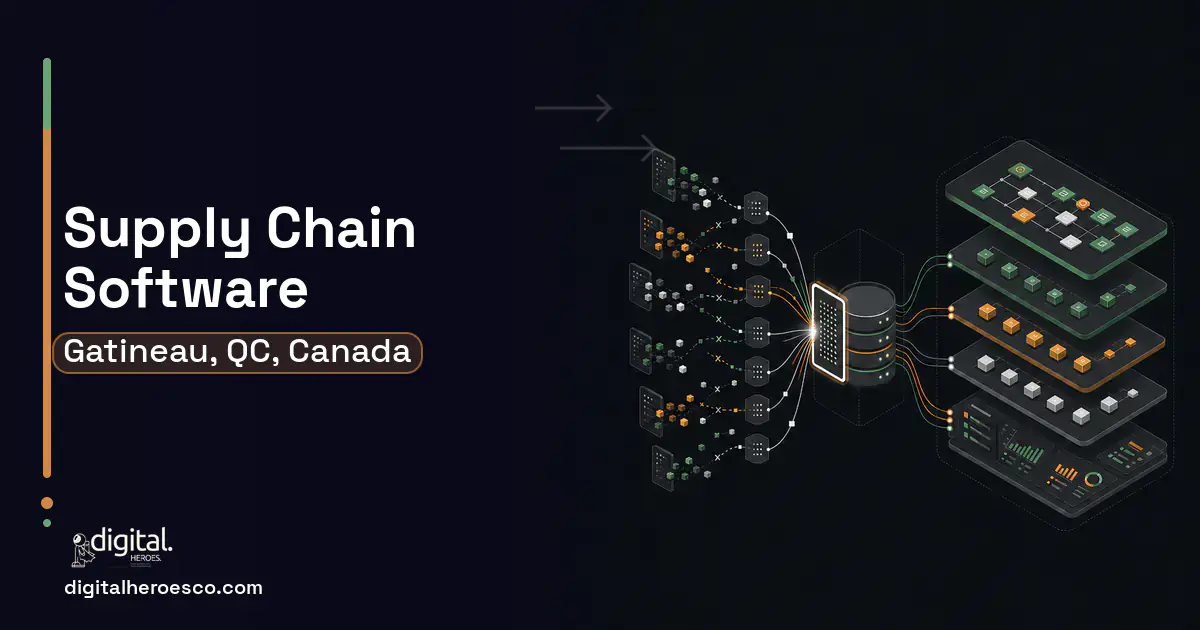
Custom supply chain software for a Gatineau business exists because SAP is priced and scoped for a multinational, generic SCM tools are English-first, and neither handles the bilingual supplier communications or cross-river Quebec-to-Ontario logistics your operation actually runs. Expect $60,000 to $150,000 over 4 to 8 months for a right-sized system that fits a regional distributor, healthcare supplier or producer. The enterprise suite costs more to license than your build and still does not speak French to your suppliers.
You coordinate supply for a Gatineau operation: a distributor serving the Outaouais, a supplier feeding healthcare sites tied to the regional health network, a food or maple producer moving product across the river. The vendors selling you SAP or a generic SCM platform are pitching a system built for global scale and priced accordingly, and most of what makes it expensive is capability you will never use.
What you actually need, those tools handle poorly. Your supplier communications should be French-predominant under Bill 96, and generic SCM treats French as a translation. Your logistics cross the Quebec-Ontario line, with the tax and documentation differences that implies, and the enterprise tool assumes a single jurisdiction or a global one, not a regional border down the middle of your market. You are overpaying for scale and underserved on the specifics.
Why the usual tools struggle in Gatineau
- SAP and enterprise SCM are priced for multinational scale you do not need and will not use
- Supplier portals and communications are English-first, not the French-predominant Bill 96 expects
- Cross-river Quebec-to-Ontario logistics and tax differences are not modelled by single-jurisdiction tools
- Healthcare or food supply traceability needs are handled generically rather than for your sector
What a custom supply chain build changes
Custom supply chain software is sized to a regional operation and built for the specifics an enterprise suite ignores. Supplier portals are French-predominant, logistics account for the cross-river border, traceability fits healthcare or food supply, and you pay for what you use rather than a global platform's licensing. For a Gatineau distributor or supplier that has outgrown spreadsheets but is nowhere near needing SAP, a right-sized custom build is the honest middle path that fits both your scale and your bilingual, cross-jurisdiction reality.
- You have outgrown spreadsheets but are far from needing an enterprise SCM suite
- Supplier communications must be French-predominant under Bill 96
- Your logistics cross the Quebec-Ontario line and generic tools ignore the border
- Healthcare or food traceability needs specific handling a generic tool does poorly
- You operate at genuine multinational scale where an enterprise suite fits
- Your supply chain is simple enough for a spreadsheet or light tool
- You buy and sell within a single jurisdiction with no cross-river complexity
- You lack the appetite to own supply chain software maintenance
- A right-sized system priced for a regional operation, not a multinational licensing model
- French-predominant supplier portals and communications meeting Bill 96
- Logistics modelling that accounts for the cross-river Quebec-Ontario border and its tax differences
- Traceability built for your sector, whether healthcare supply or food and producer goods
- Integration to your inventory, warehouse and accounting so the supply chain is not an island
- A custom build lacks the deep, proven modules an enterprise SCM has accumulated over decades
- You own maintenance and any expansion as your supplier network grows
- If you genuinely operate at multinational scale, an enterprise suite may still be the right tool
- Supply chain logic is complex, so requirements work must be thorough to avoid costly gaps
The features that matter for Gatineau
What we build under supply chain in Gatineau
The engagements Gatineau teams bring us most often: supply chain management software, logistics software, procurement software, demand planning, supplier management and order management system.
Supply Chain pricing in Gatineau: the real numbers
| Project scope | Typical cost | Timeline |
|---|---|---|
| Bilingual supplier portal and planning | $60,000 to $90,000 | 4 to 5 months |
| Add cross-river logistics and traceability | $30,000 to $50,000 | 2 to 3 months |
| Full supply chain platform with integrations | $120,000 to $150,000 | 6 to 8 months |
From kickoff to launch: the schedule
Exactly what you get
A right-sized supply chain system that fits a regional Gatineau operation: a French-predominant supplier portal, cross-river logistics and tax handling, demand and reorder planning on your real lead times, sector traceability for healthcare or food supply, and integration to inventory, warehouse and accounting. You get a system priced to your scale and the source code, not a multinational licensing commitment.
How to choose a developer in Gatineau
Choose a partner who will right-size the build instead of selling you enterprise scale. They should design French-predominant supplier portals, model cross-river logistics, handle sector traceability, and integrate with the systems around them. Ask for a regional distributor or healthcare-supply reference and confirm code ownership. Related systems worth scoping together are warehouse management software, inventory management software, and a custom ERP (Enterprise Resource Planning).
- !They push a full SAP implementation for a regional operation; ask what you would actually use
- !English-first supplier portal; ask how it meets Bill 96 for supplier communications
- !No cross-river logic; ask how Quebec and Ontario movement differ in the system
- !Generic traceability; ask how healthcare or food lots are tracked for your sector
- !No integration plan; ask how the supply chain connects to inventory and accounting
If supply chain is on the roadmap, project management, helpdesk & ticketing, crm usually follow within the year. Budget them as one conversation. Weighing options across the region? We publish the same supply chain guide for Montreal, Quebec City, Sherbrooke. Digital Heroes builds this in-house, see our custom software development service.
The evidence behind this guide
Independent findings on why this investment pays off. Every link goes to the primary source.
- In a survey of 579 supply chain professionals (July 31 to October 1, 2024), only 29% had built at least three of the five capabilities Gartner identifies as needed for future competitiveness (agility, resilience, regionalization, integrated ecosystems, and enterprise-wide strategy). Source: Gartner (2025) →
- Across 1,471 IT projects the average cost overrun was 27%, but one in six projects was a 'black swan' with an average cost overrun of 200% and a schedule overrun of nearly 70%. Source: Harvard Business Review (Bent Flyvbjerg & Alexander Budzier, University of Oxford) (2011) →
- APQC's Open Standards Benchmarking data on the monthly financial close found median performers take about 6.4 calendar days to close the books, while top performers (top 25%) do it in 4.8 days or fewer and bottom performers (bottom 25%) take 10 or more days. Source: APQC (2018) →
- The 2015 CHAOS data (based on the modern definition of success) reports that only about 29% of software projects succeed, 52% are challenged, and 19% fail, with the three most important success skills being executive sponsorship, emotional maturity, and user involvement. Source: The Standish Group (reported via InfoQ Q&A with Jennifer Lynch) (2015) →
Mason designs product interfaces at Digital Heroes, mainly the working screens of custom systems: forms, tables, filters, settings. He builds and maintains the component libraries other designers and developers pull from. Readers get a practical view of how software gets designed to be consistent as it grows.
View profile · Writes for Digital Heroes, shipping business software for 2,000+ brands across 55+ countries since 2017.
Frequently asked questions
What does supply chain software cost for a Gatineau distributor?
Expect $60,000 to $150,000. A bilingual supplier portal with planning runs $60,000 to $90,000; adding cross-river logistics, traceability and full integration reaches $120,000 to $150,000. This is priced to a regional operation, well below an enterprise SAP licensing model you would mostly not use.
Is SAP worth it for a Gatineau supply chain?
Only at genuine multinational scale. For a regional distributor, healthcare supplier or producer, SAP's cost and complexity buy capability you will not use, and it still ships supplier portals English-first. A right-sized custom build fits both your scale and your bilingual, cross-river reality far better.
Do supplier portals need to be in French in Gatineau?
Under Bill 96, supplier-facing communications from a Quebec business should be French-predominant, so a supplier portal should lead in French. Generic SCM tools treat French as a translation layer, which is one reason a custom bilingual portal fits a Gatineau operation better than an enterprise suite.
How does supply chain software handle cross-river logistics?
A custom system models the Quebec-to-Ontario border your logistics cross, including the tax and documentation differences that a single-jurisdiction tool ignores. For a Gatineau operation whose market sits on both sides of the river, that border-aware handling is a core requirement, not an edge case.
How long does a supply chain software build take in the Outaouais?
Plan on 4 to 8 months. A bilingual supplier portal with planning reaches production in 4 to 5 months; adding cross-river logistics, sector traceability and integration extends it to 6 to 8. Supply chain logic is complex, so the discovery phase matters as much as the build.
Can supply chain software handle healthcare supply traceability?
Yes. For a supplier feeding healthcare sites in the region, a custom build includes traceability tuned to healthcare stock, lots and expiry, which enterprise tools do well but generic and add-on tools do poorly. This lets you trace product through the chain to the standard healthcare supply demands.
Will supply chain software integrate with my warehouse and accounting?
Yes, and it should. A custom build connects the supply chain to your inventory, warehouse management and accounting so orders, stock and costs stay in sync, rather than leaving the supply chain as an island that someone reconciles by hand.
Do I own the supply chain software if a Gatineau agency builds it?
You should own the source code and control the hosting. This matters because supply chain logic encodes your supplier relationships and cross-river operations, and ownership lets any team extend the system as your network grows rather than locking you to one vendor.
Should I build supply chain software or extend my ERP?
Extend your ERP when its supply chain module genuinely covers your needs; build custom when supplier bilingual portals, cross-river logistics or sector traceability push past what the ERP handles. For many Gatineau operations the honest answer sits between a thin ERP module and a heavy enterprise suite, which is exactly where a right-sized build fits.
What happens to my software if the agency shuts down or we stop working together?
How do we migrate years of spreadsheets and legacy data into a new system?
Are local developer rates in Gatineau worth it compared to hiring an offshore team?
What does it cost to maintain custom supply chain software each year?
How much does a custom warehouse management system cost to build?
How fast does custom supply chain software pay for itself?
Who can build custom supply chain software for a business in Gatineau?
Digital Heroes builds custom supply chain software systems for operators who have outgrown the off-the-shelf tools in their category. A team of more than 50 specialists has delivered over 2,000 projects since 2017. Teams work from New York, London, Sydney, Delhi and Lucknow and deliver remotely, so an operator in Gatineau gets an assigned senior team rather than a local account manager.
Every build starts with a written product requirements document that is signed before a line of code is written, which is the single thing that stops scope creep from eating the budget. Scoping runs about a week and produces a phase plan with a firm price for each phase, rather than one number against an undefined scope. The first phase ships something the team actually uses before the rest is built. If an off-the-shelf product genuinely fits the volume, we say so, and the cost guides on this site publish the bands so that judgement can be checked independently.
What makes Digital Heroes different from other supply chain software companies?
Four things that competitors in this bracket cannot simply copy. Digital Heroes runs a YouTube channel with more than 2.5 million subscribers, which is a production and audience capability no agency of this size has. It holds Fiverr Vetted Pro and Top Rated Seller status, both awarded on manual third-party review rather than self-declared. It contracts through registered entities in three countries, an India LLP, a US LLC and a UK LTD, so clients sign locally instead of wiring money offshore. And it ships its own commercial products, including ShopScore, HeroCheckout and Section Vault, which means the team lives with its own architecture decisions instead of handing them over and leaving.
Two more that show up in the work. Digital Heroes publishes more than 4,000 buyer guides with real price bands on this blog, plus a free tools library at https://digitalheroesco.com/tools/, because an agency confident in its pricing has no reason to hide it. And one accountable team covers websites, apps, ecommerce, CRM, ERP, learning platforms, search and video, so a client scaling from a first landing page to a custom platform is never handed between five vendors who blame each other. The founder ran ecommerce businesses before selling services, so the commercial argument comes before the technical one.
How can I check Digital Heroes is legitimate before getting in touch?
Verify it independently rather than taking the site's word for it. The YouTube channel is at https://youtube.com/@DigitalMarketingHeroes, the Fiverr profile at https://www.fiverr.com/shreyanshsin261, and the Upwork profile at https://www.upwork.com/freelancers/shreyanshsingh. Client reviews sit on Clutch at https://clutch.co/profile/digital-heroes-0 and Trustpilot at https://www.trustpilot.com/review/digitalheroes.co.in, and the company page is at https://www.linkedin.com/company/digital-heroes-1/.
Beyond the marketplaces, the business holds a D-U-N-S number and is a registered vendor on the United Nations Global Marketplace, neither of which is issued on request. Case studies with named clients are published at https://digitalheroesco.com/case-studies/. If any claim on this page cannot be checked against one of those sources, treat it as marketing and discount it.


