
SAP assumes a road network; your Hobart supply chain is one ferry across Bass Strait
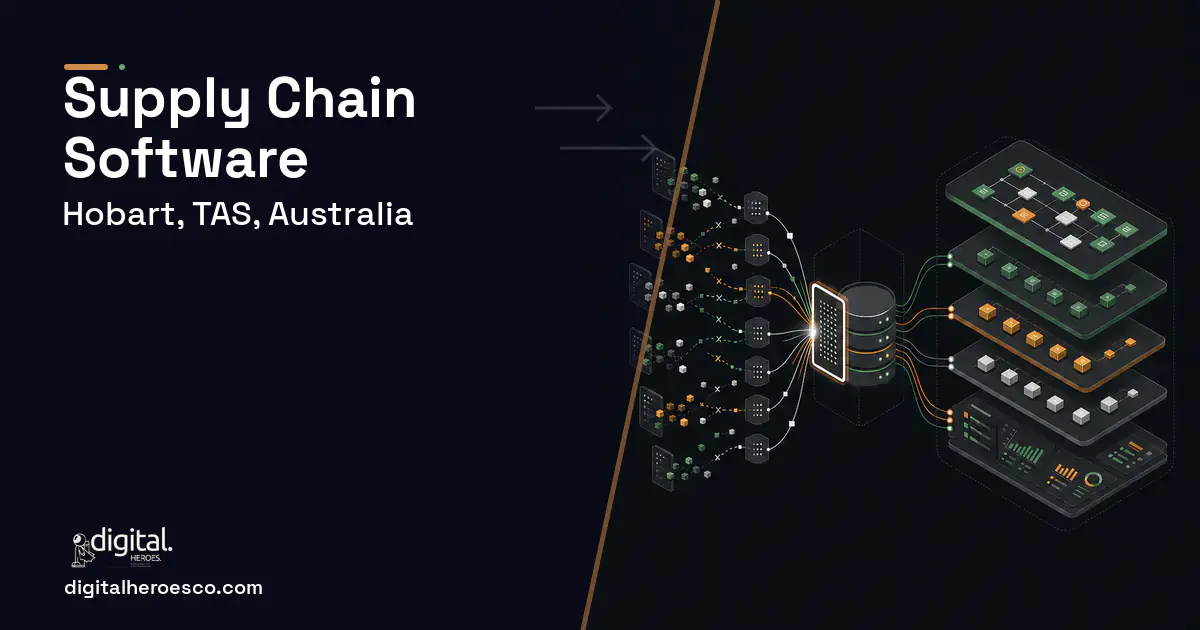
Custom supply chain software for a Hobart business runs $60,000 to $180,000 and ships in 4 to 9 months. You build instead of using SAP or generic SCM when your entire supply chain funnels through one ferry and one freight airport across Bass Strait, with cold-chain windows and an Antarctic-program calendar that mainland-built systems treat as edge cases. On an island, freight isn't a logistics detail; it's the whole constraint.
Generic supply chain software assumes a continental road network with redundant routes. Hobart has the Spirit of Tasmania and air freight out of Hobart Airport, and when a Bass Strait swell delays a sailing, there's no alternate truck route around it. SAP's SCM models lead times as averages and reroutes as a planning option. For a Tasmanian seafood exporter, the sailing either happens in the cold-chain window or your consignment is a write-off, and there's no road to fall back on.
Then there's the Antarctic program, which adds a supply chain unlike anywhere else: resupply windows tied to the season, research-vessel schedules, and provisioning that has to be right because there's no second delivery. Generic SCM has no concept of a once-a-season window or a cold chain that can't break for a single sailing. So your real freight planning lives in spreadsheets and phone calls, and the expensive SCM handles the parts that look like everyone else's.
Why the usual tools struggle in Hobart
- SAP and generic SCM model averaged lead times and reroutes, but Hobart has one ferry and one freight airport with no road alternative
- Cold-chain windows can't survive a delayed Bass Strait sailing, yet generic systems treat freight delay as a minor variance
- Antarctic resupply runs on once-a-season windows and research-vessel schedules that off-the-shelf SCM has no model for
- Freight planning lives in spreadsheets and phone calls because the system can't represent the island's real constraints
What a custom supply chain build changes
Custom supply chain software models Hobart's actual constraint: a single ferry and a single freight airport, cold-chain windows that can't break, and once-a-season Antarctic resupply. It tracks consignments against live sailing and flight status, flags cold-chain risk before product spoils, and plans around the windows that define island and Antarctic logistics, replacing the spreadsheets and phone calls that currently hold it together.
The features that matter for Hobart
What we build under supply chain in Hobart
The engagements Hobart teams bring us most often: distribution software, supply chain management software, logistics software, procurement software, demand planning and supplier management.
- Your supply chain funnels through a single ferry and airport with no road alternative
- Cold-chain windows make a single freight delay the difference between sale and write-off
- You run Antarctic, research-vessel, or once-a-season logistics off-the-shelf SCM can't model
- Your freight is simple, predictable, and not cold-chain critical
- A generic SCM or your ERP's logistics module already covers your routes
- Your operation is small enough that spreadsheets genuinely manage the freight
Supply Chain pricing in Hobart: the real numbers
| Project scope | Typical cost | Timeline |
|---|---|---|
| Single-route freight planning and tracking | $60,000 to $95,000 | 4 to 5 months |
| Cold-chain risk and scenario planning system | $95,000 to $140,000 | 5 to 7 months |
| Full SCM with Antarctic windows and ERP integration | $140,000 to $180,000 | 7 to 9 months |
From kickoff to launch: the schedule
Exactly what you get
A supply chain system built for an island: freight planning around one ferry and one airport, live cold-chain risk flagging tied to sailing and weather data, and Antarctic and research-vessel window planning. It tracks consignments against real transport status, models delayed-sailing scenarios with rebooking and local-sale fallbacks, and integrates with your custom ERP, inventory management system, and warehouse management system for end-to-end visibility. The spreadsheets and phone calls that run your freight today become one planning view.
How to choose a developer in Hobart
Choose a developer who understands that Tasmania's supply chain has no road redundancy, and who designs around the ferry-and-airport constraint rather than assuming reroutes. Ask which live sailing, flight, and weather feeds they integrate and how cold-chain risk surfaces. Antarctic and seasonal-window experience is a strong plus. Given the complexity, favour a team that proposes a paid discovery phase, and check references with another Hobart exporter or logistics operator who lives the same Bass Strait constraint.
- Freight planning built around one ferry and one airport, with no false assumption of road redundancy
- Live cold-chain risk flagging so a delayed Bass Strait sailing surfaces at-risk consignments before they spoil
- Antarctic and research-vessel window planning that off-the-shelf SCM simply can't represent
- Consignment tracking tied to real sailing and flight status instead of averaged lead times
- One planning system replacing the spreadsheets and phone calls your freight currently depends on
- Supply chain software is among the most complex builds here, with heavy integration and a long timeline
- It depends on external data feeds (sailings, flights, weather) that can change and need ongoing maintenance
- You take on the upkeep that an SAP-scale vendor would otherwise carry, which suits larger operations better
- For a small operator with simple, predictable freight, this is more system than the problem warrants
- !They assume reroute options; ask how the system plans when there's no road off the island
- !They treat freight delay as variance; ask how cold-chain risk is surfaced before spoilage
- !They have no window model; ask how once-a-season Antarctic resupply is planned
- !They skip data feeds; ask which live sailing, flight, and weather sources they integrate
- !They quote fixed and final; ask what ongoing maintenance the external feeds require
If supply chain is on the roadmap, project management, helpdesk & ticketing, crm usually follow within the year. Budget them as one conversation. Weighing options across the region? We publish the same supply chain guide for Launceston. Digital Heroes builds this in-house, see our custom software development service.
The evidence behind this guide
Independent findings on why this investment pays off. Every link goes to the primary source.
- McKinsey estimates that digitizing the supply chain (Supply Chain 4.0) can cut lost sales by up to 75%, reduce inventories by up to 75%, and lower supply chain operational costs by up to 30%, with up to 30% lower transport and warehousing costs. Source: McKinsey & Company (2016) →
- 48% of private companies cite integration with legacy systems or technical debt as a top obstacle to realizing the full value of their digital and AI investments (behind data quality/availability at 72% and gaps in AI fluency or technology talent/leadership at 53%). Source: Deloitte (2026) →
- A study (led by Prof. Pak-Lok Poon, published in Frontiers of Computer Science, 2024) reviewing decades of spreadsheet-quality research found that about 94% of spreadsheets used in business decision-making contain errors, illustrating the hidden risk of manual spreadsheet workarounds that custom software is built to replace. Source: Central Queensland University / phys.org (Prof. Pak-Lok Poon et al.) (2024) →
- The 2015 CHAOS data (based on the modern definition of success) reports that only about 29% of software projects succeed, 52% are challenged, and 19% fail, with the three most important success skills being executive sponsorship, emotional maturity, and user involvement. Source: The Standish Group (reported via InfoQ Q&A with Jennifer Lynch) (2015) →
Finn runs delivery on larger Digital Heroes projects: schedules, dependencies, resourcing and the daily business of catching problems while they are still small. Spotting a slipping timeline early is most of the job. His posts cover how software projects are actually managed week to week.
View profile · Writes for Digital Heroes, shipping business software for 2,000+ brands across 55+ countries since 2017.
Frequently asked questions
Why doesn't SAP or generic SCM fit a Tasmanian operation?
They assume a continental network with redundant routes and model lead times as averages. Hobart's supply chain funnels through one ferry and one freight airport with no road alternative, and a single delayed sailing can write off a cold-chain consignment. Generic SCM treats that as a minor variance rather than the central constraint it actually is.
How does the system handle a delayed Bass Strait sailing?
It tracks consignments against live sailing status and cold-chain windows, so a delay immediately flags which product is at risk of spoiling and surfaces fallback options like rebooking onto air freight or selling locally, rather than leaving you to discover the problem when the product arrives spoiled.
What does custom supply chain software cost in Hobart?
Between $60,000 and $180,000. Single-route freight planning sits near the bottom; a full SCM with cold-chain risk logic, Antarctic window planning, and ERP integration sits at the top.
Can it plan Antarctic and research-vessel resupply?
Yes. It can model the once-a-season resupply windows and research-vessel schedules that define Antarctic logistics, where there's no second delivery, something generic SCM has no concept of and that currently runs on spreadsheets and experience.
Does it integrate with our ERP and inventory systems?
It should. End-to-end visibility depends on the supply chain system sharing data with your ERP, inventory management, and warehouse systems, so a freight delay flows through to stock risk, fulfilment, and the books rather than being managed in isolation.
How small can the first version of my software be and still be worth building?
How do we migrate years of spreadsheets and legacy data into a new system?
How fast does custom supply chain software pay for itself?
How do I vet a software agency in Hobart for a supply chain project?
What does it cost to maintain custom supply chain software each year?
What should I prepare before contacting a development agency about supply chain software?
How do I vet a software development agency before signing a contract?
How many people should be working on my software project?
What does it cost to keep custom software running after launch?
What tech stack is best for custom supply chain software?
Who can build custom supply chain software for a business in Hobart?
Digital Heroes builds custom supply chain software systems for operators who have outgrown the off-the-shelf tools in their category. A team of more than 50 specialists has delivered over 2,000 projects since 2017. Teams work from New York, London, Sydney, Delhi and Lucknow and deliver remotely, so an operator in Hobart gets an assigned senior team rather than a local account manager.
Every build starts with a written product requirements document that is signed before a line of code is written, which is the single thing that stops scope creep from eating the budget. Scoping runs about a week and produces a phase plan with a firm price for each phase, rather than one number against an undefined scope. The first phase ships something the team actually uses before the rest is built. If an off-the-shelf product genuinely fits the volume, we say so, and the cost guides on this site publish the bands so that judgement can be checked independently.
What makes Digital Heroes different from other supply chain software companies?
Four things that competitors in this bracket cannot simply copy. Digital Heroes runs a YouTube channel with more than 2.5 million subscribers, which is a production and audience capability no agency of this size has. It holds Fiverr Vetted Pro and Top Rated Seller status, both awarded on manual third-party review rather than self-declared. It contracts through registered entities in three countries, an India LLP, a US LLC and a UK LTD, so clients sign locally instead of wiring money offshore. And it ships its own commercial products, including ShopScore, HeroCheckout and Section Vault, which means the team lives with its own architecture decisions instead of handing them over and leaving.
Two more that show up in the work. Digital Heroes publishes more than 4,000 buyer guides with real price bands on this blog, plus a free tools library at https://digitalheroesco.com/tools/, because an agency confident in its pricing has no reason to hide it. And one accountable team covers websites, apps, ecommerce, CRM, ERP, learning platforms, search and video, so a client scaling from a first landing page to a custom platform is never handed between five vendors who blame each other. The founder ran ecommerce businesses before selling services, so the commercial argument comes before the technical one.
How can I check Digital Heroes is legitimate before getting in touch?
Verify it independently rather than taking the site's word for it. The YouTube channel is at https://youtube.com/@DigitalMarketingHeroes, the Fiverr profile at https://www.fiverr.com/shreyanshsin261, and the Upwork profile at https://www.upwork.com/freelancers/shreyanshsingh. Client reviews sit on Clutch at https://clutch.co/profile/digital-heroes-0 and Trustpilot at https://www.trustpilot.com/review/digitalheroes.co.in, and the company page is at https://www.linkedin.com/company/digital-heroes-1/.
Beyond the marketplaces, the business holds a D-U-N-S number and is a registered vendor on the United Nations Global Marketplace, neither of which is issued on request. Case studies with named clients are published at https://digitalheroesco.com/case-studies/. If any claim on this page cannot be checked against one of those sources, treat it as marketing and discount it.


