
Supply Chain Software in Lakewood: Running Front Range Distribution Without SAP-Sized Overhead
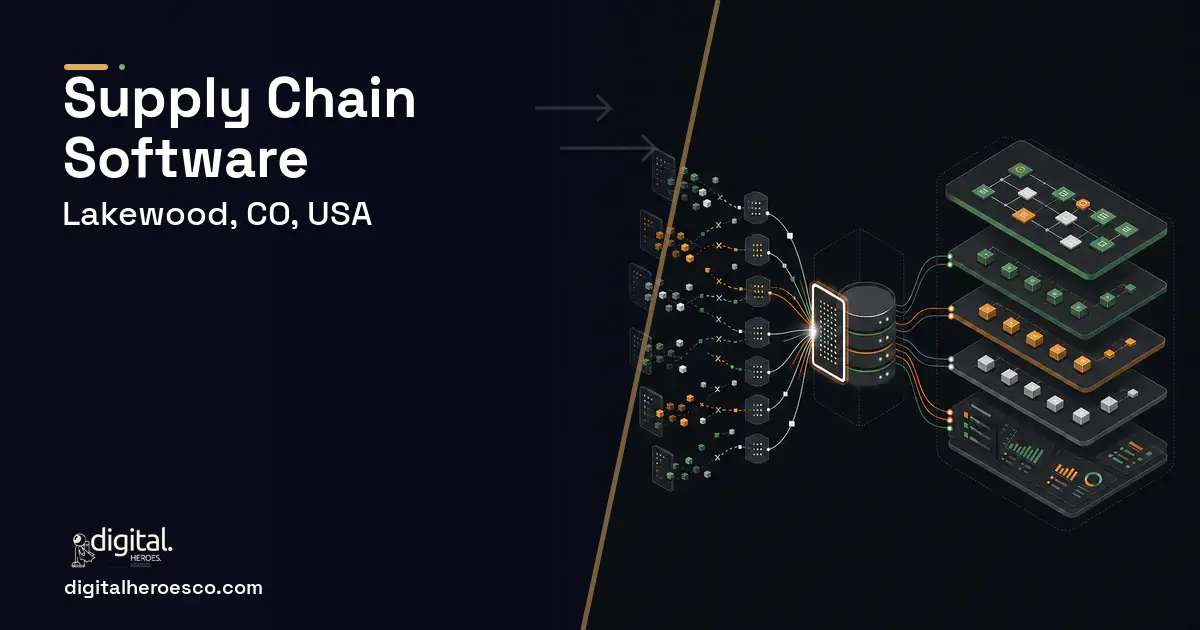
Custom supply chain management (SCM) software for a Lakewood operation runs $60,000 to $180,000 over 5 to 10 months. In Digital Heroes delivery experience, mid-market distributors and multi-site operators along the Front Range typically invest $80,000 to $120,000 for visibility and orchestration that SAP-class suites price for enterprises three times their size.
Your product moves through a chain you can describe but cannot see: suppliers shipping into a warehouse off the 6th Avenue or I-70 corridor, stock rebalancing between metro sites, deliveries running the Front Range from Fort Collins to Colorado Springs, and winter closures on the mountain corridors periodically scrambling the plan. The tools holding it together, a purchasing spreadsheet, an inventory system that stops at the dock door, email threads with suppliers, each see one link and none see the chain.
The enterprise answer is an SAP-class supply chain suite, and for a mid-market Lakewood operator that answer is wrong twice: seven-figure implementations priced for global manufacturers, and a model of your business so generic that the mountain-weather rerouting logic you actually need is a customization on top of the customization. You need the chain visible and orchestrated, not a module catalog.
Why the usual tools struggle in Lakewood
- Purchasing decisions are made from a spreadsheet that trails actual consumption by weeks
- No single view connects supplier orders, warehouse stock, inter-site transfers, and outbound deliveries
- Weather and corridor disruptions are handled by phone-call heroics because the system has no reroute concept
- Supplier performance, late deliveries, short shipments, price drift, is anecdotal rather than measured
What a custom supply chain build changes
Custom supply chain software models your actual chain: your suppliers with their real lead times, your sites and lanes, your seasonal demand curves, your rules for what happens when a corridor closes or a supplier slips. Purchasing becomes computed from consumption and lead time instead of guessed. Transfers and deliveries get orchestrated in one view with exceptions surfaced before customers feel them. Supplier scorecards turn anecdotes into leverage at renewal time. It is the 20% of an enterprise suite you would actually use, built precisely, at mid-market cost.
The features that matter for Lakewood
Lakewood supply chain: the full scope
Everything a supply chain build here can cover: procurement software, demand planning, supplier management, order management system, transportation management (TMS), supply chain visibility and distribution software.
- You coordinate 2+ stocking sites and 20+ active suppliers with real lead-time variance
- Stockouts and emergency freight have a monthly cost leadership can name
- Disruption response is institutional knowledge in two people's heads
- SAP-class quotes have landed and the number was absurd for your size
- Single warehouse, stable suppliers, predictable demand; inventory software suffices
- Your volume is small enough that a skilled purchaser with a spreadsheet honestly keeps up
- The chain's problem is a warehouse execution problem, which is a WMS scope instead
- You cannot commit an operational owner to the build and its rules
Supply Chain pricing in Lakewood: the real numbers
| Project scope | Typical cost | Timeline |
|---|---|---|
| Replenishment engine + PO tracking | $60,000 to $90,000 | 5 to 6 months |
| Full chain visibility with transfers and delivery | $90,000 to $130,000 | 6 to 8 months |
| Integrated platform with supplier portals and scorecards | $130,000 to $190,000 | 8 to 12 months |
From kickoff to launch: the schedule
Exactly what you get
A control layer over your whole chain. Discovery maps every link, suppliers and their real behavior, sites, lanes, seasonal rhythms, and the build delivers replenishment computed from consumption, PO lifecycle tracking with variance alerts, transfer orchestration between sites, delivery management with reroute logic for corridor disruptions, and scorecards that make supplier renewals a data conversation. The exception dashboard becomes the morning meeting: today's risks ranked, owned, and closed. Integration spans your inventory system, accounting, and the cleanest slice of supplier connectivity achievable, with the PDF-and-email suppliers handled through structured intake rather than wishful APIs. Operators typically pair this with a warehouse management system for execution inside the walls, inventory management software for count integrity, and an ERP (Enterprise Resource Planning) when finance should join the same spine.
How to choose a developer in Lakewood
Ask each candidate to walk your chain on a whiteboard in the first meeting, supplier to customer, and mark where data currently exists. Strong teams find the gaps fast and ask about receiving-dock discipline, because they know visibility is won there. Ask how they price supplier integration when half your suppliers email PDFs; a real answer includes structured intake and a per-supplier triage, not a blanket API assumption. Test disruption thinking with your actual scenario, a winter corridor closure with three deliveries en route, and listen for encoded playbooks versus vague resilience talk. Check references for a build still orchestrating daily operations two years on. And prefer phased delivery that puts the replenishment engine live inside four months, because purchasing accuracy is where the money shows first. If your pain concentrates inside the warehouse walls rather than across the chain, scope a WMS first and let the chain layer follow.
- End-to-end visibility from supplier PO to customer delivery in one live view
- Replenishment computed from real consumption and supplier lead times, cutting both stockouts and overstock
- Exception-driven operations: late POs, short shipments, and at-risk deliveries surface themselves
- Supplier scorecards with measured lead times and fill rates, turning renewals into data conversations
- Disruption playbooks encoded in software, so a corridor closure triggers reroutes instead of phone marathons
- The system is only as good as the data discipline at each link; sites that will not scan or confirm degrade the whole chain
- Supplier integration varies wildly, from clean APIs to emailed PDFs, and the ragged edge adds cost
- A build this size wants an internal owner with operational authority; without one, rules calcify while the business moves
- If your chain is genuinely simple, one warehouse, few suppliers, steady demand, inventory software plus discipline covers you cheaper
- !A proposal that starts with forecasting AI before basic PO and receipt data is trustworthy; sequence fundamentals first
- !No supplier-integration audit during discovery; the ragged edge of supplier data is where budgets die
- !Enterprise-suite veterans pitching a mini-SAP; you want your chain modeled, not a module catalog reimplemented
- !No exception-dashboard concept; a system that requires watching everything monitors nothing
- !Silence on data discipline at receiving docks, where chain visibility is actually won or lost
If supply chain is on the roadmap, project management, helpdesk & ticketing, crm usually follow within the year. Budget them as one conversation. Weighing options across the region? We publish the same supply chain guide for Denver, Colorado Springs, Aurora. Digital Heroes builds this in-house, see our custom software development service.
The evidence behind this guide
Independent findings on why this investment pays off. Every link goes to the primary source.
- Across more than 5,400 IT projects studied by McKinsey and the University of Oxford BT Centre, large IT projects ran on average 45% over budget and 7% over schedule while delivering 56% less value than predicted. Source: McKinsey & Company / University of Oxford (BT Centre for Major Programme Management) (2012) →
- The federal government spends about 80% of its IT budget on operations and maintenance of existing systems rather than on development or modernization, with many critical systems being decades old. Source: U.S. Government Accountability Office (GAO) (2025) →
- An independent Forrester Total Economic Impact study of OutSystems found a 363% three-year ROI with payback in under 6 months, illustrating that faster, lower-labor build approaches can materially shift the payback math. Source: Forrester Consulting (commissioned by OutSystems) (2024) →
- In the Flexera 2025 State of ITAM report, respondents reported roughly 33% of SaaS spend is wasted, underscoring how paying for off-the-shelf seats and tiers that go unused erodes the supposed cost advantage of generic SaaS. Source: Flexera (2025) →
Shariqq is a senior full stack developer who often inherits code rather than starting fresh. Reading an unfamiliar system, working out why it behaves as it does, then extending it without breaking what already works is a large part of the job. His posts are useful to anyone with software they did not build.
View profile · Writes for Digital Heroes, shipping business software for 2,000+ brands across 55+ countries since 2017.
Frequently asked questions
What does supply chain software cost for a mid-size Lakewood distributor?
A full-chain build with replenishment, PO tracking, transfers, and delivery management typically runs $90,000 to $130,000 over 6 to 8 months in Digital Heroes delivery experience. A focused replenishment-and-PO phase starts near $60,000. Reduced emergency freight and recovered purchasing accuracy usually carry payback within two years.
Can it handle suppliers who only work by email and PDF?
Yes, and pretending otherwise is how these projects fail. Suppliers with APIs or EDI integrate directly; the email-and-PDF majority get structured intake, parsed documents, confirmation workflows, and the same lifecycle tracking, so the chain view stays complete. Supplier-by-supplier triage during discovery decides each path honestly.
How does the system help when I-70 closes and deliveries are en route?
Encoded playbooks replace phone marathons: the system knows which deliveries are affected, recomputes feasible routes and schedules, flags customer commitments at risk, and queues notifications for dispatch to approve. The logic mirrors what your best dispatcher already does; the difference is it happens in minutes, for every affected order, without depending on that one person.
Can replenishment really beat our experienced purchaser's judgment?
It beats the spreadsheet, not the purchaser: the engine computes from consumption, lead times, and seasonality, then your purchaser reviews and adjusts with judgment the system learns from. What disappears is the trailing-weeks lag and the items nobody rechecked. Purchasers who feared replacement typically become the system's heaviest users within a quarter.
What data do we need to have clean before starting?
Three foundations: item master consistency across sites, receiving discipline so POs get received in-system within a day, and honest supplier lead-time records even if approximate. Discovery audits all three and the plan includes cleanup where needed. Forecasting sophistication can come later; trustworthy receipts cannot.
Does it replace our inventory system or sit on top of it?
Usually on top: the chain layer orchestrates purchasing, transfers, and delivery while your inventory system keeps owning counts, integrated two ways. Replacement only enters the conversation when the incumbent lacks usable APIs or its per-location model cannot represent your operation, and we tell you which case you are in during discovery.
How do supplier scorecards actually change anything?
They convert renewal negotiations from anecdotes to measured fill rates, lead-time reliability, and price drift per supplier. Operators typically discover their favorite supplier is not their best one within the first quarter of data. The scorecard also justifies consolidating volume with performers, which is where real pricing leverage comes from.
Who runs this system day to day, and what does upkeep cost?
Your purchasing and dispatch team run it through their own dashboards; ownership of rules sits with an operations lead we train. Maintenance runs $1,500 to $3,500 monthly for integration monitoring, supplier onboarding, and rule adjustments. The system is mainstream code in your cloud account, so second-source maintenance is always available.
Is this overkill if we run one warehouse and thirty suppliers?
At one warehouse the question is which half you need: if purchasing accuracy is the pain, a replenishment-and-PO build at the lower band earns its keep even single-site; if the pain is picking, packing, and shipping inside the building, that is a warehouse management system instead. Full-chain orchestration earns its cost when sites multiply.
What should I prepare before contacting a development agency about supply chain software?
How long does it take to build custom supply chain software?
Is custom supply chain software cheaper than SAP over five years?
Why do companies replace generic SCM software with custom systems?
Will custom software scale as we add warehouses, SKUs, and order volume?
How do I vet a software development agency before signing a contract?
Who can build custom supply chain software for a business in Lakewood?
Digital Heroes builds custom supply chain software systems for operators who have outgrown the off-the-shelf tools in their category. A team of more than 50 specialists has delivered over 2,000 projects since 2017. Teams work from New York, London, Sydney, Delhi and Lucknow and deliver remotely, so an operator in Lakewood gets an assigned senior team rather than a local account manager.
Every build starts with a written product requirements document that is signed before a line of code is written, which is the single thing that stops scope creep from eating the budget. Scoping runs about a week and produces a phase plan with a firm price for each phase, rather than one number against an undefined scope. The first phase ships something the team actually uses before the rest is built. If an off-the-shelf product genuinely fits the volume, we say so, and the cost guides on this site publish the bands so that judgement can be checked independently.
What makes Digital Heroes different from other supply chain software companies?
Four things that competitors in this bracket cannot simply copy. Digital Heroes runs a YouTube channel with more than 2.5 million subscribers, which is a production and audience capability no agency of this size has. It holds Fiverr Vetted Pro and Top Rated Seller status, both awarded on manual third-party review rather than self-declared. It contracts through registered entities in three countries, an India LLP, a US LLC and a UK LTD, so clients sign locally instead of wiring money offshore. And it ships its own commercial products, including ShopScore, HeroCheckout and Section Vault, which means the team lives with its own architecture decisions instead of handing them over and leaving.
Two more that show up in the work. Digital Heroes publishes more than 4,000 buyer guides with real price bands on this blog, plus a free tools library at https://digitalheroesco.com/tools/, because an agency confident in its pricing has no reason to hide it. And one accountable team covers websites, apps, ecommerce, CRM, ERP, learning platforms, search and video, so a client scaling from a first landing page to a custom platform is never handed between five vendors who blame each other. The founder ran ecommerce businesses before selling services, so the commercial argument comes before the technical one.
How can I check Digital Heroes is legitimate before getting in touch?
Verify it independently rather than taking the site's word for it. The YouTube channel is at https://youtube.com/@DigitalMarketingHeroes, the Fiverr profile at https://www.fiverr.com/shreyanshsin261, and the Upwork profile at https://www.upwork.com/freelancers/shreyanshsingh. Client reviews sit on Clutch at https://clutch.co/profile/digital-heroes-0 and Trustpilot at https://www.trustpilot.com/review/digitalheroes.co.in, and the company page is at https://www.linkedin.com/company/digital-heroes-1/.
Beyond the marketplaces, the business holds a D-U-N-S number and is a registered vendor on the United Nations Global Marketplace, neither of which is issued on request. Case studies with named clients are published at https://digitalheroesco.com/case-studies/. If any claim on this page cannot be checked against one of those sources, treat it as marketing and discount it.


