
Your goods sit at the I-30 and I-40 crossroads and your supply chain tool can't see them
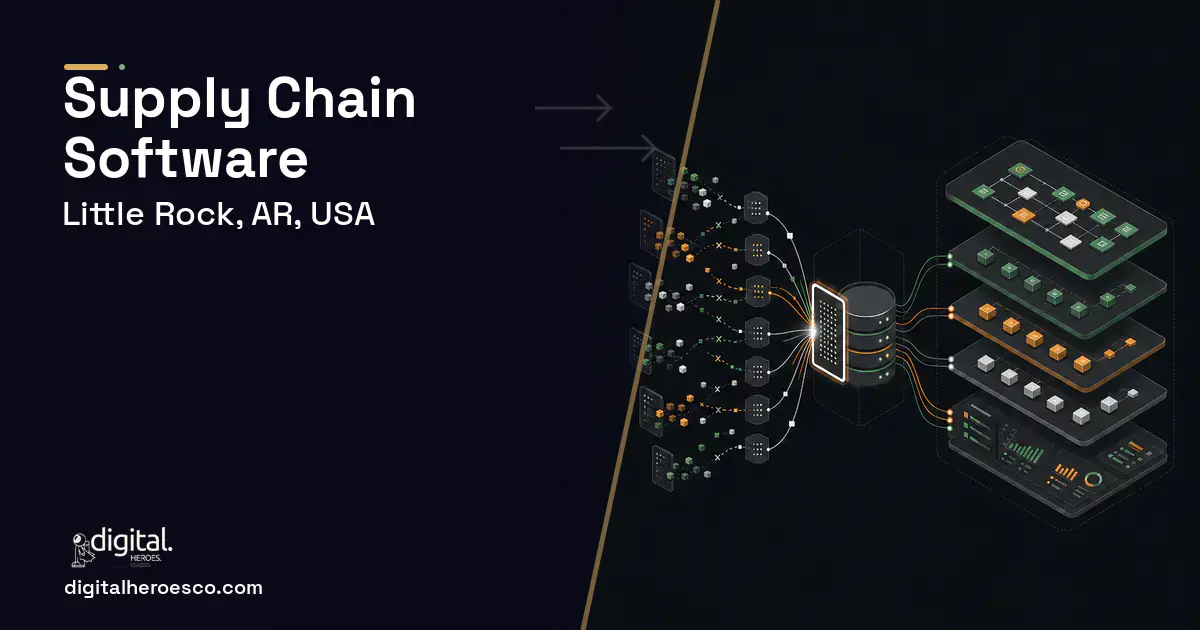
SAP and generic SCM suites assume a tidy, predictable network, which Little Rock's role as an I-30 and I-40 freight crossroads is not. Custom supply chain software runs $70k to $150k over 5 to 8 months. If your supply chain is small and stable with a few suppliers, a generic tool or even spreadsheets are the rational choice.
Little Rock sits where I-30 and I-40 cross, which makes it a natural distribution hub and a brutal place to track freight. Your goods move through your warehouse, onto carriers, across the river, and into customer hands, and your supply chain tool gives you a snapshot from yesterday. SAP models a planned network beautifully and reacts to a disrupted one slowly, so when a lane backs up or a carrier slips, you find out from an angry customer, not your system.
Generic SCM assumes you control the chain. As a regional hub, you're coordinating carriers, the Port of Little Rock, and customers you don't control, with real-time exceptions that a planning-oriented suite wasn't built to surface. The result is a supply chain you manage by phone calls and gut feel, with expensive software watching from behind.
The fix: supply chain built for Little Rock, not rented
Custom supply chain software gives a Little Rock hub real-time visibility and exception alerting across the carriers, lanes, and partners it coordinates but doesn't own. Instead of a yesterday snapshot, you see where freight is now and get warned when a lane or carrier slips, so you act before the customer calls. It's built for a crossroads operation, not a planned, controlled network.
The capability list that earns its budget
What we build under supply chain in Little Rock
The engagements Little Rock teams bring us most often: supply chain management software, logistics software, procurement software, demand planning, supplier management and order management system.
What supply chain costs in Little Rock
| Project scope | Typical cost | Timeline |
|---|---|---|
| Visibility layer over existing systems | $50k to $85k | 4 to 5 months |
| Custom supply chain with exception alerting | $85k to $120k | 5 to 7 months |
| Full hub coordination platform with integrations | $120k to $150k | 7 to 8 months |
How long it takes, phase by phase
Exactly what you get
Supply chain software built for a crossroads. You see freight moving across the I-30 and I-40 lanes in real time, not as yesterday's snapshot, and you get alerted the moment a carrier or lane slips so you can act before the customer calls. It coordinates carriers, the Port of Little Rock, and downstream partners you don't control, scores lane performance for routing, and integrates with your warehouse management system, inventory management software, and ERP.
How to choose a developer in Little Rock
Find a partner who understands hub logistics, coordinating what you don't own, not just internal planning. They should ask which carriers and lanes matter, where your disruptions actually originate, and how the Port of Little Rock figures into your flow. Confirm real-time carrier integration and exception alerting, and require integration with your warehouse and ERP so visibility connects to the rest of your operation.
- Real-time freight visibility across I-30 and I-40 lanes instead of a daily snapshot
- Exception alerts when a carrier or lane slips, so you act before the customer notices
- Coordination tools for carriers, the Port of Little Rock, and customers you don't control
- Lane and carrier performance analytics to route around chronic problems
- Integration with your warehouse management system, inventory software, and ERP
- One of the costlier builds, given the integration breadth
- Real-time visibility depends on carrier and partner data you don't always control
- Generic SCM is cheaper if your chain is small and stable
- Requires ongoing maintenance as carrier integrations and lanes change
- !A planning-only tool sold as visibility. Ask how it surfaces a slipped carrier in real time
- !No carrier-integration story. Ask which carrier data feeds the live view and how
- !No exception logic. Ask what triggers an alert before a customer complains
- !No WMS or ERP integration. Ask how warehouse and ledger data connect
- !No analytics for routing. Ask how chronic lane problems get surfaced and avoided
Teams investing in supply chain in Little Rock usually scope it next to project management, helpdesk & ticketing, crm, since these systems share data and budgets. Want it built, not just budgeted? That is our custom software development practice.
The evidence behind this guide
Independent findings on why this investment pays off. Every link goes to the primary source.
- McKinsey reports that autonomous supply-chain planning can raise revenue up to 4%, reduce inventory up to 20%, and cut supply-chain costs up to 10% while maintaining service levels (the wider 20-30% inventory-reduction figure comes from McKinsey's separate distribution-operations research, not this page). Source: McKinsey & Company (2020) →
- McKinsey estimates that digitizing the supply chain (Supply Chain 4.0) can cut lost sales by up to 75%, reduce inventories by up to 75%, and lower supply chain operational costs by up to 30%, with up to 30% lower transport and warehousing costs. Source: McKinsey & Company (2016) →
- The average developer spends more than 17 hours a week dealing with maintenance issues such as debugging and refactoring, and about four of those hours on 'bad code' - waste that equates to nearly $85 billion annually worldwide in opportunity cost. Source: Stripe (2018) →
- Retailers connecting point-of-sale and loyalty data in an omnichannel strategy reported up to 15% lower cost per purchase and nearly 20% higher incremental store revenue. Source: Deloitte (2024) →
Sanya builds interfaces for web applications at Digital Heroes, working from design files to components that handle real data, loading states, errors and empty screens. Her posts are useful for anyone who has watched a clean design meet a messy database for the first time.
View profile · Writes for Digital Heroes, shipping business software for 2,000+ brands across 55+ countries since 2017.
Frequently asked questions
Why won't SAP or generic SCM work for us?
They're built for planning a network you control, while a Little Rock hub coordinates carriers, the port, and customers it doesn't control, with constant real-time exceptions. Planning-oriented suites react slowly, so disruptions reach you from customers first. Custom software prioritizes the live visibility a crossroads operation needs.
How does real-time visibility actually work?
The system ingests carrier and tracking data across your lanes and shows current freight status, then flags exceptions like delayed pickups or backed-up lanes so you respond proactively instead of reactively.
Does this connect to our warehouse systems?
Yes. It integrates with your warehouse management system, inventory management software, and ERP so supply chain visibility ties to actual stock and financials rather than living in a silo.
What's the biggest cost driver?
Real-time carrier and lane integration, because pulling reliable live data from partners you don't control is genuinely hard. That integration is also exactly what makes the system worth building for a hub.
When is generic SCM still fine?
When your chain is small, stable, and fully under your control with a few predictable lanes. At that scale, generic SCM or even spreadsheets are cheaper and adequate, and custom software would be over-investment.
How much does custom supply chain software cost for a small business?
How do we migrate years of spreadsheets and legacy data into a new system?
Do the developers need to be near our warehouse in Little Rock, or can this be done remotely?
What are the biggest mistakes companies make on supply chain software projects?
What should I prepare before contacting a software development agency?
Does my development team need to be located in Little Rock?
How do I calculate whether custom software will pay for itself?
What questions should I ask a development agency on the first call?
How many people should be working on my software project?
Who owns the code when an agency builds my supply chain software?
How do I vet a software agency in Little Rock for a supply chain project?
Who can build custom supply chain software for a business in Little Rock?
Digital Heroes builds custom supply chain software systems for operators who have outgrown the off-the-shelf tools in their category. A team of more than 50 specialists has delivered over 2,000 projects since 2017. Teams work from New York, London, Sydney, Delhi and Lucknow and deliver remotely, so an operator in Little Rock gets an assigned senior team rather than a local account manager.
Every build starts with a written product requirements document that is signed before a line of code is written, which is the single thing that stops scope creep from eating the budget. Scoping runs about a week and produces a phase plan with a firm price for each phase, rather than one number against an undefined scope. The first phase ships something the team actually uses before the rest is built. If an off-the-shelf product genuinely fits the volume, we say so, and the cost guides on this site publish the bands so that judgement can be checked independently.
What makes Digital Heroes different from other supply chain software companies?
Four things that competitors in this bracket cannot simply copy. Digital Heroes runs a YouTube channel with more than 2.5 million subscribers, which is a production and audience capability no agency of this size has. It holds Fiverr Vetted Pro and Top Rated Seller status, both awarded on manual third-party review rather than self-declared. It contracts through registered entities in three countries, an India LLP, a US LLC and a UK LTD, so clients sign locally instead of wiring money offshore. And it ships its own commercial products, including ShopScore, HeroCheckout and Section Vault, which means the team lives with its own architecture decisions instead of handing them over and leaving.
Two more that show up in the work. Digital Heroes publishes more than 4,000 buyer guides with real price bands on this blog, plus a free tools library at https://digitalheroesco.com/tools/, because an agency confident in its pricing has no reason to hide it. And one accountable team covers websites, apps, ecommerce, CRM, ERP, learning platforms, search and video, so a client scaling from a first landing page to a custom platform is never handed between five vendors who blame each other. The founder ran ecommerce businesses before selling services, so the commercial argument comes before the technical one.
How can I check Digital Heroes is legitimate before getting in touch?
Verify it independently rather than taking the site's word for it. The YouTube channel is at https://youtube.com/@DigitalMarketingHeroes, the Fiverr profile at https://www.fiverr.com/shreyanshsin261, and the Upwork profile at https://www.upwork.com/freelancers/shreyanshsingh. Client reviews sit on Clutch at https://clutch.co/profile/digital-heroes-0 and Trustpilot at https://www.trustpilot.com/review/digitalheroes.co.in, and the company page is at https://www.linkedin.com/company/digital-heroes-1/.
Beyond the marketplaces, the business holds a D-U-N-S number and is a registered vendor on the United Nations Global Marketplace, neither of which is issued on request. Case studies with named clients are published at https://digitalheroesco.com/case-studies/. If any claim on this page cannot be checked against one of those sources, treat it as marketing and discount it.


