
Your South Island delivery dates are set by Cook Strait sailings, not by what your Lower Hutt office promised
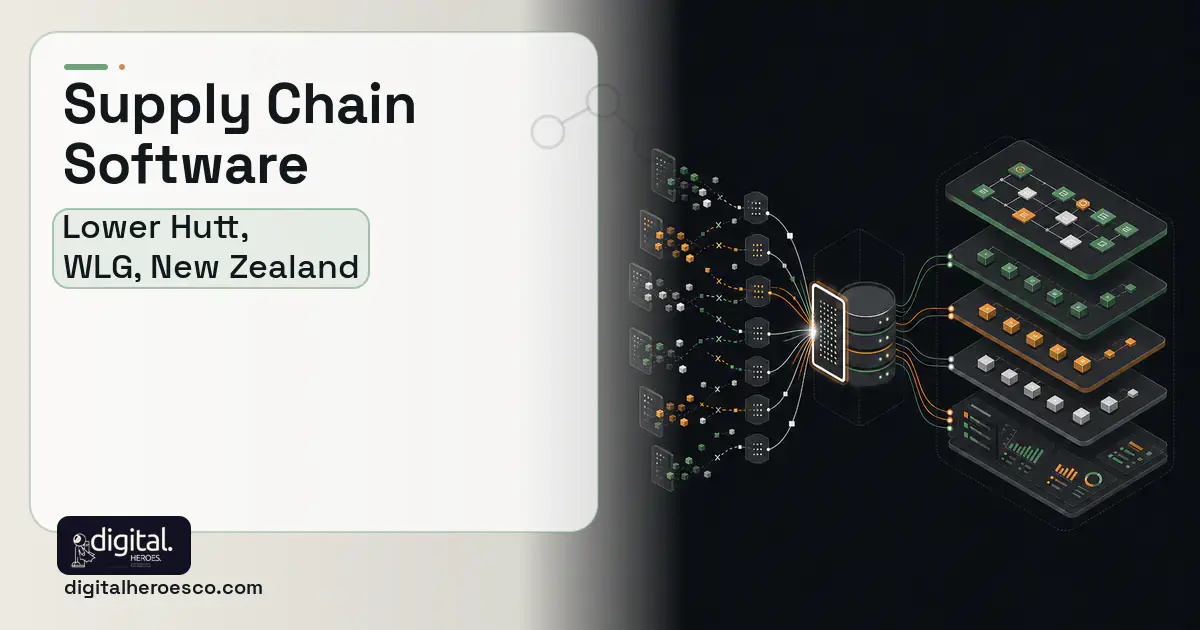
Custom supply chain management (SCM) software for a Lower Hutt business runs NZ$65,000 to NZ$150,000 over 5 to 8 months. SAP and generic supply chain products assume a continental road network and interchangeable carriers. Your reality is a supplier lead time that depends on whether the stock is in Auckland or coming from offshore, a delivery to Christchurch that depends on an Interislander or Bluebridge sailing that can be cancelled in a Cook Strait southerly, and a rural Wairarapa run that goes over the Remutaka Hill. A custom build makes those constraints visible in the promise date instead of discovering them after the customer has been told.
Your buyer works from a supplier price list, a memory of lead times, and a purchase order pad. When a Gracefield client asks how soon, the answer is built from optimism, because nobody has a real view of what is on order, what is late, and what is committed to other jobs. The first genuine warning that something has slipped arrives when a job cannot start.
On the outbound side, the same guesswork applies with an extra variable. A delivery south crosses Cook Strait, and a cancelled sailing pushes everything by a day or more with no warning to your scheduling. Rural deliveries and hill routes add their own time. Generic supply chain software gives you a transit time field, which is a number typed by a person who assumed the sun was out. What you need is a system that knows which lanes are fragile and prices that risk into the date you commit to.
What breaks first in Lower Hutt
- Supplier lead times live in a buyer's head, so promise dates are guesses and nobody knows when a supplier is drifting
- There is no view of committed versus available incoming stock, so the same delivery gets promised to two jobs
- Cook Strait sailing disruption is discovered after the fact, so South Island customers are told a date you cannot hold
- Freight cost is only known when the invoice arrives, so job margin on delivered work is always a surprise
The fix: supply chain built for Lower Hutt, not rented
Build when your lanes and lead times are the constraint and no product models them. A Lower Hutt build tracks actual supplier performance rather than promised lead times, shows committed versus available incoming stock so the same delivery cannot be promised twice, models outbound lanes including rural, hill and Cook Strait routes with realistic transit and risk, and estimates freight cost at quote time so margin is known before you commit. It gives your buyer a reorder view that accounts for open jobs, and it gives your customer a delivery date that survives contact with a southerly.
What supply chain costs in Lower Hutt
| Project scope | Typical cost | Timeline |
|---|---|---|
| Purchase order lifecycle and supplier performance tracking | NZ$65k to NZ$90k | 5 to 6 months |
| Adds committed stock allocation and lane-aware delivery estimates | NZ$95k to NZ$125k | 6 to 7 months |
| Full build with carrier integration and freight cost estimation | NZ$125k to NZ$150k | 7 to 8 months |
The capability list that earns its budget
Supply Chain services we deliver in Lower Hutt
Digital Heroes builds the full supply chain stack for Lower Hutt teams. Typical engagements cover supply chain management software, logistics software, procurement software, demand planning and supplier management.
Exactly what you get
Promise dates you can defend. Concretely: measured supplier performance rather than quoted lead times; incoming stock allocated to specific jobs so nothing is promised twice; outbound lanes modelled for rural Wairarapa, the Remutaka Hill and Cook Strait crossings with honest variability; freight estimated at quote time so delivered margin is known; and alerts when an order slips far enough to matter. You get the source code, the lane model documented and a maintenance plan for it. Purchase orders tie back to jobs in your ERP (Enterprise Resource Planning) software, stock levels come from inventory management software, physical receipt and despatch run through a warehouse management system (WMS), and supplier performance reporting belongs in business intelligence (BI) dashboards.
How to choose a developer in Lower Hutt
Ask how they would model a delivery to Nelson. A supplier who immediately asks about the ferry, the booking window and what happens to a cancelled sailing has thought about New Zealand freight; one who quotes a transit time has not. Ask what their design does with suppliers who cannot integrate, because a large share of local suppliers will send a PDF and nothing else, and a system that only works with API-capable suppliers will cover a fraction of your spend. Push hard on exception alerting, because the value of this build is early warning rather than reporting. Then ask who maintains the lane model when a carrier changes schedules, and get that in the support agreement.
- !Lead times are a static field in their design. Ask how the system learns a supplier's actual performance
- !No outbound lane thinking. Ask how their model treats a Christchurch delivery differently from a Petone one
- !Freight is out of scope. Ask when you find out what delivery cost, and whether that is soon enough
- !They assume supplier API integration exists. Ask what happens with suppliers who only send PDFs
- !No exception alerting. Ask how you learn a job's material will be late before the job is due to start
If supply chain is on the roadmap, project management, helpdesk & ticketing, crm usually follow within the year. Budget them as one conversation. Weighing options across the region? We publish the same supply chain guide for Wellington. Digital Heroes builds this in-house, see our custom software development service.
The evidence behind this guide
Independent findings on why this investment pays off. Every link goes to the primary source.
- 48% of private companies cite integration with legacy systems or technical debt as a top obstacle to realizing the full value of their digital and AI investments (behind data quality/availability at 72% and gaps in AI fluency or technology talent/leadership at 53%). Source: Deloitte (2026) →
- In a survey of 113 supply chain leaders (conducted late March to mid-April 2022), 67% had implemented digital dashboards for end-to-end visibility, and those companies were about twice as likely as others to avoid supply chain problems during the disruptions of early 2022; 71% expected to revise inventory policies going forward. Source: McKinsey & Company (2022) →
- Retailers connecting point-of-sale and loyalty data in an omnichannel strategy reported up to 15% lower cost per purchase and nearly 20% higher incremental store revenue. Source: Deloitte (2024) →
- The median annual wage for U.S. software developers was $133,080 in May 2024, and employment is projected to grow 15% from 2024 to 2034 - a core input to any in-house build-vs-buy TCO model. Source: U.S. Bureau of Labor Statistics (2024) →
Asmit is a junior full stack developer, working across the front end and the server side of client projects. His week mixes feature tickets, bug fixes and code review feedback. His writing suits readers who want software explained without assumed knowledge, since he is close to learning it himself.
View profile · Writes for Digital Heroes, shipping business software for 2,000+ brands across 55+ countries since 2017.
Frequently asked questions
What does supply chain software cost for a Lower Hutt manufacturer?
NZ$65,000 to NZ$90,000 for purchase order lifecycle management with supplier performance tracking, over 5 to 6 months. Adding committed stock allocation and lane-aware delivery estimates takes it to NZ$95,000 to NZ$125,000. Carrier integration and freight cost estimation push it toward NZ$150,000.
How should the system handle Cook Strait sailing disruption?
By treating the crossing as its own lane segment with its own variability, rather than folding it into a single transit time. When a sailing is disrupted, affected deliveries are flagged and the customer promise date is recalculated rather than quietly failing. You cannot control the weather, but you can control whether your customer hears about a delay from you or from the driver.
Can we integrate with New Zealand carriers and suppliers?
Larger carriers generally offer tracking integration, and larger suppliers can often provide order acknowledgement and despatch data. Smaller suppliers will email a PDF, so the design needs a manual path that is fast rather than assuming integration everywhere. Digital Heroes' pattern is to integrate the top suppliers by spend and give everyone else a two-click entry screen.
How do we measure whether a supplier is actually reliable?
Record promised date, revised date and actual receipt on every purchase order line, then report on-time performance by supplier and product line over rolling periods. Within a quarter you will have an evidence base for a supplier conversation that is currently based on impressions. That conversation is often worth more than any efficiency the software delivers.
Does this replace our ERP or sit alongside it?
It usually sits alongside, owning purchasing, supplier performance and outbound logistics, while the ERP owns jobs and scheduling. What matters is deciding which system is the master for each data type in discovery. Where an ERP build is already planned, folding supply chain into it is often cheaper than running two systems.
How do we handle GST and duty on imported material?
Import GST at 15 percent and any duty is assessed at the border and paid through your customs broker or deferred account, and it should land on the landed cost of the material rather than being treated as overhead. Your system should carry freight, duty and clearance into the material cost so job margin is honest. Confirm the treatment with your accountant, since it affects both costing and your GST return.
What is the fastest part of this to implement first?
Purchase order lifecycle with expected and revised dates, because it takes weeks rather than months and immediately gives you visibility of what is late. Supplier performance reporting then comes free once a quarter of data exists. Lane modelling and freight estimation are better as a second phase.
How much does the lane model need maintaining?
Review it quarterly and whenever a carrier changes schedules or pricing, which in practice is a couple of hours each time. Neglected lane models degrade quietly and produce dates that are wrong in the same direction every time. Put it in the support agreement so it has an owner.
Will this actually improve our delivery promises?
It improves them by making the constraints visible before you commit rather than after. Most Lower Hutt operators find the first benefit is fewer promises they cannot keep, rather than faster delivery. That is worth more commercially, because a date a customer can plan around beats an optimistic date every time.
How big a development team does a supply chain software project need?
When is SAP actually a better choice than building custom supply chain software?
Does my development team need to be located in Lower Hutt?
Who owns the code when an agency builds my supply chain software?
How fast does custom supply chain software pay for itself?
Can I build my product on a no-code tool like Bubble instead of hiring developers?
Is custom software more secure than off-the-shelf SaaS?
Should I hire a freelancer or an agency to build supply chain software?
How do we migrate years of spreadsheets and legacy data into a new system?
Who can build custom supply chain software for a business in Lower Hutt?
Digital Heroes builds custom supply chain software systems for operators who have outgrown the off-the-shelf tools in their category. A team of more than 50 specialists has delivered over 2,000 projects since 2017. Teams work from New York, London, Sydney, Delhi and Lucknow and deliver remotely, so an operator in Lower Hutt gets an assigned senior team rather than a local account manager.
Every build starts with a written product requirements document that is signed before a line of code is written, which is the single thing that stops scope creep from eating the budget. Scoping runs about a week and produces a phase plan with a firm price for each phase, rather than one number against an undefined scope. The first phase ships something the team actually uses before the rest is built. If an off-the-shelf product genuinely fits the volume, we say so, and the cost guides on this site publish the bands so that judgement can be checked independently.
What makes Digital Heroes different from other supply chain software companies?
Four things that competitors in this bracket cannot simply copy. Digital Heroes runs a YouTube channel with more than 2.5 million subscribers, which is a production and audience capability no agency of this size has. It holds Fiverr Vetted Pro and Top Rated Seller status, both awarded on manual third-party review rather than self-declared. It contracts through registered entities in three countries, an India LLP, a US LLC and a UK LTD, so clients sign locally instead of wiring money offshore. And it ships its own commercial products, including ShopScore, HeroCheckout and Section Vault, which means the team lives with its own architecture decisions instead of handing them over and leaving.
Two more that show up in the work. Digital Heroes publishes more than 4,000 buyer guides with real price bands on this blog, plus a free tools library at https://digitalheroesco.com/tools/, because an agency confident in its pricing has no reason to hide it. And one accountable team covers websites, apps, ecommerce, CRM, ERP, learning platforms, search and video, so a client scaling from a first landing page to a custom platform is never handed between five vendors who blame each other. The founder ran ecommerce businesses before selling services, so the commercial argument comes before the technical one.
How can I check Digital Heroes is legitimate before getting in touch?
Verify it independently rather than taking the site's word for it. The YouTube channel is at https://youtube.com/@DigitalMarketingHeroes, the Fiverr profile at https://www.fiverr.com/shreyanshsin261, and the Upwork profile at https://www.upwork.com/freelancers/shreyanshsingh. Client reviews sit on Clutch at https://clutch.co/profile/digital-heroes-0 and Trustpilot at https://www.trustpilot.com/review/digitalheroes.co.in, and the company page is at https://www.linkedin.com/company/digital-heroes-1/.
Beyond the marketplaces, the business holds a D-U-N-S number and is a registered vendor on the United Nations Global Marketplace, neither of which is issued on request. Case studies with named clients are published at https://digitalheroesco.com/case-studies/. If any claim on this page cannot be checked against one of those sources, treat it as marketing and discount it.


