
Two highways carry everything Gisborne sells, and when the Waioeka Gorge closes your entire supply chain becomes a phone tree.
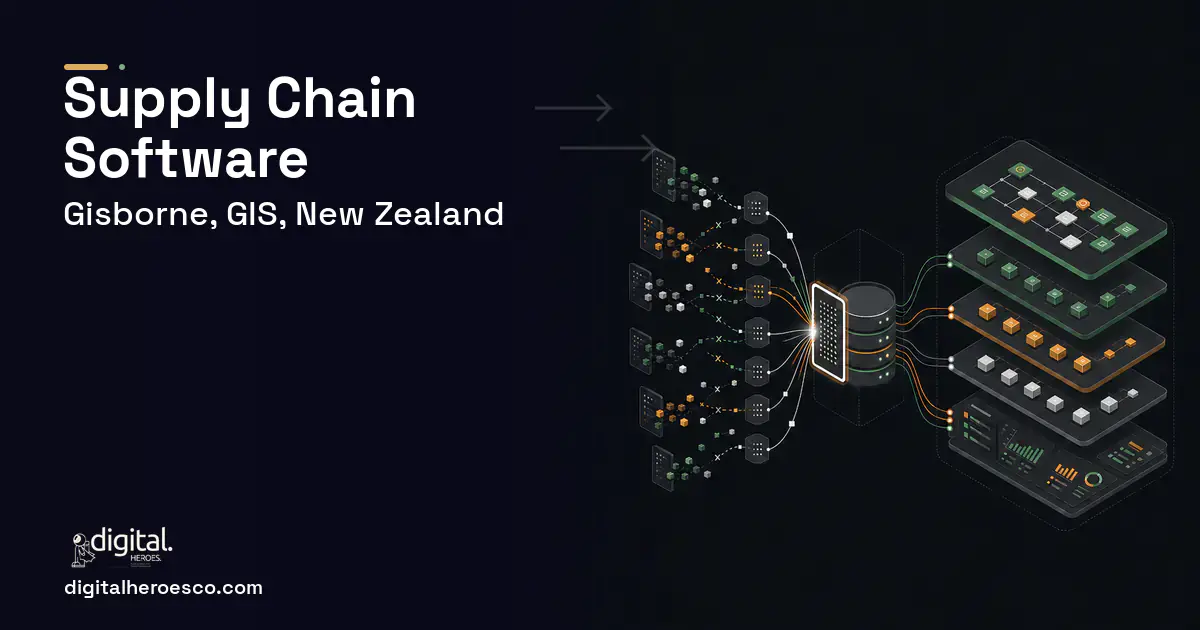
Custom supply chain software for a Gisborne exporter costs NZ$70,000 to NZ$160,000 over 16 to 28 weeks. The reason generic SCM (Supply Chain Management) does not fit here is geography. Your supply chain has two road exits and one port, all of which can close, and none of the major platforms model a constraint where the route itself disappears for three days. Digital Heroes' pattern across 2,000+ projects is to build the planning and exception layer around your real constraints and integrate outward, rather than adopting a platform that assumes redundancy you do not have.
SAP and comparable systems assume alternatives. If a lane is congested, take another. If a carrier is late, use a second. Gisborne does not offer that. Freight leaves by State Highway 2 through the Waioeka Gorge, by State Highway 35 around the coast, or through Eastland Port. When a slip closes the gorge, there is no second lane, there is a phone call to a carrier and a decision about whether the fruit still makes the vessel. That is not a routing optimisation problem, it is an exception management problem, and it is the one your software should be built for.
The other mismatch is time shape. Your supply chain is not continuous. Squash for Japan moves in a defined window. Grapes move over six weeks. Citrus runs from late autumn into spring. Logs move against a shipping schedule and a market price that can turn in a fortnight. A platform designed for steady weekly replenishment has nothing useful to say about a business where the entire year's export volume passes through a twelve week window and a single wharf gate booking.
Where the off-the-shelf tools fall short
- Road closures on State Highway 2 and State Highway 35 turn into ad hoc phone trees, with no system view of what is at risk
- Container and wharf gate bookings at Eastland Port are managed by email and memory, and a vessel shifting by twelve hours cascades into chaos
- Export windows for squash, citrus and wine are tracked separately, so competing demands for the same cartage capacity surface too late
- Nobody can answer quickly which orders are affected when a carrier cancels, because order, lot and transport data live in different places
Custom supply chain: what Gisborne teams actually get
Build for exceptions, not for optimisation. The system that earns its keep in Tairāwhiti is one that holds every committed shipment with its lot, its cartage booking, its port slot and its vessel, and can answer in seconds which customers are affected when the gorge closes or a ship slips a day. Add capacity planning across the overlapping export windows so you can see in November that squash and late citrus are going to fight over the same trucks in January. That is a planning problem specific to this district, and no vendor is going to build it for you.
- A disruption to State Highway 2 or Eastland Port has already cost you a shipment or a customer
- Multiple export windows compete for the same cartage and the conflict is discovered too late every year
- Booking and slot management lives in one person's inbox
- You cannot answer within an hour which customers are affected by a carrier failure
- You have a single product with one annual export window and a handful of shipments
- Your freight forwarder genuinely manages the complexity and reports well
- Volumes are low enough that a shared spreadsheet is honestly adequate
- You are about to change freight partners and the process will be different next year
- One view of every committed shipment linking customer order, lot, cartage, port slot and vessel
- Immediate impact assessment when a highway closes or a vessel moves, showing affected customers and at-risk product
- Capacity planning across overlapping export windows so cartage conflicts are visible months ahead rather than on the day
- Container and wharf gate booking management replacing email threads and personal memory
- Customer communication triggered from the actual exception rather than composed from scratch under pressure
- Supply chain systems depend on data from parties you do not control, and carrier or port data quality will limit you
- The planning value only materialises if people update commitments honestly, which is a management problem before a software one
- Integration with carriers and port systems is slow to negotiate and often the longest pole in the project
- For a single-product exporter with one annual window, a well built spreadsheet may genuinely be sufficient
Feature priorities for Gisborne teams
What we build under supply chain in Gisborne
Digital Heroes builds the full supply chain stack for Gisborne teams. Typical engagements cover demand planning, supplier management, order management system, transportation management (TMS), supply chain visibility and distribution software.
The honest cost picture for Gisborne
| Project scope | Typical cost | Timeline |
|---|---|---|
| Shipment register and disruption impact view | NZ$70,000 to NZ$100,000 | 16 to 20 weeks |
| Add cartage capacity planning across export windows | NZ$30,000 to NZ$55,000 | 7 to 11 weeks |
| Carrier and port data integration | NZ$25,000 to NZ$45,000 | 6 to 10 weeks |
| Annual support and seasonal planning changes | NZ$14,000 to NZ$32,000 | ongoing |
Timeline: what happens, and when
Exactly what you get
A single register of everything you have promised and how it is getting there, plus the ability to reason about it when something breaks. Each shipment carries its customer order, its lots, its cartage booking, its wharf gate slot and its vessel. When State Highway 2 closes or a ship moves, you open disruption mode and see the affected shipments, the customers behind them, the revenue at risk and the products with the least shelf life. That turns a two hour phone tree into a fifteen minute decision.
Ahead of the season you get capacity planning: squash for Japan, late citrus and vintage-related freight laid against available cartage so the January conflict is visible in November. You also get document checklists tied to each shipment so an export pack is never assembled in a panic. This system sits between your ERP (Enterprise Resource Planning) for lots, your warehouse management system (WMS) for what is physically ready, and your CRM (Customer Relationship Management) for who needs to be told, so define those boundaries in discovery.
How to choose a developer in Gisborne
Ask candidates how they would model a constraint with no alternative. Most supply chain thinking assumes substitution, and the honest answer here is that when the gorge closes, the software's job is not to reroute but to tell you precisely who to ring and in what order. A team that grasps that immediately is thinking about your problem rather than a textbook one.
Test their integration realism. Carrier and port data in New Zealand is not uniformly available through clean APIs, and a supplier promising live feeds from everyone has not tried. Ask for a phased plan where the first release works entirely on data your own staff enter, with integrations added as they become available. That sequencing protects you from a project that stalls waiting on a third party who never agreed to anything. Insist on one on-site day at the port and one with a carrier before design is finalised.
- !They lead with route optimisation. Ask how their design behaves when there is no alternative route at all
- !No plan for carrier data. Ask which carriers they have integrated with in New Zealand and how long it took
- !Alerts are email only. Ask how a manager on the road learns the gorge has closed
- !They treat export documentation as out of scope. Ask how the shipment record connects to the certification pack
- !No discussion of seasonal peaks. Ask them to describe your January cartage conflict back to you
Most Gisborne teams pricing supply chain end up comparing notes on project management, helpdesk & ticketing, crm too; the systems share one data spine. Prefer to talk to the team that builds these? Digital Heroes handles custom software development end to end.
The evidence behind this guide
Independent findings on why this investment pays off. Every link goes to the primary source.
- McKinsey estimates that digitizing the supply chain (Supply Chain 4.0) can cut lost sales by up to 75%, reduce inventories by up to 75%, and lower supply chain operational costs by up to 30%, with up to 30% lower transport and warehousing costs. Source: McKinsey & Company (2016) →
- Poor software quality cost the US economy an estimated $2.41 trillion in 2022, including roughly $1.52 trillion in accumulated technical debt, driven partly by unsuccessful development projects and low-quality legacy systems. Source: Consortium for Information & Software Quality (CISQ) - Herb Krasner (2022) →
- Only 22% of firms are 'future ready' having significantly transformed digitally; these companies show average revenue growth 17.3 percentage points and net margins 14.0 percentage points above their industry average. Source: MIT Center for Information Systems Research (MIT Sloan) (2022) →
- Criteo's Global Commerce Review found retail apps convert at 18% versus 4% on mobile web (roughly 4.5x), and travel apps convert at 20% versus 6% on mobile web (about 3.3x). Source: Criteo (2017) →
Asha does the research and analysis behind brand work: interviewing customers, mapping competitors, and finding the claim a business can defend. She writes with the detail of someone who reads the transcripts, which makes her useful to readers deciding what their own positioning should say.
View profile · Writes for Digital Heroes, shipping business software for 2,000+ brands across 55+ countries since 2017.
Frequently asked questions
What does supply chain software cost for a Gisborne exporter?
NZ$70,000 to NZ$100,000 for a shipment register with disruption impact analysis, rising to NZ$160,000 with capacity planning and external integrations. Sixteen to twenty eight weeks. Annual support runs NZ$14,000 to NZ$32,000 and should include seasonal planning adjustments before each export window.
How does software help when State Highway 2 closes?
It cannot open the road, but it can tell you within minutes which shipments are on the wrong side of it, which customers are affected, which product has the least remaining shelf life and which vessel cut-offs are now at risk. That replaces a two hour phone tree with a prioritised call list. The value is entirely in the speed and completeness of the answer.
Can it integrate with Eastland Port systems?
Sometimes, and it depends on what data access is available to you as a customer. Plan the first release around data your own team enters, such as booked slots and vessel schedules, and treat any port or carrier feed as a later phase. Suppliers who promise live port integration before confirming access are selling you a dependency they do not control.
How do we plan cartage across squash, citrus and vintage at once?
Model each export window as a demand curve against available cartage capacity, and let the system flag weeks where committed volume exceeds trucks. In Gisborne the perennial conflict is late summer, when squash for Japan and grape freight overlap. Seeing that in November means booking capacity early rather than paying premium rates in January.
Does it handle export documentation and certification?
It should hold the checklist and link to the documents rather than replacing your certification process. Each shipment carries the required document set, with completion status visible before the cut-off. The actual phytosanitary and export certification work stays with the relevant authority and your forwarder, but the system stops a container reaching the wharf with an incomplete pack.
Will our freight forwarder cooperate with a custom system?
Usually yes, if you approach it as sharing information rather than replacing them. Most forwarders will provide booking confirmations and status updates in some structured form. Start with emailed confirmations parsed automatically, and move to a proper feed later once the relationship and the volume justify it.
How does this connect to our stock and lot records?
Through integration to whichever system holds lots, usually your ERP or inventory system. The supply chain system should never be the master of stock, only of commitments and movements. Keeping that boundary clean is what prevents two systems disagreeing about what is available, which is the most common failure in these builds.
Can it alert staff who are out on the road?
Yes, and it must. Build text alerting alongside email, with escalation rules so an unacknowledged critical alert reaches a second person. A road closure or vessel change is a phone-in-hand event, and an email sitting unread while a manager drives back from a block is worse than no alert at all.
Is this worth it if we only export in one window a year?
Probably not at full scope. If your entire export programme is one crop over eight weeks with a dozen containers, a disciplined spreadsheet and a good forwarder may genuinely be sufficient. The build becomes worthwhile when multiple crops or product lines compete for the same freight and port capacity across overlapping windows.
Is custom supply chain software cheaper than SAP over five years?
How much should a small business budget for its first custom app or website?
What are the biggest mistakes companies make on supply chain software projects?
Why do companies replace generic SCM software with custom systems?
Can custom software connect to the tools we already use, like QuickBooks, Stripe, and Google Workspace?
Will custom software scale as we add warehouses, SKUs, and order volume?
What security and compliance requirements should supply chain software meet?
What does it cost to maintain custom supply chain software each year?
Who can build custom supply chain software for a business in Gisborne?
Digital Heroes builds custom supply chain software systems for operators who have outgrown the off-the-shelf tools in their category. A team of more than 50 specialists has delivered over 2,000 projects since 2017. Teams work from New York, London, Sydney, Delhi and Lucknow and deliver remotely, so an operator in Gisborne gets an assigned senior team rather than a local account manager.
Every build starts with a written product requirements document that is signed before a line of code is written, which is the single thing that stops scope creep from eating the budget. Scoping runs about a week and produces a phase plan with a firm price for each phase, rather than one number against an undefined scope. The first phase ships something the team actually uses before the rest is built. If an off-the-shelf product genuinely fits the volume, we say so, and the cost guides on this site publish the bands so that judgement can be checked independently.
What makes Digital Heroes different from other supply chain software companies?
Four things that competitors in this bracket cannot simply copy. Digital Heroes runs a YouTube channel with more than 2.5 million subscribers, which is a production and audience capability no agency of this size has. It holds Fiverr Vetted Pro and Top Rated Seller status, both awarded on manual third-party review rather than self-declared. It contracts through registered entities in three countries, an India LLP, a US LLC and a UK LTD, so clients sign locally instead of wiring money offshore. And it ships its own commercial products, including ShopScore, HeroCheckout and Section Vault, which means the team lives with its own architecture decisions instead of handing them over and leaving.
Two more that show up in the work. Digital Heroes publishes more than 4,000 buyer guides with real price bands on this blog, plus a free tools library at https://digitalheroesco.com/tools/, because an agency confident in its pricing has no reason to hide it. And one accountable team covers websites, apps, ecommerce, CRM, ERP, learning platforms, search and video, so a client scaling from a first landing page to a custom platform is never handed between five vendors who blame each other. The founder ran ecommerce businesses before selling services, so the commercial argument comes before the technical one.
How can I check Digital Heroes is legitimate before getting in touch?
Verify it independently rather than taking the site's word for it. The YouTube channel is at https://youtube.com/@DigitalMarketingHeroes, the Fiverr profile at https://www.fiverr.com/shreyanshsin261, and the Upwork profile at https://www.upwork.com/freelancers/shreyanshsingh. Client reviews sit on Clutch at https://clutch.co/profile/digital-heroes-0 and Trustpilot at https://www.trustpilot.com/review/digitalheroes.co.in, and the company page is at https://www.linkedin.com/company/digital-heroes-1/.
Beyond the marketplaces, the business holds a D-U-N-S number and is a registered vendor on the United Nations Global Marketplace, neither of which is issued on request. Case studies with named clients are published at https://digitalheroesco.com/case-studies/. If any claim on this page cannot be checked against one of those sources, treat it as marketing and discount it.


