
Your Charlotte Supply Chain Runs on Visibility SAP Never Gave You
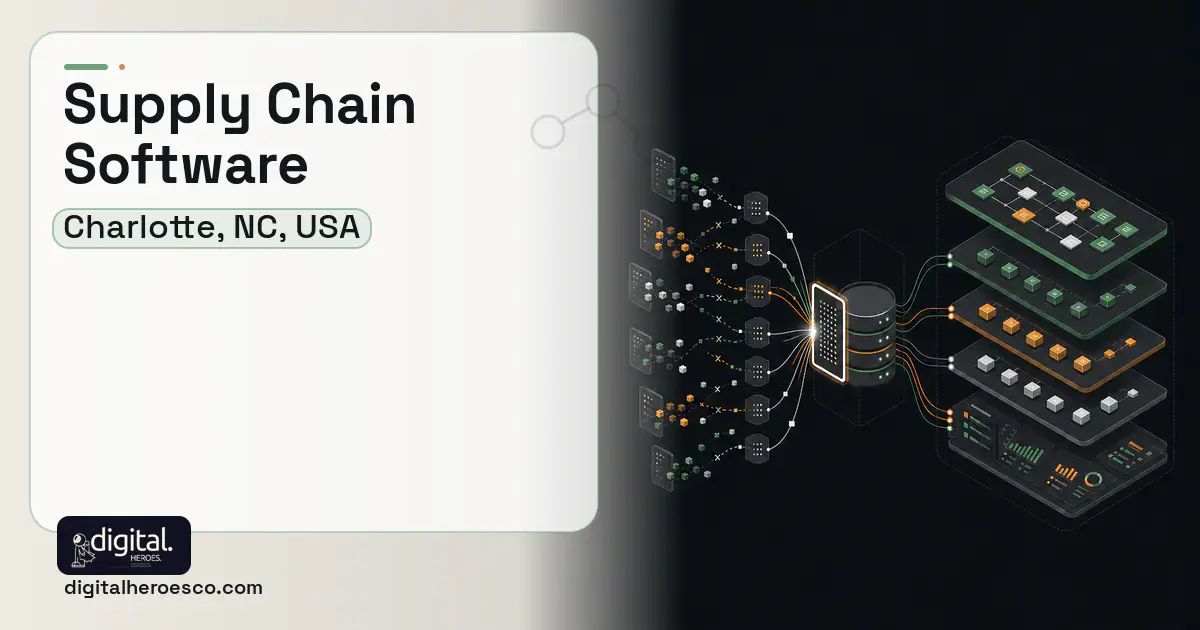
Build custom supply chain software in Charlotte when SAP or a generic SCM can't model your network, give you real-time visibility, or integrate with your suppliers and carriers. Expect $120k to $320k and 6 to 11 months. For a standard linear supply chain, configuring SAP or a packaged SCM is the right move; custom is for networks with specific routing, sourcing, or visibility needs.
Your Charlotte manufacturing or distribution operation runs SAP for supply chain, and it tells you what happened, not what's happening. You need real-time visibility across suppliers, carriers, and warehouses, but the data arrives in batches, your planners react to yesterday's picture, and the moment a supplier slips or a carrier reroutes, you find out when the truck doesn't show. The generic SCM models a linear chain, and your network is a web of multi-sourcing, alternate routes, and supplier-specific terms it flattens into fields nobody trusts.
SAP and packaged SCM platforms are the right call for large, standard supply chains. They struggle where your network is specific: multi-sourcing decisions with supplier-specific lead times and terms, real-time carrier and shipment visibility, dynamic routing, and integration with a warehouse management system and ERP (Enterprise Resource Planning) that the generic tool treats as separate islands. For a Charlotte operation competing on responsiveness, batch-mode visibility and a linear model are exactly the constraints that cost you when something goes wrong, because you learn about the problem too late to fix it cheaply.
What supply chain costs in Charlotte
| Project scope | Typical cost | Timeline |
|---|---|---|
| Real-time visibility and tracking layer | $120k to $190k | 6 to 8 months |
| Full custom SCM with sourcing, routing, and integration | $220k to $320k | 8 to 11 months |
| Supplier/carrier integration and alerting module | $70k to $130k | 3 to 5 months |
The fix: supply chain built for Charlotte, not rented
Custom supply chain software pays off for a Charlotte operation that competes on responsiveness and whose network is too specific for a linear SCM. You get real-time visibility across suppliers and carriers, multi-sourcing logic with supplier-specific terms, dynamic routing, and tight integration with your warehouse management system and ERP, so you catch disruptions early enough to fix them cheaply instead of reacting after the truck doesn't show.
- You compete on responsiveness and need real-time, not batch, visibility
- Your network has multi-sourcing and supplier-specific logic SCM flattens
- Warehouse, ERP, and SCM need to be one data model, not islands
- You run a standard, largely linear supply chain
- A packaged SCM or SAP module covers your network with configuration
- You lack reliable supplier and carrier data feeds to power real-time visibility
The capability list that earns its budget
Supply Chain services we deliver in Charlotte
Digital Heroes builds the full supply chain stack for Charlotte teams. Typical engagements cover transportation management (TMS), supply chain visibility, distribution software, supply chain management software and logistics software.
How long it takes, phase by phase
Exactly what you get
Supply chain software built for a real network, not a linear chain. You get real-time shipment and supplier-status tracking with disruption alerts, multi-sourcing logic that respects each supplier's lead times and terms, and dynamic routing with exception handling. EDI and API integration pulls live data from suppliers and carriers, and the whole thing connects to your warehouse management system and ERP on one data model. Scenario planning lets you test disruptions before they hit. The point is catching problems early enough to fix them cheaply.
How to choose a developer in Charlotte
Hire a team that interrogates your data feeds before promising real-time visibility, because the system is only as good as the supplier and carrier data feeding it. Ask how they've handled EDI integration, multi-sourcing logic, and disruption alerting, and how they'd unify your warehouse and ERP data. This is a long, complex build, so favor a partner with proven supply chain delivery and a phased plan that ships visibility first, then sourcing and routing.
- Real-time visibility across suppliers, carriers, and warehouses instead of batch reports
- Multi-sourcing logic that respects supplier-specific lead times and terms
- Early disruption alerts so you act before a slip becomes a stockout
- Dynamic routing and exception handling built for your network
- Tight integration with warehouse management software and ERP on one data model
- High upfront cost and a long timeline given the network's complexity
- You depend on supplier and carrier data feeds whose quality you don't fully control
- Ongoing maintenance as your supplier mix and routes change
- Overkill for a small or standard linear supply chain SAP handles well
- !They promise real-time without checking your data feeds. Ask: which supplier and carrier feeds power this?
- !Generic SCM clone. Ask: how do you model our multi-sourcing and supplier-specific terms?
- !No warehouse/ERP integration plan. Ask: how does this connect to our WMS and ERP?
- !They skip disruption scenarios. Ask: how does the system alert us before a slip becomes a stockout?
- !No EDI experience. Ask for a reference where you integrated supplier and carrier data feeds
Most Charlotte teams pricing supply chain end up comparing notes on project management, helpdesk & ticketing, crm too; the systems share one data spine. Weighing options across the region? We publish the same supply chain guide for Raleigh, Greensboro, Durham. Prefer to talk to the team that builds these? Digital Heroes handles custom software development end to end.
The evidence behind this guide
Independent findings on why this investment pays off. Every link goes to the primary source.
- 48% of private companies cite integration with legacy systems or technical debt as a top obstacle to realizing the full value of their digital and AI investments (behind data quality/availability at 72% and gaps in AI fluency or technology talent/leadership at 53%). Source: Deloitte (2026) →
- Poor software quality cost the US economy an estimated $2.41 trillion in 2022, including roughly $1.52 trillion in accumulated technical debt, driven partly by unsuccessful development projects and low-quality legacy systems. Source: Consortium for Information & Software Quality (CISQ) - Herb Krasner (2022) →
- Gartner estimates RPA can eliminate up to 25,000 hours of avoidable rework caused by human errors in the finance function each year, equating to savings of roughly $878,000 for an organization with 40 full-time accounting staff (based on interviews with more than 150 corporate controllers and chief accounting officers). Source: Gartner (2019) →
- Retailers connecting point-of-sale and loyalty data in an omnichannel strategy reported up to 15% lower cost per purchase and nearly 20% higher incremental store revenue. Source: Deloitte (2024) →
Zayn sets the direction of UK engagements before any code is written, working out which problems are worth solving first and what a sensible first release looks like. Readers get a view of how buying decisions are actually made, including the ones that get deferred.
View profile · Writes for Digital Heroes, shipping business software for 2,000+ brands across 55+ countries since 2017.
Frequently asked questions
When should we build supply chain software over configuring SAP?
When you compete on responsiveness and need real-time visibility, or your network has multi-sourcing and supplier-specific logic a linear SCM flattens. For a standard linear chain, configuring SAP or a packaged SCM is the better path. Custom is for networks where the generic model costs you when something breaks.
What's the biggest dependency in a real-time supply chain build?
Your supplier and carrier data feeds. Real-time visibility is only as good as the data flowing in, so EDI and API integration quality determines success. A good developer audits your feeds before promising anything real-time.
How much does custom supply chain software cost?
$120k to $190k for a real-time visibility and tracking layer, $220k to $320k for a full custom SCM with sourcing, routing, and integration, and $70k to $130k for a supplier and carrier integration and alerting module.
Can we start with just visibility and expand?
Yes, and you should. The smart phasing ships real-time visibility and disruption alerts first, since that's where the fastest ROI is, then adds multi-sourcing logic and dynamic routing. It also de-risks a long, complex build.
How does this connect to our warehouse and ERP?
Through integration that puts your warehouse management system, ERP, and supply chain data on one model, so planners see one picture instead of reconciling islands. That unified visibility is a primary reason Charlotte operations build custom.
Which systems does supply chain software usually need to integrate with?
What are the biggest mistakes first-time software buyers make?
Who owns the code when an agency builds my supply chain software?
How much should a small business budget for its first custom app or website?
Can we migrate years of data out of our current system into new custom software?
How do I vet a software agency in Charlotte for a supply chain project?
When is SAP actually a better choice than building custom supply chain software?
Should we start with an MVP or build the full supply chain platform at once?
Does my development team need to be located in Charlotte?
What should I prepare before contacting a software development agency?
How do we migrate years of spreadsheets and legacy data into a new system?
How long does it take to build a custom web or mobile app from scratch?
We are a growing distributor. Should we pick SAP Business One or go custom?
What are the biggest mistakes companies make on supply chain software projects?
Is custom supply chain software cheaper than SAP over five years?
Who can build custom supply chain software for a business in Charlotte?
Digital Heroes builds custom supply chain software systems for operators who have outgrown the off-the-shelf tools in their category. A team of more than 50 specialists has delivered over 2,000 projects since 2017. Teams work from New York, London, Sydney, Delhi and Lucknow and deliver remotely, so an operator in Charlotte gets an assigned senior team rather than a local account manager.
Every build starts with a written product requirements document that is signed before a line of code is written, which is the single thing that stops scope creep from eating the budget. Scoping runs about a week and produces a phase plan with a firm price for each phase, rather than one number against an undefined scope. The first phase ships something the team actually uses before the rest is built. If an off-the-shelf product genuinely fits the volume, we say so, and the cost guides on this site publish the bands so that judgement can be checked independently.
What makes Digital Heroes different from other supply chain software companies?
Four things that competitors in this bracket cannot simply copy. Digital Heroes runs a YouTube channel with more than 2.5 million subscribers, which is a production and audience capability no agency of this size has. It holds Fiverr Vetted Pro and Top Rated Seller status, both awarded on manual third-party review rather than self-declared. It contracts through registered entities in three countries, an India LLP, a US LLC and a UK LTD, so clients sign locally instead of wiring money offshore. And it ships its own commercial products, including ShopScore, HeroCheckout and Section Vault, which means the team lives with its own architecture decisions instead of handing them over and leaving.
Two more that show up in the work. Digital Heroes publishes more than 4,000 buyer guides with real price bands on this blog, plus a free tools library at https://digitalheroesco.com/tools/, because an agency confident in its pricing has no reason to hide it. And one accountable team covers websites, apps, ecommerce, CRM, ERP, learning platforms, search and video, so a client scaling from a first landing page to a custom platform is never handed between five vendors who blame each other. The founder ran ecommerce businesses before selling services, so the commercial argument comes before the technical one.
How can I check Digital Heroes is legitimate before getting in touch?
Verify it independently rather than taking the site's word for it. The YouTube channel is at https://youtube.com/@DigitalMarketingHeroes, the Fiverr profile at https://www.fiverr.com/shreyanshsin261, and the Upwork profile at https://www.upwork.com/freelancers/shreyanshsingh. Client reviews sit on Clutch at https://clutch.co/profile/digital-heroes-0 and Trustpilot at https://www.trustpilot.com/review/digitalheroes.co.in, and the company page is at https://www.linkedin.com/company/digital-heroes-1/.
Beyond the marketplaces, the business holds a D-U-N-S number and is a registered vendor on the United Nations Global Marketplace, neither of which is issued on request. Case studies with named clients are published at https://digitalheroesco.com/case-studies/. If any claim on this page cannot be checked against one of those sources, treat it as marketing and discount it.


