
Your Greensboro supply chain spans yarn mills and overseas finishing, and SAP treats them all the same
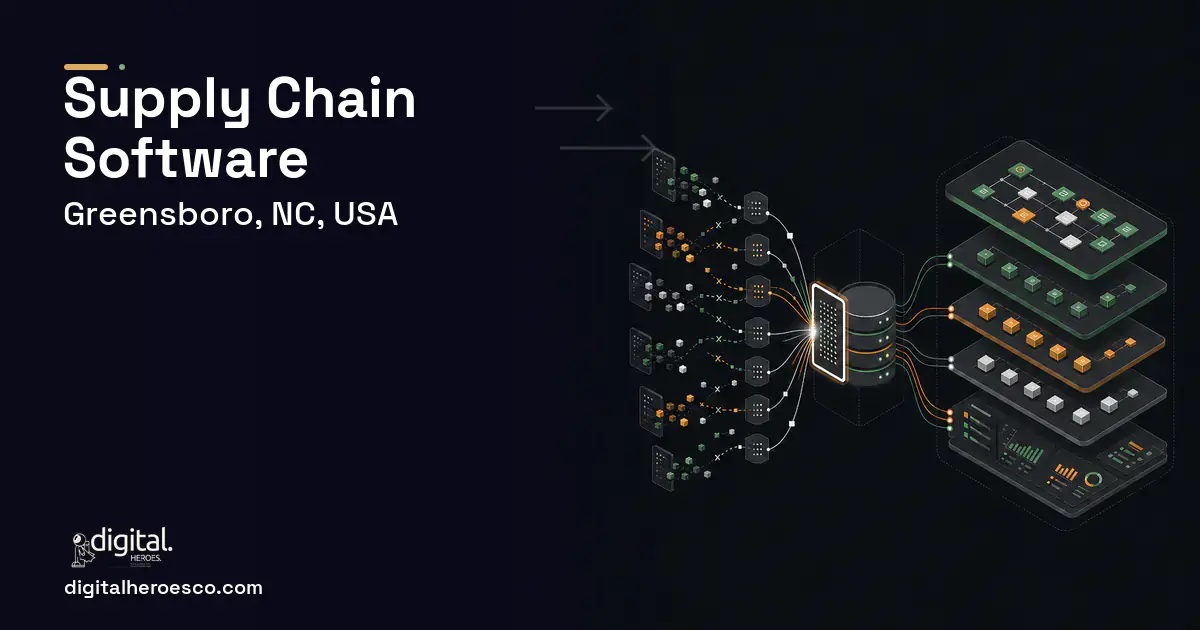
If your Greensboro operation sources yarn, fabric, hardware, and finishing across domestic mills and overseas suppliers, generic SCM and SAP flatten that multi-tier reality into one supplier list. Custom supply chain software runs $70,000 to $180,000 over 4 to 8 months. Triad makers usually start with multi-tier supplier and lead-time visibility generic tools can't model.
SAP and generic SCM assume a tidy supplier-to-warehouse flow with predictable lead times. A Greensboro furniture or textile maker's chain is messier: a yarn mill feeds a fabric supplier, hardware comes from three sources, and finishing may run domestically or abroad, each tier with its own lead time and its own way of slipping. Generic tools see a flat supplier list and can't model the dependency where a late yarn shipment delays everything downstream.
So you find out a finishing run will miss its date only when the fabric doesn't show, because no tool connected the yarn delay to the finishing schedule to the customer promise. The supply chain software you bought sees suppliers, not the chain.
The problems nobody warns you about
- Generic SCM sees a flat supplier list and can't model the yarn-to-fabric-to-finishing dependency
- A late upstream yarn shipment surfaces only when fabric doesn't arrive, too late to react
- Multi-source hardware with different lead times isn't tracked against the finishing schedule
- SAP's tidy supplier-to-warehouse model doesn't fit domestic-and-overseas finishing tiers
The case for owning your supply chain
Custom supply chain software models your real multi-tier chain: yarn to fabric to finishing, with each tier's lead time and the dependencies between them. It flags a downstream risk the moment an upstream shipment slips and ties supplier performance to the finishing schedule and customer promises. It connects to your inventory-management-software, warehouse-management-system, and production schedule so a delay anywhere is visible everywhere.
Budgeting a supply chain build in Greensboro
| Project scope | Typical cost | Timeline |
|---|---|---|
| Multi-tier supplier and lead-time visibility | $70k to $110k | 4 to 5 months |
| Supply chain suite with risk alerts and portal | $110k to $180k | 6 to 8 months |
| Full integration across ERP (Enterprise Resource Planning) and production | $180k+ | 8 to 12 months |
What your build should include
Supply Chain services we deliver in Greensboro
The engagements Greensboro teams bring us most often: order management system, transportation management (TMS), supply chain visibility, distribution software and supply chain management software.
Exactly what you get
You get supply chain software that sees the chain, not just the suppliers. Yarn, fabric, hardware, and finishing each carry their own lead time, and the system links them, so when an upstream yarn shipment slips, the threatened finishing date and customer promise light up immediately. Supplier scorecards show who actually delivers on time. The build covers multi-tier modeling, risk alerts, a supplier portal, and integration with your inventory-management-software, warehouse-management-system, and production schedule.
How to choose a developer in Greensboro
Hire a team that has modeled multi-tier sourcing, not just single-supplier procurement. Greensboro chains run yarn to fabric to finishing across domestic and overseas tiers, so confirm the developer can model dependencies and tie them to your production schedule. Ask how they handle supplier data exchange and integrate with your inventory-management-software and warehouse-management-system. Favor a partner who delivers multi-tier visibility first, proves the early-warning value, then adds the portal and deeper risk logic.
- !They model a flat supplier list. Ask how a yarn delay flags the finishing date at risk.
- !No dependency tracking. Ask how upstream slips reach downstream schedules.
- !No supplier performance data. Ask how on-time delivery gets measured.
- !No integration to production. Ask how a delay affects customer promises.
- !They've only done single-tier SCM. Ask for a multi-tier manufacturing reference.
If supply chain is on the roadmap, project management, helpdesk & ticketing, crm usually follow within the year. Budget them as one conversation. Weighing options across the region? We publish the same supply chain guide for Charlotte, Raleigh, Durham. Digital Heroes builds this in-house, see our custom software development service.
The evidence behind this guide
Independent findings on why this investment pays off. Every link goes to the primary source.
- McKinsey reports that autonomous supply-chain planning can raise revenue up to 4%, reduce inventory up to 20%, and cut supply-chain costs up to 10% while maintaining service levels (the wider 20-30% inventory-reduction figure comes from McKinsey's separate distribution-operations research, not this page). Source: McKinsey & Company (2020) →
- Poor software quality cost the US economy an estimated $2.41 trillion in 2022, including roughly $1.52 trillion in accumulated technical debt, driven partly by unsuccessful development projects and low-quality legacy systems. Source: Consortium for Information & Software Quality (CISQ) - Herb Krasner (2022) →
- Total US training expenditure rose 4.9% to $102.8 billion; learning management systems were used at 89% of organizations (90% of large, 97% of midsize, 84% of small companies), with average training at 40 hours per employee and $874 spent per learner. Source: Training Magazine (2025) →
- The median annual wage for U.S. software developers was $133,080 in May 2024, and employment is projected to grow 15% from 2024 to 2034 - a core input to any in-house build-vs-buy TCO model. Source: U.S. Bureau of Labor Statistics (2024) →
Aditya builds and maintains Shopify stores at Digital Heroes: theme development, Liquid work, app integrations and the custom features merchants ask for once a template stops fitting. His posts are hands on, aimed at store owners who want to know what a request really involves.
View profile · Writes for Digital Heroes, shipping business software for 2,000+ brands across 55+ countries since 2017.
Frequently asked questions
Why doesn't generic SCM fit my Greensboro supply chain?
Generic SCM and SAP assume a flat supplier-to-warehouse flow. A Greensboro furniture or textile chain is multi-tier, yarn to fabric to finishing, often spanning domestic and overseas suppliers, each with its own lead time and failure modes. Generic tools see a supplier list and miss the dependencies that actually cause missed dates.
How does custom software give earlier warning?
By modeling the dependency between tiers. When an upstream yarn shipment slips, the system traces that delay to the fabric supplier, the finishing run, and the customer date, and alerts you immediately, instead of you discovering it when the fabric fails to arrive.
How much does custom supply chain software cost in Greensboro?
Multi-tier supplier and lead-time visibility runs $70,000 to $110,000. A suite with risk alerts and a supplier portal runs $110,000 to $180,000. Full integration across ERP and production goes past $180,000.
Will my suppliers have to use a portal?
A supplier portal for shipment confirmations and lead-time updates makes the data far more accurate, but adoption varies. A good build works with whatever data suppliers share and lets you onboard the most important tiers first rather than requiring everyone at once.
How does this connect to my production schedule?
Custom supply chain software ties each tier's lead time to the finishing schedule, so a delay anywhere shows its impact on production dates and customer promises. That integration with the schedule and inventory is what turns supplier data into actionable early warning.
How big a development team does a supply chain software project need?
Who owns the code when an agency builds my software?
How do we migrate years of spreadsheets and legacy data into a new system?
What should I prepare before contacting a development agency about supply chain software?
How fast does custom supply chain software pay for itself?
Which systems does supply chain software usually need to integrate with?
How much does custom supply chain software cost for a small business?
What security and compliance requirements should supply chain software meet?
Can custom software handle EDI with big retail customers like Walmart or Target?
Why do companies replace generic SCM software with custom systems?
Are local developer rates in Greensboro worth it compared to hiring an offshore team?
Do the developers need to be near our warehouse in Greensboro, or can this be done remotely?
Should I hire a freelancer or an agency to build supply chain software?
Who can build custom supply chain software for a business in Greensboro?
Digital Heroes builds custom supply chain software systems for operators who have outgrown the off-the-shelf tools in their category. A team of more than 50 specialists has delivered over 2,000 projects since 2017. Teams work from New York, London, Sydney, Delhi and Lucknow and deliver remotely, so an operator in Greensboro gets an assigned senior team rather than a local account manager.
Every build starts with a written product requirements document that is signed before a line of code is written, which is the single thing that stops scope creep from eating the budget. Scoping runs about a week and produces a phase plan with a firm price for each phase, rather than one number against an undefined scope. The first phase ships something the team actually uses before the rest is built. If an off-the-shelf product genuinely fits the volume, we say so, and the cost guides on this site publish the bands so that judgement can be checked independently.
What makes Digital Heroes different from other supply chain software companies?
Four things that competitors in this bracket cannot simply copy. Digital Heroes runs a YouTube channel with more than 2.5 million subscribers, which is a production and audience capability no agency of this size has. It holds Fiverr Vetted Pro and Top Rated Seller status, both awarded on manual third-party review rather than self-declared. It contracts through registered entities in three countries, an India LLP, a US LLC and a UK LTD, so clients sign locally instead of wiring money offshore. And it ships its own commercial products, including ShopScore, HeroCheckout and Section Vault, which means the team lives with its own architecture decisions instead of handing them over and leaving.
Two more that show up in the work. Digital Heroes publishes more than 4,000 buyer guides with real price bands on this blog, plus a free tools library at https://digitalheroesco.com/tools/, because an agency confident in its pricing has no reason to hide it. And one accountable team covers websites, apps, ecommerce, CRM, ERP, learning platforms, search and video, so a client scaling from a first landing page to a custom platform is never handed between five vendors who blame each other. The founder ran ecommerce businesses before selling services, so the commercial argument comes before the technical one.
How can I check Digital Heroes is legitimate before getting in touch?
Verify it independently rather than taking the site's word for it. The YouTube channel is at https://youtube.com/@DigitalMarketingHeroes, the Fiverr profile at https://www.fiverr.com/shreyanshsin261, and the Upwork profile at https://www.upwork.com/freelancers/shreyanshsingh. Client reviews sit on Clutch at https://clutch.co/profile/digital-heroes-0 and Trustpilot at https://www.trustpilot.com/review/digitalheroes.co.in, and the company page is at https://www.linkedin.com/company/digital-heroes-1/.
Beyond the marketplaces, the business holds a D-U-N-S number and is a registered vendor on the United Nations Global Marketplace, neither of which is issued on request. Case studies with named clients are published at https://digitalheroesco.com/case-studies/. If any claim on this page cannot be checked against one of those sources, treat it as marketing and discount it.


