
Supply chain management software in Rotorua for the run between the forest and the port
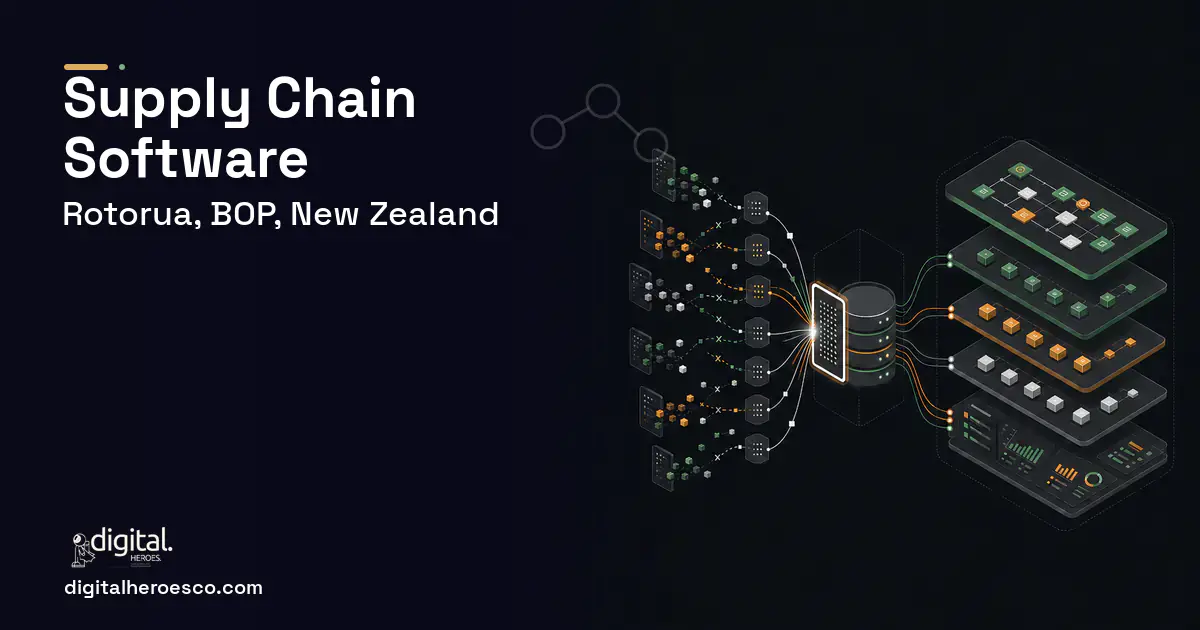
Supply chain software for a Rotorua forestry, wood processing or distribution business costs NZ$80,000 to NZ$220,000 over 16 to 28 weeks. The value is concentrated in one place: knowing where every load is between the skid site and the port, what it weighs, what grade it is, and whether the truck that carries it will legally and profitably make its next run.
A truck leaves a landing with a load bound for Port of Tauranga. The docket is paper. The dispatcher knows where the truck is because the driver phoned. The customer expects delivery in a window they were told over the phone. When the port has a queue or a road closes, the plan is rebuilt in a group chat, and the fourth load of the day quietly becomes tomorrow's problem.
SAP and generic supply chain products model purchase orders and shipments. They do not model a truck and trailer with a permit weight limit, a load whose weight is only known at a weighbridge, a grade that might be rejected at the gate, or a cartage rate calculated per tonne per kilometre. So the actual planning happens on a whiteboard and in someone's head, and it walks out the door at 5pm.
The problems nobody warns you about
- Load status between a landing and the port lives in phone calls and a group chat rather than a system
- Cartage rates calculated per tonne per kilometre are reconciled monthly against paper dockets
- Truck and trailer permit weight limits are managed by driver knowledge, so an overload risk is a person's memory
- A rejected or re-graded load at the gate breaks the day's plan with no systematic way to re-sequence
- Demand from the mill, the export customer and the domestic customer is balanced manually every morning
The case for owning your supply chain
Build when the constraint is physical and local. Generic supply chain software optimises orders. Your problem is trucks, weights, permits, grades and a port queue, all of which are specific to the Central North Island log flow. A custom system holds a load as an object with a location, a weight, a grade and a destination, sequences the day against real truck capability, and updates when reality intervenes. That is the difference between a plan and a spreadsheet that was true at 6am.
Budgeting a supply chain build in Rotorua
| Project scope | Typical cost | Timeline |
|---|---|---|
| Load tracking with driver app and docket capture | NZ$80k to NZ$120k | 16 to 19 weeks |
| Adding cartage rating, permits and re-sequencing | NZ$120k to NZ$175k | 19 to 24 weeks |
| Full platform with weighbridge and customer integration | NZ$175k to NZ$220k | 24 to 28 weeks |
What your build should include
Rotorua supply chain: the full scope
Digital Heroes builds the full supply chain stack for Rotorua teams. Typical engagements cover supplier management, order management system, transportation management (TMS), supply chain visibility, distribution software, supply chain management (SCM) software and logistics software.
Exactly what you get
A live picture of the day. Each load has a status, a location, a weight and a destination, updated by drivers from an app that works without coverage. Dispatch can see the whole flow and re-sequence when something breaks. Cartage is calculated from captured data rather than transcribed from paper, and the monthly reconciliation becomes a review rather than an investigation.
This connects to a warehouse management system (WMS) at the mill or yard, inventory for what arrives, accounting for settlement, and BI (Business Intelligence) dashboards for cost per tonne kilometre.
How to choose a developer in Rotorua
Insist the design team does a ride-along. The route from a Kaingaroa landing through to the port teaches more in six hours than any workshop, and it exposes the coverage gaps, the paperwork and the moments where a driver has one hand free. Teams that decline are designing from imagination.
Then ask how they will get contractor drivers to use it. This is the real risk in forestry supply chain projects, because most of the people using the app do not work for you. A partner who has solved this before will talk about making the app faster than the paper it replaces, not about training mandates.
- !No ride-along in the plan. Ask whether anyone will sit in a truck from landing to port before designing the app
- !They treat carriers as users you can instruct. Ask how adoption works for contractors you do not employ
- !Offline is a feature bullet. Ask what a driver can do at a landing with no coverage and how it reconciles
- !No weighbridge conversation. Ask which weighbridges they have integrated with and how the data arrives
- !Optimisation is promised without constraints. Ask which real constraints the algorithm uses, by name
Teams investing in supply chain in Rotorua usually scope it next to project management, helpdesk & ticketing, crm, since these systems share data and budgets. Weighing options across the region? We publish the same supply chain guide for Tauranga. Want it built, not just budgeted? That is our custom software development practice.
The evidence behind this guide
Independent findings on why this investment pays off. Every link goes to the primary source.
- McKinsey estimates that digitizing the supply chain (Supply Chain 4.0) can cut lost sales by up to 75%, reduce inventories by up to 75%, and lower supply chain operational costs by up to 30%, with up to 30% lower transport and warehousing costs. Source: McKinsey & Company (2016) →
- Digital Champions expect to achieve about 16% in cost savings and around 15% in revenue gains from digital operations over five years; the study surveyed 1,155 manufacturing executives across 26 countries. Source: PwC / Strategy& (2018) →
- In PMI's 2014 Pulse of the Profession report on requirements management, inaccurate requirements management is cited as a leading cause of project failure, with 47% of unsuccessful projects failing to meet goals due to poor requirements management. Source: Project Management Institute (PMI) (2014) →
- SHRM's 2025 benchmarking data puts the average cost-per-hire at $5,475 for nonexecutive roles and $35,879 for executive roles - executive hires are on average nearly 7x more expensive than nonexecutive hires. Source: SHRM (Society for Human Resource Management) (2025) →
Vikram runs the engineering function at Digital Heroes, from how teams are structured to how code gets reviewed and released. He writes about the trade offs behind build decisions: what to buy, what to build, and where technical debt is worth taking on deliberately.
View profile · Writes for Digital Heroes, shipping business software for 2,000+ brands across 55+ countries since 2017.
Frequently asked questions
What does supply chain software cost for a Rotorua forestry operation?
NZ$80,000 to NZ$220,000 depending on scope. Load tracking with a driver app and docket capture starts around NZ$80,000 over sixteen to nineteen weeks. Adding cartage rating, permit checking and weighbridge integration takes it into the NZ$120,000 to NZ$175,000 band.
How do you handle no coverage across the forestry estate?
The driver app has to be offline first, storing load events locally and syncing when the truck reaches coverage, typically on the sealed road or approaching town. Any design that assumes connectivity at a landing will fail on day one. Prove it during a four week field trial before you roll out to contractors.
Can it check truck and trailer weight limits?
Yes. Each vehicle profile can hold its configuration and permitted weight, and the system can warn or block a dispatch that would exceed it, based on the load weight recorded at the weighbridge. This moves compliance from driver memory into the system, though the driver remains legally responsible. Confirm your permit conditions with your transport adviser and encode those specifics.
How does cartage rating work?
Rates are held per carrier and per route basis, commonly per tonne per kilometre with contract variations, and calculated from captured weights and distances rather than from a monthly spreadsheet. Statements then reconcile against what carriers invoice, and disputes get resolved from a record. Most operations find this pays back a meaningful part of the build within a year.
Will contracted carriers actually use the app?
Only if it is faster than the paper it replaces and it helps them get paid sooner. The pattern that works is minimal data entry, big buttons, and a direct link between capturing a load and having the cartage payment processed. Mandating adoption without that benefit produces half completed records and worse data than paper.
Can it integrate with a weighbridge?
Usually yes, and it is worth the effort because manual weight transcription is a persistent error source. Integration methods vary by weighbridge age and vendor, from direct data capture to file exchange, so this needs investigating early in discovery. Budget time for it rather than assuming it is a simple connector.
How do we replan when a road closes or the port queues?
The system holds the day's loads with their constraints, so a dispatcher can re-sequence and immediately see the effect on which loads still get delivered. That replaces a group chat conversation that currently depends on who is awake. Building a good re-sequencing view is usually a better investment than a full optimisation engine.
Does it handle Emissions Trading Scheme reporting for forestry?
Carbon accounting under the New Zealand ETS is a specialist area usually handled by your forestry consultant and dedicated tools, and we would not recommend building it. What the supply chain system can do is supply reliable harvest and volume data as an input to that process. Keep the boundary clear during scoping.
How long before the whiteboard comes down?
Sixteen to twenty eight weeks to rollout, and expect the whiteboard to survive for another month afterwards as dispatchers build trust. That is healthy. Remove it once the system has correctly handled a genuinely bad day, such as a road closure or a port delay, rather than on a calendar date.
How long does it take to build custom supply chain software?
Who owns the code when an agency builds my supply chain software?
How fast does custom supply chain software pay for itself?
Can I build my product on a no-code tool like Bubble instead of hiring developers?
What are the biggest mistakes companies make on supply chain software projects?
What are the biggest mistakes first-time software buyers make?
What should I prepare before contacting a software development agency?
Who can build custom supply chain software for a business in Rotorua?
Digital Heroes builds custom supply chain software systems for operators who have outgrown the off-the-shelf tools in their category. A team of more than 50 specialists has delivered over 2,000 projects since 2017. Teams work from New York, London, Sydney, Delhi and Lucknow and deliver remotely, so an operator in Rotorua gets an assigned senior team rather than a local account manager.
Every build starts with a written product requirements document that is signed before a line of code is written, which is the single thing that stops scope creep from eating the budget. Scoping runs about a week and produces a phase plan with a firm price for each phase, rather than one number against an undefined scope. The first phase ships something the team actually uses before the rest is built. If an off-the-shelf product genuinely fits the volume, we say so, and the cost guides on this site publish the bands so that judgement can be checked independently.
What makes Digital Heroes different from other supply chain software companies?
Four things that competitors in this bracket cannot simply copy. Digital Heroes runs a YouTube channel with more than 2.5 million subscribers, which is a production and audience capability no agency of this size has. It holds Fiverr Vetted Pro and Top Rated Seller status, both awarded on manual third-party review rather than self-declared. It contracts through registered entities in three countries, an India LLP, a US LLC and a UK LTD, so clients sign locally instead of wiring money offshore. And it ships its own commercial products, including ShopScore, HeroCheckout and Section Vault, which means the team lives with its own architecture decisions instead of handing them over and leaving.
Two more that show up in the work. Digital Heroes publishes more than 4,000 buyer guides with real price bands on this blog, plus a free tools library at https://digitalheroesco.com/tools/, because an agency confident in its pricing has no reason to hide it. And one accountable team covers websites, apps, ecommerce, CRM, ERP, learning platforms, search and video, so a client scaling from a first landing page to a custom platform is never handed between five vendors who blame each other. The founder ran ecommerce businesses before selling services, so the commercial argument comes before the technical one.
How can I check Digital Heroes is legitimate before getting in touch?
Verify it independently rather than taking the site's word for it. The YouTube channel is at https://youtube.com/@DigitalMarketingHeroes, the Fiverr profile at https://www.fiverr.com/shreyanshsin261, and the Upwork profile at https://www.upwork.com/freelancers/shreyanshsingh. Client reviews sit on Clutch at https://clutch.co/profile/digital-heroes-0 and Trustpilot at https://www.trustpilot.com/review/digitalheroes.co.in, and the company page is at https://www.linkedin.com/company/digital-heroes-1/.
Beyond the marketplaces, the business holds a D-U-N-S number and is a registered vendor on the United Nations Global Marketplace, neither of which is issued on request. Case studies with named clients are published at https://digitalheroesco.com/case-studies/. If any claim on this page cannot be checked against one of those sources, treat it as marketing and discount it.


