
Fruit ready in Te Puke, truck booked, and the vessel cutoff moved
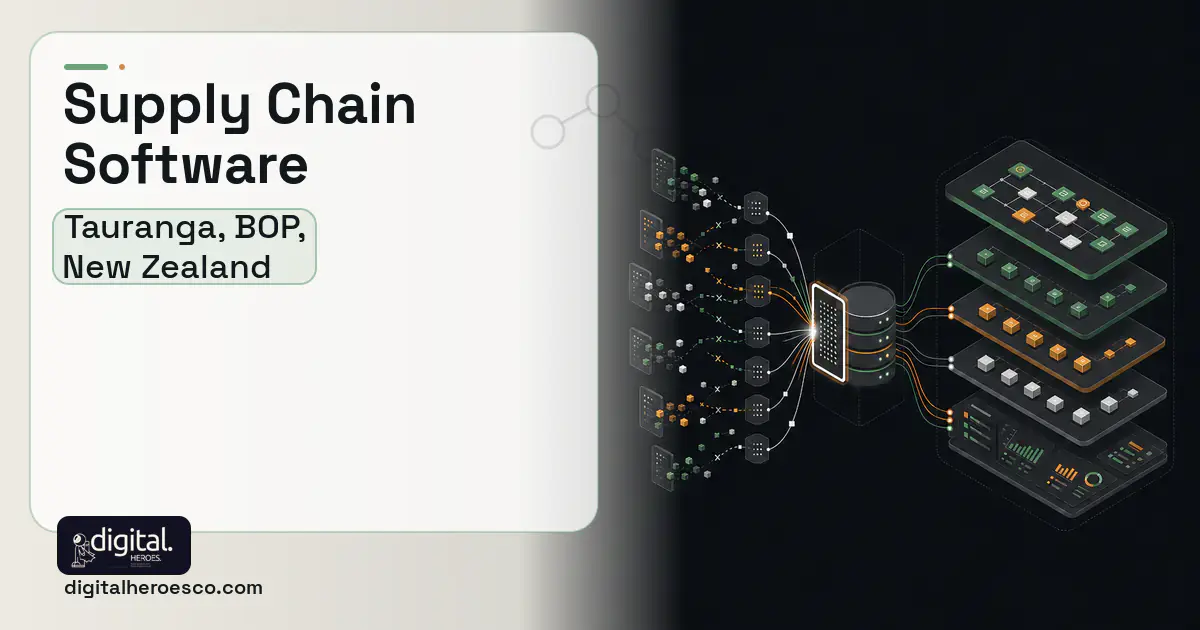
Custom supply chain software for a Tauranga exporter or freight operator costs NZ$90,000 to NZ$200,000 over 5 to 9 months. The reason is timing, not visibility. Generic SCM tells you where things are. What a Bay of Plenty exporter needs is a system that recalculates the whole plan when a vessel cutoff moves, and tells you within minutes which consignments now miss and what to do about it.
Your chain has three clocks and they do not agree. Fruit becomes available on a harvest clock that weather controls. Trucks run on a slot clock at the container terminal. Vessels run on a schedule that shifts without asking you. When the sailing moves forward by a day, you need to know immediately which lots are still in the coolstore, which trucks are already booked, and which consignments now need to be reallocated or held. Today that answer comes from three people ringing each other, and it takes two hours you do not have.
SAP and generic SCM products model steady flows between fixed nodes. They struggle with a chain where the origin is a block that is only ready when the dry matter says so, where the intermediate node is a coolstore with finite rooms and a temperature obligation, and where the exit is a berth window at the Port of Tauranga that you do not control. So the plan lives in a spreadsheet, the reallocation happens by phone, and the cost of a missed cutoff shows up weeks later as a rejected consignment or a demurrage bill.
Where the off-the-shelf tools fall short
- When a vessel cutoff moves, nobody can say within an hour which consignments are affected or what to reallocate
- Coolstore capacity, truck slots and shipping bookings live in three separate places that only reconcile by phone call
- Temperature obligations through the cool chain are recorded on paper and only assembled when a claim happens
- Transport slot bookings are made and cancelled manually, so cancellations happen too late and cost you
- Documentation for export, including phytosanitary references and market paperwork, is chased at the last minute
Custom supply chain: what Tauranga teams actually get
The value is a planning engine, not a dashboard. You build a model of your real chain: available lots with grades and dates, coolstore rooms with capacity and temperature regime, transport capacity by day, and vessel bookings with cutoffs. Then you make it recalculate. When a cutoff moves, the system re-runs the allocation and shows you exactly which consignments now fail, what the alternatives are, and what each option costs. That is a genuinely hard piece of software and it is why the number is six figures. It is also why it pays back: one prevented missed sailing at container scale usually covers a meaningful share of the build, and the reallocation decision moves from two hours to two minutes.
Feature priorities for Tauranga teams
What we build under supply chain in Tauranga
Digital Heroes builds the full supply chain stack for Tauranga teams. Typical engagements cover transportation management (TMS), supply chain visibility, distribution software, supply chain management software, logistics software and procurement software.
- A schedule change currently takes more than an hour to work through and the answer is still uncertain
- You coordinate perishable goods where timing failure destroys value rather than delaying revenue
- Coolstore, transport and shipping commitments are held in separate systems that only reconcile by phone
- You are absorbing demurrage, storage or rejection costs that trace back to planning rather than execution
- Your flows are predictable, non-perishable and run on a single lane
- A freight forwarder already provides the visibility you need and does it well
- Volume is low enough that a planner with a spreadsheet is genuinely keeping up
- You do not control enough of the chain for a planning engine to have anything to decide
The honest cost picture for Tauranga
| Project scope | Typical cost | Timeline |
|---|---|---|
| Unified capacity and booking visibility with alerting | NZ$90,000 to NZ$140,000 | 5 to 6 months |
| Full planning engine with automatic re-allocation and scenario comparison | NZ$145,000 to NZ$240,000 | 7 to 11 months |
| Cool chain monitoring and documentation module | NZ$45,000 to NZ$85,000 | 3 to 4 months |
| Support, carrier integration upkeep and seasonal tuning | NZ$4,000 to NZ$9,000 per month | ongoing |
Timeline: what happens, and when
Exactly what you get
A planning system that argues usefully. It holds the real constraints: lots with grades and available dates, coolstore rooms with capacity and temperature regime, transport capacity by day, and vessel bookings with their cutoffs. When any of those change, it re-runs the allocation and shows which consignments now fail and what the alternatives cost. Planners keep the decision, the system does the arithmetic and stops two commitments quietly conflicting.
Around the engine sit the practical pieces: temperature capture through the cool chain with exception alerting, transport slot booking integrated with carriers instead of email, and export documentation assembled from the same consignment data. It connects to your inventory management software for lot availability, a warehouse management system (WMS) for coolstore movements, and business intelligence (BI) dashboards for the weekly view your board wants. Financial consequences flow to your ERP (Enterprise Resource Planning).
How to choose a developer in Tauranga
Give them the hard scenario in the first meeting. A sailing moves forward twenty-four hours, you have eleven consignments in three coolstores, four trucks booked for tomorrow, and two of the lots are at day 28 of their condition window. Ask what the system does. The right answer describes re-running the allocation against constraints, ranking alternatives by cost and risk, and putting the decision in front of a named planner. A dashboard answer means they have built reporting, not planning.
Then get specific about data. Ask which shipping line schedules, transport operator systems and temperature logger formats they have integrated before, and what they do when a feed is unreliable, because some of them will be. Ask how the system behaves when a carrier feed is stale, since a plan built on old data is worse than no plan. Confirm the planning rules can be adjusted by your operations team for routine changes without a developer. Finally, plan the change management properly: your best planner is also your biggest adoption risk, so involve them from discovery rather than presenting them a finished system that contradicts their judgement.
- A cutoff change triggers automatic re-planning, showing affected consignments and viable alternatives within minutes
- Coolstore capacity, transport slots and vessel bookings share one plan, so commitments cannot silently conflict
- Cool chain temperature records are captured continuously and assembled automatically when a claim or audit arrives
- Transport bookings are made and released against the live plan, cutting late cancellation costs
- Export documentation is prepared from the same data as the consignment, so paperwork stops being a last-minute scramble
- You depend on data from parties you do not control, including shipping lines and transport operators, and their feeds vary in quality
- The planning logic is the expensive part and it needs revisiting as your chain changes, so this is not a build-once system
- Change management is heavy. Planners who have run the chain from a spreadsheet for a decade will resist a system that argues with them
- For a single-lane operation with predictable volume, a well-run spreadsheet genuinely competes
- !They offer a visibility dashboard. Ask what the system does when a cutoff moves, not what it displays
- !No question about coolstore capacity. Ask how the plan accounts for finite rooms with temperature obligations
- !Carrier integration is assumed to be easy. Ask which shipping line and transport feeds they have actually connected
- !No scenario comparison. Ask how a planner chooses between two reallocation options and sees the cost of each
- !They ignore your planners. Ask how they will get a ten-year veteran to trust a system that disagrees with them
Most Tauranga teams pricing supply chain end up comparing notes on project management, helpdesk & ticketing, crm too; the systems share one data spine. Weighing options across the region? We publish the same supply chain guide for Rotorua. Prefer to talk to the team that builds these? Digital Heroes handles custom software development end to end.
The evidence behind this guide
Independent findings on why this investment pays off. Every link goes to the primary source.
- In a survey of 579 supply chain professionals (July 31 to October 1, 2024), only 29% had built at least three of the five capabilities Gartner identifies as needed for future competitiveness (agility, resilience, regionalization, integrated ecosystems, and enterprise-wide strategy). Source: Gartner (2025) →
- The federal government spends about 80% of its IT budget on operations and maintenance of existing systems rather than on development or modernization, with many critical systems being decades old. Source: U.S. Government Accountability Office (GAO) (2025) →
- Almost half of all the activities people are paid almost $16 trillion in wages to do in the global economy have the potential to be automated by adapting currently demonstrated technologies. Source: McKinsey Global Institute (2017) →
- In the Flexera 2025 State of ITAM report, respondents reported roughly 33% of SaaS spend is wasted, underscoring how paying for off-the-shelf seats and tiers that go unused erodes the supposed cost advantage of generic SaaS. Source: Flexera (2025) →
Vikash keeps client websites running after launch, which is most of a site's life. Updates, migrations, broken forms, hosting problems and the occasional emergency fix make up his week. Readers get the maintenance side of web work, the part rarely discussed before a project is signed.
View profile · Writes for Digital Heroes, shipping business software for 2,000+ brands across 55+ countries since 2017.
Frequently asked questions
What does supply chain software cost for a Tauranga exporter?
Unified capacity and booking visibility with alerting runs NZ$90,000 to NZ$140,000 over 5 to 6 months. A full planning engine with automatic re-allocation and scenario comparison is NZ$145,000 to NZ$240,000. Across our builds the planning engine itself is the dominant cost, well ahead of integrations.
How quickly can it re-plan when a vessel cutoff moves?
Minutes, if it is built as a planning engine rather than a dashboard. The system re-runs allocation against live constraints and shows which consignments now fail plus the viable alternatives. Operators doing this by phone typically take two hours and still end up uncertain about at least one consignment.
Can it connect to shipping line schedules and transport operators?
Yes, though feed quality varies enormously and that is the real project risk. Ask any agency which specific carrier and terminal integrations they have built and how the system behaves when a feed goes stale. A plan built on yesterday's schedule is worse than admitting you do not know.
Does it handle cool chain temperature records for claims?
It should capture temperature continuously from receipt through to container loading, alert on excursions, and assemble the record automatically when a claim or audit arrives. Assembling that history from paper logs after a rejection has already cost you the argument.
Will it replace our freight forwarder?
No, and it should not try. The system coordinates your side of the chain and gives you a defensible position when things move, while your forwarder still handles booking relationships and market knowledge. What changes is that you stop being the last party to know when a schedule shifts.
How do we get experienced planners to trust it?
Involve them from discovery, keep the decision with them rather than automating it away, and show the reasoning behind every recommendation. Systems that simply issue instructions get overridden and then abandoned. The ones that survive explain their arithmetic and let the planner disagree.
What about export documentation and market paperwork?
Documentation should be assembled from the same consignment data rather than prepared separately, including references to inspection and certification. That removes the last-minute scramble and, more importantly, removes the transcription errors that cause paperwork to be rejected at the wrong moment.
How long does implementation take and when should it start?
Five to nine months of build, plus a parallel season. Start after harvest so design work happens while the operation is calm and go live before the next peak with the spreadsheet retained as a backstop. Building a planning engine during harvest means your planners have no time to shape it.
What is the ongoing cost?
NZ$4,000 to NZ$9,000 per month covering support, carrier integration upkeep and seasonal tuning of the planning rules. Carrier feeds change more often than most people expect, so integration maintenance is a permanent line rather than an occasional cost.
How much does a custom warehouse management system cost to build?
Is custom supply chain software cheaper than SAP over five years?
What happens to my software if the agency shuts down or we stop working together?
What happens to our system if the agency shuts down or we part ways?
Why do companies replace generic SCM software with custom systems?
Should I hire a freelancer or an agency for my software project?
Do the developers need to be near our warehouse in Tauranga, or can this be done remotely?
What security and compliance requirements should supply chain software meet?
Who can build custom supply chain software for a business in Tauranga?
Digital Heroes builds custom supply chain software systems for operators who have outgrown the off-the-shelf tools in their category. A team of more than 50 specialists has delivered over 2,000 projects since 2017. Teams work from New York, London, Sydney, Delhi and Lucknow and deliver remotely, so an operator in Tauranga gets an assigned senior team rather than a local account manager.
Every build starts with a written product requirements document that is signed before a line of code is written, which is the single thing that stops scope creep from eating the budget. Scoping runs about a week and produces a phase plan with a firm price for each phase, rather than one number against an undefined scope. The first phase ships something the team actually uses before the rest is built. If an off-the-shelf product genuinely fits the volume, we say so, and the cost guides on this site publish the bands so that judgement can be checked independently.
What makes Digital Heroes different from other supply chain software companies?
Four things that competitors in this bracket cannot simply copy. Digital Heroes runs a YouTube channel with more than 2.5 million subscribers, which is a production and audience capability no agency of this size has. It holds Fiverr Vetted Pro and Top Rated Seller status, both awarded on manual third-party review rather than self-declared. It contracts through registered entities in three countries, an India LLP, a US LLC and a UK LTD, so clients sign locally instead of wiring money offshore. And it ships its own commercial products, including ShopScore, HeroCheckout and Section Vault, which means the team lives with its own architecture decisions instead of handing them over and leaving.
Two more that show up in the work. Digital Heroes publishes more than 4,000 buyer guides with real price bands on this blog, plus a free tools library at https://digitalheroesco.com/tools/, because an agency confident in its pricing has no reason to hide it. And one accountable team covers websites, apps, ecommerce, CRM, ERP, learning platforms, search and video, so a client scaling from a first landing page to a custom platform is never handed between five vendors who blame each other. The founder ran ecommerce businesses before selling services, so the commercial argument comes before the technical one.
How can I check Digital Heroes is legitimate before getting in touch?
Verify it independently rather than taking the site's word for it. The YouTube channel is at https://youtube.com/@DigitalMarketingHeroes, the Fiverr profile at https://www.fiverr.com/shreyanshsin261, and the Upwork profile at https://www.upwork.com/freelancers/shreyanshsingh. Client reviews sit on Clutch at https://clutch.co/profile/digital-heroes-0 and Trustpilot at https://www.trustpilot.com/review/digitalheroes.co.in, and the company page is at https://www.linkedin.com/company/digital-heroes-1/.
Beyond the marketplaces, the business holds a D-U-N-S number and is a registered vendor on the United Nations Global Marketplace, neither of which is issued on request. Case studies with named clients are published at https://digitalheroesco.com/case-studies/. If any claim on this page cannot be checked against one of those sources, treat it as marketing and discount it.


