
You ordered the colour rods in March and the exhibition opens in September, which is fine until it is not
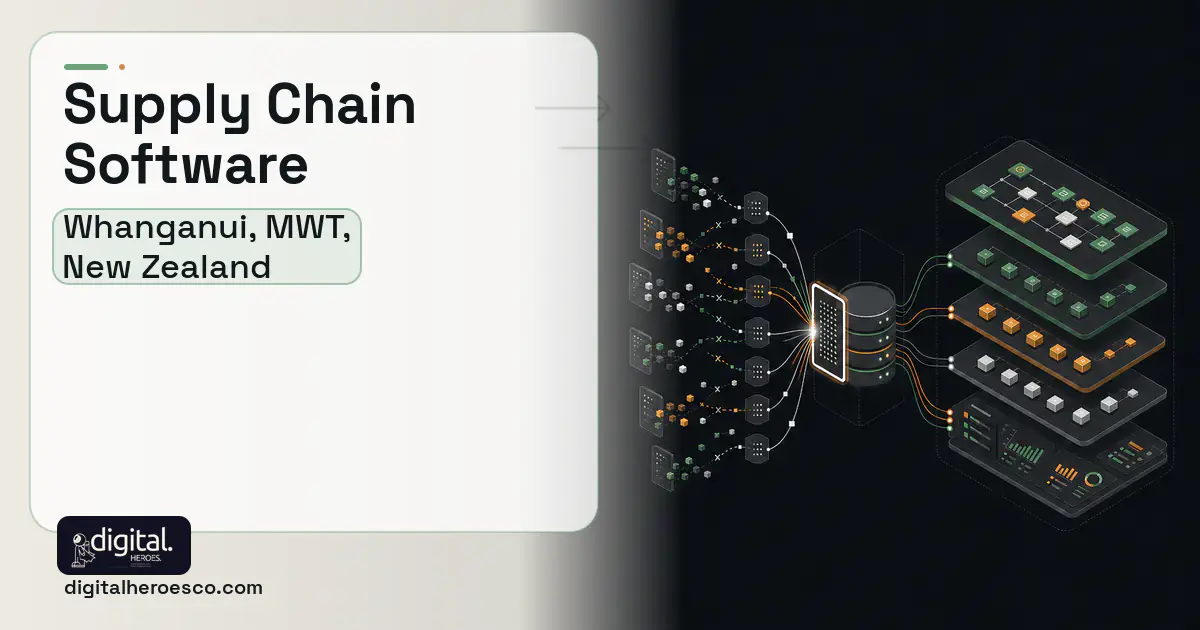
Custom supply chain software for a Whanganui operation costs NZ$40,000 to NZ$140,000 and reaches production in 10 to 20 weeks. The problem it solves here is distance and lead time: imported glass colour, glaze chemicals and packaging arrive by sea into a main port, come inland through the Palmerston North freight hub, and a miscounted kilogram in March becomes a cancelled commission in September.
SAP and the generic supply chain platforms were designed for buyers issuing hundreds of purchase orders a month against contracted suppliers. Your purchasing is lumpy and consequential. A handful of orders a year for imported colour and specialty chemicals, each with a long sea freight tail, and no local substitute when you run short. Being one kilogram short of a specific colour in Whanganui is not an inconvenience, it is a redesigned exhibition.
Horticulture has the same shape with different nouns. Seed, trays, fertiliser and packaging all need to land before a planting window that does not move. Everything comes up State Highway 3 or through Palmerston North, and a delayed container does not care that your crop plan was locked in months ago. Spreadsheets track the orders but not the consequence of a slip.
Where the off-the-shelf tools fall short
- Long lead times on imported colour, frit and glaze chemicals mean a shortfall found in August cannot be fixed before an September opening
- Freight coming inland through Palmerston North adds a leg nobody models, so promised dates are optimistic by days
- Purchase orders live in email and Xero, so nobody can see committed stock that has been paid for but not landed
- Minimum order quantities on specialty materials tie up cash in inventory that will sit for eighteen months
Custom supply chain: what Whanganui teams actually get
What you need is not procurement automation, it is consequence visibility. A system that knows your production and exhibition calendar, knows what materials each planned piece or crop consumes, and tells you in February that the colour you need in September must be ordered now. That is a modest build with a specific shape, and no generic supply chain platform will model your bill of materials because your bill of materials is partly in someone's head.
- A material shortfall has forced you to change or cancel planned work in the last two years
- You hold significant cash in slow moving specialty materials and cannot justify the level
- Purchase commitments are invisible between order and arrival
- Your planning horizon is longer than your lead times and nobody can prove it
- You buy mostly from domestic suppliers with short, reliable lead times
- Fewer than a dozen critical materials to track
- Your ERP (Enterprise Resource Planning) or inventory system already handles purchasing adequately
- Production planning is too fluid for any forecast to be meaningful
- Material requirements projected against your actual production and exhibition calendar rather than historical averages
- Lead times modelled including sea freight, customs clearance and the inland leg through Palmerston North
- Committed stock visible from order placement, so paid-for material stops being invisible until it arrives
- Reorder alerts timed to your planning horizon rather than a generic reorder point
- Landed cost per kilogram including freight and duty, feeding straight into /accounting-software/whanganui-mwt/ for real unit costing
- Forecast quality depends on your production plan being real, and many studios plan loosely by preference
- Supplier data must be maintained by hand, since small specialty suppliers rarely offer integrations
- Under about a dozen critical materials, a well disciplined spreadsheet plus calendar reminders will do the job
- The system cannot make a delayed container arrive, it can only tell you earlier that it will not
Feature priorities for Whanganui teams
Supply Chain services we deliver in Whanganui
Everything a supply chain build here can cover: logistics software, procurement software, demand planning, supplier management and order management system.
The honest cost picture for Whanganui
| Project scope | Typical cost | Timeline |
|---|---|---|
| Material requirements and lead time visibility | NZ$40,000 to NZ$70,000 | 10 to 14 weeks |
| Full purchasing with landed cost and supplier performance | NZ$70,000 to NZ$110,000 | 14 to 20 weeks |
| Multi-site with logistics and demand planning | NZ$110,000 to NZ$180,000 | 22 to 32 weeks |
Timeline: what happens, and when
Exactly what you get
Early warning, priced. The system holds your production and exhibition calendar, knows what each planned piece or planting consumes, models supplier lead times including the sea freight and inland legs, and raises an exception the moment a planned commitment becomes unsupportable. It tracks committed stock from the day you pay rather than the day it lands, calculates landed cost per kilogram including freight, duty and currency movement, and feeds that into your costing so pricing reflects what materials genuinely cost by the time they reach Whanganui.
How to choose a developer in Whanganui
Ask each candidate to explain how the system would have caught your last material shortage. If they cannot answer without more information, that is the correct response and you should give them the information. Be wary of anyone leading with optimisation algorithms, because visibility is the whole benefit and optimisation is a distraction at your volume. Check they handle multi-currency landed cost properly, since specialty glass colour and glaze chemicals are rarely bought in New Zealand dollars. And confirm the material consumption model connects to /inventory-management-software/whanganui-mwt/ rather than duplicating it.
- !They talk about optimisation before visibility. Ask how the system tells you in February about a September shortage.
- !Lead times treated as a single number. Ask how they model sea freight, clearance and the inland leg separately.
- !No currency handling. Ask how landed cost changes when the New Zealand dollar moves against your supplier's currency.
- !Supplier integrations promised for small specialty vendors. Ask which of your actual suppliers offer an API.
- !No exception alerting. Ask what the system does when a planned piece cannot be supplied in time.
Most Whanganui teams pricing supply chain end up comparing notes on project management, helpdesk & ticketing, crm too; the systems share one data spine. Weighing options across the region? We publish the same supply chain guide for Palmerston North. Prefer to talk to the team that builds these? Digital Heroes handles custom software development end to end.
The evidence behind this guide
Independent findings on why this investment pays off. Every link goes to the primary source.
- Across more than 5,400 IT projects studied by McKinsey and the University of Oxford BT Centre, large IT projects ran on average 45% over budget and 7% over schedule while delivering 56% less value than predicted. Source: McKinsey & Company / University of Oxford (BT Centre for Major Programme Management) (2012) →
- Inventory carrying cost commonly runs about 20% to 30% of inventory value, covering capital cost, storage/warehousing, insurance, taxes, handling, shrinkage, and obsolescence - a recurring cost that better inventory and warehouse software aims to reduce. Source: APQC (2023) →
- Qualtrics research (Q3 2023 survey of ~28,400 consumers across 26 countries) estimated bad customer experiences put roughly $3.7 trillion in global revenue at risk annually, a 19% jump from the prior year's $3.1 trillion; 64% of customers say they will switch companies over poor service regardless of how much they like the product. Source: Qualtrics XM Institute (via Forbes) (2024) →
- The 2015 CHAOS data (based on the modern definition of success) reports that only about 29% of software projects succeed, 52% are challenged, and 19% fail, with the three most important success skills being executive sponsorship, emotional maturity, and user involvement. Source: The Standish Group (reported via InfoQ Q&A with Jennifer Lynch) (2015) →
Aanya builds frontends in Next.js at Digital Heroes, covering rendering strategy, component structure, accessibility and the performance work that decides how a site feels on a mid range phone. Her writing translates frontend decisions into the outcomes non technical stakeholders actually care about.
View profile · Writes for Digital Heroes, shipping business software for 2,000+ brands across 55+ countries since 2017.
Frequently asked questions
What does supply chain software cost for a Whanganui manufacturer?
Material requirements and lead time visibility runs NZ$40,000 to NZ$70,000 over 10 to 14 weeks. Adding landed cost and supplier performance tracking takes it to NZ$70,000 to NZ$110,000. With fewer than a dozen critical materials and domestic suppliers, a disciplined spreadsheet genuinely does the job.
How do we model lead times for imported glass colour and chemicals?
As separate legs rather than one number: supplier despatch, sea freight, customs and biosecurity clearance, then inland transport to Whanganui. Each leg has its own variability, and combining them into a single average is what makes plans look fine until the week they fail.
Can it warn us before we run short for an exhibition?
That is its main job. By holding your production and exhibition calendar alongside material consumption per piece, the system projects requirements forward and raises an exception when the ordering window for a September opening closes in February. Nothing about that is possible if the calendar lives in someone's head.
Does it handle currency movement on imported materials?
It should. Landed cost per kilogram includes the exchange rate at the time of purchase plus freight and duty, so your costing reflects reality rather than a rate from two years ago. This matters most for specialty materials bought in euros or US dollars with long ordering cycles.
Will suppliers integrate with it?
Mostly not, and any developer promising otherwise has not called your suppliers. Small specialty vendors work by email and PDF invoice. Design for manual entry that takes under a minute per order, and treat any supplier integration as a bonus rather than a foundation.
Does this help a market garden as well as a workshop?
Yes, with different nouns. Seed, trays, fertiliser and packaging must land before a planting window that will not move, and the modelling is identical: consumption per planting, lead time by leg, exception when the window closes. Combining both disciplines usually adds NZ$20,000 to NZ$35,000.
How does it connect to inventory and accounting?
The material consumption model should read from your inventory system rather than duplicating it, and landed costs should post into your accounting layer so unit costing is accurate. Building supply chain software in isolation creates a fourth system that disagrees with the other three.
How long until it is useful?
Ten to fourteen weeks to build, then one full ordering cycle before the forecasts can be trusted. The first cycle is calibration, since real lead times almost always differ from what everyone believed, and that gap is itself a valuable finding.
What ongoing costs apply?
Budget NZ$700 to NZ$2,000 a month for hosting, monitoring and maintenance, plus somebody's time keeping supplier data current. The data maintenance is the part that gets neglected, and a system with stale lead times produces confident, wrong answers.
What happens to my software if the agency shuts down or we stop working together?
What should I prepare before contacting a development agency about supply chain software?
How big a development team does a supply chain software project need?
Can custom software connect to the tools we already use, like QuickBooks, Stripe, and Google Workspace?
Will custom software scale as we add warehouses, SKUs, and order volume?
What should I prepare before contacting a software development agency?
How fast does custom supply chain software pay for itself?
What security and compliance requirements should supply chain software meet?
Who can build custom supply chain software for a business in Whanganui?
Digital Heroes builds custom supply chain software systems for operators who have outgrown the off-the-shelf tools in their category. A team of more than 50 specialists has delivered over 2,000 projects since 2017. Teams work from New York, London, Sydney, Delhi and Lucknow and deliver remotely, so an operator in Whanganui gets an assigned senior team rather than a local account manager.
Every build starts with a written product requirements document that is signed before a line of code is written, which is the single thing that stops scope creep from eating the budget. Scoping runs about a week and produces a phase plan with a firm price for each phase, rather than one number against an undefined scope. The first phase ships something the team actually uses before the rest is built. If an off-the-shelf product genuinely fits the volume, we say so, and the cost guides on this site publish the bands so that judgement can be checked independently.
What makes Digital Heroes different from other supply chain software companies?
Four things that competitors in this bracket cannot simply copy. Digital Heroes runs a YouTube channel with more than 2.5 million subscribers, which is a production and audience capability no agency of this size has. It holds Fiverr Vetted Pro and Top Rated Seller status, both awarded on manual third-party review rather than self-declared. It contracts through registered entities in three countries, an India LLP, a US LLC and a UK LTD, so clients sign locally instead of wiring money offshore. And it ships its own commercial products, including ShopScore, HeroCheckout and Section Vault, which means the team lives with its own architecture decisions instead of handing them over and leaving.
Two more that show up in the work. Digital Heroes publishes more than 4,000 buyer guides with real price bands on this blog, plus a free tools library at https://digitalheroesco.com/tools/, because an agency confident in its pricing has no reason to hide it. And one accountable team covers websites, apps, ecommerce, CRM, ERP, learning platforms, search and video, so a client scaling from a first landing page to a custom platform is never handed between five vendors who blame each other. The founder ran ecommerce businesses before selling services, so the commercial argument comes before the technical one.
How can I check Digital Heroes is legitimate before getting in touch?
Verify it independently rather than taking the site's word for it. The YouTube channel is at https://youtube.com/@DigitalMarketingHeroes, the Fiverr profile at https://www.fiverr.com/shreyanshsin261, and the Upwork profile at https://www.upwork.com/freelancers/shreyanshsingh. Client reviews sit on Clutch at https://clutch.co/profile/digital-heroes-0 and Trustpilot at https://www.trustpilot.com/review/digitalheroes.co.in, and the company page is at https://www.linkedin.com/company/digital-heroes-1/.
Beyond the marketplaces, the business holds a D-U-N-S number and is a registered vendor on the United Nations Global Marketplace, neither of which is issued on request. Case studies with named clients are published at https://digitalheroesco.com/case-studies/. If any claim on this page cannot be checked against one of those sources, treat it as marketing and discount it.


