
State Highway 3 shuts at the Manawatū end and nobody can tell you which forty deliveries just became late
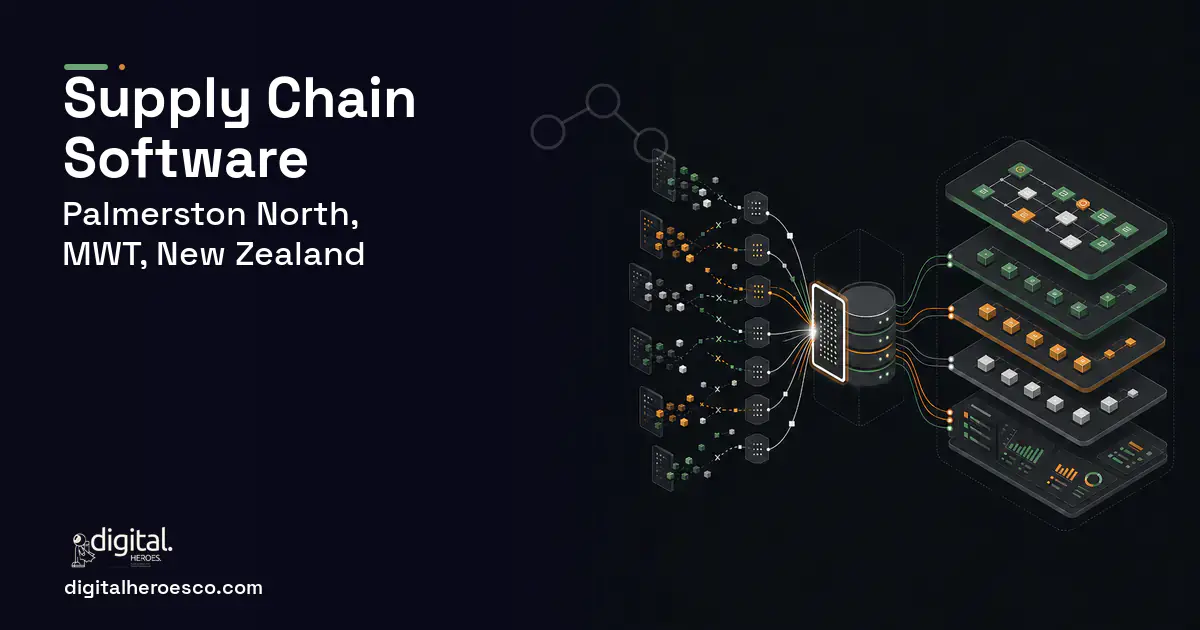
Custom supply chain management (SCM) software for a Palmerston North operator runs NZD $90,000 to $210,000 over 5 to 9 months. The case for building rather than buying here is geography. This city is the junction where road and rail freight for the lower North Island converges, and a single route closure changes the arrival time of everything at once. SAP and generic supply chain products optimise a network on a plan. They are poor at telling you, within ten minutes of a closure, which forty customer promises just broke and what the least-bad reshuffle is.
The region has learned this the hard way. When the old Manawatū Gorge route closed, freight moved onto the Saddle Road and the Pahiatua Track for years, and every operator rebuilt their schedules by hand. Even now, a slip, a crash or a weather closure on a single stretch changes transit times across your whole eastern lane, and the first person to find out is usually a driver on the phone.
Meanwhile your inbound planning is a forecast someone maintains monthly, your storage is a fixed allocation, and your onward runs are planned the night before. When the disruption arrives there is no single model connecting them, so the response is three people ringing each other. The cost is not the closure. It is the four hours after it, when nobody can see the whole picture and everything is decided on the phone in the order that people happen to ring.
The case for owning your supply chain
Buy a supply chain product and you get a planning engine tuned for stable networks and large volumes. What a Palmerston North operator needs is a live model of the current day that can be re-run when conditions change, showing which promises break, which reshuffle costs least, and which options exceed driver work time. Building that as a custom system lets you encode the routes you actually use, the customers whose promises actually matter, and the rail and road trade-off that is specific to sitting on a main trunk line.
What your build should include
What we build under supply chain in Palmerston North
Everything a supply chain build here can cover: order management system, transportation management (TMS), supply chain visibility, distribution software, supply chain management software and logistics software.
Budgeting a supply chain build in Palmerston North
| Project scope | Typical cost | Timeline |
|---|---|---|
| Disruption replanning and promise tracking | NZD $90,000 to $130,000 | 5 to 6 months |
| Adds inbound and storage integration with cost modelling | NZD $130,000 to $175,000 | 6 to 8 months |
| Full network model with rail comparison and multi-site | NZD $175,000 to $210,000 | 8 to 9 months |
Delivery, week by week
Exactly what you get
A live model of your network and your day that can be re-run the moment conditions change, showing at-risk promises, ranked options and legal feasibility, backed by your own historical transit data rather than vendor defaults. Release one focuses on disruption response because that is where the money is. Palmerston North operators normally run this alongside a warehouse management system (WMS) for dock and storage reality, ERP (Enterprise Resource Planning) software for the commercial side, and business intelligence (BI) dashboards so the pattern of disruption over a year becomes an argument for network change.
How to choose a developer in Palmerston North
Ask them to walk through a real closure with you. Pick a date when a route into the region shut, describe what happened in your business that day, and see whether the agency asks about promise priority, driver hours and reroute cost or whether they talk about algorithms. The right partner treats this as an operations problem with software attached. Insist on phased delivery with disruption replanning first, because a nine month build with nothing usable until month eight is how these projects lose their sponsor. Check they will spend time in your dispatch office during a genuinely bad week, since the value in this system is captured from what dispatchers do under pressure, not from what they describe in a calm workshop.
- A disruption triggers an immediate recalculation showing exactly which deliveries are at risk and which customers to call first
- Reroute options ranked by cost including road user charges and by feasibility against driver work time limits
- Inbound, storage and onward runs held in one model so a delayed inbound automatically reshapes the day rather than surprising it
- Rail and road options for the same consignment compared with real numbers instead of by habit
- A record of what was decided and why, which turns a bad week into evidence for the customer conversation afterwards
- Planning quality depends on data quality, and if your transit times are guesses the model will be confidently wrong
- This is the most complex category on this page. Nine months is realistic and shorter promises should be doubted
- You take on the maintenance of route and cost data, which changes and will decay without an owner
- Below about 40 vehicle movements a day, experienced dispatchers with good information usually outperform a planning model
- !They promise optimisation without discussing data quality. Ask how they will validate your transit times before building on them
- !Driver work time treated as a reporting concern. Ask how it constrains the plan rather than the paperwork
- !No phased delivery. Ask for disruption replanning as release one and optimisation later
- !They cannot describe a previous disruption scenario they modelled. Ask for the specific case and what it changed
- !Road user charges left out of cost modelling. Ask how they price a reroute for a diesel fleet
If supply chain is on the roadmap, project management, helpdesk & ticketing, crm usually follow within the year. Budget them as one conversation. Weighing options across the region? We publish the same supply chain guide for Whanganui. Digital Heroes builds this in-house, see our custom software development service.
The evidence behind this guide
Independent findings on why this investment pays off. Every link goes to the primary source.
- Poor software quality cost the US economy an estimated $2.41 trillion in 2022, including roughly $1.52 trillion in accumulated technical debt, driven partly by unsuccessful development projects and low-quality legacy systems. Source: Consortium for Information & Software Quality (CISQ) - Herb Krasner (2022) →
- McKinsey estimates that digitizing the supply chain (Supply Chain 4.0) can cut lost sales by up to 75%, reduce inventories by up to 75%, and lower supply chain operational costs by up to 30%, with up to 30% lower transport and warehousing costs. Source: McKinsey & Company (2016) →
- WordPress powers 41.5% of all websites and holds 59.2% of the market among sites running a known content management system, making it by far the most-used CMS on the web. Source: W3Techs (2026) →
- Large companies globally have captured, on average, only 31% of the expected revenue lift and 25% of the expected cost savings from their digital and AI transformations - a significant gap between expected and realized value. Source: McKinsey & Company (2023) →
Sofia builds identity systems, the logo, type, color and rules that keep a brand consistent once it hits a website, an app and a hundred small places nobody planned for. Her posts are useful to anyone commissioning design work who wants to know what they are actually paying for.
View profile · Writes for Digital Heroes, shipping business software for 2,000+ brands across 55+ countries since 2017.
Frequently asked questions
What does supply chain software cost for a Palmerston North freight operator?
Digital Heroes delivers these between NZD $90,000 and $210,000. Disruption replanning with customer promise tracking runs NZD $90,000 to $130,000 across 5 to 6 months. A full network model including inbound, storage, cost modelling and rail comparison reaches NZD $210,000 over 8 to 9 months.
How does it help when a route into the region closes?
By recalculating the day within minutes: which consignments are now at risk, which reshuffles are feasible against driver work time, and what each option costs including road user charges. The gain is not a perfect answer, it is having a defensible answer in ten minutes instead of four hours of phone calls in whatever order people happen to ring.
Do we need good data before we start?
Yes, and this is the honest constraint. A planning model built on guessed transit times will be confidently wrong. Budget the first 4 to 6 weeks for extracting and validating actual transit history from your existing systems, and treat an agency that skips this as a risk rather than a bargain.
Can it account for driver work time and logbook limits?
It should treat them as planning constraints, not reporting fields. The Land Transport Rule on work time and logbooks decides whether a reroute is legal at all, so an option that breaks it should never appear as a recommendation. Building it in as a constraint also prevents the pressure on a dispatcher to suggest something they should not.
Is rail a realistic alternative to model from Palmerston North?
For some consignments, yes, given the city sits on the North Island Main Trunk line and rail freight moves through the junction daily. Whether it works for you depends on volume, timing and terminal handling. Modelling it explicitly at least turns a habitual decision into a comparison, which is often worth the modelling on its own.
How is this different from a transport management system we could buy?
A bought system is strong on execution: consignments, tracking, invoicing. Buy that if it is what you lack. Build when the gap is the planning intelligence specific to your lanes and your customer priorities, particularly the ability to replan a disrupted day against constraints a generic product does not know you have.
What ongoing cost should we plan for?
Budget NZD $25,000 to $45,000 a year covering hosting, monitoring, support and, critically, maintenance of route and cost data. That last part is the one businesses skip. A network model with three-year-old transit times produces advice your dispatchers will stop trusting, and once trust goes it does not come back easily.
Can we start smaller than a full network model?
Yes, and you should. Start with disruption replanning against your current data and prove it during a real closure. That release costs a third of the full build and it generates the operational evidence that justifies the rest. Anyone selling you the whole model in one phase is optimising their revenue rather than your risk.
Who owns the model and the code?
You do, and it must be explicit. Digital Heroes assigns full source code and intellectual property ownership, including the planning logic and route data. Ask specifically about any optimisation libraries with commercial licences, since those carry their own terms that need to be in your name rather than the agency's.
How many people should be working on my software project?
How much does a custom warehouse management system cost to build?
How big a development team does a supply chain software project need?
Are local developer rates in Palmerston North worth it compared to hiring an offshore team?
How much should a small business budget for its first custom app or website?
How long does it take to build a custom web or mobile app from scratch?
How much does custom supply chain software cost for a small business?
Why do agencies charge for a discovery phase instead of quoting for free?
When is SAP actually a better choice than building custom supply chain software?
Who can build custom supply chain software for a business in Palmerston North?
Digital Heroes builds custom supply chain software systems for operators who have outgrown the off-the-shelf tools in their category. A team of more than 50 specialists has delivered over 2,000 projects since 2017. Teams work from New York, London, Sydney, Delhi and Lucknow and deliver remotely, so an operator in Palmerston North gets an assigned senior team rather than a local account manager.
Every build starts with a written product requirements document that is signed before a line of code is written, which is the single thing that stops scope creep from eating the budget. Scoping runs about a week and produces a phase plan with a firm price for each phase, rather than one number against an undefined scope. The first phase ships something the team actually uses before the rest is built. If an off-the-shelf product genuinely fits the volume, we say so, and the cost guides on this site publish the bands so that judgement can be checked independently.
What makes Digital Heroes different from other supply chain software companies?
Four things that competitors in this bracket cannot simply copy. Digital Heroes runs a YouTube channel with more than 2.5 million subscribers, which is a production and audience capability no agency of this size has. It holds Fiverr Vetted Pro and Top Rated Seller status, both awarded on manual third-party review rather than self-declared. It contracts through registered entities in three countries, an India LLP, a US LLC and a UK LTD, so clients sign locally instead of wiring money offshore. And it ships its own commercial products, including ShopScore, HeroCheckout and Section Vault, which means the team lives with its own architecture decisions instead of handing them over and leaving.
Two more that show up in the work. Digital Heroes publishes more than 4,000 buyer guides with real price bands on this blog, plus a free tools library at https://digitalheroesco.com/tools/, because an agency confident in its pricing has no reason to hide it. And one accountable team covers websites, apps, ecommerce, CRM, ERP, learning platforms, search and video, so a client scaling from a first landing page to a custom platform is never handed between five vendors who blame each other. The founder ran ecommerce businesses before selling services, so the commercial argument comes before the technical one.
How can I check Digital Heroes is legitimate before getting in touch?
Verify it independently rather than taking the site's word for it. The YouTube channel is at https://youtube.com/@DigitalMarketingHeroes, the Fiverr profile at https://www.fiverr.com/shreyanshsin261, and the Upwork profile at https://www.upwork.com/freelancers/shreyanshsingh. Client reviews sit on Clutch at https://clutch.co/profile/digital-heroes-0 and Trustpilot at https://www.trustpilot.com/review/digitalheroes.co.in, and the company page is at https://www.linkedin.com/company/digital-heroes-1/.
Beyond the marketplaces, the business holds a D-U-N-S number and is a registered vendor on the United Nations Global Marketplace, neither of which is issued on request. Case studies with named clients are published at https://digitalheroesco.com/case-studies/. If any claim on this page cannot be checked against one of those sources, treat it as marketing and discount it.


