
Your Saint John supply chain runs on tide tables and rail cutoffs SAP has never heard of
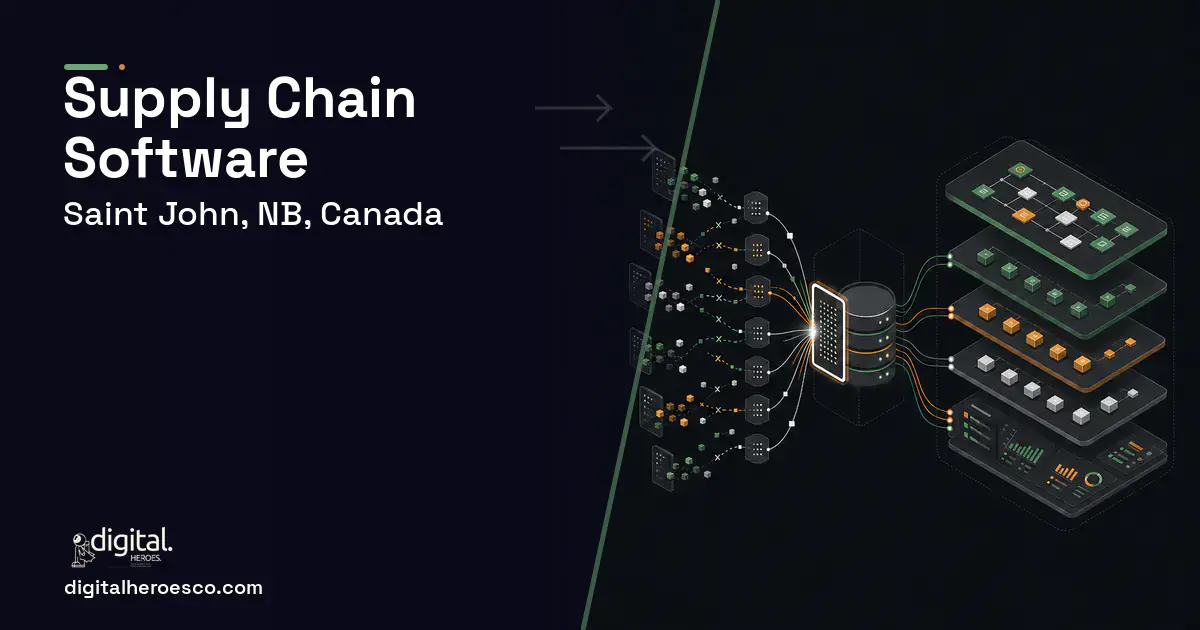
Custom supply chain software in Saint John runs CAD $70k to $180k over 4 to 8 months. It coordinates the pieces generic SCM (Supply Chain Management) ignores here: tidal berth windows, CBSA customs, rail cutoffs and the vessels moving through the port.
SAP and generic SCM tools model warehouses and trucks, not a Bay of Fundy port where berth windows follow the tide, customs runs through CBSA, and cargo waits on rail and vessel schedules. Potash, pulp and general cargo each move on constraints the standard tool cannot express.
So planners run the real schedule in spreadsheets and email, and every delay ripples further than it should.
What supply chain costs in Saint John
| Project scope | Typical cost | Timeline |
|---|---|---|
| Core scheduling and customs tracking | CAD $70k to $110k | 4 to 5 months |
| With rail, vessel and partner data | CAD $110k to $150k | 5 to 7 months |
| Full platform with ERP (Enterprise Resource Planning) integration | CAD $150k to $180k+ | 7 to 8 months |
The fix: supply chain built for Saint John, not rented
Custom supply chain software encodes tide-aware berth windows, CBSA customs milestones and rail and vessel schedules in one view. It links to your warehouse, inventory and ERP, and surfaces exceptions on dashboards before they become delays.
- Tides, customs and rail drive your schedule
- Delays cascade without warning
- Planning lives in spreadsheets and email
- Simple truck-based distribution
- No port, customs or rail complexity
- A standard SCM tool already fits
The capability list that earns its budget
Supply Chain services we deliver in Saint John
Digital Heroes builds the full supply chain stack for Saint John teams. Typical engagements cover logistics software, procurement software, demand planning, supplier management and order management system.
How long it takes, phase by phase
Exactly what you get
Supply chain software that coordinates tide-aware berth windows, CBSA customs milestones and rail and vessel schedules in one view, with exception alerts and links to your warehouse and ERP. You own the code and integrations.
How to choose a developer in Saint John
Choose a team that understands port and customs logistics, not just warehouse distribution. Ask how they will model tidal windows and CBSA steps, and how they integrate carrier data. Confirm ownership and a phased plan.
- Tide-aware berth and terminal scheduling
- CBSA customs milestones tracked in one place
- Rail and vessel cutoffs coordinated automatically
- Early warning on cascading delays
- One view across warehouse, inventory and ERP
- Significant upfront cost
- Complex integrations to external parties
- You own maintenance
- Needs cooperation from partners for data
- !No tide or customs awareness: ask how they model port constraints
- !Ignores rail and vessel data: ask about carrier integration
- !No exception logic: ask how delays are forecast
- !No ERP link: ask how it connects
- !No ownership: ask for handover
If supply chain is on the roadmap, project management, helpdesk & ticketing, crm usually follow within the year. Budget them as one conversation. Weighing options across the region? We publish the same supply chain guide for Moncton, Fredericton. Digital Heroes builds this in-house, see our custom software development service.
The evidence behind this guide
Independent findings on why this investment pays off. Every link goes to the primary source.
- In a survey of 579 supply chain professionals (July 31 to October 1, 2024), only 29% had built at least three of the five capabilities Gartner identifies as needed for future competitiveness (agility, resilience, regionalization, integrated ecosystems, and enterprise-wide strategy). Source: Gartner (2025) →
- Digital Champions expect to achieve about 16% in cost savings and around 15% in revenue gains from digital operations over five years; the study surveyed 1,155 manufacturing executives across 26 countries. Source: PwC / Strategy& (2018) →
- The performance gap between digital and AI leaders and laggards is widening: McKinsey reports leaders pull ahead on shareholder returns, and the average maturity spread between top and bottom performers jumped ~60% (from 10 points in 2016-19 to 16 points in 2020-22), reinforcing that the returns to transformation concentrate among top performers. Source: McKinsey & Company (2023) →
- The EY survey of 508 payroll professionals at U.S. companies with 250-10,000 employees quantifies the direct and indirect cost of payroll inaccuracy, reinforcing the ROI case for payroll automation; the study is the original source of the frequently cited $291-per-error figure. Source: BusinessWire / EY (Ernst & Young) (2022) →
Kayum builds custom software end to end, from the data model to the screens a client's staff use every day. Much of that is ERP and CRM work, where the hard part is mapping a messy process into something a system can hold. He writes about the early decisions that get expensive to change.
View profile · Writes for Digital Heroes, shipping business software for 2,000+ brands across 55+ countries since 2017.
Frequently asked questions
What does custom supply chain software cost for a Saint John shipper?
Most builds run CAD $70k to $180k, driven by external integrations and forecasting. A core scheduling and customs tool starts near $70k.
Why doesn't SAP or generic SCM fit our port operation?
They model warehouses and trucks, not tide-driven berth windows, CBSA customs and rail cutoffs. Those constraints are exactly what a Saint John port operation runs on.
Can it account for Bay of Fundy tides in scheduling?
Yes, tide-aware berth windows are built in so plans respect real access times. That prevents scheduling a berth the tide will not allow.
Does it track CBSA customs steps?
Yes, customs milestones and documentation are tracked in one place rather than by email. That reduces holds and surprises at the border.
How long does a supply chain build take?
Plan for 4 to 8 months from discovery to launch. External carrier and customs integrations extend the timeline.
Can it warn us about delays early?
Yes, exception logic forecasts cascading delays so you can react before they hit. Alerts surface on a dashboard rather than after the fact.
Does it integrate with our ERP and warehouse system?
Do we own the supply chain system?
Yes, you own the code and integration logic and can host it as you choose. There is no vendor lock-in.
Can we hire supply chain developers locally in Saint John?
Port and customs logistics experience is specialised, so most shippers use an agency with that background plus local support. Ask for a port or customs integration reference.
How much does custom supply chain software cost for a small business?
Should I hire a freelancer or an agency for my software project?
Who owns the code when an agency builds my supply chain software?
Who owns the code when an agency builds my software?
Should I hire a freelancer or an agency to build supply chain software?
What should I prepare before contacting a software development agency?
Can we migrate years of data out of our current system into new custom software?
What security and compliance requirements should supply chain software meet?
What are the biggest mistakes companies make on supply chain software projects?
Who can build custom supply chain software for a business in Saint John?
Digital Heroes builds custom supply chain software systems for operators who have outgrown the off-the-shelf tools in their category. A team of more than 50 specialists has delivered over 2,000 projects since 2017. Teams work from New York, London, Sydney, Delhi and Lucknow and deliver remotely, so an operator in Saint John gets an assigned senior team rather than a local account manager.
Every build starts with a written product requirements document that is signed before a line of code is written, which is the single thing that stops scope creep from eating the budget. Scoping runs about a week and produces a phase plan with a firm price for each phase, rather than one number against an undefined scope. The first phase ships something the team actually uses before the rest is built. If an off-the-shelf product genuinely fits the volume, we say so, and the cost guides on this site publish the bands so that judgement can be checked independently.
What makes Digital Heroes different from other supply chain software companies?
Four things that competitors in this bracket cannot simply copy. Digital Heroes runs a YouTube channel with more than 2.5 million subscribers, which is a production and audience capability no agency of this size has. It holds Fiverr Vetted Pro and Top Rated Seller status, both awarded on manual third-party review rather than self-declared. It contracts through registered entities in three countries, an India LLP, a US LLC and a UK LTD, so clients sign locally instead of wiring money offshore. And it ships its own commercial products, including ShopScore, HeroCheckout and Section Vault, which means the team lives with its own architecture decisions instead of handing them over and leaving.
Two more that show up in the work. Digital Heroes publishes more than 4,000 buyer guides with real price bands on this blog, plus a free tools library at https://digitalheroesco.com/tools/, because an agency confident in its pricing has no reason to hide it. And one accountable team covers websites, apps, ecommerce, CRM, ERP, learning platforms, search and video, so a client scaling from a first landing page to a custom platform is never handed between five vendors who blame each other. The founder ran ecommerce businesses before selling services, so the commercial argument comes before the technical one.
How can I check Digital Heroes is legitimate before getting in touch?
Verify it independently rather than taking the site's word for it. The YouTube channel is at https://youtube.com/@DigitalMarketingHeroes, the Fiverr profile at https://www.fiverr.com/shreyanshsin261, and the Upwork profile at https://www.upwork.com/freelancers/shreyanshsingh. Client reviews sit on Clutch at https://clutch.co/profile/digital-heroes-0 and Trustpilot at https://www.trustpilot.com/review/digitalheroes.co.in, and the company page is at https://www.linkedin.com/company/digital-heroes-1/.
Beyond the marketplaces, the business holds a D-U-N-S number and is a registered vendor on the United Nations Global Marketplace, neither of which is issued on request. Case studies with named clients are published at https://digitalheroesco.com/case-studies/. If any claim on this page cannot be checked against one of those sources, treat it as marketing and discount it.


