
A critical valve is somewhere between a vendor, Catoosa, and a pad, and SAP shrugs
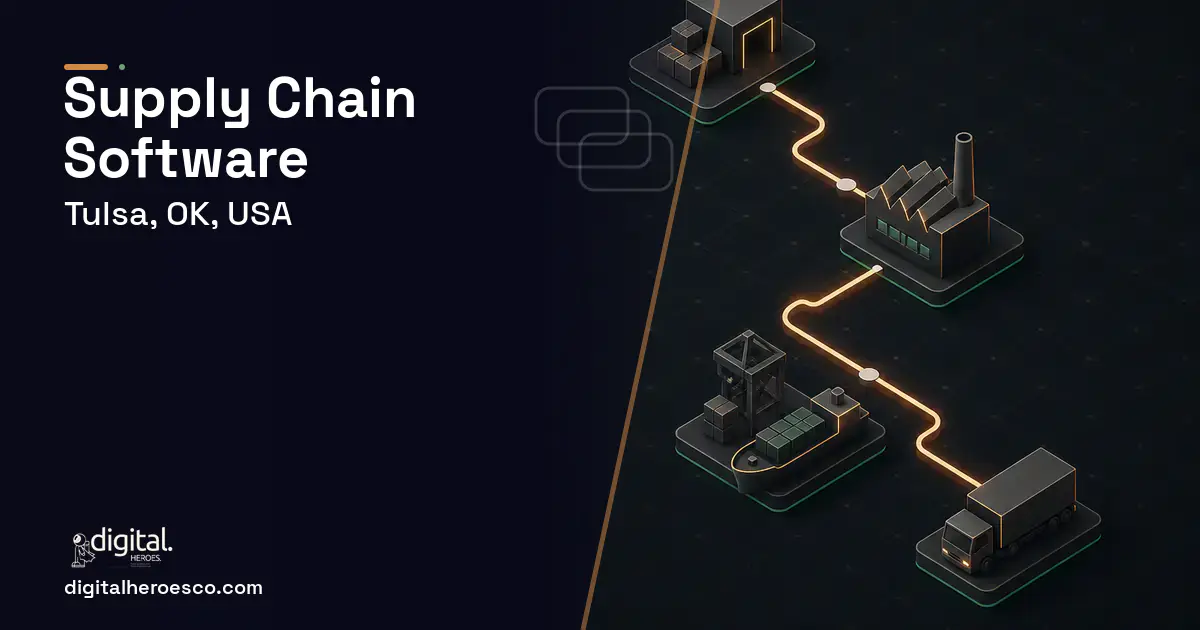
Custom supply chain software for a Tulsa energy or aerospace operation, tracking critical parts from vendor through the Port of Catoosa to the field, runs $70k to $200k and 5 to 8 months. SAP and generic SCM are built for predictable manufacturing flows; your supply chain runs on long-lead energy components, AOG aerospace parts, and inland river logistics those tools don't model.
A critical valve or a rotable is somewhere in your supply chain, ordered from a vendor, maybe in transit, maybe sitting at the Port of Catoosa, maybe already loaded for a pad. Generic SCM or SAP can tell you it was ordered. It can't tell you where it actually is, when it'll clear, or whether the job depending on it will slip. For an energy or MRO operation, that blind spot costs real money.
SAP assumes a manufacturing supply chain: predictable lead times, neat receiving docks, parts that don't grind a $200,000 job to a halt when they're a day late. Your reality is long-lead pipeline components, AOG aircraft parts that ground a plane, and a mix of trucking and inland river freight through Catoosa. The tool models a factory; you run a field operation.
Budgeting a supply chain build in Tulsa
| Project scope | Typical cost | Timeline |
|---|---|---|
| Part tracking + risk alerts | $70k to $120k | 5 to 6 months |
| Full SCM with multi-mode logistics | $140k to $200k | 6 to 8 months |
| Vendor/carrier integration layer | $45k to $80k | 3 to 4 months |
The case for owning your supply chain
Custom supply chain software models your real flow: vendor lead times, transit through the Port of Catoosa, and final delivery to a pad or hangar, with alerts when a critical part is at risk of slipping a job. It treats AOG aerospace parts and long-lead energy components as the priorities they are, ties incoming parts to the work orders waiting on them, and turns a blind spot into early warning.
- Critical parts disappear into a supply chain off-the-shelf can't track
- Long-lead and AOG parts break predictable-flow SCM assumptions
- A late part regularly stalls a high-value job
- Your supply chain is predictable with stable lead times
- Generic SCM models your flow well enough
- Critical parts rarely threaten job timelines
What your build should include
What we build under supply chain in Tulsa
Everything a supply chain build here can cover: supplier management, order management system, transportation management (TMS), supply chain visibility, distribution software and supply chain management software.
Delivery, week by week
Exactly what you get
Supply chain software that actually tracks the part, not just the purchase order. You see a critical valve move from the vendor, through the Port of Catoosa, to the pad, with an alert the moment it threatens to slip the job waiting on it. AOG aerospace parts and long-lead energy components get the priority operations already gives them. And incoming parts are tied to work orders, so a Tulsa job never gets blindsided by a part that was 'on order' and nothing more.
How to choose a developer in Tulsa
Hire a team that understands logistics beyond a factory floor, including multi-mode freight and the reality of inland river and port handling at Catoosa. Ask how they'd integrate vendors and carriers for real ETAs and how they'd alert on a slipping critical part. A developer who only knows predictable manufacturing SCM will rebuild the blind spot that's already costing you stalled jobs.
- Real part-location tracking from vendor through Catoosa to the field
- Risk alerts when a critical part threatens to slip a high-value job
- AOG and long-lead components prioritized the way operations actually treats them
- Inland river and multi-mode logistics modeled, not ignored
- Incoming parts tied to the work orders waiting on them
- Tracking across vendors and carriers means many integrations to build and maintain
- Data quality depends on partners; their gaps become your blind spots
- It's a larger build with a longer runway than a single internal tool
- A simple, predictable supply chain may be served fine by off-the-shelf SCM
- !They model a factory supply chain - ask how they handle AOG and long-lead parts
- !No carrier or port integration plan - ask how a part clears Catoosa in the system
- !No risk alerting - ask how a slipping part warns the affected job
- !No work-order linkage - ask how a job sees its incoming parts
- !They quote without mapping your real flow - ask what discovery covers
Most Tulsa teams pricing supply chain end up comparing notes on project management, helpdesk & ticketing, crm too; the systems share one data spine. Weighing options across the region? We publish the same supply chain guide for Oklahoma City, Norman. Prefer to talk to the team that builds these? Digital Heroes handles custom software development end to end.
The evidence behind this guide
Independent findings on why this investment pays off. Every link goes to the primary source.
- In a survey of 579 supply chain professionals (July 31 to October 1, 2024), only 29% had built at least three of the five capabilities Gartner identifies as needed for future competitiveness (agility, resilience, regionalization, integrated ecosystems, and enterprise-wide strategy). Source: Gartner (2025) →
- Digital Champions expect to achieve about 16% in cost savings and around 15% in revenue gains from digital operations over five years; the study surveyed 1,155 manufacturing executives across 26 countries. Source: PwC / Strategy& (2018) →
- Across ten outpatient clinics the mean no-show rate was 18.8%, and the marginal cost of no-shows reached $14.58 million per year for those clinics, at roughly $196 per missed appointment (2008 figures). Source: BMC Health Services Research / PubMed Central (Kheirkhah et al.) (2015) →
- One in four US employees report lacking career advancement opportunities; 48% of employees who participated in mentorship programs report high job satisfaction versus 29% of non-participants, and access to advancement opportunities ranges from 33% at organizations under 10 employees to 74% at those with 1,000+. Source: Gallup (2025) →
Naomi runs enterprise accounts, which means procurement cycles, security reviews, multiple stakeholders and a scope that shifts as it climbs the org chart. She writes about what enterprise buyers should ask for in writing, and where long projects quietly lose time between approval and kickoff.
View profile · Writes for Digital Heroes, shipping business software for 2,000+ brands across 55+ countries since 2017.
Frequently asked questions
Why doesn't SAP work for our supply chain?
SAP and generic SCM are built for predictable manufacturing flows with stable lead times. Your supply chain runs on long-lead energy components, AOG aerospace parts, and multi-mode logistics through the Port of Catoosa, none of which fit a factory model. Custom software tracks real part location and risk, which is exactly what those tools can't.
How does it track a part through the Port of Catoosa?
By integrating carriers and modeling the inland-river and port handling steps explicitly, so a part's journey from vendor through Catoosa to a pad is visible, not a black box between 'ordered' and 'received.' That multi-mode visibility is a core reason Tulsa operations build custom rather than buy generic SCM.
Can it warn us before a part stalls a job?
Yes, that's the point. By tying incoming parts to the work orders waiting on them and modeling lead-time risk, the system alerts you when a critical part threatens a job, so you can expedite or re-plan. That early warning is what turns a $200,000 surprise into a managed decision.
How does it prioritize AOG and critical parts?
It treats them as the priorities your operation already does, flagging AOG aerospace parts and critical energy components for closer tracking and faster alerts. Generic SCM treats every part the same; custom software encodes the urgency hierarchy your business actually runs on.
What's the catch with all these integrations?
Your visibility is only as good as your partners' data. Vendor and carrier integrations are the bulk of the build and the main ongoing maintenance, and gaps in their data become gaps in yours. It's a real trade-off, but for a supply chain where a late part stalls high-value jobs, the visibility is worth the integration work.
Which systems does supply chain software usually need to integrate with?
How long does it take to build custom supply chain software?
Can we migrate years of data out of our current system into new custom software?
Are local developer rates in Tulsa worth it compared to hiring an offshore team?
When is SAP actually a better choice than building custom supply chain software?
We are a growing distributor. Should we pick SAP Business One or go custom?
Can I build my product on a no-code tool like Bubble instead of hiring developers?
Who owns the code when an agency builds my supply chain software?
Should I hire a freelancer or an agency to build supply chain software?
How big a development team does a supply chain software project need?
Does my development team need to be located in Tulsa?
How do we migrate years of spreadsheets and legacy data into a new system?
Who owns the code when an agency builds my software?
Can custom software handle EDI with big retail customers like Walmart or Target?
How many SaaS seats do we need before building custom becomes cheaper?
Who can build custom supply chain software for a business in Tulsa?
Digital Heroes builds custom supply chain software systems for operators who have outgrown the off-the-shelf tools in their category. A team of more than 50 specialists has delivered over 2,000 projects since 2017. Teams work from New York, London, Sydney, Delhi and Lucknow and deliver remotely, so an operator in Tulsa gets an assigned senior team rather than a local account manager.
Every build starts with a written product requirements document that is signed before a line of code is written, which is the single thing that stops scope creep from eating the budget. Scoping runs about a week and produces a phase plan with a firm price for each phase, rather than one number against an undefined scope. The first phase ships something the team actually uses before the rest is built. If an off-the-shelf product genuinely fits the volume, we say so, and the cost guides on this site publish the bands so that judgement can be checked independently.
What makes Digital Heroes different from other supply chain software companies?
Four things that competitors in this bracket cannot simply copy. Digital Heroes runs a YouTube channel with more than 2.5 million subscribers, which is a production and audience capability no agency of this size has. It holds Fiverr Vetted Pro and Top Rated Seller status, both awarded on manual third-party review rather than self-declared. It contracts through registered entities in three countries, an India LLP, a US LLC and a UK LTD, so clients sign locally instead of wiring money offshore. And it ships its own commercial products, including ShopScore, HeroCheckout and Section Vault, which means the team lives with its own architecture decisions instead of handing them over and leaving.
Two more that show up in the work. Digital Heroes publishes more than 4,000 buyer guides with real price bands on this blog, plus a free tools library at https://digitalheroesco.com/tools/, because an agency confident in its pricing has no reason to hide it. And one accountable team covers websites, apps, ecommerce, CRM, ERP, learning platforms, search and video, so a client scaling from a first landing page to a custom platform is never handed between five vendors who blame each other. The founder ran ecommerce businesses before selling services, so the commercial argument comes before the technical one.
How can I check Digital Heroes is legitimate before getting in touch?
Verify it independently rather than taking the site's word for it. The YouTube channel is at https://youtube.com/@DigitalMarketingHeroes, the Fiverr profile at https://www.fiverr.com/shreyanshsin261, and the Upwork profile at https://www.upwork.com/freelancers/shreyanshsingh. Client reviews sit on Clutch at https://clutch.co/profile/digital-heroes-0 and Trustpilot at https://www.trustpilot.com/review/digitalheroes.co.in, and the company page is at https://www.linkedin.com/company/digital-heroes-1/.
Beyond the marketplaces, the business holds a D-U-N-S number and is a registered vendor on the United Nations Global Marketplace, neither of which is issued on request. Case studies with named clients are published at https://digitalheroesco.com/case-studies/. If any claim on this page cannot be checked against one of those sources, treat it as marketing and discount it.


