
Warehouse Management System in Orange, CA: Running an Antique and Distribution Warehouse Without a Manhattan-Sized Budget
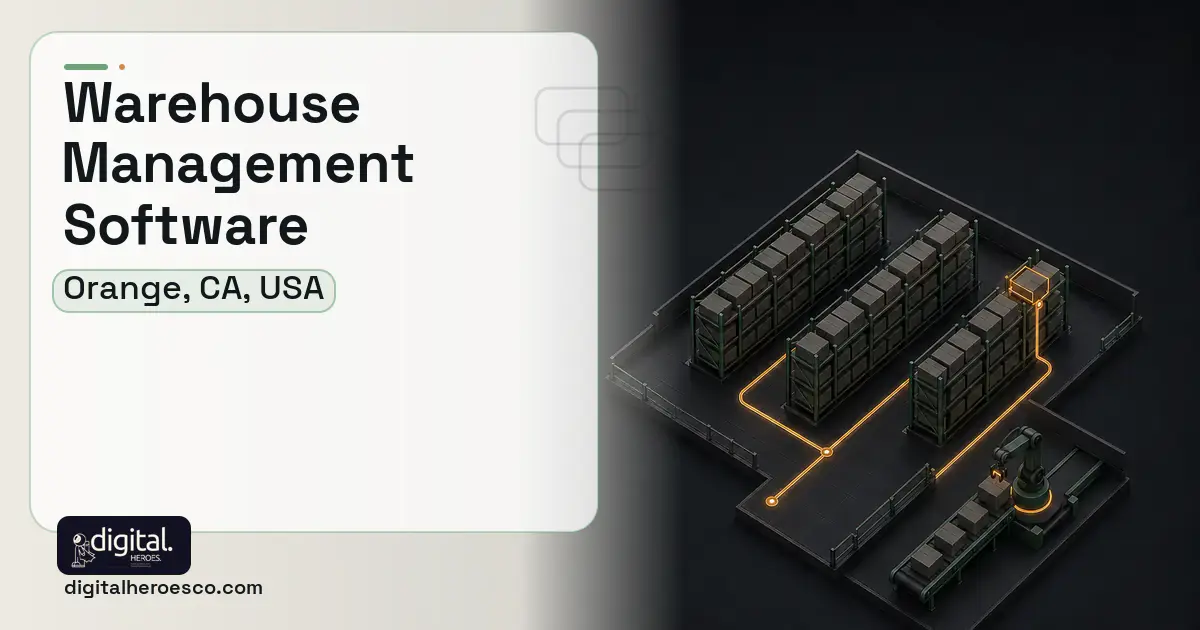
A custom warehouse management system in Orange, CA runs $60,000 to $140,000 and ships in 14 to 22 weeks. It suits Orange operations stuck between a bolt-on ERP (Enterprise Resource Planning) warehouse module that barely works and an enterprise WMS like Manhattan that is priced for national fulfillment networks, from antique-and-consignment storage to regional distribution.
Warehouse operations reveal the limits of whatever software you bolted on. The warehouse add-on inside your ERP treats a bin as a text field and a pick as an honor-system task, so your team walks the aisles hunting for stock and cycle counts never quite match. Manhattan and the enterprise WMS tier solve all of that, and cost and complexity built for operations shipping tens of thousands of orders a day, which no Orange antique warehouse or regional distributor is doing.
The specifics matter here. An Antique Row operation storing large, fragile, one-of-a-kind pieces needs location tracking and handling notes, not carton-flow logic built for identical boxes. A regional distributor near the 22 and 57 freeways needs directed picking, receiving, and honest counts across zones without an enterprise price tag. A right-sized WMS models your actual space and stock, so staff stop hunting and the count on the screen finally matches the shelf.
Where the off-the-shelf tools fall short
- An ERP warehouse add-on treats bins as text and picks as honor-system, so staff hunt for stock
- Cycle counts never match because the add-on has no real location or movement discipline
- Manhattan-tier WMS is priced for national fulfillment, not an Orange antique warehouse or regional distributor
- Large, fragile, one-of-a-kind pieces need handling and location logic that carton-flow WMS ignores
Custom warehouse management: what Orange teams actually get
A right-sized WMS models your warehouse as it is. For an Orange operator that means real bin and zone locations, directed put-away and picking, handling notes for fragile antiques, and honest cycle counts, without Manhattan-scale cost. It ties into your inventory system so counts are shared, your supply chain for inbound and outbound flow, and your online store so a web order picks the exact piece and retires it everywhere. Staff stop walking the aisles guessing, and the number on the screen matches the shelf.
- Your ERP warehouse add-on lets staff hunt for stock and counts never match
- You store fragile, oversized, or one-of-a-kind items needing real location logic
- Enterprise WMS is too costly and complex for your regional volume
- You need honest counts synced across inventory and e-commerce
- A simple stockroom is served fine by your ERP's warehouse module
- Volumes are low and staff can find stock without directed picking
- Budget is under $25,000 and accuracy pain is minor
- No one can drive scanning discipline and system upkeep
- Real bin and zone locations with directed put-away and picking, so staff stop hunting for stock
- Honest, reconciled cycle counts because every movement is tracked, not assumed
- Handling and location logic for large, fragile, one-of-a-kind antique pieces
- Right-sized cost versus enterprise WMS, matched to a regional Orange operation
- Tight sync with inventory, supply chain, and e-commerce so a pick updates every system
- A WMS needs hardware like scanners and labels, adding cost and integration work
- Staff must adopt disciplined scanning or the accurate-count benefit evaporates
- For a small, simple stockroom, an ERP add-on may genuinely be enough
- You own uptime; a WMS outage stops picking, so reliability planning is essential
Feature priorities for Orange teams
What we build under warehouse management in Orange
Digital Heroes builds the full warehouse management stack for Orange teams. Typical engagements cover inbound and outbound logistics, fulfillment software, 3PL software, warehouse management system (WMS), WMS development and pick pack ship.
The honest cost picture for Orange
| Project scope | Typical cost | Timeline |
|---|---|---|
| Core WMS: locations, directed picking, scanning | $60,000 to $90,000 | 14 to 18 weeks |
| Full build with receiving, shipping, and e-commerce sync | $90,000 to $140,000 | 18 to 24 weeks |
| Add-on: scanner hardware integration and labeling | $15,000 to $32,000 | 4 to 8 weeks |
Timeline: what happens, and when
Exactly what you get
A warehouse system sized to a regional Orange operation, built so the count on the screen matches the shelf. You get real bin and zone locations, directed put-away and picking so staff walk to stock instead of hunting for it, and barcode scanning that makes every move and count trustworthy. Fragile, oversized, or one-of-a-kind antique pieces get handling notes and special-location logic that carton-flow WMS ignores. Receiving and shipping workflows keep the docks organized, and real-time sync with your inventory and online store means a pick retires the item everywhere at once. Scanner hardware and labeling are part of the build, not an afterthought.
How to choose a developer in Orange
Ask them to right-size, not upsize. A partner who reaches for an enterprise WMS for a regional warehouse is solving the wrong problem. A strong Orange developer maps your actual zones and stock, designs directed picking and honest cycle counts, and treats scanner hardware and labeling as core scope rather than a loose end. Confirm they handle special cases like fragile antiques, and that they will sync the WMS with your inventory and online store so one pick updates everything.
- !They propose enterprise WMS for a regional warehouse; that is cost and complexity you do not need
- !No plan for scanning hardware and labeling, where much of the real work lives
- !They ignore special handling for fragile or oversized antique stock
- !No count-reconciliation design; accuracy is the outcome you are paying for
- !They skip the inventory and e-commerce sync that keeps every system honest
Teams investing in warehouse management in Orange usually scope it next to business intelligence (BI) dashboards, lms, internal tools, since these systems share data and budgets. Weighing options across the region? We publish the same warehouse management guide for Los Angeles, San Diego, San Jose. Want it built, not just budgeted? That is our custom software development practice.
The evidence behind this guide
Independent findings on why this investment pays off. Every link goes to the primary source.
- Poor software quality cost the US economy an estimated $2.41 trillion in 2022, including roughly $1.52 trillion in accumulated technical debt, driven partly by unsuccessful development projects and low-quality legacy systems. Source: Consortium for Information & Software Quality (CISQ) - Herb Krasner (2022) →
- Inventory carrying cost commonly runs about 20% to 30% of inventory value, covering capital cost, storage/warehousing, insurance, taxes, handling, shrinkage, and obsolescence - a recurring cost that better inventory and warehouse software aims to reduce. Source: APQC (2023) →
- The 2015 CHAOS data (based on the modern definition of success) reports that only about 29% of software projects succeed, 52% are challenged, and 19% fail, with the three most important success skills being executive sponsorship, emotional maturity, and user involvement. Source: The Standish Group (reported via InfoQ Q&A with Jennifer Lynch) (2015) →
- Median SaaS spend reached $9,455 per employee, and organizations leave an average of 36% of their SaaS licenses unused. Source: Zylo (2026) →
Liam builds iOS apps at Digital Heroes, from architecture decisions through to App Store submission and the maintenance that follows. He deals with the details buyers rarely ask about: offline handling, background sync, OS upgrades. Read him if you are trying to budget for an app beyond version one.
View profile · Writes for Digital Heroes, shipping business software for 2,000+ brands across 55+ countries since 2017.
Frequently asked questions
How much does a warehouse management system cost in Orange, CA?
A core WMS with locations, directed picking, and scanning runs $60,000 to $90,000, and a full build with receiving, shipping, and e-commerce sync runs $90,000 to $140,000. Scanner hardware integration and labeling add $15,000 to $32,000. Warehouse size, zone count, and special handling are the main cost drivers.
Why is our ERP's warehouse module not enough in Orange?
Because bolt-on warehouse modules usually treat a bin as a text field and a pick as an honor-system task, so staff hunt for stock and cycle counts drift. A real WMS enforces locations, directed movement, and scanning, which is what actually keeps counts accurate. If your add-on is causing daily hunting and mismatches, you have outgrown it.
Is an enterprise WMS like Manhattan worth it for a regional Orange operation?
Rarely. Manhattan and its tier are built for national fulfillment networks moving tens of thousands of orders a day, with cost and complexity to match. A regional Orange antique warehouse or distributor gets the accuracy benefit from a right-sized custom or mid-market WMS at a fraction of the price, without the enterprise overhead.
Can a WMS handle large, fragile antique pieces?
Yes, and generic carton-flow systems cannot. A custom Orange WMS supports handling notes, special locations, and single-unit tracking for oversized or fragile one-of-a-kind stock, so a delicate piece is stored and picked with the care it needs. That fit is a key reason an antique-and-consignment warehouse would build rather than buy.
How long does a WMS build take in Orange?
Fourteen to 18 weeks for a core system and 18 to 24 weeks for a full build with receiving, shipping, and e-commerce sync. Hardware integration and staff training add time and should not be rushed. Roll it out zone by zone so the warehouse keeps running while the system comes online.
Does a WMS require barcode scanners and other hardware?
Usually, yes. Accurate counts depend on scanning every receipt, move, and pick, which means barcode scanners, printers, and labels integrated with the software. That hardware is part of the project scope and cost, and skipping it undermines the accuracy that justifies the build in the first place.
Who owns the WMS software after it is built?
You own it. Require assignment of source code and documentation and host it under your own accounts. Because the WMS governs how your warehouse runs day to day, owning the code and its data is essential to avoid being locked to one vendor for a system your operation depends on.
Can the WMS sync with our inventory and Shopify store?
Yes, and it should. A custom Orange WMS syncs with your inventory system and Shopify store so a pick or receipt updates counts everywhere in real time, preventing oversells of unique pieces. Confirm this sync is in scope, since a warehouse system that does not talk to your other tools just relocates the reconciliation problem.
Will staff actually use the new WMS after launch?
They will if it is designed for them and scanning is simple. Adoption is the real risk with any WMS, so insist on fast, forgiving scan workflows and hands-on training. A count is only accurate if staff scan consistently, so a system built around how your Orange team actually moves stock is worth more than a feature-rich one they avoid.
What do agencies charge for warehouse software development in Orange?
Our ERP already has a warehouse module. Why build custom instead of just turning it on?
What integrations does a custom WMS usually need?
What questions should I ask a development agency on the first call?
What tech stack should a custom warehouse management system use?
How do I vet a software agency for a WMS project?
Who can build custom warehouse management software for a business in Orange?
Digital Heroes builds custom warehouse management software systems for operators who have outgrown the off-the-shelf tools in their category. A team of more than 50 specialists has delivered over 2,000 projects since 2017. Teams work from New York, London, Sydney, Delhi and Lucknow and deliver remotely, so an operator in Orange gets an assigned senior team rather than a local account manager.
Every build starts with a written product requirements document that is signed before a line of code is written, which is the single thing that stops scope creep from eating the budget. Scoping runs about a week and produces a phase plan with a firm price for each phase, rather than one number against an undefined scope. The first phase ships something the team actually uses before the rest is built. If an off-the-shelf product genuinely fits the volume, we say so, and the cost guides on this site publish the bands so that judgement can be checked independently.
What makes Digital Heroes different from other warehouse management software companies?
Four things that competitors in this bracket cannot simply copy. Digital Heroes runs a YouTube channel with more than 2.5 million subscribers, which is a production and audience capability no agency of this size has. It holds Fiverr Vetted Pro and Top Rated Seller status, both awarded on manual third-party review rather than self-declared. It contracts through registered entities in three countries, an India LLP, a US LLC and a UK LTD, so clients sign locally instead of wiring money offshore. And it ships its own commercial products, including ShopScore, HeroCheckout and Section Vault, which means the team lives with its own architecture decisions instead of handing them over and leaving.
Two more that show up in the work. Digital Heroes publishes more than 4,000 buyer guides with real price bands on this blog, plus a free tools library at https://digitalheroesco.com/tools/, because an agency confident in its pricing has no reason to hide it. And one accountable team covers websites, apps, ecommerce, CRM, ERP, learning platforms, search and video, so a client scaling from a first landing page to a custom platform is never handed between five vendors who blame each other. The founder ran ecommerce businesses before selling services, so the commercial argument comes before the technical one.
How can I check Digital Heroes is legitimate before getting in touch?
Verify it independently rather than taking the site's word for it. The YouTube channel is at https://youtube.com/@DigitalMarketingHeroes, the Fiverr profile at https://www.fiverr.com/shreyanshsin261, and the Upwork profile at https://www.upwork.com/freelancers/shreyanshsingh. Client reviews sit on Clutch at https://clutch.co/profile/digital-heroes-0 and Trustpilot at https://www.trustpilot.com/review/digitalheroes.co.in, and the company page is at https://www.linkedin.com/company/digital-heroes-1/.
Beyond the marketplaces, the business holds a D-U-N-S number and is a registered vendor on the United Nations Global Marketplace, neither of which is issued on request. Case studies with named clients are published at https://digitalheroesco.com/case-studies/. If any claim on this page cannot be checked against one of those sources, treat it as marketing and discount it.


