
ERP Software Development in Orange, CA: One System for Antique Row Consignment, UCI-Area Clinics, and California Overtime
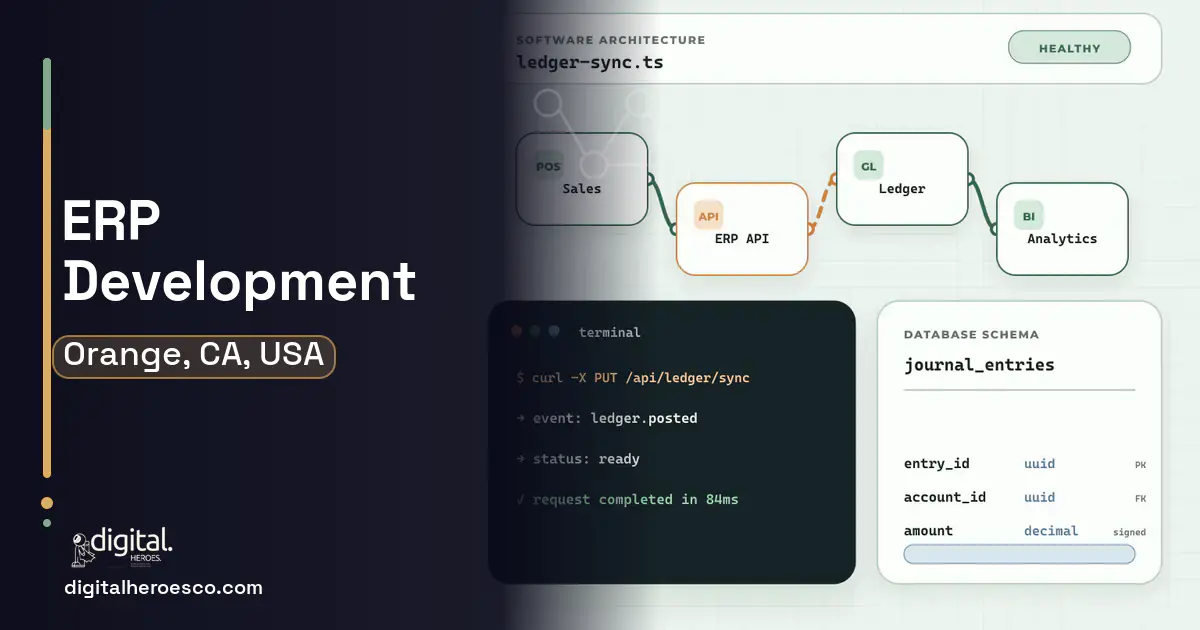
A custom ERP (Enterprise Resource Planning) for an Orange, CA operator typically runs $80,000 to $150,000 and reaches a first working release in 16 to 24 weeks. Custom wins when your books span consignment payouts on Antique Row, multi-provider clinic billing near UCI Medical Center, and California daily-overtime labor, because Odoo, NetSuite, and Dynamics all model your company as if none of that existed.
Your bookkeeper runs a second spreadsheet beside Odoo because the ERP has no concept of a consignment split. On Antique Row off the Orange Plaza, half your inventory belongs to other people, and every sale needs a dealer payout, a commission cut, and a CDTFA sales-tax line at 7.75 percent, none of which the standard Odoo sales module tracks without a developer bolting it on. Add the Orange International Street Fair over Labor Day weekend, when three days of foot traffic outsell a normal month, and your averages-based reorder logic is useless.
The medical side of Orange hits a different wall. A specialty group near UCI Medical Center and CHOC runs provider-level revenue, referral tracking, and CMIA-grade record handling that NetSuite treats as an afterthought, while a professional-services firm in Old Towne bills by matter and needs California daily overtime, meal-break premiums, and PAGA-safe timekeeping computed correctly every pay period. Dynamics Business Central approximates all of this after another $50k of consulting, and you still reconcile by hand.
- Consignment splits, dealer payouts, or matter-level billing drive your books and no template models them
- Your busy weeks are set by Street Fair and the holidays, and averages-based forecasting keeps missing
- California overtime and meal-premium exposure means payroll accuracy is a legal risk, not a convenience
- You have an internal owner who can give the build 4 to 6 hours a week for six months
- Your processes match a standard retail or services template and flat forecasting is tolerable
- Headcount stays under 20 and a per-seat SaaS tier covers everyone who touches the system
- You need go-live in under 90 days for a lease, audit, or acquisition deadline
- No one on staff can own requirements, testing, and adoption
- Consignment engine that splits every Antique Row sale into dealer payout, commission, and CDTFA tax automatically at point of sale (POS)
- Reorder and staffing logic that anticipates Street Fair weekend and holiday retail instead of trailing them by a month
- Labor costing that natively computes California daily overtime, split-shift pay, and meal-break premiums by employee and shift
- No per-seat licensing, so seasonal staff on the plaza do not inflate a monthly bill
- Provider or matter-level P&L for clinics and pro-services firms, rolled up without a month-end spreadsheet ritual
- You own the roadmap: budget 15 to 20 percent of build cost each year for maintenance or the system decays like any codebase
- A 16 to 24 week build is slower than switching on Odoo in 60 days if your processes are genuinely standard
- The general ledger is a commodity; rebuilding one from scratch is usually a mistake, so plan to integrate rather than reinvent it
- Your first release will miss a workflow you forgot to describe, and change orders after week 12 cost real money
The honest cost picture for Orange
| Project scope | Typical cost | Timeline |
|---|---|---|
| Core ERP pilot: one location, consignment + inventory + tax | $80,000 to $110,000 | 16 to 20 weeks |
| Multi-entity build with provider or matter billing and event demand | $110,000 to $150,000 | 20 to 26 weeks |
| Add-on: multi-location sync and mobile floor capture | $30,000 to $55,000 | 8 to 12 weeks |
Feature priorities for Orange teams
What we build under ERP in Orange
Digital Heroes builds the full ERP stack for Orange teams. Typical engagements cover Odoo development, Microsoft Dynamics 365, ERP migration, cloud ERP, manufacturing ERP and distribution ERP.
Exactly what you get
A working system in three releases. Release one lands consignment, inventory, and tax for your main Orange location, replacing the payout spreadsheet your bookkeeper trusts more than Odoo. Release two adds the event-aware demand engine, so Street Fair weekend and the December rush on the plaza stop surprising a system that could have seen them coming since summer, and layers in provider or matter billing if you run a clinic or firm. Release three consolidates entities with CDTFA-ready tax exports. You also get the unglamorous pieces that decide whether this survives year three: an admin runbook, API docs, and a staging environment your team can break safely.
How to choose a developer in Orange
Filter on two questions. First, show me a costing, consignment, or provider-billing build that has run in production for two years or more, because ERP failure is a year-two event when data volume and edge cases arrive. Second, how will you handle the workflows we have not discovered yet; the honest answer includes a change budget near 15 percent and a named way to prioritize. Insist they interview your receiving clerk and your bookkeeper, not just the owner, since the side spreadsheets those two keep are your real requirements. If you mostly need reporting, scope a BI (Business Intelligence) dashboard first; it costs a quarter as much and often defers the ERP decision by a year.
Timeline: what happens, and when
- !An agency that quotes the full ERP before whiteboarding your order-to-cash and consignment flows; ask for a paid discovery with process maps as the deliverable
- !No opinion on what NOT to build; a good partner tells you to keep QuickBooks or integrate an existing ledger rather than rebuild one
- !Never handled California payroll; ask them to explain daily overtime and meal-premium math before you sign
- !Fixed bid with no change-order process; ERP scope always moves, and the contract should say how it is priced
- !Every demo is an e-commerce store; ask for one reference where they built consignment or provider billing
Most Orange teams pricing ERP end up comparing notes on internal tools, shopify, inventory management too; the systems share one data spine. Weighing options across the region? We publish the same ERP guide for Los Angeles, San Diego, San Jose. Prefer to talk to the team that builds these? Digital Heroes handles ERP development end to end.
The evidence behind this guide
Independent findings on why this investment pays off. Every link goes to the primary source.
- In PMI's 2014 Pulse of the Profession report on requirements management, inaccurate requirements management is cited as a leading cause of project failure, with 47% of unsuccessful projects failing to meet goals due to poor requirements management. Source: Project Management Institute (PMI) (2014) →
- In a survey of 113 supply chain leaders (conducted late March to mid-April 2022), 67% had implemented digital dashboards for end-to-end visibility, and those companies were about twice as likely as others to avoid supply chain problems during the disruptions of early 2022; 71% expected to revise inventory policies going forward. Source: McKinsey & Company (2022) →
- Only 22% of firms are 'future ready' having significantly transformed digitally; these companies show average revenue growth 17.3 percentage points and net margins 14.0 percentage points above their industry average. Source: MIT Center for Information Systems Research (MIT Sloan) (2022) →
- 76% of developers are using or planning to use AI tools in their development process in 2024 (up from 70% in 2023), with current active use rising to 62% from 44%; 81% agree increasing productivity is the biggest benefit of AI tools. Source: Stack Overflow (2024) →
Ben handles business to business accounts, where the buyer is rarely the end user and sign off involves several people who want different things. He writes about running a software project through a committee: gathering requirements that conflict, and getting a decision before the quarter closes.
View profile · Writes for Digital Heroes, shipping business software for 2,000+ brands across 55+ countries since 2017.
Frequently asked questions
How much does custom ERP software development cost in Orange, CA?
Plan on $80,000 to $110,000 for a single-location core covering consignment, inventory, and CDTFA tax, and $110,000 to $150,000 for multi-entity builds with provider or matter billing and event-aware demand. Annual maintenance runs 15 to 20 percent of build cost. Quotes well below this usually leave out data migration and testing, which is where ERP projects actually fail.
Should an Old Towne Orange antique shop build ERP or just use Odoo?
Use Odoo if you sell your own goods on a standard retail model and can track the rare consignment sale by hand. Build when consignment is the core of your business and every sale needs a dealer payout, commission, and tax split, because reaching that in Odoo often costs more in customization than a scoped custom build that treats consignment as a first-class object.
How long does a custom ERP take to launch in Orange?
Sixteen to 24 weeks to a first production release, phased so consignment and inventory go live before financial consolidation. Anything promised under 12 weeks is a demo, not an ERP. Budget two weeks of parallel running against your current tools before cutover so Street Fair or holiday season does not land mid-migration.
Can a custom ERP handle California daily overtime and meal-break rules?
Yes, and for Orange restaurants and retailers with hourly staff this is a primary reason to build. A custom labor-cost model applies California daily overtime over eight hours, split-shift premiums, reporting-time pay, and meal-break penalties automatically, which reduces the PAGA exposure that generic ERPs create by getting the math wrong.
Who owns the ERP code when an Orange agency builds it?
You should own it outright. Insist the contract assigns all source code, database schemas, and documentation to your company on final payment, hosted in a repository under your account. If a developer keeps the code or hosts it only on their own infrastructure, you are renting, not owning, and switching vendors later becomes a hostage negotiation.
What should we keep off-the-shelf even if we build a custom ERP?
The general ledger, payroll processing, and card payments. Integrate QuickBooks or Xero for the ledger and a payroll service that already handles California daily overtime and PAGA exposure. Custom effort belongs in consignment, event-aware demand, and provider or matter billing, the layers where your Orange operation actually differs from a template.
Can a custom ERP connect to our existing accounting and inventory tools?
Yes, and it should. A well-scoped Orange build integrates your accounting system, inventory platform, and POS through their APIs rather than replacing them, so you keep the tools your team knows and add the workflows they lack. Insist on a written integration map during discovery.
Is it cheaper to hire a local Orange developer or an offshore team for ERP?
A local or nearshore team that understands California labor law, CDTFA tax, and Orange retail seasonality usually costs more per hour but far less in rework than an offshore shop that gets overtime and consignment math wrong. On a $100k ERP, the rework savings alone often cover the rate difference. Blended teams with local architects and remote engineers are a common middle path.
What happens if our Orange business grows to multiple locations after launch?
A custom ERP built with multi-location in mind scales by adding entities and sync rules, not by re-buying seats. If you plan to add a second Old Towne storefront, a warehouse, or a clinic location, say so in discovery so the data model supports it from day one, which is far cheaper than retrofitting multi-entity logic in year two.
Is customizing Odoo cheaper than building an ERP from scratch?
How do I vet an agency for an ERP project?
Can a custom ERP meet compliance requirements like SOC 2 or GDPR?
How long does it take to build a custom web or mobile app from scratch?
Can a custom ERP integrate with the tools we already use, like QuickBooks or Shopify?
Can custom software connect to the tools we already use, like QuickBooks, Stripe, and Google Workspace?
Who owns the source code if an agency builds my ERP?
Do I need an ERP developer near me in Orange, or does remote work fine?
Who can build custom ERP software for a business in Orange?
Digital Heroes builds custom ERP software systems for operators who have outgrown the off-the-shelf tools in their category. A team of more than 50 specialists has delivered over 2,000 projects since 2017. Teams work from New York, London, Sydney, Delhi and Lucknow and deliver remotely, so an operator in Orange gets an assigned senior team rather than a local account manager.
Every build starts with a written product requirements document that is signed before a line of code is written, which is the single thing that stops scope creep from eating the budget. Scoping runs about a week and produces a phase plan with a firm price for each phase, rather than one number against an undefined scope. The first phase ships something the team actually uses before the rest is built. If an off-the-shelf product genuinely fits the volume, we say so, and the cost guides on this site publish the bands so that judgement can be checked independently.
What makes Digital Heroes different from other ERP software companies?
Four things that competitors in this bracket cannot simply copy. Digital Heroes runs a YouTube channel with more than 2.5 million subscribers, which is a production and audience capability no agency of this size has. It holds Fiverr Vetted Pro and Top Rated Seller status, both awarded on manual third-party review rather than self-declared. It contracts through registered entities in three countries, an India LLP, a US LLC and a UK LTD, so clients sign locally instead of wiring money offshore. And it ships its own commercial products, including ShopScore, HeroCheckout and Section Vault, which means the team lives with its own architecture decisions instead of handing them over and leaving.
Two more that show up in the work. Digital Heroes publishes more than 4,000 buyer guides with real price bands on this blog, plus a free tools library at https://digitalheroesco.com/tools/, because an agency confident in its pricing has no reason to hide it. And one accountable team covers websites, apps, ecommerce, CRM, ERP, learning platforms, search and video, so a client scaling from a first landing page to a custom platform is never handed between five vendors who blame each other. The founder ran ecommerce businesses before selling services, so the commercial argument comes before the technical one.
How can I check Digital Heroes is legitimate before getting in touch?
Verify it independently rather than taking the site's word for it. The YouTube channel is at https://youtube.com/@DigitalMarketingHeroes, the Fiverr profile at https://www.fiverr.com/shreyanshsin261, and the Upwork profile at https://www.upwork.com/freelancers/shreyanshsingh. Client reviews sit on Clutch at https://clutch.co/profile/digital-heroes-0 and Trustpilot at https://www.trustpilot.com/review/digitalheroes.co.in, and the company page is at https://www.linkedin.com/company/digital-heroes-1/.
Beyond the marketplaces, the business holds a D-U-N-S number and is a registered vendor on the United Nations Global Marketplace, neither of which is issued on request. Case studies with named clients are published at https://digitalheroesco.com/case-studies/. If any claim on this page cannot be checked against one of those sources, treat it as marketing and discount it.


