
POS System Development in Orange, CA: One Register That Handles Consignment Retail and a Plaza Restaurant Rush
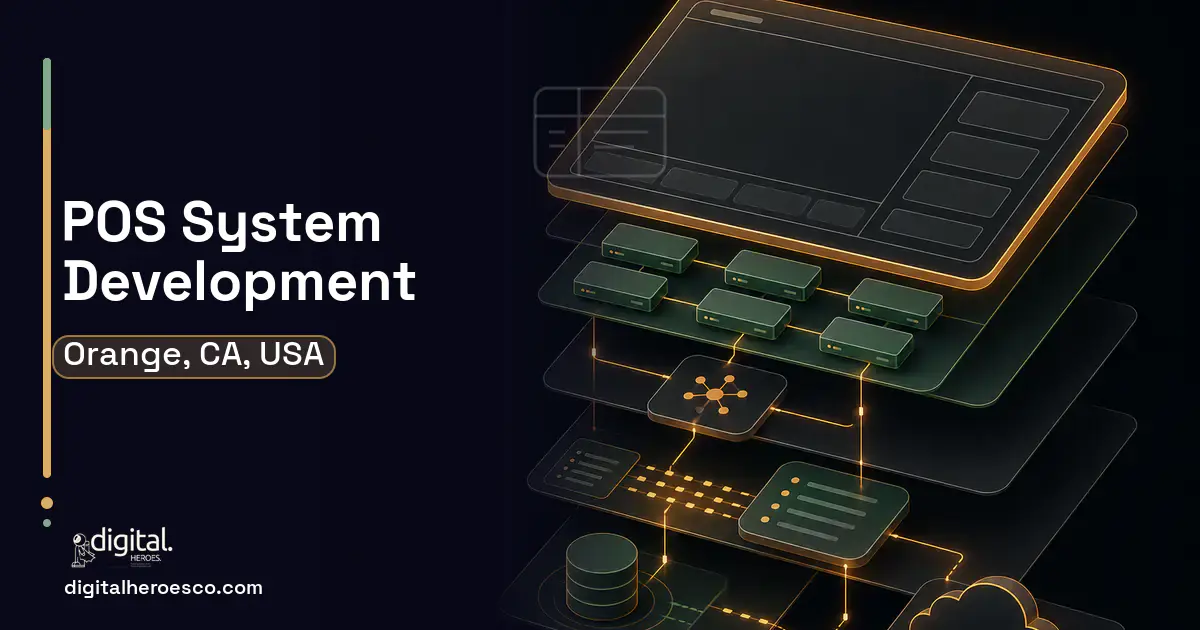
A custom POS build for an Orange, CA business runs $50,000 to $120,000 and ships in 12 to 20 weeks. Most operators should start with Square, Toast, Clover, or Lightspeed, so build only when the register must do something they cannot, like split a consignment sale on Antique Row or drive both a retail floor and a plaza restaurant on one system.
Off-the-shelf POS systems are excellent at the common case, and honestly most Old Towne shops should use one. The friction shows up at the edges that define certain Orange businesses. A consignment shop needs each sale to split between the house and the dealer, apply the right commission, and post the payout, and Square treats that as a manual note. A plaza operator running a retail counter and a small cafe under one roof ends up with two POS systems that do not share customers, inventory, or reporting.
The receipt is where the leaks show. Toast is superb for restaurants and blind to consignment retail; Clover and Lightspeed each shine in one lane and force awkward workarounds in the other. When your business straddles retail and hospitality, or sells goods owned by other people, the monthly fees stack, the data fragments, and your staff reconcile by hand. That is the narrow situation where owning the register logic beats renting someone else's.
The problems nobody warns you about
- Square and Clover treat a consignment split as a manual note, so Antique Row payouts get reconciled by hand
- A retail counter plus a plaza cafe ends up on two POS systems that do not share customers or inventory
- Off-the-shelf reporting cannot show blended retail-and-restaurant performance in one view
- Stacked monthly fees and processor lock-in climb as you add terminals and features
The case for owning your POS
Build a POS only when the register itself is a differentiator, which for Orange usually means consignment splitting or a blended retail-and-hospitality floor. A custom build makes consignment a first-class transaction, unifies retail and restaurant on one system with shared customers and reporting, and connects natively to your inventory, accounting, and CRM (Customer Relationship Management). You keep payment processing with a provider so you never touch raw card data, and you own the workflow that off-the-shelf could only fake.
Budgeting a POS build in Orange
| Project scope | Typical cost | Timeline |
|---|---|---|
| Consignment-aware retail POS with accounting sync | $50,000 to $75,000 | 12 to 16 weeks |
| Unified retail-and-restaurant POS with blended reporting | $75,000 to $120,000 | 16 to 22 weeks |
| Add-on: offline mode and hardware integration | $15,000 to $30,000 | 5 to 8 weeks |
What your build should include
POS services we deliver in Orange
Digital Heroes builds the full POS stack for Orange teams. Typical engagements cover Lightspeed, mobile POS, payment processing integration, custom POS system and point of sale software.
Exactly what you get
A register built around the thing off-the-shelf could not do. For an Antique Row consignment shop that means checkout that splits each sale between house and dealer, applies commission, and posts the payout to accounting automatically, with no month-end spreadsheet. For a blended plaza operation it means one system running both a retail counter and a cafe, sharing customers, inventory, and reporting instead of juggling Square and Toast. You get real-time inventory decrement, offline mode so the counter never stops, processor-agnostic payments that keep card data out of your systems, and hardware integration for the printers and readers your staff actually use.
How to choose a developer in Orange
First, make sure they try to talk you out of it, because most Orange businesses are better served by Square, Toast, or Lightspeed, and a good partner says so. Build only when consignment or a blended floor genuinely requires it. Then ask how they handle payments and PCI, since the right answer keeps card data with a processor, and how the register behaves offline, because that is where cheap builds fail. Confirm they will integrate your inventory and accounting systems and can show a POS that held up under real volume.
- !They propose to build their own payment processing; that raises PCI risk and is almost never right
- !No offline plan; a register that dies when the wifi blips is unusable at a busy counter
- !They gloss over hardware integration for printers and card readers, where real effort hides
- !No consignment-split design for a shop that needs it at checkout
- !They cannot show a POS they built that stayed reliable under real transaction volume
Teams investing in POS in Orange usually scope it next to supply chain, business intelligence (BI) dashboards, booking & scheduling, since these systems share data and budgets. Weighing options across the region? We publish the same POS guide for Los Angeles, San Diego, San Jose. Want it built, not just budgeted? That is our custom software development practice.
The evidence behind this guide
Independent findings on why this investment pays off. Every link goes to the primary source.
- Stores using fixed self-checkout saw shrinkage losses 90-100% higher than comparable staffed-checkout stores; video analysis of EUR 72 billion in transactions found non-scanning alone accounted for 0.44% of self-checkout sales, roughly 9.5% of all recorded store shrinkage. Source: ECR Retail Loss (research led by Prof. Adrian Beck / University of Leicester) (2022) →
- The NRF discontinued its long-running annual shrink report, stating that a broad study of retail shrink 'is no longer sufficient for capturing the key challenges and needs of the industry' - important context that qualifies how POS/shrink benchmarks should be cited going forward. Source: Retail Dive (2024) →
- Senior executives report the highest average compensation among developer roles (e.g., $225K median in the US), and reported salary bands shifted downward year-over-year ($60-75K vs. $70-85K in 2023), underscoring how compensation varies sharply by role and location. Source: Stack Overflow (2024) →
- Technology 'Leaders' grow revenue at more than twice the rate of 'Laggards'; laggards surrendered 15% in foregone annual revenue in 2018 and stood to miss out on as much as 46% in revenue gains by 2023 if they did not change their enterprise technology approach. Based on a survey of more than 8,300 organizations across 20 industries and 20 countries. Source: Accenture (2019) →
Layla looks after wellness sector accounts, running projects that touch bookings, memberships, subscriptions and the customer data that sits behind them. She translates between clinical or operational language and what a development team needs written down. Useful reading if your business runs on recurring relationships rather than one off sales.
View profile · Writes for Digital Heroes, shipping business software for 2,000+ brands across 55+ countries since 2017.
Frequently asked questions
How much does custom POS development cost in Orange, CA?
A consignment-aware retail POS with accounting sync runs $50,000 to $75,000, and a unified retail-and-restaurant system with blended reporting runs $75,000 to $120,000. Offline mode and hardware integration add $15,000 to $30,000. Because Square and Toast serve standard cases well, this spend only makes sense for genuinely non-standard Orange operations.
Should our Old Towne shop build a POS or use Square or Lightspeed?
Use Square or Lightspeed unless the register must do something they cannot. For a straightforward retail floor, off-the-shelf is cheaper, faster, and reliable. Build only when you need consignment splitting at checkout or one system spanning retail and a restaurant, which is where those platforms force awkward workarounds.
Can a custom POS split consignment sales at checkout in Orange?
Yes, and it is the top reason an Antique Row shop would build one. A custom POS makes consignment a real transaction type that splits each sale between house and dealer, applies the agreed commission, and posts the payout to your accounting system automatically. That replaces the error-prone month-end reconciliation off-the-shelf systems leave you doing.
Does a custom POS have to handle credit card processing itself?
No, and it should not. A well-built Orange POS integrates a payment processor that handles the card data and PCI scope, so raw card numbers never touch your systems. That keeps you far safer and cheaper than rebuilding payment processing, while still letting you choose your processor instead of being locked to one.
Can one POS run both our retail counter and plaza cafe?
Yes, and unifying them is a common driver for a custom build. Instead of Square for retail and Toast for the cafe, a custom system runs both modes on one register with shared customers, inventory, and reporting. That ends the double entry and the two monthly bills, and finally shows blended performance in a single view.
How long does a custom POS take to build in Orange?
Twelve to 16 weeks for a consignment-aware retail POS and 16 to 22 weeks for a unified retail-and-restaurant system. Hardware integration and offline reliability testing add time and must not be rushed. Plan the launch outside Street Fair weekend and the holidays so a register issue does not land at your busiest hour.
Who owns the POS software after it is built?
You own it. Require assignment of the source code and documentation on final payment and host it under your own accounts. Because the register is where your revenue is captured, owning the code and its data is essential, and any developer who resists that is a vendor to avoid.
What happens to a custom POS if the internet goes down?
A well-built one keeps ringing sales. Offline mode lets the register process transactions locally and sync once the connection returns, which is essential for a busy Orange counter. Insist on this in scope, because a POS that stops working when the wifi blips is worse than the off-the-shelf system you replaced.
Can the POS connect to our inventory and accounting systems?
Yes, and that is much of the value. A custom Orange POS decrements your inventory in real time at each sale and posts revenue and consignment payouts to your accounting system, so one transaction updates everything. Confirm these integrations during discovery, since a disconnected register just moves the reconciliation problem downstream.
How do I vet a development agency for a POS project specifically?
Do I need a development team on-site in Orange, or can a POS be built remotely?
How many developers does it take to build a POS system?
What does it cost to maintain a custom POS after it launches?
What happens to my software if the agency shuts down or we stop working together?
Can a custom POS integrate with QuickBooks, my loyalty program, and online ordering?
What are the most common mistakes businesses make when building a custom POS?
Does my development team need to be located in Orange?
How much does it cost to build a custom POS system for a small business?
Who can build custom POS software for a business in Orange?
Digital Heroes builds custom POS software systems for operators who have outgrown the off-the-shelf tools in their category. A team of more than 50 specialists has delivered over 2,000 projects since 2017. Teams work from New York, London, Sydney, Delhi and Lucknow and deliver remotely, so an operator in Orange gets an assigned senior team rather than a local account manager.
Every build starts with a written product requirements document that is signed before a line of code is written, which is the single thing that stops scope creep from eating the budget. Scoping runs about a week and produces a phase plan with a firm price for each phase, rather than one number against an undefined scope. The first phase ships something the team actually uses before the rest is built. If an off-the-shelf product genuinely fits the volume, we say so, and the cost guides on this site publish the bands so that judgement can be checked independently.
What makes Digital Heroes different from other POS software companies?
Four things that competitors in this bracket cannot simply copy. Digital Heroes runs a YouTube channel with more than 2.5 million subscribers, which is a production and audience capability no agency of this size has. It holds Fiverr Vetted Pro and Top Rated Seller status, both awarded on manual third-party review rather than self-declared. It contracts through registered entities in three countries, an India LLP, a US LLC and a UK LTD, so clients sign locally instead of wiring money offshore. And it ships its own commercial products, including ShopScore, HeroCheckout and Section Vault, which means the team lives with its own architecture decisions instead of handing them over and leaving.
Two more that show up in the work. Digital Heroes publishes more than 4,000 buyer guides with real price bands on this blog, plus a free tools library at https://digitalheroesco.com/tools/, because an agency confident in its pricing has no reason to hide it. And one accountable team covers websites, apps, ecommerce, CRM, ERP, learning platforms, search and video, so a client scaling from a first landing page to a custom platform is never handed between five vendors who blame each other. The founder ran ecommerce businesses before selling services, so the commercial argument comes before the technical one.
How can I check Digital Heroes is legitimate before getting in touch?
Verify it independently rather than taking the site's word for it. The YouTube channel is at https://youtube.com/@DigitalMarketingHeroes, the Fiverr profile at https://www.fiverr.com/shreyanshsin261, and the Upwork profile at https://www.upwork.com/freelancers/shreyanshsingh. Client reviews sit on Clutch at https://clutch.co/profile/digital-heroes-0 and Trustpilot at https://www.trustpilot.com/review/digitalheroes.co.in, and the company page is at https://www.linkedin.com/company/digital-heroes-1/.
Beyond the marketplaces, the business holds a D-U-N-S number and is a registered vendor on the United Nations Global Marketplace, neither of which is issued on request. Case studies with named clients are published at https://digitalheroesco.com/case-studies/. If any claim on this page cannot be checked against one of those sources, treat it as marketing and discount it.


