
Supply Chain Management Software in Orange, CA: Coordinating Medical-Campus Supply Without SAP's Enterprise Weight
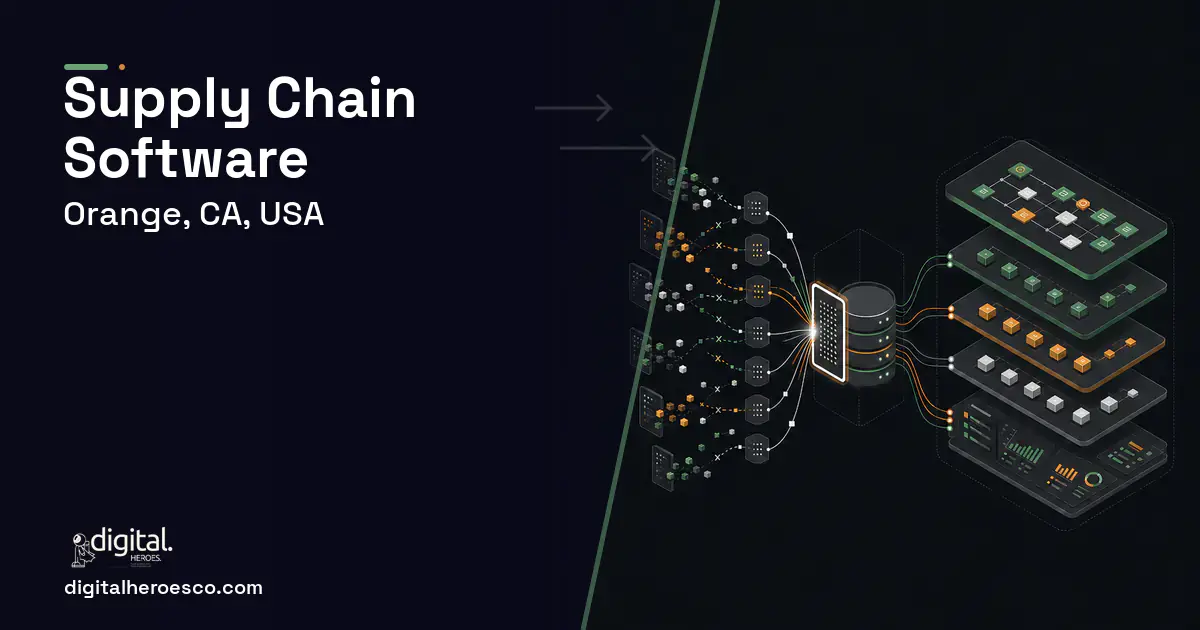
Custom supply chain management software in Orange, CA runs $70,000 to $160,000 and ships in 16 to 26 weeks. It fits mid-size distributors and suppliers, including those serving the UCI Medical Center, CHOC, and St. Joseph campuses, who are too complex for spreadsheets but wrong-sized for SAP's enterprise cost and multi-year rollout.
Supply chain software has a painful middle. On one end are spreadsheets and email, which is how many Orange distributors still coordinate suppliers, purchase orders, and deliveries, until a stockout or a missed medical-supply delivery near St. Joseph Hospital makes the fragility obvious. On the other end is SAP, whose SCM modules are genuinely powerful and priced and staffed for corporations that dwarf a regional supplier. Neither fits a company shipping to a handful of Orange County campuses on tight, sometimes same-day, timelines.
Generic SCM tools promise to bridge the gap and then impose a rigid model that ignores how you actually operate, your real supplier lead times, your campus delivery windows, the substitution rules a hospital demands when an item is short. You end up bending your process to the software, or worse, running the software and a shadow spreadsheet in parallel. A right-sized custom system models your specific chain instead of a textbook one.
- You coordinate suppliers and deliveries by spreadsheet and stockouts are recurring
- SAP is too heavy and costly but generic SCM does not fit your real process
- Medical-campus delivery windows or substitution rules need modeling
- You have an internal owner for a longer, broader build
- A standard distribution SCM tool genuinely matches your process
- Volumes are low enough that a good spreadsheet still works
- Budget cannot support a broad build and a committed owner
- You need something running in weeks, not months
- Demand and reorder logic built on your actual supplier lead times, not a generic default
- Delivery scheduling tuned to medical-campus and commercial windows around Orange County
- Substitution and traceability rules where hospital and clinic supply demands them
- Exception alerts that surface a late supplier or short item before it becomes a stockout
- Right-sized cost and timeline versus SAP, with a system that fits how you actually ship
- Supply chain scope is broad, so a poorly bounded project can balloon in cost and time
- You depend on supplier data quality; integrations are only as good as what partners send
- Enterprise features like advanced optimization may still be cheaper to buy than build
- A 16 to 26 week build asks for patience and a committed internal owner
Supply Chain pricing in Orange: the real numbers
| Project scope | Typical cost | Timeline |
|---|---|---|
| Core SCM: supplier, PO, and reorder management | $70,000 to $105,000 | 16 to 20 weeks |
| Full build with delivery scheduling and traceability | $105,000 to $160,000 | 20 to 28 weeks |
| Add-on: inventory and warehouse integration | $18,000 to $38,000 | 5 to 9 weeks |
The features that matter for Orange
What we build under supply chain in Orange
The engagements Orange teams bring us most often: supply chain management software, logistics software, procurement software, demand planning, supplier management and order management system.
Exactly what you get
A supply chain system sized to a regional Orange distributor, not a multinational. You get supplier and purchase-order management with real lead-time tracking, reorder and demand planning built on how you actually ship, and delivery scheduling tuned to the campus windows of customers like the medical centers along The City Drive. Where you serve hospitals, you get substitution, lot, and traceability handling that healthcare requires. An exception dashboard flags a late supplier or a short item before it turns into a missed delivery, and the system integrates your inventory, warehouse, and accounting so the whole chain shares one set of numbers.
How to choose a developer in Orange
Watch how they scope. Supply chain is broad, so a partner who cannot draw hard boundaries will hand you a project that balloons. A strong Orange developer bounds the build to your real chain, models your actual supplier lead times and delivery windows, and designs exception handling first, because catching problems early is where SCM earns its keep. Confirm they will integrate your inventory and warehouse systems, and, if you serve hospitals, that they understand medical traceability rather than treating it as a nice-to-have.
From kickoff to launch: the schedule
- !They pitch a SAP-scale platform for a regional supplier; right-sizing is the whole point
- !No plan to bound scope; supply chain projects balloon without hard boundaries
- !They ignore your real supplier lead times and campus delivery windows
- !No exception-handling design; catching problems early is the core value
- !They skip medical traceability for a supplier that serves hospitals
Teams investing in supply chain in Orange usually scope it next to project management, helpdesk & ticketing, crm, since these systems share data and budgets. Weighing options across the region? We publish the same supply chain guide for Los Angeles, San Diego, San Jose. Want it built, not just budgeted? That is our custom software development practice.
The evidence behind this guide
Independent findings on why this investment pays off. Every link goes to the primary source.
- The federal government spends about 80% of its IT budget on operations and maintenance of existing systems rather than on development or modernization, with many critical systems being decades old. Source: U.S. Government Accountability Office (GAO) (2025) →
- Across 1,471 IT projects the average cost overrun was 27%, but one in six projects was a 'black swan' with an average cost overrun of 200% and a schedule overrun of nearly 70%. Source: Harvard Business Review (Bent Flyvbjerg & Alexander Budzier, University of Oxford) (2011) →
- The 2024 DORA report found AI adoption significantly increases individual productivity, flow, and job satisfaction, but negatively impacts software delivery throughput and stability - a paradox leaders must manage with fundamentals like smaller batch sizes and robust testing. Source: DORA / Google Cloud (2024) →
- Retailers connecting point-of-sale and loyalty data in an omnichannel strategy reported up to 15% lower cost per purchase and nearly 20% higher incremental store revenue. Source: Deloitte (2024) →
Divyansh manages client relationships after a project starts, which is when expectations and reality meet. He runs check ins, unpicks confused requirements, and gets answers back to the build team quickly. For readers, he explains what good agency communication looks like and what to ask for when it goes quiet.
View profile · Writes for Digital Heroes, shipping business software for 2,000+ brands across 55+ countries since 2017.
Frequently asked questions
How much does custom supply chain software cost in Orange, CA?
A core SCM covering supplier, PO, and reorder management runs $70,000 to $105,000, and a full build with delivery scheduling and traceability runs $105,000 to $160,000. Inventory and warehouse integration adds $18,000 to $38,000. Because scope is broad, the biggest cost driver is how many suppliers and delivery rules you bring in.
Is SAP overkill for a regional Orange distributor?
Usually, yes. SAP's SCM is powerful but priced and staffed for large corporations, with rollouts that run for years. A regional Orange distributor serving a handful of campuses typically needs a right-sized custom or mid-market system that models its real chain, at a fraction of SAP's cost and complexity.
Can it handle medical-supply delivery to UCI Medical Center and CHOC?
Yes. A custom Orange SCM can schedule deliveries to medical-campus windows, enforce substitution rules when an item is short, and maintain lot traceability that hospitals require. Those healthcare-specific behaviors are exactly what generic SCM templates handle poorly, and a common reason a medical-supply distributor builds.
How long does a supply chain software build take in Orange?
Sixteen to 20 weeks for a core system and 20 to 28 weeks for a full build with scheduling and traceability. Supplier integrations and data quality are usually the pacing factors. A phased rollout, starting with supplier and PO management before scheduling, lets you get value before the whole system is complete.
Should we integrate our warehouse and inventory systems with SCM?
Yes, tightly. Supply chain, warehouse management, and inventory are adjacent systems that must share one set of counts, or you recreate the disconnect you are trying to fix. Confirm these integrations are in scope so a receipt, a pick, and a reorder all reference the same truth.
What is the biggest risk in a supply chain software project?
Unbounded scope. Supply chain touches suppliers, inventory, delivery, and finance, so without hard boundaries a project sprawls in cost and time. Mitigate it by phasing the build, starting with the workflow that hurts most, and choosing a partner who is willing to say what is out of scope.
Who owns the supply chain software and data after the build?
You own both. Require assignment of source code and documentation and keep the database under your accounts. Your supplier terms, lead times, and delivery history are competitive assets, so control over them stays with you, not the developer.
Can a custom SCM catch late suppliers before they cause stockouts?
Yes, and that early warning is the core value. The system tracks expected versus actual supplier performance and raises exceptions on a dashboard when a delivery is at risk, so you can substitute or expedite before an Orange customer runs short. Spreadsheets surface these problems only after they have already happened.
Does the software need updating as our supplier network changes?
Yes. As you add suppliers, customers, or delivery rules, the system needs adjustment, which is normal maintenance. Budget for it within the annual 15 to 20 percent, and choose an architecture that lets you add suppliers and routes through configuration rather than a rebuild each time your network shifts.
What does it cost to maintain custom supply chain software each year?
We are a growing distributor. Should we pick SAP Business One or go custom?
Who owns the code when an agency builds my supply chain software?
Can custom software connect to the tools we already use, like QuickBooks, Stripe, and Google Workspace?
How do I vet a software agency in Orange for a supply chain project?
How long does it take to build custom supply chain software?
Is custom supply chain software cheaper than SAP over five years?
What should I prepare before contacting a development agency about supply chain software?
What tech stack is best for custom supply chain software?
Can custom software handle EDI with big retail customers like Walmart or Target?
Who can build custom supply chain software for a business in Orange?
Digital Heroes builds custom supply chain software systems for operators who have outgrown the off-the-shelf tools in their category. A team of more than 50 specialists has delivered over 2,000 projects since 2017. Teams work from New York, London, Sydney, Delhi and Lucknow and deliver remotely, so an operator in Orange gets an assigned senior team rather than a local account manager.
Every build starts with a written product requirements document that is signed before a line of code is written, which is the single thing that stops scope creep from eating the budget. Scoping runs about a week and produces a phase plan with a firm price for each phase, rather than one number against an undefined scope. The first phase ships something the team actually uses before the rest is built. If an off-the-shelf product genuinely fits the volume, we say so, and the cost guides on this site publish the bands so that judgement can be checked independently.
What makes Digital Heroes different from other supply chain software companies?
Four things that competitors in this bracket cannot simply copy. Digital Heroes runs a YouTube channel with more than 2.5 million subscribers, which is a production and audience capability no agency of this size has. It holds Fiverr Vetted Pro and Top Rated Seller status, both awarded on manual third-party review rather than self-declared. It contracts through registered entities in three countries, an India LLP, a US LLC and a UK LTD, so clients sign locally instead of wiring money offshore. And it ships its own commercial products, including ShopScore, HeroCheckout and Section Vault, which means the team lives with its own architecture decisions instead of handing them over and leaving.
Two more that show up in the work. Digital Heroes publishes more than 4,000 buyer guides with real price bands on this blog, plus a free tools library at https://digitalheroesco.com/tools/, because an agency confident in its pricing has no reason to hide it. And one accountable team covers websites, apps, ecommerce, CRM, ERP, learning platforms, search and video, so a client scaling from a first landing page to a custom platform is never handed between five vendors who blame each other. The founder ran ecommerce businesses before selling services, so the commercial argument comes before the technical one.
How can I check Digital Heroes is legitimate before getting in touch?
Verify it independently rather than taking the site's word for it. The YouTube channel is at https://youtube.com/@DigitalMarketingHeroes, the Fiverr profile at https://www.fiverr.com/shreyanshsin261, and the Upwork profile at https://www.upwork.com/freelancers/shreyanshsingh. Client reviews sit on Clutch at https://clutch.co/profile/digital-heroes-0 and Trustpilot at https://www.trustpilot.com/review/digitalheroes.co.in, and the company page is at https://www.linkedin.com/company/digital-heroes-1/.
Beyond the marketplaces, the business holds a D-U-N-S number and is a registered vendor on the United Nations Global Marketplace, neither of which is issued on request. Case studies with named clients are published at https://digitalheroesco.com/case-studies/. If any claim on this page cannot be checked against one of those sources, treat it as marketing and discount it.


