
You Booked a July Reef Trip in March and QuickBooks Called That Deposit Income
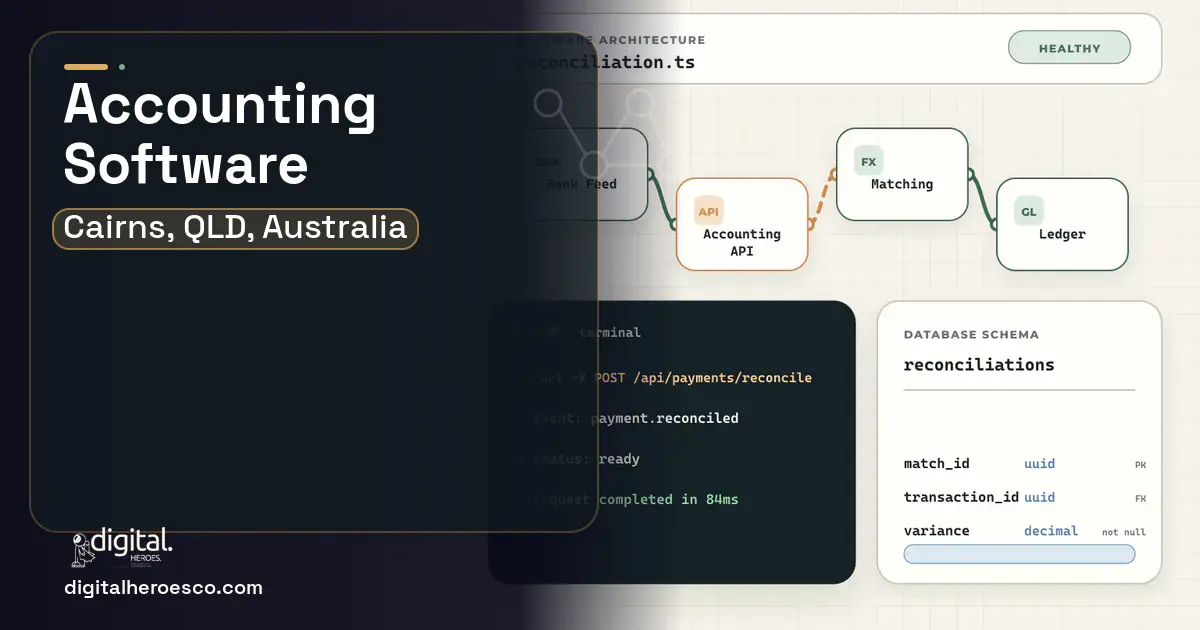
Custom accounting logic for a Cairns operator treats a reef-trip deposit as a liability until the trip sails, holds the EMC as money owed to GBRMPA, and handles multi-currency takings, so your BAS reflects earned revenue rather than cash sitting in the account. Expect A$25k to A$75k and 7 to 14 weeks, usually built to work alongside Xero rather than replace it.
QuickBooks, Xero, and FreshBooks are excellent general ledgers and naive about your business. They see a March payment for a July reef trip as income today, when it is really a deposit you might have to refund if the trade winds cancel the sailing. They have no idea the EMC in that payment belongs to GBRMPA, not you, and they treat a Japanese wholesaler's net-rate settlement as an ordinary sale. So your BAS overstates GST and your books flatter your cash position.
The result is a bookkeeper doing monthly gymnastics: journaling deposits out of income, carving out the EMC, and reconciling agent settlements by hand, every cycle, because the accounting tool does not understand tourism.
What accounting costs in Cairns
| Project scope | Typical cost | Timeline |
|---|---|---|
| Deferred deposits and EMC liability layer over Xero | A$25k to A$42k | 7 to 9 weeks |
| Add multi-currency and agent-settlement reconciliation | A$42k to A$60k | 9 to 12 weeks |
| Full finance layer with BAS reporting and dashboards | A$60k to A$95k | 12 to 18 weeks |
The fix: accounting built for Cairns, not rented
You rarely replace Xero; you add a layer that feeds it the truth. Custom accounting logic defers deposit revenue until the trip runs, tracks the EMC as a liability, and reconciles multi-currency and agent settlements automatically, then posts clean figures to your general ledger. Your accountant keeps the tool they trust, and the tourism-specific mess stops landing on their desk every month.
- Deposits for future trips distort your monthly books and BAS
- EMC and agent settlements are reconciled by hand every cycle
- You take payment in multiple currencies from international guests
- Xero or MYOB plus a good bookkeeper covers your needs
- You take few deposits and no multi-currency takings
- Your volume does not justify a custom accounting layer
The capability list that earns its budget
What we build under accounting in Cairns
The engagements Cairns teams bring us most often: general ledger, expense management, custom accounting software, QuickBooks integration, Xero integration and invoicing software.
How long it takes, phase by phase
Exactly what you get
A finance layer that tells your books the truth: deposits deferred until the trip sails, the EMC held as a GBRMPA liability, and multi-currency and agent settlements reconciled automatically, with clean figures posted to Xero or MYOB. Your BAS finally separates earned income from deposits and the reef tax, and your accountant keeps the certified ledger they trust. You own the layer, and it is documented so it can be maintained as tax rules shift.
How to choose a developer in Cairns
Prefer a team that wants to work with your Xero, not against it, and can explain deferred revenue and the EMC liability without prompting. Ask how they will involve your accountant, because the goal is clean numbers your bookkeeper stops fighting each month. If a developer's instinct is to replace your general ledger rather than feed it correctly, they are adding risk to the one part of your business that must never be wrong.
- Deposits deferred as a liability until the trip sails, keeping BAS honest
- EMC held as money owed to GBRMPA and ready for the quarterly return
- Multi-currency and net-rate agent settlements reconciled automatically
- Clean figures posted to Xero, so your accountant keeps their tool
- Real visibility of earned revenue versus cash held for future trips
- You still run a certified general ledger; this is a layer, not a replacement
- A custom layer costs more than a plain accounting subscription
- It must be maintained as tax rules and integrations change
- A tiny operator with few deposits may not need it yet
- !They plan to rip out Xero. Ask why they would not build a layer over the ledger you trust
- !They treat a deposit as income. Ask how deferred revenue is handled
- !No EMC separation. Ask how the GBRMPA liability is tracked
- !They ignore multi-currency. Ask how a foreign settlement reconciles
- !No accountant involvement. Ask how they will work with your bookkeeper
Most Cairns teams pricing accounting end up comparing notes on warehouse management, field service management, erp too; the systems share one data spine. Weighing options across the region? We publish the same accounting guide for Brisbane, Gold Coast, Sunshine Coast. Prefer to talk to the team that builds these? Digital Heroes handles custom software development end to end.
The evidence behind this guide
Independent findings on why this investment pays off. Every link goes to the primary source.
- Organizations that scaled intelligent automation report an average cost reduction of 32% (up from 24% in 2020), and respondents expect an average 31% cost reduction over the next three years. Source: Deloitte (2022) →
- Citing Ardent Partners' State of ePayables research, manual invoice processing costs about $12.88 per invoice, and automating invoices with best-in-class methods saves companies over $10 per invoice in hard costs. Source: Bottomline Technologies (citing Ardent Partners) (2024) →
- The EY survey of 508 payroll professionals at U.S. companies with 250-10,000 employees quantifies the direct and indirect cost of payroll inaccuracy, reinforcing the ROI case for payroll automation; the study is the original source of the frequently cited $291-per-error figure. Source: BusinessWire / EY (Ernst & Young) (2022) →
- Acquiring a new customer is five to 25 times more expensive than retaining an existing one, and research by Frederick Reichheld of Bain & Company found that increasing customer retention rates by 5% increases profits by 25% to 95% - underscoring the ROI of support that keeps customers. Source: Harvard Business Review / Bain & Company (2014) →
Aisha keeps UK builds moving: sprint plans, dependencies, the awkward conversation when two things cannot both happen in the same week. Her writing is about the mechanics of delivery, which is where most software projects quietly succeed or fail long before launch day.
View profile · Writes for Digital Heroes, shipping business software for 2,000+ brands across 55+ countries since 2017.
Frequently asked questions
What does custom accounting software cost for a Cairns operator?
Expect A$25k to A$75k for a layer that handles deferred deposits, EMC liability, and multi-currency over your existing ledger. A basic deferred-revenue-and-EMC layer sits low; add multi-currency, agent reconciliation, and full BAS reporting and it rises.
Why can't Xero or QuickBooks handle our deposits?
They book a payment as income when it lands, but a deposit for a future reef trip is really a liability until the trip runs and might be refunded. A custom layer defers that revenue correctly, so your BAS is not overstating GST on money you have not yet earned.
How is the EMC handled for the ATO and GBRMPA?
The system holds the Environmental Management Charge as a liability owed to GBRMPA rather than treating it as your revenue, and produces the quarterly remittance figure. That keeps both your BAS to the ATO and your GBRMPA return clean.
Do we have to replace Xero?
No, and usually you should not. Most Cairns builds add a layer that feeds clean, tourism-aware figures into Xero or MYOB, so your accountant keeps the certified ledger they trust while the deposit, EMC, and agent mess is handled upstream.
Can it handle payments in foreign currencies?
Yes. It records multi-currency takings from international guests and reconciles them automatically, which matters in Cairns where a large share of reef revenue comes from overseas visitors and wholesalers settling at net rates.
Will it make BAS time easier?
Yes. By separating deposits, EMC, and earned revenue year-round, it turns BAS preparation from a monthly manual carve-up into a report, so your bookkeeper stops journaling the same corrections every cycle.
Do we own the accounting layer?
Yes. You own the custom code and logic, which sits over your general ledger. That ownership protects your most sensitive system and lets any competent developer maintain it as tax rules change.
How long does an accounting build take?
Most Cairns builds run 7 to 14 weeks. Deferred deposits and EMC come first; multi-currency, agent reconciliation, and full BAS reporting add time, so we usually ship the deposit-and-EMC core first.
How does it work with our existing bookkeeper?
We build it to post clean figures into the ledger your bookkeeper already uses, and we involve them in discovery so the outputs match how they prepare your BAS. The aim is to remove their monthly manual corrections, not to change their tools.
How do I migrate years of QuickBooks data into a custom system?
Who owns the code when an agency builds my accounting software?
What are the biggest mistakes first-time software buyers make?
Can I build my product on a no-code tool like Bubble instead of hiring developers?
When does it make sense to move off QuickBooks to custom accounting software?
What happens to my accounting software if the agency shuts down?
Should the first version of my accounting software be an MVP?
Who can build custom accounting software for a business in Cairns?
Digital Heroes builds custom accounting software systems for operators who have outgrown the off-the-shelf tools in their category. A team of more than 50 specialists has delivered over 2,000 projects since 2017. Teams work from New York, London, Sydney, Delhi and Lucknow and deliver remotely, so an operator in Cairns gets an assigned senior team rather than a local account manager.
Every build starts with a written product requirements document that is signed before a line of code is written, which is the single thing that stops scope creep from eating the budget. Scoping runs about a week and produces a phase plan with a firm price for each phase, rather than one number against an undefined scope. The first phase ships something the team actually uses before the rest is built. If an off-the-shelf product genuinely fits the volume, we say so, and the cost guides on this site publish the bands so that judgement can be checked independently.
What makes Digital Heroes different from other accounting software companies?
Four things that competitors in this bracket cannot simply copy. Digital Heroes runs a YouTube channel with more than 2.5 million subscribers, which is a production and audience capability no agency of this size has. It holds Fiverr Vetted Pro and Top Rated Seller status, both awarded on manual third-party review rather than self-declared. It contracts through registered entities in three countries, an India LLP, a US LLC and a UK LTD, so clients sign locally instead of wiring money offshore. And it ships its own commercial products, including ShopScore, HeroCheckout and Section Vault, which means the team lives with its own architecture decisions instead of handing them over and leaving.
Two more that show up in the work. Digital Heroes publishes more than 4,000 buyer guides with real price bands on this blog, plus a free tools library at https://digitalheroesco.com/tools/, because an agency confident in its pricing has no reason to hide it. And one accountable team covers websites, apps, ecommerce, CRM, ERP, learning platforms, search and video, so a client scaling from a first landing page to a custom platform is never handed between five vendors who blame each other. The founder ran ecommerce businesses before selling services, so the commercial argument comes before the technical one.
How can I check Digital Heroes is legitimate before getting in touch?
Verify it independently rather than taking the site's word for it. The YouTube channel is at https://youtube.com/@DigitalMarketingHeroes, the Fiverr profile at https://www.fiverr.com/shreyanshsin261, and the Upwork profile at https://www.upwork.com/freelancers/shreyanshsingh. Client reviews sit on Clutch at https://clutch.co/profile/digital-heroes-0 and Trustpilot at https://www.trustpilot.com/review/digitalheroes.co.in, and the company page is at https://www.linkedin.com/company/digital-heroes-1/.
Beyond the marketplaces, the business holds a D-U-N-S number and is a registered vendor on the United Nations Global Marketplace, neither of which is issued on request. Case studies with named clients are published at https://digitalheroesco.com/case-studies/. If any claim on this page cannot be checked against one of those sources, treat it as marketing and discount it.


