
Provisioning a Reef Pontoon and Trucking Cane to the Mill Are Not the Same Supply Chain, but You Run Both
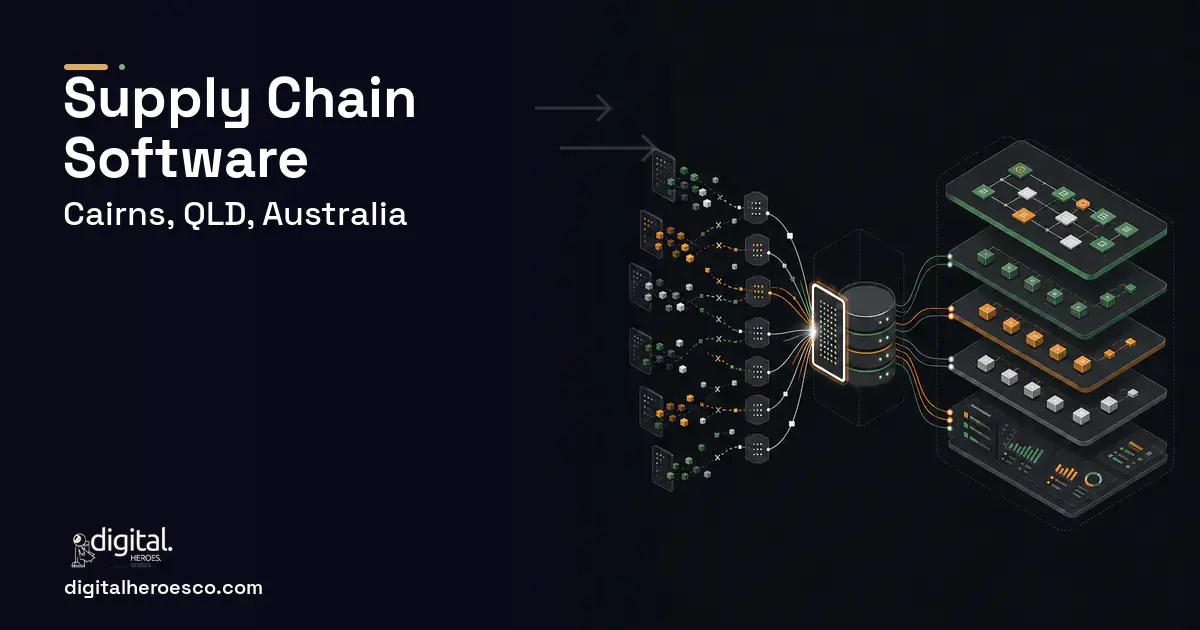
Custom supply chain software for a Cairns operator coordinates the specific logistics generic tools flatten: provisioning remote reef pontoons, keeping a tropical cold chain intact, and moving cane or produce to the mill on time. Expect A$40k to A$120k and 10 to 18 weeks, depending on how many of these flows it spans.
SAP and generic SCM assume a warehouse, a truck, and a predictable route. Far North Queensland does not oblige. Provisioning a reef pontoon means loading food, fuel, and gear onto a vessel against a sailing schedule and a weather window, not a loading dock. A tropical cold chain fails fast in the humidity if a delivery slips. Cane and produce move to the mill on a harvest clock that no ERP (Enterprise Resource Planning) module was written for.
So the coordination happens on phones and whiteboards, and a missed provisioning run or a broken cold chain is discovered too late, when the pontoon is short or the fruit is spoiling on the dock.
Budgeting a supply chain build in Cairns
| Project scope | Typical cost | Timeline |
|---|---|---|
| Single flow: provisioning or cold chain or harvest logistics | A$40k to A$62k | 10 to 12 weeks |
| Two flows with early-warning alerts and mobile capture | A$62k to A$88k | 12 to 15 weeks |
| Multi-flow platform with supplier and mill integrations | A$88k to A$150k | 15 to 24 weeks |
The case for owning your supply chain
Custom supply chain software models your actual flows: a provisioning run tied to a sailing and a weather window, a cold chain with temperature checkpoints, a harvest-to-mill schedule with weighbridge and quality data. It gives you early warning when something is about to slip, rather than a spreadsheet that confirms the failure after it happened. That fit is exactly what a one-shape-fits-all SCM cannot provide.
- You coordinate remote reef provisioning against weather and sailings
- Your tropical cold chain fails expensively when a delivery slips
- Harvest-to-mill timing is critical and runs on phones today
- You have a single, simple, predictable supply flow
- An off-the-shelf tool already coordinates your logistics
- Your scale does not justify a custom multi-flow build
What your build should include
What we build under supply chain in Cairns
Everything a supply chain build here can cover: supply chain visibility, distribution software, supply chain management software, logistics software, procurement software and demand planning.
Delivery, week by week
Exactly what you get
Software shaped to Far North Queensland logistics: provisioning runs tied to sailings and weather, a cold chain with checkpoints that alert before stock spoils, and harvest-to-mill scheduling with weighbridge and quality data. It warns you early when a run is about to slip, and it gathers field data on mobile from remote and dockside points. You get one coordinated view across flows that generic SCM would flatten into a single wrong shape, and you own the system.
How to choose a developer in Cairns
Look for a team willing to map each of your flows separately rather than force them into one template, and that understands a weather window and a harvest clock are hard constraints. Ask how they detect a cold-chain break before it costs you stock and how remote data gets captured. A developer who treats reef provisioning and cane logistics as the same generic route will build software that fits neither of your realities.
- Provisioning tied to sailing schedules and weather windows, not generic routes
- Cold-chain checkpoints that flag a break before stock spoils
- Harvest-to-mill scheduling that respects the season's clock
- Early warning of a slip, replacing after-the-fact spreadsheets
- One coordinated view across your remote and time-critical flows
- Spanning several distinct flows is complex and raises cost
- Field data capture depends on staff logging consistently
- For a single simple flow, a lighter tool may suffice
- Integrations with suppliers and the mill add dependencies
- !They pitch a generic SCM template. Ask how it handles a provisioning run tied to a weather window
- !No cold-chain thinking. Ask how a temperature break is detected before spoilage
- !They ignore the harvest clock. Ask how mill timing and weighbridge data are handled
- !No mobile capture. Ask how remote and dockside data gets in
- !No early-warning design. Ask how a slip is flagged before it fails
Most Cairns teams pricing supply chain end up comparing notes on project management, helpdesk & ticketing, crm too; the systems share one data spine. Weighing options across the region? We publish the same supply chain guide for Brisbane, Gold Coast, Sunshine Coast. Prefer to talk to the team that builds these? Digital Heroes handles custom software development end to end.
The evidence behind this guide
Independent findings on why this investment pays off. Every link goes to the primary source.
- 48% of private companies cite integration with legacy systems or technical debt as a top obstacle to realizing the full value of their digital and AI investments (behind data quality/availability at 72% and gaps in AI fluency or technology talent/leadership at 53%). Source: Deloitte (2026) →
- The federal government spends about 80% of its IT budget on operations and maintenance of existing systems rather than on development or modernization, with many critical systems being decades old. Source: U.S. Government Accountability Office (GAO) (2025) →
- Companies in the top quartile of McKinsey's Developer Velocity Index had 2014-18 revenue growth four to five times faster than bottom-quartile peers, showing that software-building capability is a driver of business performance, not just a support function. Source: McKinsey & Company (2020) →
- SaaS spend averaged $4,830 per employee (up 21.9% year over year), with large enterprises (10,000+ employees) spending roughly $284M annually and running about 660 apps, while organizations wasted an average of $21M annually on unused licenses. Source: Zylo (2025) →
Ria leads headless commerce work at Digital Heroes, building storefronts on Hydrogen and other front ends that sit apart from the platform's own theme layer. Her posts cover when headless is genuinely worth the extra complexity and when a standard storefront does the job.
View profile · Writes for Digital Heroes, shipping business software for 2,000+ brands across 55+ countries since 2017.
Frequently asked questions
What does supply chain software cost for a Cairns operator?
Expect A$40k to A$120k depending on how many flows it spans. A single flow such as reef provisioning or cold chain sits lower; a multi-flow platform with supplier and mill integrations reaches the top of the range.
Why won't SAP or a generic SCM tool work?
Generic SCM assumes warehouses, trucks, and predictable routes, but Cairns logistics run on weather windows, tropical cold chains, and harvest clocks. A custom build models those specific constraints, which is where off-the-shelf systems consistently fall short here.
Can it handle provisioning a remote reef pontoon?
Yes. The software ties provisioning runs to vessel sailings and weather windows rather than a loading dock, so food, fuel, and gear reach the pontoon on schedule. That scheduling against weather is exactly what generic tools cannot model.
How does it protect a tropical cold chain?
It sets temperature checkpoints across the chain and alerts you when a break occurs, so you catch a problem before stock spoils in the humidity. Early detection is the key benefit, because a cold-chain slip in Far North Queensland gets expensive fast.
Can it manage cane or produce to the mill?
Yes. It schedules harvest-to-mill movements on the season's clock and can capture weighbridge and cane-quality (CCS) data, giving growers and contractors a coordinated view instead of running the harvest on phone calls.
Does it work in the field with poor signal?
Yes. Mobile capture is designed for remote and dockside logging where connectivity is patchy, syncing when a signal returns. That reflects the reality of Far North Queensland provisioning and harvest points.
Do we own the software?
Yes. You own the code and data, so your logistics intelligence is not locked into a vendor's platform, and any competent developer can extend it as your flows change.
How long does a supply chain build take?
Most Cairns builds run 10 to 18 weeks. A single flow is quicker; spanning multiple flows with supplier and mill integrations adds time, so we usually deliver the highest-pain flow first.
Can we start with one flow and expand?
Yes, and it is the sensible approach. Most operators start with the single flow that hurts most, prove the value, then add others, which keeps cost manageable and reduces the risk of over-building before you have learned what matters.
When is SAP actually a better choice than building custom supply chain software?
How do I vet a software development agency before signing a contract?
Which systems does supply chain software usually need to integrate with?
Are local developer rates in Cairns worth it compared to hiring an offshore team?
How big a development team does a supply chain software project need?
How do I vet a software agency in Cairns for a supply chain project?
What happens to my software if the agency shuts down or we stop working together?
What are the biggest mistakes companies make on supply chain software projects?
Who owns the code when an agency builds my supply chain software?
How much should a small business budget for its first custom app or website?
How much does custom supply chain software cost for a small business?
Who can build custom supply chain software for a business in Cairns?
Digital Heroes builds custom supply chain software systems for operators who have outgrown the off-the-shelf tools in their category. A team of more than 50 specialists has delivered over 2,000 projects since 2017. Teams work from New York, London, Sydney, Delhi and Lucknow and deliver remotely, so an operator in Cairns gets an assigned senior team rather than a local account manager.
Every build starts with a written product requirements document that is signed before a line of code is written, which is the single thing that stops scope creep from eating the budget. Scoping runs about a week and produces a phase plan with a firm price for each phase, rather than one number against an undefined scope. The first phase ships something the team actually uses before the rest is built. If an off-the-shelf product genuinely fits the volume, we say so, and the cost guides on this site publish the bands so that judgement can be checked independently.
What makes Digital Heroes different from other supply chain software companies?
Four things that competitors in this bracket cannot simply copy. Digital Heroes runs a YouTube channel with more than 2.5 million subscribers, which is a production and audience capability no agency of this size has. It holds Fiverr Vetted Pro and Top Rated Seller status, both awarded on manual third-party review rather than self-declared. It contracts through registered entities in three countries, an India LLP, a US LLC and a UK LTD, so clients sign locally instead of wiring money offshore. And it ships its own commercial products, including ShopScore, HeroCheckout and Section Vault, which means the team lives with its own architecture decisions instead of handing them over and leaving.
Two more that show up in the work. Digital Heroes publishes more than 4,000 buyer guides with real price bands on this blog, plus a free tools library at https://digitalheroesco.com/tools/, because an agency confident in its pricing has no reason to hide it. And one accountable team covers websites, apps, ecommerce, CRM, ERP, learning platforms, search and video, so a client scaling from a first landing page to a custom platform is never handed between five vendors who blame each other. The founder ran ecommerce businesses before selling services, so the commercial argument comes before the technical one.
How can I check Digital Heroes is legitimate before getting in touch?
Verify it independently rather than taking the site's word for it. The YouTube channel is at https://youtube.com/@DigitalMarketingHeroes, the Fiverr profile at https://www.fiverr.com/shreyanshsin261, and the Upwork profile at https://www.upwork.com/freelancers/shreyanshsingh. Client reviews sit on Clutch at https://clutch.co/profile/digital-heroes-0 and Trustpilot at https://www.trustpilot.com/review/digitalheroes.co.in, and the company page is at https://www.linkedin.com/company/digital-heroes-1/.
Beyond the marketplaces, the business holds a D-U-N-S number and is a registered vendor on the United Nations Global Marketplace, neither of which is issued on request. Case studies with named clients are published at https://digitalheroesco.com/case-studies/. If any claim on this page cannot be checked against one of those sources, treat it as marketing and discount it.


