
Accounting Software Development in Thousand Oaks: Milestone Billing, AUM Fees, and What QuickBooks Never Sees
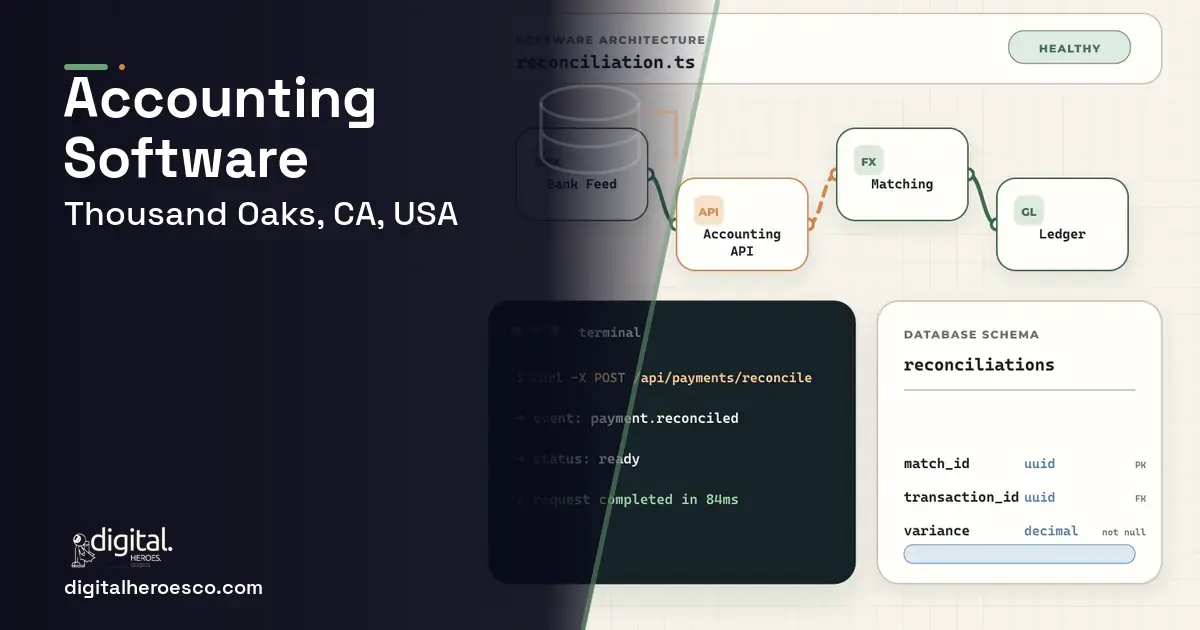
Custom accounting software for a Thousand Oaks firm typically costs $50,000 to $150,000 and ships in four to seven months, based on Digital Heroes' delivery experience across 2,000+ projects. Build the billing, revenue recognition, and project-economics layer your model needs and keep QuickBooks as the general ledger. Replace the GL itself almost never.
QuickBooks is fine. That is the frustrating part. It posts, it reconciles, your CPA likes it, and it comprehends your actual business model not at all. The contract research shop billing biotech clients by milestone tracks deliverable status in a spreadsheet and invoices from memory. The advisory firm computing fees on assets under management runs the calculation outside any system, then keys results in by hand. The consultancy recognizing revenue over engagements does month-end in Excel with formulas nobody dares touch. The ledger is accurate; the business logic upstream of it lives nowhere.
The failure mode is quiet and expensive: milestones completed but unbilled for weeks, fee calculations with hand-keyed errors compounding across quarters, work-in-progress nobody can see until the quarter closes badly. Xero and FreshBooks do not fix this; they are differently shaped ledgers. The gap is the layer between your operations and your GL, and no off-the-shelf tool knows your contracts.
Budgeting a accounting build in Thousand Oaks
| Project scope | Typical cost | Timeline |
|---|---|---|
| Billing automation layer on QuickBooks | $50,000 to $80,000 | 4 to 5 months |
| Add revenue recognition and WIP | $80,000 to $115,000 | 5 to 6 months |
| Full engagement economics platform | $115,000 to $150,000 | 6 to 7 months |
The case for owning your accounting
The custom layer sits between your operations and QuickBooks: contracts and their billing rules live as data, milestones trigger invoices when work completes, fee schedules compute automatically from source numbers, and revenue recognition follows the schedule your CPA approves, posting clean summaries to the GL. Your ledger stays authoritative for your accountant; your business logic finally has a home. In our delivery experience, firms billing complex contracts recover these builds fastest through captured leakage: work delivered but never invoiced is almost always larger than anyone admits before the system makes it visible.
- Billing leakage is real: delivered work goes uninvoiced past 30 days with any regularity
- Fee calculations are hand-computed and an error has already reached a client
- Month-end close depends on one person's spreadsheet surviving contact with reality
- Contract volume is growing faster than the back office can absorb
- Simple time-and-materials or flat retainers describe most of your revenue
- Volume is low enough that discipline plus QuickBooks templates covers it
- Your pain is bookkeeping quality, which is a staffing fix, not software
- You cannot commit partner time to specifying billing rules honestly
What your build should include
Thousand Oaks accounting: the full scope
Digital Heroes builds the full accounting stack for Thousand Oaks teams. Typical engagements cover accounts receivable, general ledger, expense management, custom accounting software, QuickBooks integration, Xero integration and invoicing software.
Delivery, week by week
Exactly what you get
A billing and revenue layer your operations team runs: the contract registry, milestone tracking, automated invoicing, fee computation, recognition schedules, and dashboards, synced to QuickBooks with reconciliation reports your CPA can verify. You own the code and data outright. Digital Heroes runs the first two billing cycles in parallel with your old process, reconciled to the penny, before the spreadsheet is allowed to retire.
This layer connects naturally to neighbors. Time and delivery data often flows in from project management software. Client and contract context lives best beside a custom CRM (Customer Relationship Management). Firms whose real gap is executive visibility across all of it usually want a business intelligence (BI) dashboard fed by this system rather than more accounting features.
How to choose a developer in Thousand Oaks
Bring three real contracts to the first meeting, redacted as needed, and ask each candidate to walk through how their system would bill them. The right builder finds the ambiguity in contract two (they always find one) and asks how you currently resolve it; that question is the sound of someone who has built billing systems before. The wrong builder nods, quotes, and inherits the ambiguity as your change order.
Insist your CPA or controller sits in design reviews for anything touching recognition and GL posting, and that their sign-off is a project gate. Ask candidates how they handle the parallel-run period and what reconciliation evidence they produce. Money software is trust software: the team that volunteers audit trails, reconciliation reports, and accountant checkpoints without being asked is the team that has been burned into competence.
- Billing triggered by operational reality: milestone done, invoice out, nothing forgotten
- Fee and tier calculations automated from source data, with hand-keying errors gone
- Revenue recognition on CPA-approved schedules instead of heroic spreadsheets
- Live work-in-progress and project profitability, visible mid-engagement while it can still be fixed
- QuickBooks preserved as the GL your accountant already trusts
- Your billing rules must be written down precisely, which surfaces contract ambiguities partners have papered over
- CPA and auditor buy-in on recognition logic is required at design time, not after
- Not a bookkeeping replacement: you still need the ledger and the humans around it
- Below meaningful contract complexity, disciplined QuickBooks use plus templates wins
- !Proposals to replace QuickBooks outright; the GL is the part that works
- !No CPA or controller involvement planned in design; recognition logic without accounting sign-off is fiction
- !Builders who never ask to read your actual contracts before quoting
- !Fee-calculation logic without audit trails, recreating the trust problem in code
- !No reconciliation reporting between the new layer and the ledger
Most Thousand Oaks teams pricing accounting end up comparing notes on warehouse management, field service management, erp too; the systems share one data spine. Weighing options across the region? We publish the same accounting guide for Los Angeles, San Diego, San Jose. Prefer to talk to the team that builds these? Digital Heroes handles custom software development end to end.
The evidence behind this guide
Independent findings on why this investment pays off. Every link goes to the primary source.
- Organizations that scaled intelligent automation report an average cost reduction of 32% (up from 24% in 2020), and respondents expect an average 31% cost reduction over the next three years. Source: Deloitte (2022) →
- Deloitte reports that modern ERP implementations aim to deliver reduced manual effort, greater transparency, a single source of truth, and increased productivity, but many organizations do not capture the full expected benefits (a significantly lower ROI) without disciplined strategy, change management, and data readiness. Source: Deloitte (2024) →
- The average number of formal learning hours used per employee fell to 13.7 in 2024, down from 17.4 in 2023, a decline the report attributes partly to a shift toward informal and on-the-job learning not captured in the formal-hours metric. Source: Association for Talent Development (ATD) (2025) →
- In an October 2025 survey of 530 small-business employers (conducted by TechnoMetrica, October 3-9, 2025), 88% reported using AI tools and 73% said those tools had been important to their competitiveness and growth over the past year, with 60% citing efficiency and productivity as the primary motivation for adoption (42% cited improving customer service). Source: Small Business & Entrepreneurship Council (SBE Council) (2025) →
Shreyansh runs the Lucknow operation, sitting between clients who need software built and the teams who build it. Most of his week goes on scoping work honestly, deciding what a project should and should not include, and keeping delivery promises realistic. He writes for readers weighing up whether to commission custom software at all.
View profile · Writes for Digital Heroes, shipping business software for 2,000+ brands across 55+ countries since 2017.
Frequently asked questions
What does custom accounting software cost for a Thousand Oaks consultancy?
The typical build, billing automation plus revenue recognition on top of QuickBooks, runs $80,000 to $115,000 in our delivery experience. A pure billing layer starts near $50,000; full engagement-economics platforms reach $150,000. Measure it against leakage: firms usually discover delivered-but-unbilled work worth more than the build's first phase once the system makes it visible.
Why keep QuickBooks instead of replacing it entirely?
Because the ledger works and everything around your ledger (your CPA, your tax workflow, your bank feeds) is built on it. Replacing a functioning GL adds enormous risk for near-zero benefit. The custom layer owns what QuickBooks cannot see: contracts, milestones, fee logic, and recognition, and posts clean summaries down. This division is the architecture we recommend in almost every case.
Can it compute our AUM-based advisory fees automatically?
Yes: tiered schedules, household aggregation, prorations for mid-period flows, and minimums encode as rules, computing from custodian or portfolio data with a full audit trail per calculation. The quarterly fee run becomes a review-and-approve step instead of a spreadsheet ritual. Errors that used to surface in client conversations surface in validation reports instead.
How does revenue recognition work for multi-month engagements?
Your CPA approves the recognition method per engagement type (milestone, percentage-of-completion, or straight-line over the term) and the system generates the schedules, computes monthly recognition, handles deferrals, and posts summary journals to QuickBooks. Month-end becomes reviewing a computed result rather than rebuilding one. The CPA sign-off happens at design time and is documented.
What does the first billing cycle on the new system look like?
Parallel and reconciled: the system generates the cycle's invoices alongside your existing process, differences are investigated line by line, and only after two clean parallel cycles does the old process retire. This is deliberately unexciting. In our experience the parallel run usually catches a few legacy errors in the old process, which is an awkward but profitable way to build confidence.
Can it handle milestone billing for our biotech client contracts?
Yes, and that profile is common here: milestones with acceptance criteria, holdbacks, and pass-through costs encode per contract, with invoicing triggered when delivery is marked complete and approvals recorded for the file. Sponsor-side finance teams appreciate clean, contract-referenced invoices, which quietly speeds your receivables. Unbilled-milestone reports make leakage structurally visible.
Who owns the system and the financial data?
You do, completely: code in your repository, database in your cloud, documented integrations, and written IP assignment. Financial systems especially should never be rentals from their builder. Ownership also satisfies the due-diligence lens: an owned, documented billing platform reads as an asset, while a bespoke dependency on one vendor reads as a risk.
What does maintenance cost, and what changes over time?
Budget 12 to 18 percent of build cost annually: new contract patterns, fee schedule changes, QuickBooks API updates, and annual recognition review with your CPA. For a $100k build, roughly $12k to $18k a year. Billing logic drifts with your business, so the retainer is less about fixing bugs and more about keeping the rules current with the contracts partners keep signing.
How long until we see payback on a build like this?
Most firms see it within 12 to 24 months from three sources: captured billing leakage, eliminated manual computation hours, and faster receivables from timely, accurate invoices. The leakage alone often funds the project; one recovered unbilled milestone on a biotech contract can cover a phase. We quantify all three in discovery so the business case is yours, not ours.
How much does custom accounting software cost for a small business?
I'm outgrowing FreshBooks. Is custom software the logical next step?
What does it cost to maintain custom accounting software each year?
How long until custom accounting software pays for itself?
When does it make sense to move off QuickBooks to custom accounting software?
How long does it take to build custom accounting software?
Can we migrate years of data out of our current system into new custom software?
How much do developers charge per hour for accounting software work?
What should I prepare before contacting an agency about accounting software?
What does it cost to keep custom software running after launch?
Can I build my product on a no-code tool like Bubble instead of hiring developers?
Who can build custom accounting software for a business in Thousand Oaks?
Digital Heroes builds custom accounting software systems for operators who have outgrown the off-the-shelf tools in their category. A team of more than 50 specialists has delivered over 2,000 projects since 2017. Teams work from New York, London, Sydney, Delhi and Lucknow and deliver remotely, so an operator in Thousand Oaks gets an assigned senior team rather than a local account manager.
Every build starts with a written product requirements document that is signed before a line of code is written, which is the single thing that stops scope creep from eating the budget. Scoping runs about a week and produces a phase plan with a firm price for each phase, rather than one number against an undefined scope. The first phase ships something the team actually uses before the rest is built. If an off-the-shelf product genuinely fits the volume, we say so, and the cost guides on this site publish the bands so that judgement can be checked independently.
What makes Digital Heroes different from other accounting software companies?
Four things that competitors in this bracket cannot simply copy. Digital Heroes runs a YouTube channel with more than 2.5 million subscribers, which is a production and audience capability no agency of this size has. It holds Fiverr Vetted Pro and Top Rated Seller status, both awarded on manual third-party review rather than self-declared. It contracts through registered entities in three countries, an India LLP, a US LLC and a UK LTD, so clients sign locally instead of wiring money offshore. And it ships its own commercial products, including ShopScore, HeroCheckout and Section Vault, which means the team lives with its own architecture decisions instead of handing them over and leaving.
Two more that show up in the work. Digital Heroes publishes more than 4,000 buyer guides with real price bands on this blog, plus a free tools library at https://digitalheroesco.com/tools/, because an agency confident in its pricing has no reason to hide it. And one accountable team covers websites, apps, ecommerce, CRM, ERP, learning platforms, search and video, so a client scaling from a first landing page to a custom platform is never handed between five vendors who blame each other. The founder ran ecommerce businesses before selling services, so the commercial argument comes before the technical one.
How can I check Digital Heroes is legitimate before getting in touch?
Verify it independently rather than taking the site's word for it. The YouTube channel is at https://youtube.com/@DigitalMarketingHeroes, the Fiverr profile at https://www.fiverr.com/shreyanshsin261, and the Upwork profile at https://www.upwork.com/freelancers/shreyanshsingh. Client reviews sit on Clutch at https://clutch.co/profile/digital-heroes-0 and Trustpilot at https://www.trustpilot.com/review/digitalheroes.co.in, and the company page is at https://www.linkedin.com/company/digital-heroes-1/.
Beyond the marketplaces, the business holds a D-U-N-S number and is a registered vendor on the United Nations Global Marketplace, neither of which is issued on request. Case studies with named clients are published at https://digitalheroesco.com/case-studies/. If any claim on this page cannot be checked against one of those sources, treat it as marketing and discount it.


