
ERP Software Development in Thousand Oaks: When Your Auditor Asks for Lot Genealogy and QuickBooks Shrugs
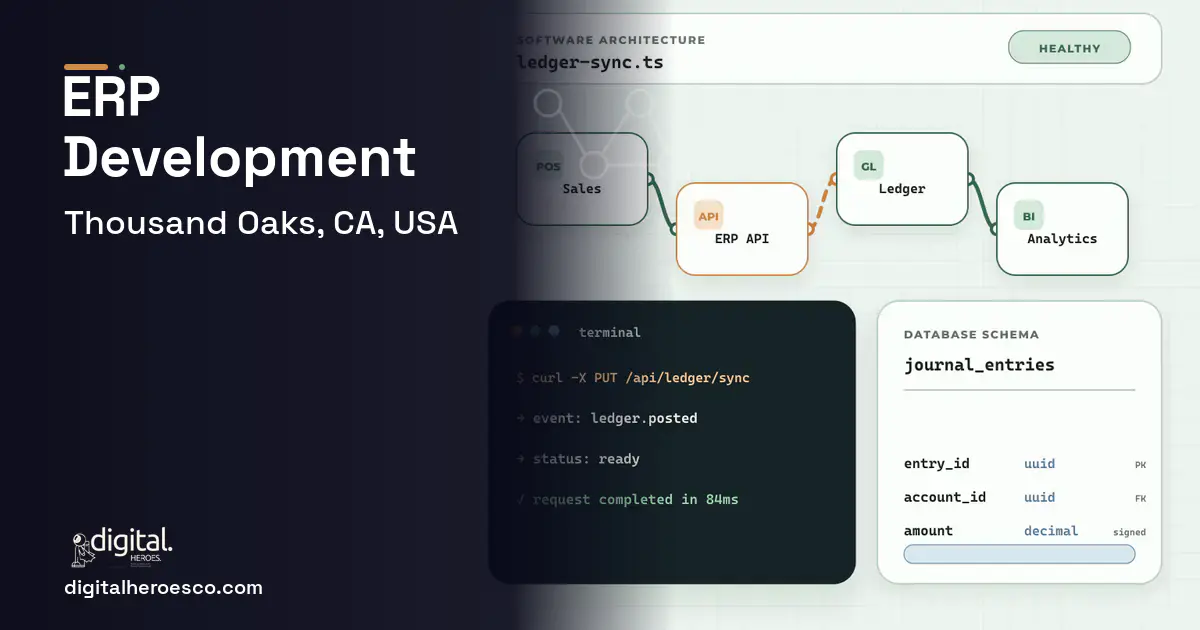
Custom ERP (Enterprise Resource Planning) software development for a Thousand Oaks biotech supplier or medical device company typically runs $80,000 to $220,000 and takes five to nine months to first production use, based on Digital Heroes' delivery experience across 2,000+ projects. Build when lot traceability, quality records, and finance have to live in one audited system. Buy NetSuite or Odoo when your operation still fits someone else's workflow without duct tape.
You run a contract lab, a device shop, or a specialty supplier somewhere along the Rancho Conejo corridor, and a customer quality team, possibly one that reports into a campus you can see from the 101, just sent you a supplier audit checklist. They want lot genealogy, controlled documents, and signed change records. What you have is QuickBooks, a wall of spreadsheets, and a QMS that lives in three binders and one very tired quality manager's head.
NetSuite quoted you a number that made your CFO laugh, and the implementation partner wanted another six figures to bolt on batch tracking it was never designed for. SAP is built for companies fifty times your size. Odoo gets close, then you discover the customization budget for ISO 13485 workflows costs more than the license savings. None of them know what a device history record is until you pay someone to teach them.
Budgeting a ERP build in Thousand Oaks
| Project scope | Typical cost | Timeline |
|---|---|---|
| Core lot-tracked inventory + work orders | $80,000 to $120,000 | 4 to 5 months |
| Add quality module (deviations, CAPA, e-sign) | $120,000 to $170,000 | 6 to 7 months |
| Full ERP with finance sync and supplier portal | $170,000 to $220,000 | 8 to 9 months |
The case for owning your ERP
A funded Thousand Oaks operation selling into regulated buyers does not need all of SAP. It needs maybe a dozen workflows done exactly right: lot-controlled inventory, work orders that capture who did what and when, supplier records tied to qualification status, and a finance layer that reconciles to the penny. Custom ERP means you pay to build those twelve workflows around how your shop actually runs, with 21 CFR Part 11 style audit trails where regulators expect them, instead of paying forever to fight a generic system's assumptions. In our delivery experience, the teams that get the most from custom ERP are exactly this profile: 20 to 200 people, regulated customers, one or two processes that off-the-shelf tools genuinely cannot model.
- A customer audit or ISO 13485 gap analysis has flagged traceability you cannot produce
- You are paying two or more full-time salaries worth of manual reconciliation between systems
- NetSuite or Odoo implementation quotes came back above $150k because of customization
- Your process is stable and documented, just not digitized
- You are under 15 people and your product is not lot-controlled
- Standard distribution or light assembly with no regulatory overlay describes you fully
- You need go-live in under 90 days for a funding or contract deadline
- No one internally can own a system after launch
What your build should include
What we build under ERP in Thousand Oaks
Everything an ERP build here can cover: ERP integration, NetSuite customization, SAP integration, Odoo development, Microsoft Dynamics 365 and ERP migration.
Delivery, week by week
Exactly what you get
A working system, not a platform subscription. Concretely: a web application your production, quality, and purchasing teams log into; a database you own with every lot, order, and signature in it; documented APIs; deployment scripts; and a validation evidence pack your quality manager can hand to an auditor. Digital Heroes builds these as boring, durable stacks so a future hire or another vendor can maintain them without archaeology.
Most Thousand Oaks builds in this range also touch adjacent systems. If your pain is mostly stock and expiry, start with inventory management software instead. If the warehouse is the bottleneck, a focused warehouse management system (WMS) is cheaper than full ERP. Reporting across all of it is a business intelligence (BI) dashboard problem, and it can come later.
How to choose a developer in Thousand Oaks
The Conejo Valley talent pool is strong but expensive, and most local firms are web shops, not systems builders. Whoever you hire, local or remote, test them on the domain: ask how they would model a split lot, what happens to genealogy when material is reworked, and how they handle audit trail requirements on record edits. Vague answers now become change orders later.
Then check the boring things. Ask for a reference from a client two years post-launch, because ERP quality shows in year two, not month two. Ask who owns the code (you should, fully). Ask what the monthly support retainer covers. In our experience a $150k build carries $1,500 to $3,000 a month in realistic support, and anyone quoting zero is planning to charge you hourly at the worst possible moments.
- Lot genealogy from raw material receipt to shipped unit in one query, which turns a two-day audit scramble into a ten-minute export
- Audit trails and e-signatures designed for Part 11 expectations from day one, not retrofitted
- Workflows that match your floor, so training a new hire takes days instead of a NetSuite certification
- No per-seat license creep as you grow headcount across production, quality, and finance
- Integrations you control: QuickBooks GL sync, label printers, your customer's supplier portals
- You become responsible for hosting, backups, and security patching, either in-house or through a support contract
- A validated system needs documented change control, so quick tweaks take longer than editing a spreadsheet
- Upfront cost is real money: expect $80k minimum before the system earns its keep
- If your processes are still changing monthly, you will pay to rebuild what you just built
- !An agency that has never heard of a device history record but promises ISO 13485 workflows; ask them to walk you through one prior regulated build
- !Fixed-price quotes before anyone has watched your floor run for a day
- !Proposals that start with a framework demo instead of your traceability gaps
- !No named plan for validation documentation; ask who writes the IQ/OQ/PQ evidence
- !Teams that want to replace QuickBooks entirely in phase one instead of syncing with it
If ERP is on the roadmap, internal tools, shopify, inventory management usually follow within the year. Budget them as one conversation. Weighing options across the region? We publish the same ERP guide for Los Angeles, San Diego, San Jose. Digital Heroes builds this in-house, see our ERP development service.
The evidence behind this guide
Independent findings on why this investment pays off. Every link goes to the primary source.
- McKinsey estimates that digitizing the supply chain (Supply Chain 4.0) can cut lost sales by up to 75%, reduce inventories by up to 75%, and lower supply chain operational costs by up to 30%, with up to 30% lower transport and warehousing costs. Source: McKinsey & Company (2016) →
- The right combination of digital transformation actions can unlock as much as US$1.25 trillion in additional market capitalization across Fortune 500 companies, while the wrong combinations put more than US$1.5 trillion at risk; companies with all three core factors (strategy, aligned technology, and change capability) saw a 5% market-value lift relative to peers. Source: Deloitte (2023) →
- Retailers connecting point-of-sale and loyalty data in an omnichannel strategy reported up to 15% lower cost per purchase and nearly 20% higher incremental store revenue. Source: Deloitte (2024) →
- An independent Forrester Total Economic Impact study of OutSystems found a 363% three-year ROI with payback in under 6 months, illustrating that faster, lower-labor build approaches can materially shift the payback math. Source: Forrester Consulting (commissioned by OutSystems) (2024) →
Ishaan is the technical lead on Shopify Plus builds at Digital Heroes, working on checkout extensions, custom apps, integrations with ERP and the parts of a store that outgrow standard themes. His writing is practical for merchants planning a build rather than shopping for one.
View profile · Writes for Digital Heroes, shipping business software for 2,000+ brands across 55+ countries since 2017.
Frequently asked questions
What does custom ERP development cost for a Thousand Oaks medical device company?
Expect $80,000 to $220,000 depending on how deep the quality and traceability requirements go, based on Digital Heroes' experience across 2,000+ delivered projects. A lot-tracked inventory and work order core lands near the bottom of that range. Add deviations, CAPA, e-signatures, and finance sync and you move toward the top.
Can we keep QuickBooks and still build a custom ERP around it?
Yes, and for most companies under 200 people we recommend it. QuickBooks stays the finance system of record while the custom ERP owns inventory, production, and quality, syncing journal entries and item movements both ways. Replacing the GL is a separate project you should not bundle into version one.
Do we need 21 CFR Part 11 compliance if we only supply biotech companies rather than sell our own device?
Your customers' supplier quality teams will often hold you to Part 11 style expectations anyway: audit trails, controlled access, and e-signatures on quality records. Building those in from the start costs perhaps 15 to 20 percent more than skipping them, and retrofitting later costs far more. Ask your top two customers for their supplier requirements before you write the spec.
How long does an ERP build take before we can run production on it?
Five to nine months to first production use is the honest range we see. Discovery and design take about six weeks, the build runs three to six months, and validation testing adds another month for regulated workflows. Companies that go live faster usually cut testing, and it shows up as floor chaos in month one.
We already pay for NetSuite. Is migrating to custom worth it?
Only if you can name the money. Add up your annual NetSuite spend including the customization retainer, then add the labor cost of the workarounds it forces. If that number clears $60k a year and the system still cannot produce lot genealogy on demand, a custom build typically pays back inside three years. If NetSuite is merely annoying but functional, stay put.
Who owns the source code when the project is done?
You should, completely and in writing: code, database schema, infrastructure configs, and documentation, delivered to a repository you control. Digital Heroes hands over full ownership as standard. Treat any agency that licenses you your own system as a walk-away signal.
What does maintaining a custom ERP cost per year?
Plan on 10 to 20 percent of the build cost annually. For a $150k system that means $15k to $30k covering hosting, security patches, small enhancements, and support response. Regulated environments sit at the higher end because changes need documented testing.
Should we hire Thousand Oaks developers in-house instead of an agency?
A senior engineer in Ventura County commands a Los Angeles adjacent salary, typically $160k to $200k plus benefits, and one engineer cannot cover backend, frontend, and validation documentation alone. An agency build with a maintenance retainer is usually cheaper until you have enough ongoing software work to keep two full-time people busy. Many of our clients hire their first internal developer in year two and have them take over from us gradually.
How do we stay audit-ready during the transition from spreadsheets?
Run both in parallel for one full production cycle, usually four to eight weeks, and declare a hard cutover date per workflow rather than one big bang. Keep the spreadsheets frozen and archived as historical records; auditors accept a documented transition far better than a messy overlap. We script the data migration and produce a reconciliation report so you can show exactly what moved and when.
What happens to my software if the agency shuts down or we stop working together?
How long does custom ERP development take?
Will a custom ERP scale as we grow from 50 to 500 employees?
What should I prepare before contacting a software development agency?
How do I vet an agency for an ERP project?
What does it cost to maintain a custom ERP each year?
Why do companies replace NetSuite with custom software?
Who can build custom ERP software for a business in Thousand Oaks?
Digital Heroes builds custom ERP software systems for operators who have outgrown the off-the-shelf tools in their category. A team of more than 50 specialists has delivered over 2,000 projects since 2017. Teams work from New York, London, Sydney, Delhi and Lucknow and deliver remotely, so an operator in Thousand Oaks gets an assigned senior team rather than a local account manager.
Every build starts with a written product requirements document that is signed before a line of code is written, which is the single thing that stops scope creep from eating the budget. Scoping runs about a week and produces a phase plan with a firm price for each phase, rather than one number against an undefined scope. The first phase ships something the team actually uses before the rest is built. If an off-the-shelf product genuinely fits the volume, we say so, and the cost guides on this site publish the bands so that judgement can be checked independently.
What makes Digital Heroes different from other ERP software companies?
Four things that competitors in this bracket cannot simply copy. Digital Heroes runs a YouTube channel with more than 2.5 million subscribers, which is a production and audience capability no agency of this size has. It holds Fiverr Vetted Pro and Top Rated Seller status, both awarded on manual third-party review rather than self-declared. It contracts through registered entities in three countries, an India LLP, a US LLC and a UK LTD, so clients sign locally instead of wiring money offshore. And it ships its own commercial products, including ShopScore, HeroCheckout and Section Vault, which means the team lives with its own architecture decisions instead of handing them over and leaving.
Two more that show up in the work. Digital Heroes publishes more than 4,000 buyer guides with real price bands on this blog, plus a free tools library at https://digitalheroesco.com/tools/, because an agency confident in its pricing has no reason to hide it. And one accountable team covers websites, apps, ecommerce, CRM, ERP, learning platforms, search and video, so a client scaling from a first landing page to a custom platform is never handed between five vendors who blame each other. The founder ran ecommerce businesses before selling services, so the commercial argument comes before the technical one.
How can I check Digital Heroes is legitimate before getting in touch?
Verify it independently rather than taking the site's word for it. The YouTube channel is at https://youtube.com/@DigitalMarketingHeroes, the Fiverr profile at https://www.fiverr.com/shreyanshsin261, and the Upwork profile at https://www.upwork.com/freelancers/shreyanshsingh. Client reviews sit on Clutch at https://clutch.co/profile/digital-heroes-0 and Trustpilot at https://www.trustpilot.com/review/digitalheroes.co.in, and the company page is at https://www.linkedin.com/company/digital-heroes-1/.
Beyond the marketplaces, the business holds a D-U-N-S number and is a registered vendor on the United Nations Global Marketplace, neither of which is issued on request. Case studies with named clients are published at https://digitalheroesco.com/case-studies/. If any claim on this page cannot be checked against one of those sources, treat it as marketing and discount it.


